Multilogin CLI command reference
 ~4 minWritten by Yelena V
Multilogin CLI lets you manage browser profiles, Android cloud phones, workspaces, proxies, scripts, tags, and other tasks from the command line.
➡️ Use this page as a quick reference for available CLI commands. To see the full command list on your device, run xcli --help on Windows or ./xcli --help on macOS and Linux.
Before you start
- Start Multilogin CLI
- Sign in to your Multilogin account
- Use the command format for your operating system
Launch Multilogin, then open Command Prompt or Terminal, go to the CLI folder and run CLI executable:
Windows
- Go to the CLI folder:

C:/Users/%username%/mlx/deps/cli - Run
xcli.exe
macOS
- Go to the CLI folder:
/Users/%username%/mlx/deps/cli - Run
./xcli:./xcli
Linux
- Go to the CLI folder:
/Home/%username%/mlx/deps/cli - Run
./xcli:./xcli
Follow the article for more details: How to start working with CLI.
To see all available commands, use the command below (depending on your OS):
-
xcli -horxcli --help(on Windows) -
./xcli -hor./xcli --help(on macOS and Linux)
General commands | |
login |
sign in to your account |
launcher-info |
get information about the running launcher (app or agent) |
Folder commands | |
create-folder |
create a folder with a given name |
list-folder |
view all available folders |
remove-folder |
remove a folder by its ID (or a list of IDs) |
update-folder |
update folder details using its ID |
Workspace commands | |
list-workspace |
display a list of available workspaces |
switch-workspace |
switch to a different workspace |
Proxy commands | |
proxy-countries |
get a list of available countries in the proxy service |
proxy-regions |
get regions by country code |
proxy-cities |
get cities by region code |
proxy-get |
retrieve a proxy URL based on specified parameters |
Browser profile commands | |
profile-stat |
statistics about profiles currently launched |
profile-status |
status of given profile(s) |
profile-list |
lists all profiles in a given folder |
profile-start |
start a profile using its ID |
profile-stop |
stop a profile using its ID |
profile-remove |
remove profiles by their IDs |
profile-quick |
launch a profile using v4 API endpoint |
profile-template |
create a new template for a browser profile |
profile-create |
create new profile |
profile-update |
update existing profile |
profile-clone |
duplicate the profile |
profile-restore |
restore a given deleted profile |
profile-move |
move profile to a different folder |
profile-export |
export the browser profile into a file |
profile-export-status |
show profile export status |
profile-import |
profile import from a file |
profile-import-status |
show profile import status |
profile-cookie-import |
import cookies to a profile |
profile-cookie-export |
export cookies from a profile |
Script commands | |
script-list |
lists all available scripts in the Script Runner folder |
script-start |
runs a script in a Multilogin profile |
script-stop |
stops a running script |
cookie-robot |
start the Cookie robot on a given profile (or more) |
Object commands | |
object-types |
gets object types list |
object-list |
gets object list |
object-meta |
fetches and displays the object metadata |
object-create |
object creation command (requires running agent) |
object-download |
downloads the object to computer (on local storage) |
object-delete |
deletes object |
object-restore |
restore object from trash bin |
object-stats |
display the object usage statistics |
object-convert |
converts from storage type from local to cloud and cloud to local |
enable-object |
enables object for profiles |
disable-object |
disables object for profiles |
object-extension-create |
creates an extension object from a URL |
2FA related commands | |
|
enables two-factor authentication |
view-backup-codes |
views backup codes |
disable-2fa-for-user |
disables two-factor authentication for user |
disable-2fa-for-workspace |
disables two-factor authentication for workspace |
enable-2fa-for-workspace |
enables two-factor authentication for workspace |
Billing commands | |
|
gets referral code |
multipoints |
gets credits |
Need examples and required flags? Read “How to use CLI commands for cloud phones”.
Cloud phone commands | |
|
gets mobile profiles limit |
|
gets or create mobile profile group |
|
gets states by country |
|
gets cities by state |
|
checks proxy configuration |
|
gets list of phone brands by Android version |
|
gets list of mobile profiles (phones) with filters |
|
creates new mobile profiles (phones) |
|
updates mobile profile (phone) |
|
delete mobile profiles by IDs |
|
gets mobile profiles statuses |
|
assign tags to mobile profile |
|
removes tags from mobile profile |
|
shutdowns mobile profiles |
|
launches mobile profiles |
|
get list of available mobile application |
|
batches install applications for a group of phones |
|
starts mobile profiles proxy call (launch phone without GUI) |
|
stops mobile profiles proxy call (launch phone without GUI) |
|
downloads Excel template for profile import |
|
validates mobile profiles import file |
|
exports mobile profiles to Excel file |
|
lists uploaded mobile profile files |
|
uploads a file to mobile profile drive |
|
deletes files from mobile profile drive by IDs |
|
assigns tags to mobile profile files |
|
unassigns tags from mobile profile files |
|
transfers mobile profiles to another user |
mobile-profiles-adb-set |
Set ADB state on running mobile profiles |
mobile-profiles-adb-info |
Get ADB connection details for cloud phones |
Tag commands | |
|
creates one or more tags |
tag-list |
lists tags with optional search filter |
tag-remove |
removes tags by IDs |
tag-assign |
assigns tags to a profile |
tag-unassign |
unassigns tags from a profile |
Additional commands | |
help |
help for all commands |
Help options
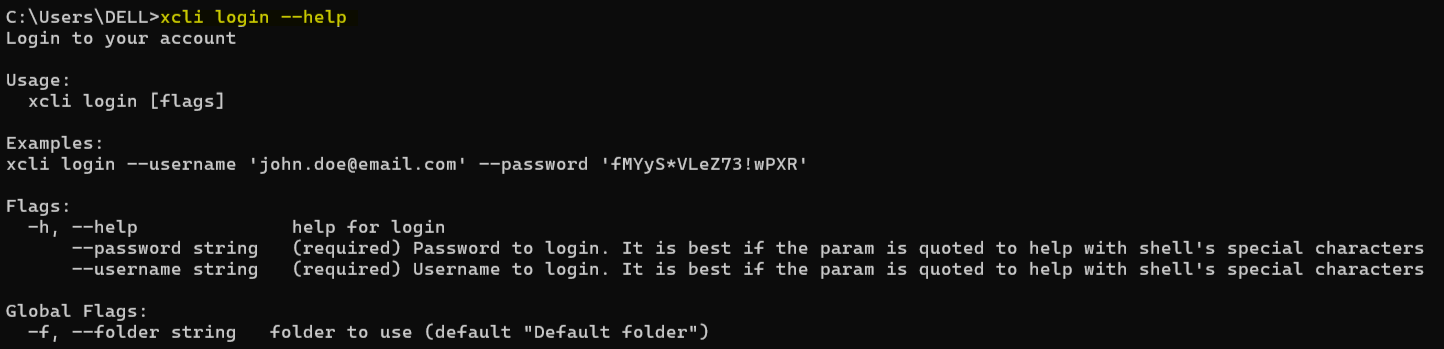
This function is always available by using -h or --help after any command names to clarify its usage.
Example: in case you don't know which flags to specify when using the login command, you can simply specify xcli login --help (or -h).