


The one AI tool that splits the room
No AI chatbot generates more disagreement than Grok. On Reddit, you’ll find threads declaring it the best reasoning model available sitting directly next to threads calling it the worst AI they’ve ever used.
On PCMag, it scores respectably in technical benchmarks but underperforms on creative and image tasks. Ask a social media manager and you’ll likely get a shrug — most haven’t tried it seriously.
That last point is the gap this review closes. Grok has one specific advantage that no other AI tool can match for social media strategy work. It also has significant weaknesses that make it a poor choice as a primary content tool. Both are worth understanding before you decide whether it belongs in your stack.
Who this review is for Social media managers, content teams, and agency operators evaluating AI tools for caption writing, X/Twitter strategy, content research, and multi-account workflows. Not a general tech review — a Grok review specifically for your job.
What is Grok AI?
Grok is xAI’s AI chatbot, founded by Elon Musk and launched in late 2023. It runs on the Grok family of large language models and is deeply integrated with X (formerly Twitter), where it can draw from posts and trending conversations in real time. That X integration is its defining feature — and the main reason a social media manager might choose it over Claude or ChatGPT.
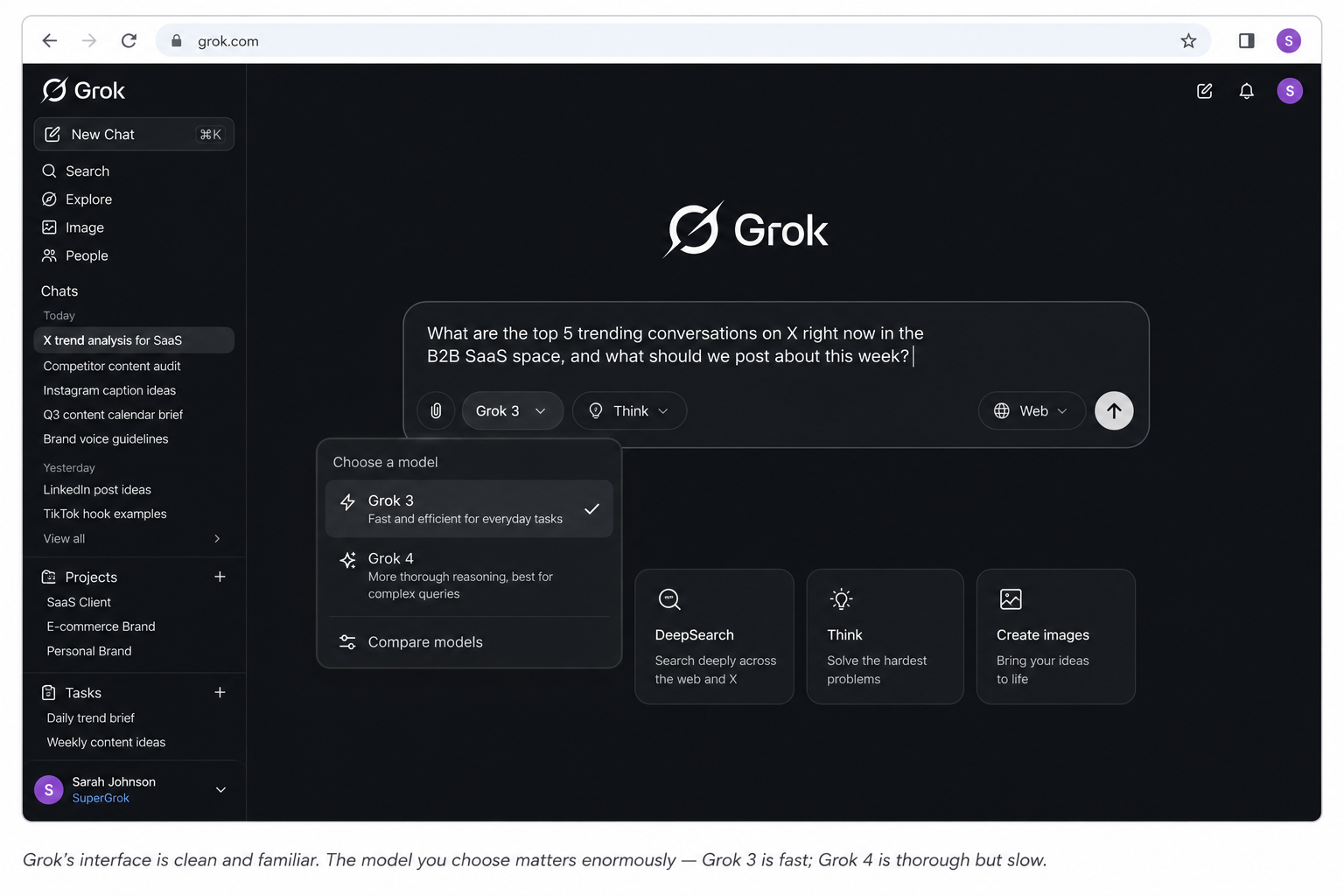
By August 2025, Grok 4 was the latest model. Grok 3 is faster and lighter; Grok 4 is more powerful but significantly slower — a tradeoff that comes up repeatedly in real-world feedback. A premium tier called SuperGrok Heavy at $250/month gives access to Grok 4 Heavy, a multi-agent version where several sub-agents confer to produce a better answer. For social media managers, the relevant tier is SuperGrok at $25/month.
Grok models in 2026
- Grok 3 — fast, capable enough for most social media drafting; the default for speed-sensitive tasks
- Grok 4 — stronger reasoning, better research depth, slower response times
- Grok 4 Heavy — multi-agent system; enterprise pricing; overkill for SMM use
Key context Grok is ranked fourth in overall quality behind ChatGPT, Gemini, and Claude by multiple independent reviewers and community polls. That ranking reflects general capability — but for X-specific social media strategy, that ordering changes.
What Grok does well for social media managers
1. X / Twitter research and strategy
This is Grok’s genuine, defensible advantage over every other AI tool on the market. When you ask Grok about a topic, it does not just search the general web — it pulls in X posts, trending discussions, and community reactions in real time. For social media managers whose clients operate on X, this is a meaningful capability that Claude and ChatGPT simply cannot replicate.
Ask Grok what people are saying about a brand, a trend, or an industry topic, and you get actual X sentiment alongside web sources. That changes the quality of content strategy research. Instead of summarising what publications say about a topic, you can see what real accounts are saying about it right now.
Access to real-time information is becoming increasingly important for AI systems that need to provide relevant answers. Bixberry helps make this possible by allowing people to contribute their internet connections, giving AI requests access to more current and locally relevant information
2. Direct, no-fluff tone
Grok’s training deliberately avoids the cautious, disclaimer-heavy tone that frustrates many users of Gemini and, to a lesser extent, ChatGPT. It answers more directly, pushes back less on borderline prompts, and tends to give shorter, more pointed responses.
“The understanding it displayed and answers it gave blew Gemini away. I feel like the responses are smarter, shorter and more to the point.” — r/grok user, Examiner7, Reddit
“More natural, thorough, helpful and unrestrained. Having a ton of fun with it!” — r/grok user, pddro, Reddit
For social media managers writing on behalf of brands that want a direct, confident voice, Grok’s default tone is closer to the target than Gemini’s heavily hedged output. The tradeoff is that Grok’s directness can tip into inaccuracy — confident answers are not always correct answers.
3. Large context window
Grok 4’s context window is 256,000 tokens — significantly larger than ChatGPT’s 32,000 tokens for GPT-5, and smaller than Gemini’s 1 million token limit but still generous. For social media managers uploading long brand documents, content calendars, or multiple client briefs in a single session, the context window determines how much Grok can hold in mind at once.
4. Persistent memory
Unlike Claude’s free tier (which starts fresh each session), Grok includes persistent memory across conversations on paid plans. It remembers prior discussions, context you have provided, and preferences you have set without you re-briefing every session. Grok also has a private mode that prevents specific conversations from being added to memory — useful for sensitive client work.
5. Task automation
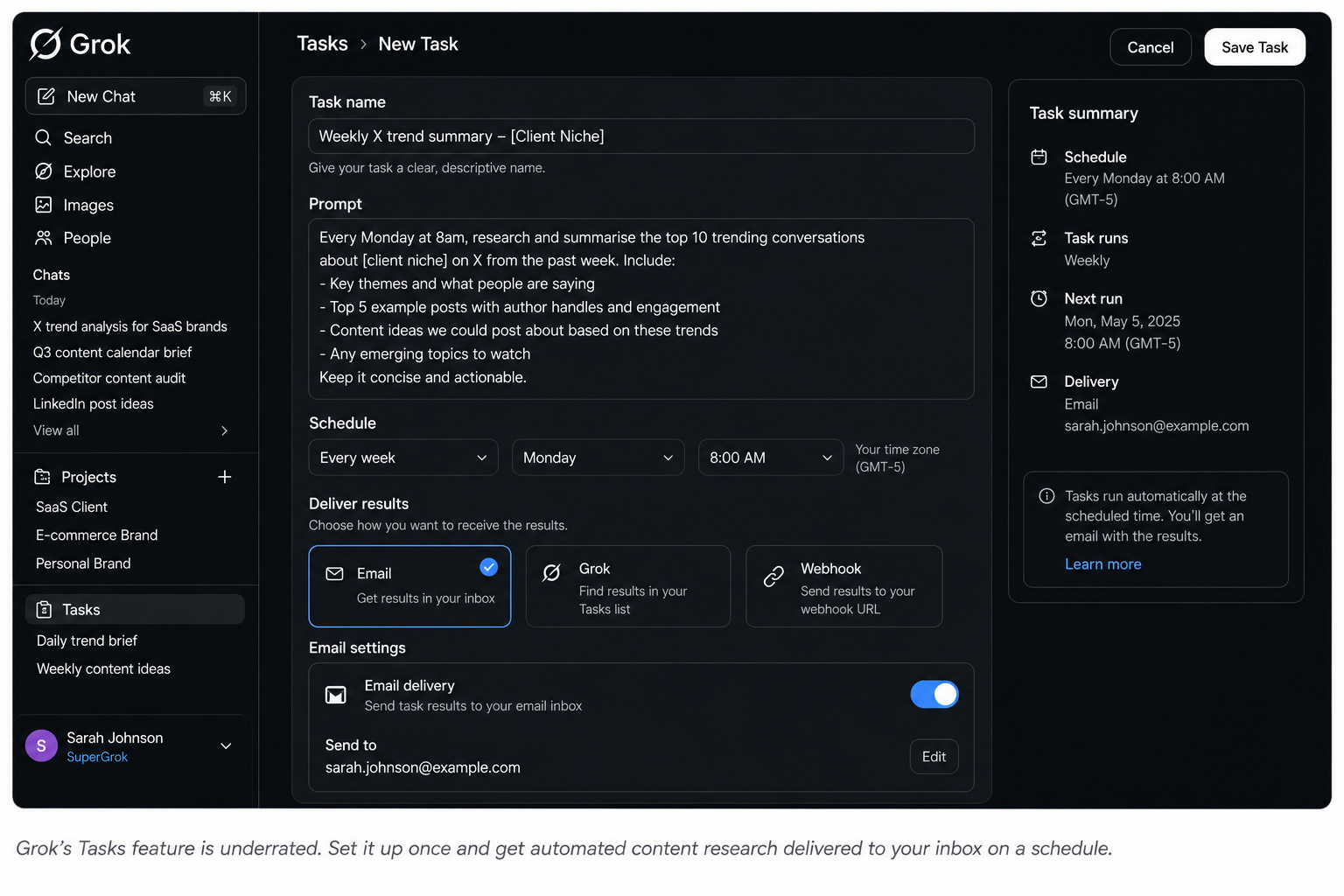
Grok’s Tasks feature lets you schedule recurring prompts to run automatically at set times. You can set Grok to generate a daily content brief, check trending topics in your niche each morning, or send you a summary of X conversations around a keyword on a weekly basis. For social media managers building repeatable research workflows, this is a meaningful time-saver.
Where Grok falls short for social media managers
Speed: Grok 4 is painfully slow
The most consistent real-world complaint about Grok is response time. Grok 4 can take several minutes to respond to a complex prompt. For content batching — where you are generating a month of posts in a single session — that latency compounds into a real workflow cost.
“The absolute worst part is how long it takes to get an answer. It’s absolutely ridiculous.” — r/grok user, nuclearseaweed, Reddit
“I can’t wait several minutes for simple questions. I’m sticking with ChatGPT since it replies right away.” — r/grok user, Ok-Crazy-2412, Reddit
Grok 3 is significantly faster, but less capable. The speed-capability tradeoff is sharper in Grok than in any competing tool. Claude Sonnet 4.6 and ChatGPT GPT-5 both deliver strong reasoning without the multi-minute wait times.
Image generation: not ready for client work
Grok’s image generation is its weakest area by a significant margin. PCMag’s independent testing found that Grok 4 produced images with visible distortion, incorrect object placement, and nonsensical diagrams across multiple prompt categories. Reddit users echoed the same finding.
“Grok image generation is bad. This is true since Grok 4 is mostly focused on reasoning tasks.” — r/grok user, tempetemplar, Reddit
The Imagine engine — Grok’s more advanced image and video generation tool, available on mobile for paid users — is an improvement but still produces lower quality output than ChatGPT’s DALL-E integration. For social media managers creating visual content for clients, do not rely on Grok for image generation. Use a dedicated tool.
No Projects equivalent for client brand management
Claude’s Projects feature lets you store a full brand brief, voice guidelines, audience description, and content history in a persistent workspace that every future conversation inherits. Grok has persistent memory and custom instructions, but no structured equivalent to Projects.
“I’m staying with Claude for hard work due to Projects. If they add projects and memory, that would make it killer. Claude rn the best UI UX.” — r/grok user, pddro, Reddit
For agencies managing multiple clients simultaneously, the absence of a Projects system means you are re-briefing Grok for each client context or working from a flat memory that mixes client information. This is a genuine workflow limitation that Claude solves better.
Pricing: more expensive for comparable features
SuperGrok at $25/month is more expensive than both Claude Pro ($20/month) and ChatGPT Plus ($20/month). The price difference is not enormous, but Grok does not offer more for it in the features most social media managers care about. There is no storage bundle like Gemini’s, no Projects like Claude’s, and no native image quality like ChatGPT’s.
Political bias concerns
xAI CEO Elon Musk’s political views are well documented, and Grok has faced scrutiny over politically biased responses. PCMag’s investigation found no clear right-wing bias, but did find a strong tendency toward false balance — presenting fringe claims as legitimate alternative viewpoints in an attempt at neutrality. For social media managers writing brand content that touches on current events, this is worth knowing: always verify Grok’s sourcing and check its claims independently.
Privacy and data security
xAI collects significant data including all conversation content, which is used by default to train its models. A federal government employee leaked an xAI security key in 2025. A rogue employee tampered with Grok’s behaviour in the same year. For agencies handling sensitive client information, these incidents are worth weighing. Do not include client passwords, personal data, or confidential business information in Grok prompts.
Grok AI and cloud phone workflows: where it fits
Like Claude and Gemini, Grok generates text and research output. It has no native connection to social platforms and no multi-account management capability. Publishing, account isolation, and platform management remain separate concerns requiring separate tools.
For social media managers running accounts across multiple clients, the practical setup works like this. Grok handles X research and content strategy in the content layer. Multilogin cloud phones handle account isolation in the device layer. A scheduler handles publishing. The three tools operate on different parts of the stack without conflicting.
The scenario where Grok makes the most sense is this: you manage a client whose strategy is heavily X-native. Their audience lives on X, their campaigns run on X, and understanding X sentiment and trending conversations is essential to their content planning. In that workflow, Grok’s research output is genuinely superior to what Claude or ChatGPT can produce — because only Grok has direct access to X post data.
For agencies managing multiple Twitter/X accounts — whether for clients or for growth strategies — Grok’s X integration makes it the most relevant content research tool in that specific workflow. The account isolation and publishing layer still belongs to cloud phones and schedulers. But the research and brief layer is where Grok earns its place.
When to use Grok in your stack [object Object]
Claude for final copy that needs to sound human and for client brand brief storage via Projects. Use cloud phones for account isolation across all of them.
Grok vs Claude vs ChatGPT: head-to-head for social media managers
Feature | Grok | Claude | ChatGPT |
Content quality | Direct but generic | Best for human-sounding copy | Strong; slightly formulaic |
X / Twitter research | Native; includes X posts | No X access | Limited X access |
Real-time web search | Yes + X posts | Yes (paid plans) | Yes |
Image generation | Poor (distortion, errors) | None — text only | Strong (DALL-E 4) |
Memory / context | Persistent; 256K tokens | Projects (persistent brief storage) | Memory; 32K tokens |
No-project brand storage | Instructions only | Projects — full brand brief | Custom GPTs |
Pricing (paid tier) | $25/mo — expensive | $20/mo — competitive | $20/mo — competitive |
NSFW content | Yes (via Imagine) | No | No |
Multi-account workflow | External tools needed | External tools needed | External tools needed |
Best for SMMs | X-native research & strategy | Content quality & client work | Integration-heavy workflows |
The honest verdict on where Grok sits
Grok is a legitimate tool with a narrow but real advantage: X integration and real-time post data. On content quality, it sits fourth in community rankings behind ChatGPT, Gemini, and Claude. On research for X-native strategy, it sits first. On image generation, it sits last among the major tools. On pricing, it is the most expensive for comparable features.
“Grok is generally ranked 4th in quality and capabilities behind ChatGPT, Gemini and Claude. It’s also slow.” — r/grok user, philip456, Reddit
The Reddit community’s overall view is nuanced: experienced AI users often run Grok as one of several tools, routing X research to Grok, reasoning tasks to Grok 4 or Claude, and content polish to Claude or ChatGPT. Few use it as their only tool.
Grok AI pricing in 2026
Plan | Price | Key features | SMM notes |
Free | $0/mo | Grok 3 with daily limits, basic web search | Hit limits fast; no Companions; limited image gen |
SuperGrok | $25/mo (annual) | Grok 3 + Grok 4, higher limits, Companions, Imagine mobile | Still slower + pricier than Claude Pro / ChatGPT Plus |
SuperGrok Heavy | $250/mo (annual) | Grok 4 Heavy (multi-agent), earliest feature access | Enterprise-only price; not relevant for most SMMs |
Via X Premium+ | $32.92/mo | SuperGrok equivalent via X subscription | Includes X Premium; useful if you pay for X anyway |
The pricing story is simple: Grok is the most expensive standard AI subscription at $25/month compared to $20/month for Claude Pro and ChatGPT Plus. It does not offer a storage bundle like Gemini, a Projects system like Claude, or image generation quality like ChatGPT. The price premium is hard to justify unless X integration is central to your workflow.
If you already pay for X Premium+, that tier includes SuperGrok equivalent access. For agencies spending on X Premium+ for client management anyway, Grok becomes effectively bundled rather than a separate cost.
Who should use Grok for social media management?
Grok is the right choice if:
- Your clients or brand strategy is X-native and real-time X sentiment data would genuinely improve your content planning
- You are managing multiple X/Twitter accounts and want a research tool that pulls from the platform itself
- You want scheduled, automated content research briefs delivered on a recurring schedule via Tasks
- You prefer a direct, low-guardrail AI tone and find Gemini’s disclaimer-heavy responses frustrating
- You already pay for X Premium+ and want to bundle your AI access
- You use it as one tool in a multi-AI workflow alongside Claude for final copy and ChatGPT for image generation
Choose a different tool if:
- Content quality and brand voice precision are your primary criteria — Claude consistently outperforms Grok here
- You need to manage multiple client brand briefs persistently — Grok has no Projects equivalent
- You are doing heavy content batching — Grok 4’s response times will slow your production significantly
- You need reliable image generation for client visual content — Grok’s image output has significant quality issues
- Privacy and data security are paramount — xAI’s 2025 security incidents are worth factoring in
- Budget is tight — at $25/month, you get more for your money with Claude or ChatGPT
Our verdict
Category | Score | Notes |
Social media content writing | 6/10 | Direct, no-fluff tone but lacks brand voice precision; generic without heavy prompting |
X / Twitter integration | 9/10 | Unique advantage: real-time X posts included in research; unmatched for X strategy |
Real-time information | 8/10 | Web search plus X posts gives more current data than most competitors |
Image generation | 4/10 | Significant distortion and prompt-following failures; not ready for client work |
Memory and context | 7/10 | Persistent memory included; 256K token context window is strong |
Speed (Grok 4) | 4/10 | Grok 4 is notoriously slow; Grok 3 is faster but less capable |
Pricing value | 5/10 | More expensive than Claude or ChatGPT; $25/mo for comparable features |
Cloud phone compatibility | 7/10 | Works as content layer; no native multi-account features |
Multi-account workflow | 5/10 | No Projects equivalent; no client isolation; requires external tools |
Overall for SMMs | 5.5/10 | Niche use case: X-heavy strategy work; Claude wins on pure content quality |
Grok is the right tool for a specific job. If that job is X-native social media strategy — monitoring sentiment, researching trends, building briefs grounded in what people are actually saying on the platform right now — Grok is better than any alternative. No other major AI tool gives you real-time X post data in its research output.
For everything else, the case gets weaker fast. Content quality sits below Claude and ChatGPT. Image generation is unreliable. Pricing is higher. Speed is slower. And the absence of a Projects-style client management system makes multi-client agency work harder than it needs to be.
The realistic use case for most social media managers is Grok as a research layer in a multi-tool stack: Grok for X strategy and trend research, Claude for content creation and client brand storage, cloud phones for account isolation, and a scheduler for publishing. In that configuration, Grok earns its place. As a standalone content tool, it does not.
Need to manage multiple social media accounts? Try Multilogin Cloud Phones.
Frequently asked questions
For X-native strategy and real-time trend research, yes — it is the best tool available because it uniquely draws from X post data. For content writing quality, image generation, and multi-client brand management, Claude and ChatGPT are stronger choices.
In community rankings and independent testing, Grok sits fourth behind ChatGPT, Gemini, and Claude in overall capability. For X-specific research and a more direct tone, Grok pulls ahead. For content quality, image generation, and integrations, ChatGPT leads.
The free tier has daily usage limits. SuperGrok costs $25/month billed annually. SuperGrok Heavy — the multi-agent version for enterprise users — costs $250/month billed annually. X Premium+ at $32.92/month includes SuperGrok-equivalent access bundled with an X subscription.
Yes. The free tier includes access to Grok 3 with daily usage limits, basic web search, image generation, and task automation. It excludes Companions, the Imagine engine on mobile, and higher usage limits. For social media managers doing heavy content work, the free tier will hit limits quickly.
xAI collects extensive data including conversation content, which is used to train its models by default. A government employee leaked an xAI security key in 2025, and a rogue employee tampered with Grok’s outputs in the same year. Do not include sensitive client information, passwords, or confidential business data in Grok prompts. You can disable model training in settings.
Based on Reddit community feedback, the most common use cases are: coding assistance and debugging, X/Twitter research and trend monitoring, general Q&A where a direct unfiltered answer is preferred, and as one tool in a multi-AI stack that also includes Claude or ChatGPT. Few professional users rely on it exclusively.