


DoorDash is one of the most accessible ways to earn income on your own schedule. No boss, no fixed hours, no qualifications required. But there’s a massive difference between someone making €8/hour wandering around accepting every order, and someone who has figured out the system and consistently pulls €18–25/hour.
That gap isn’t luck. It’s strategy.
This guide covers everything that actually moves the needle — from the basics of when and where to dash, to advanced order selection, multi-apping, and what to do if you’re ready to scale beyond a single account or device. If you want legit ways to make money online and on the ground, DoorDash done right is one of the most reliable options available.
Start your Multilogin plan if you’re running multiple gig app accounts or mobile income operations that need clean account isolation.
Can You Actually Make Good Money on DoorDash?
Yes — but not passively, and not without understanding how the platform works.
The national average DoorDash earnings sit around €15–18/hour for dashers who know what they’re doing. Dashers in dense urban markets, working peak hours, applying smart order filters report €20–30/hour regularly. The dashers stuck at the bottom are typically accepting every order, working slow hours, and driving long distances for low-value deliveries.
The variables you control matter more than the ones you don’t. Here’s how to control them properly.
How to Make the Most Money on DoorDash: Core Principles
Before getting into tactics, three principles underpin everything:
Time is your only real asset. Every minute spent driving to a restaurant, waiting for food, or completing a low-value delivery is a minute you can’t spend on a better order. Protecting your time-per-dollar is the entire game.
Not all orders are worth taking. DoorDash’s default is to show you orders sorted by availability, not by profitability. You have to train yourself to evaluate quickly and decline without hesitation when an order doesn’t meet your threshold.
Your market matters more than your effort. A great strategy in a dense city market outperforms the same strategy in a low-density suburb. If your market is genuinely slow, no amount of optimization will fix it — you may need to multi-app or reconsider your zone.
How to Make More Money on DoorDash: Know Your Numbers
Set a minimum earnings-per-mile threshold and stick to it. Most experienced dashers use €1–1.50 per mile (or equivalent per kilometre) as their floor. Below that, the order usually isn’t worth the fuel and time cost.
Before accepting, quickly calculate: delivery payout ÷ estimated distance. A €6 delivery going 8 miles is €0.75/mile — decline it. A €7 delivery going 3 miles is €2.33/mile — take it.
Also watch for:
- Long restaurant wait times. If you arrive and the food isn’t ready, that’s unpaid time. Restaurants with consistently long waits become known in your market — remember them and factor it into your decision.
- Low-tip or no-tip orders. DoorDash guarantees a base pay, but the real money is in tips. Orders with low or hidden tips often reveal themselves over time. Customers who tip well tend to tip consistently.
- Long drop-off distances. A high-payout order that takes you 12 miles from your hotspot isn’t just one bad order — it costs you 20 minutes getting back into position.
How to Make the Most Money on DoorDash: Timing and Location
Dash During Peak Hours
Peak hours are when order volume spikes and base pay goes up. Standard peaks across most markets:
- Lunch: 11am–2pm
- Dinner: 5pm–9pm
- Late night/weekends: 9pm–midnight in bar-heavy areas
During peak periods, DoorDash activates Peak Pay — an additional bonus per delivery on top of your standard payout. A €6 base order with €2 Peak Pay and a €4 tip becomes a €12 delivery. Same drive, dramatically better math.
Schedule your dashes to start 10–15 minutes before peak windows open. The app allocates dash slots in advance — if you wait until peak starts, slots fill up and you may be locked out.
Position in High-Density Hotspots
The DoorDash map shows hotspot markers — heat map areas with high order density. Park or position yourself near clusters of restaurants (not a single restaurant) in those zones. You want to be within 1–2 minutes of multiple restaurants so you’re never driving far to pick up.
Avoid positioning near a single popular restaurant. You’ll get orders from that restaurant but miss everything else in the area.
Know Your Market’s Slow Zones
Every market has dead zones — areas that look active but consistently produce low-value orders. Track your results by zone over 2–3 weeks. The data will show you where your time is actually best spent.
How to Make a Lot of Money on DoorDash: Order Stacking
Order stacking means accepting multiple orders from different restaurants whose pick-up locations and drop-off points overlap geographically. DoorDash sometimes offers stacked orders automatically (showing two orders bundled together), but you can also time it manually.
Done well, stacking means you’re earning two delivery payouts for a single trip. Done badly, it means one customer gets a cold order and leaves a bad rating.
Rules for stacking that works:
- Both restaurants need to be within a 5-minute radius of each other
- Drop-offs should be in the same direction — not opposite ends of the city
- Food that travels badly (ice cream, hot soups) shouldn’t be stacked with long second deliveries
- If one order runs late, communicate via the app — it protects your rating
How to Make More Money on DoorDash: Multi-Apping
Multi-apping means running DoorDash simultaneously with one or two other gig delivery apps — Uber Eats, Instacart, Grubhub — and strategically accepting orders from whichever platform offers the best rate at any given moment.
This is legal and common. Most experienced dashers run at least two apps. The key is knowing which orders you can safely hold and which you need to prioritise.
Practical approach: keep DoorDash as your primary, use a second app as a fill-in for gaps. When DoorDash is slow or peak pay hasn’t kicked in, the second app fills dead time. When DoorDash surges, focus there.
The risk: accepting orders on both simultaneously and failing to complete one on time. That hurts your completion rate and can affect your standing. Don’t juggle more than you can deliver — literally.
How to Make Good Money on DoorDash: Ratings and Dasher Status
Protect Your Completion Rate
DoorDash requires a minimum completion rate (currently 80%) to stay active. Dropping below that risks deactivation. Be selective about which orders you accept — but once you accept, complete.
If an order becomes genuinely problematic (restaurant is closed, food is wrong, safety issue), DoorDash has an unassign option. Use it sparingly — too many unassigns count against you.
Top Dasher Status
Top Dasher is a monthly status tier earned by meeting targets: 4.7+ customer rating, 95%+ completion rate, 100+ deliveries that month, and a 70%+ acceptance rate for the last month. Benefits include dashing anytime without scheduling in advance.
The acceptance rate requirement is the controversial one. Many dashers argue maintaining 70% acceptance requires taking low-value orders that hurt your earnings-per-hour. Whether Top Dasher is worth pursuing depends on your market — in high-demand urban areas, you likely don’t need it. In slower markets, the “dash anytime” benefit has more value.
Maintain Customer Ratings
A 4.7+ rating keeps your options open. Practical actions that protect it: use insulated bags (keeps food warm, customers notice), follow delivery instructions precisely (gate codes, leave-at-door requests), and send a quick message for any delay.
How to Make Money on DoorDash Fast: Tips for New Dashers
If you’ve just signed up and want results immediately:
- Start during dinner peak on a Friday or Saturday. Volume is highest, base pay is elevated, tips are better.
- Don’t accept orders under €5 total payout until you understand your market’s baseline.
- Decline anything requiring more than 8 miles of driving unless the payout is exceptional.
- Use the DoorDash hotspot map actively for the first few weeks — let it guide your positioning while you learn your market.
- Track every dash in a spreadsheet: start time, end time, miles driven, total earned. You can’t optimise what you don’t measure.
How to Make Money on DoorDash Without Dashing
Not everyone wants to drive. DoorDash has income options that don’t require making deliveries:
DoorDash referral program: DoorDash pays bonuses for referring new Dashers who complete a qualifying number of deliveries. Bonuses vary by market and change frequently, but can reach €50–100+ per qualified referral in high-demand areas. Share your referral link on social media, local community groups, or job boards.
DoorDash merchant side: If you run a food business, listing on DoorDash as a merchant generates revenue through the platform rather than for it. It’s a separate income model but relevant if you’re thinking about DoorDash from both sides.
Content and affiliate income: Dashers with audiences — YouTube channels, TikTok accounts, blogs — monetise their DoorDash experience through ad revenue, affiliate links to gear (insulated bags, phone mounts, navigation apps), and sponsored content. If you’re already making money on TikTok or building content around gig work, DoorDash content performs well because the audience is large and search intent is strong.
Reward and survey income alongside dashing: During slow periods or before a dash starts, paid survey platforms and apps that pay for watching ads for income run passively in the background. Not DoorDash income, but part of a complete mobile income stack.
Scaling DoorDash Operations: What Breaks and How to Fix It
Most DoorDash content assumes a single dasher on a single account. But serious gig operators — people running multiple accounts, managing teams, or operating across different markets — run into infrastructure problems that individual-dasher guides never address.
Multiple accounts and platform detection: DoorDash, like most gig platforms, monitors device signals. Two accounts operating from the same phone, same IP, or same app session get flagged. The same applies if you’re managing a team of dashers through shared devices. If you’re running multiple payment accounts or managing several operator identities, shared device signals are the fastest route to suspension.
DoorDash IP bans: DoorDash actively enforces against account abuse, and DoorDash IP bans are a real consequence for violations. Once your IP is flagged, creating new accounts from the same network creates immediate linking risk.
The operational fix is proper multi-account management: each account in a fully isolated environment with its own device identity, its own network signals, and no shared data between sessions.
Mobile-First DoorDash Operations: Where Cloud Phones Come In
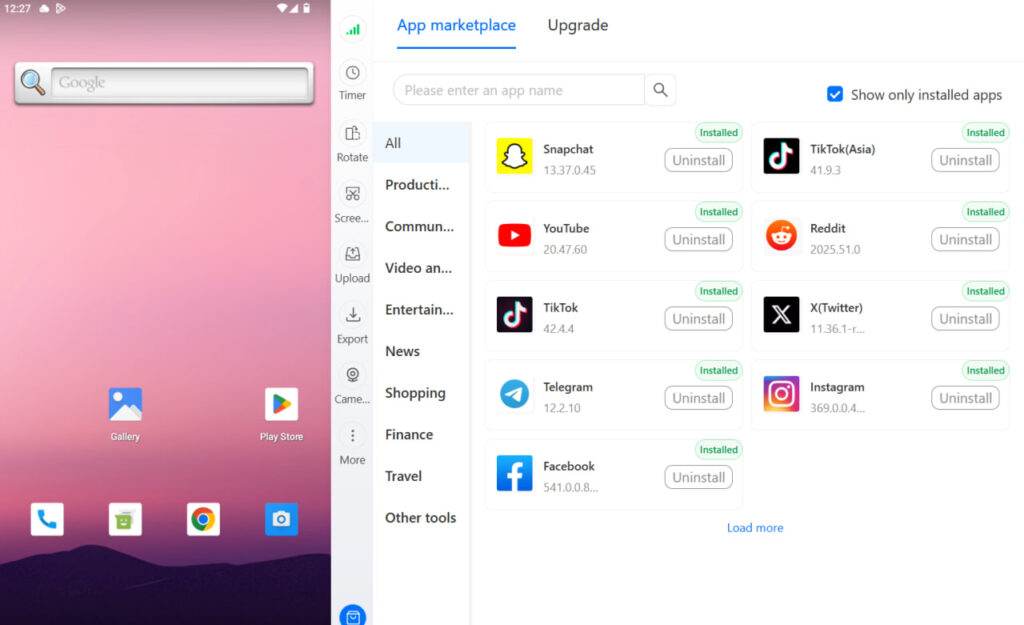
DoorDash runs entirely through the mobile app. Everything — order acceptance, navigation, delivery confirmation, ratings — happens on your phone. If you’re operating at scale (multiple dashers, multiple accounts, multiple gig apps simultaneously), you’re managing a stack of mobile environments that need to stay clean and separate.
A cloud phone is a real Android device hosted remotely — not an emulator, not a spoofed device. Real hardware identifiers (IMEI, Android ID, MAC address), persistent app storage, and login states that survive between sessions. You control it from your desktop. Each cloud phone is a completely isolated mobile environment.
Multilogin’s cloud phones are real Android devices in the cloud, running Android 10–15 across approximately 30 device types with built-in mobile-grade proxies and geolocation matching. Each device looks exactly like a real phone to the DoorDash app — because it is one.
For phone farming operations running multiple gig app accounts, reward apps, or survey platforms simultaneously, this replaces the physical multi-phone setup with cloud-managed devices controlled from a single dashboard. No hardware overhead. No device resets. No SIM management.
Start your Multilogin plan and run your DoorDash and gig app operations from clean, isolated cloud Android devices.
How Much Money Can You Make on DoorDash?
Honest numbers by approach:
- Casual dasher (10–15 hrs/week, no strategy): €80–150/week. Covers fuel and a bit more. Not worth it at this level without optimisation.
- Optimised dasher (20 hrs/week, peak hours, smart order selection): €300–500/week. Viable side income. With low overhead costs, this is €1,200–2,000/month.
- Full-time dasher (40+ hrs/week, prime market, multi-apping): €600–1,200/week in strong markets. The ceiling depends heavily on your city’s order density and competition.
- Referral income (active promotion): €200–800/month in high-demand periods when referral bonuses are elevated. Passive once the link is distributed.
- Content creator covering DoorDash: No ceiling. A YouTube channel with 50,000 subscribers covering gig work earns ad revenue plus affiliate commissions continuously. The content investment is upfront; the income is long-term.
Need to make extra money online? Try Multilogin Cloud Phones.
Frequently asked questions About How to Make Money on DoorDash
Focus on three things simultaneously: time your dashes around peak windows (lunch and dinner), use a per-mile earnings floor to filter out low-value orders fast, and position yourself in high-density hotspot zones rather than near a single restaurant. Dashers who do all three consistently outperform dashers who optimise only one variable.
Yes, with the right market and approach. Dense urban areas with high DashPass and DoorDash usage are where the strongest earnings happen. In those markets, €20–25/hour is achievable for an optimised dasher during peak hours. Rural and suburban markets are harder — multi-apping becomes more important there to fill slow periods.
Order selection is the biggest lever. Declining low-value orders and only accepting high-ratio (payout-to-distance) deliveries means more money from the same hours. Stacking orders when geography allows doubles your payout per trip without doubling your time. And peak pay windows can add €2–4 per delivery — the same delivery pays more during peak hours than off-peak.
Friday and Saturday dinner (5pm–9pm) are the highest-earning windows in most markets. Peak Pay activates most consistently during these slots, order volume is highest, and tip averages are better. Lunch on weekdays (11am–2pm) is strong in office-heavy urban areas. Late night (9pm–midnight) on weekends works well in areas with active bar and restaurant scenes.
The main options: the DoorDash referral program (earn bonuses per new Dasher who completes qualifying deliveries), creating content about DoorDash for YouTube, TikTok, or a blog (ad revenue plus affiliate income), and listing a food business as a DoorDash merchant. None of these require making deliveries yourself.
DoorDash’s terms allow one account per person. Running multiple accounts from the same device, IP address, or app session violates those terms and triggers detection. If you have a legitimate operational reason to manage multiple accounts (managing a team, separate business entities), each needs a fully isolated mobile environment with its own device identity and network signals — not just a different login on the same phone.
Key takeaways
Managing multiple DoorDash or gig app accounts and need clean isolation? Start your Multilogin plan and run every account from isolated, real cloud Android devices — no hardware, no resets, no linking risk.