Where does Buffer genuinely win for agencies?
Is Buffer’s interface really that much better?
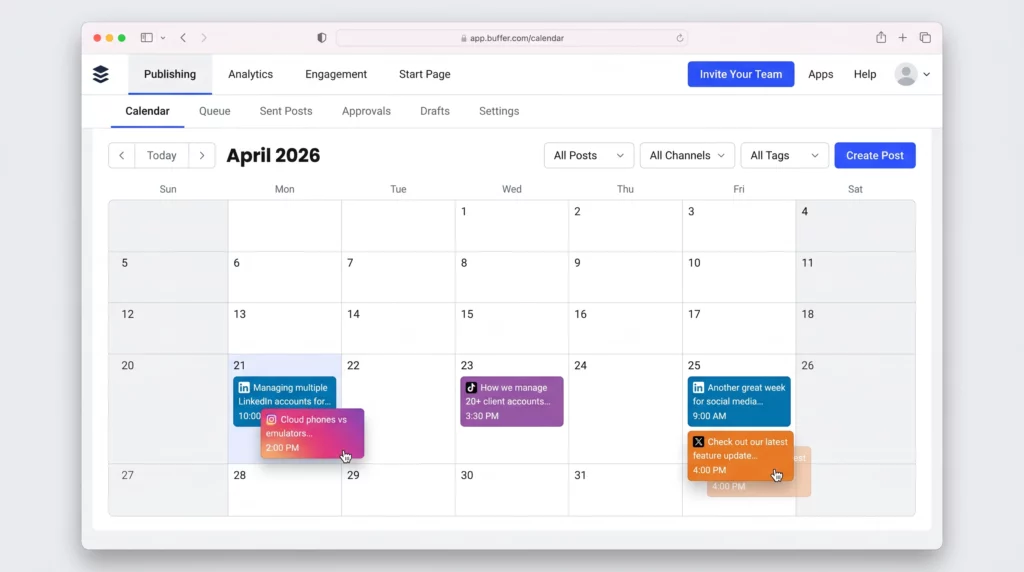
Yes. Buffer’s post composer and queue view are noticeably easier to use than Hootsuite’s. For social media managers who just want to draft, approve, and schedule content without navigating a complex platform, Buffer removes a lot of friction. A new team member can use Buffer confidently within an hour. Hootsuite takes days to learn properly and some features stay confusing even after regular use.
Is Buffer actually better for Instagram?
Yes. Buffer’s Instagram integration is the strongest of any major scheduler for the things agencies care about: first comment scheduling, story support, reminder notifications for content that requires manual publishing, and a link-in-bio tool called Start Page that is built in. For agencies whose client mix is heavily Instagram, Buffer’s native Instagram experience is meaningfully better than Hootsuite’s.
For the account isolation layer underneath the scheduler, pair Buffer with Multilogin cloud phones for social media to handle device-level separation. Buffer handles the publishing. Cloud phones handle the account isolation.
Does Buffer’s per-channel pricing actually make sense?
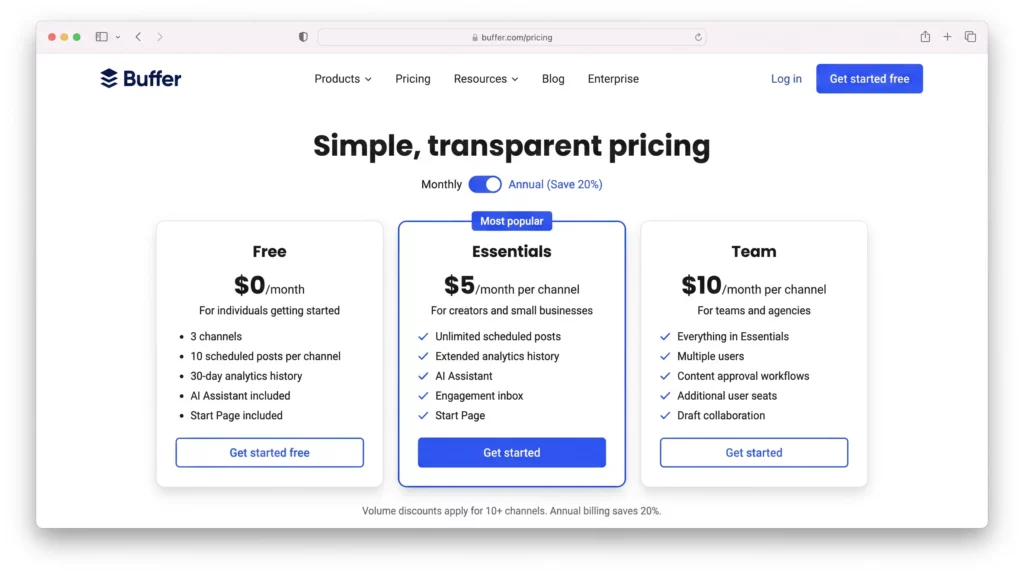
It does at low account volumes. Buffer’s Essentials plan at $6 per channel per month and Team plan at $10 per channel per month are affordable and predictable when you are managing under 20 client accounts. For a three-person agency managing 12 accounts, the cost is controllable and easy to forecast.
The per-channel model also makes it easy to add or remove accounts as the client portfolio changes. You are not paying for a flat platform seat that does not scale with your actual usage.
Where does Hootsuite genuinely win for agencies?
Is Hootsuite’s community monitoring actually worth it?
For agencies where community management is a core service, yes. Hootsuite’s streams let you monitor multiple social feeds, mentions, hashtags, and competitor activity in a single customisable view.
Catching brand mentions, managing comments across platforms, responding to customer service queries, and tracking conversations in real time is significantly easier in Hootsuite than in Buffer. Buffer’s monitoring is basic by comparison.
Are Hootsuite’s analytics actually good enough for client reporting?
Yes, and this is one of the clearest reasons to choose Hootsuite over Buffer if client reporting is a standard deliverable. Hootsuite’s analytics are exportable, customisable, and can be turned into branded PDF reports that show reach, engagement, clicks, follower growth, and best-performing content across all a client’s accounts.
Buffer’s analytics are useful for internal monitoring but not designed for external reports. If your clients expect regular analytics, Hootsuite’s reporting capability justifies a meaningful price premium.
Is Hootsuite’s approval workflow worth paying for?
For agencies with 5 or more people touching content across multiple clients, yes. Hootsuite’s approval workflow means content drafted by one team member gets reviewed and approved by another before it goes anywhere near a scheduling queue.
Buffer has a simpler version of this, but Hootsuite’s is more structured and more auditable. For agencies managing regulated industry clients or agencies where content errors are a genuine risk, this matters a lot.
What about platform coverage?
Hootsuite supports more platforms: Instagram, TikTok, Facebook, LinkedIn, X, Pinterest, YouTube, Reddit, and Google Business. For agencies managing clients across diverse platform mixes that include Reddit or extended Google integrations, Hootsuite reduces the need for additional specialised tools.
Which is actually cheaper for agencies?
This is the part most Buffer vs Hootsuite articles get wrong. They compare at low account volumes and conclude Buffer is cheaper. At agency scale, that conclusion often reverses:
- Buffer for 10 accounts at Team plan: 10 times $10 equals $100 per month
- Buffer for 25 accounts at Team plan: 25 times $10 equals $250 per month
- Buffer for 50 accounts at Team plan: 50 times $10 equals $500 per month
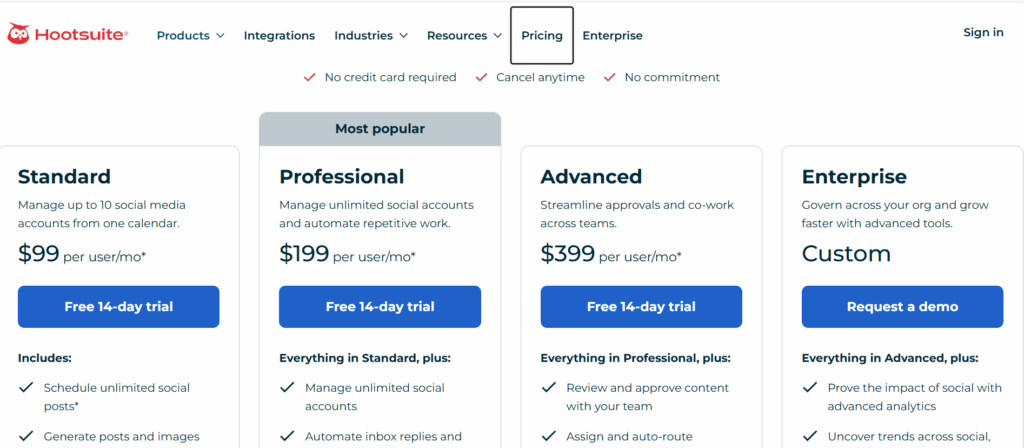
- Hootsuite Professional flat tier: approximately $99 per month for up to a set account limit
- Hootsuite Team flat tier: approximately $249 per month for larger account sets
At 25 accounts, Buffer and Hootsuite cost roughly the same. At 50 accounts, Hootsuite is significantly cheaper. Buffer is only the cheaper option at low account volumes. Model the actual cost against your full client portfolio before committing to either.
Do schedulers actually protect your accounts from shadow bans?
No. Neither Buffer nor Hootsuite protects accounts from Facebook shadow bans, TikTok shadow bans, or LinkedIn shadow bans. Shadow bans are caused by account behaviour patterns, not by which scheduler you use. Account safety is an infrastructure question handled at the device level, not the publishing level.
For agencies managing multiple social media accounts across clients, the scheduler is the publishing layer and Multilogin cloud phones are the account isolation layer. Both are required. The scheduler handles when content goes live. The cloud phones ensure each account operates from its own isolated device.
How do Buffer and Hootsuite handle multi-client workflows differently?
How does Buffer handle multiple clients?
Buffer uses a channel-based model. Each social media account is a separate channel and you switch between them in the dashboard. For agencies managing 10 to 15 accounts across 3 or 4 clients, this works well. For agencies managing 30 or more accounts, channel switching becomes slow and the lack of a true client grouping system creates friction.
Buffer’s solution is workspaces. You create a separate Buffer workspace per client and switch between them. This adds a login switch step for each client rather than a seamless dashboard view. For a team where different people manage different clients, this works fine. For a single person managing all clients simultaneously, the switching adds up over a week.
How does Hootsuite handle multiple clients?
Hootsuite uses an organisation and teams model. You create separate team spaces per client, assign team members to specific client spaces, and manage permissions granularly. For a larger agency with account managers assigned to specific clients, this structure maps well to how the agency actually operates.
The approval workflow is particularly relevant for multi-client agencies. When a junior team member drafts content for Client A, the account manager for Client A gets a notification to review and approve before it goes anywhere. Hootsuite’s approval workflow is more structured and more auditable than Buffer’s, which matters for agencies with strict client review requirements.
Which one should your agency actually use?
Use Buffer if:
- Your agency is small, 1 to 4 people, managing under 20 client accounts
- Your client mix is heavily Instagram-focused and you want the best native Instagram scheduling experience
- Clean interface and fast team onboarding matter more than feature depth
- Client reporting is handled by a separate tool like Metricool, Iconosquare, or native platform analytics
- You do not need structured content approval workflows
Use Hootsuite if:
- Your agency has 5 or more people and needs structured content approval workflows
- Client-facing analytics reports are a significant deliverable and you need them directly from the scheduler
- Community management across multiple platforms is part of your services and streams monitoring saves real time
- Your account portfolio is large enough that Hootsuite’s flat-tier pricing becomes cheaper than Buffer’s per-channel model
Worth knowing before you commit Neither Buffer nor Hootsuite is a perfect answer for every agency. Buffer’s analytics are insufficient for client reporting at most agency standards. Hootsuite’s interface slows down lean teams and its lower-tier pricing is hard to justify for small agencies. Before committing to either, also look at Metricool (combines scheduling and strong analytics at competitive pricing) and Later (strongest for Instagram and Pinterest visual brands).
What is the actual recommendation here?
Under 20 accounts, Instagram-heavy client mix, small team that needs a clean interface: Buffer is the right choice. The interface advantage is real, the Instagram integration is the best available, and the per-channel pricing is predictable at that account volume.
Over 25 accounts, diverse platform mix, clients who expect regular analytics reports, team large enough to need structured approval workflows: Hootsuite is the right choice. The flat-tier pricing becomes competitive or cheaper, the analytics justify the platform for client-facing reporting, and the streams view supports community management work.
For either tool, pair it with Multilogin cloud phones for social media for device-level account isolation. The scheduler handles when content goes live. The cloud phone handles which device it goes live from.
Both questions need an answer for a properly structured agency operation. The scheduler handles when content goes live. The cloud phone handles which device it goes live from. Get both right and account management stops being the thing that holds your agency back from growing.