


A post goes out. Twenty minutes later someone spots it: a link that 404s, a stat nobody fact-checked, a call-to-action button that’s cut off on mobile, or a sponsored post with no disclosure. The approval process technically happened. Somebody clicked “approve.” And the post still went out broken.
This is the gap between having an approval process and having one that catches problems. Most teams have the first. Fewer have the second.
Key takeaways
- Most teams already have an approval process. Few have a checklist that says what to actually check.
- The five recurring failure points are links, claims, mobile display, disclosures, and final sign-off, not tone or grammar.
- A title like “marketing manager approves” doesn’t tell anyone what to look for. A checklist does.
- Final sign-off should be a distinct, named step, not an assumption that whoever clicked “approve” checked everything.
- Approval processes break down most often at hand-off points between people, not during content creation.
- A short mobile-first preview before publish catches a large share of last-minute display errors that text-only review misses.
What is a social media approval process?
A social media approval process is the defined sequence a piece of content moves through, from first draft to publish, with clear ownership at each stage. It typically includes content creation, an internal review pass, a compliance or legal check where relevant, and a final sign-off before scheduling.
What’s the difference between a process, a checklist, and sign-off?
The difference comes down to scope: a process defines the sequence and ownership of review, a checklist defines the specific items a reviewer checks at each stage, and sign-off is the final, explicit confirmation that both happened.
Social media approval process: the sequence of steps content moves through from draft to published, including who’s involved and in what order.
Social media approval checklist: the specific items a reviewer checks at each step, like link validity, claim accuracy, mobile rendering, and disclosure requirements.
Sign-off: the final, explicit confirmation that a named person has reviewed the post against the checklist and approved it for publication.
What should a social media approval checklist include?
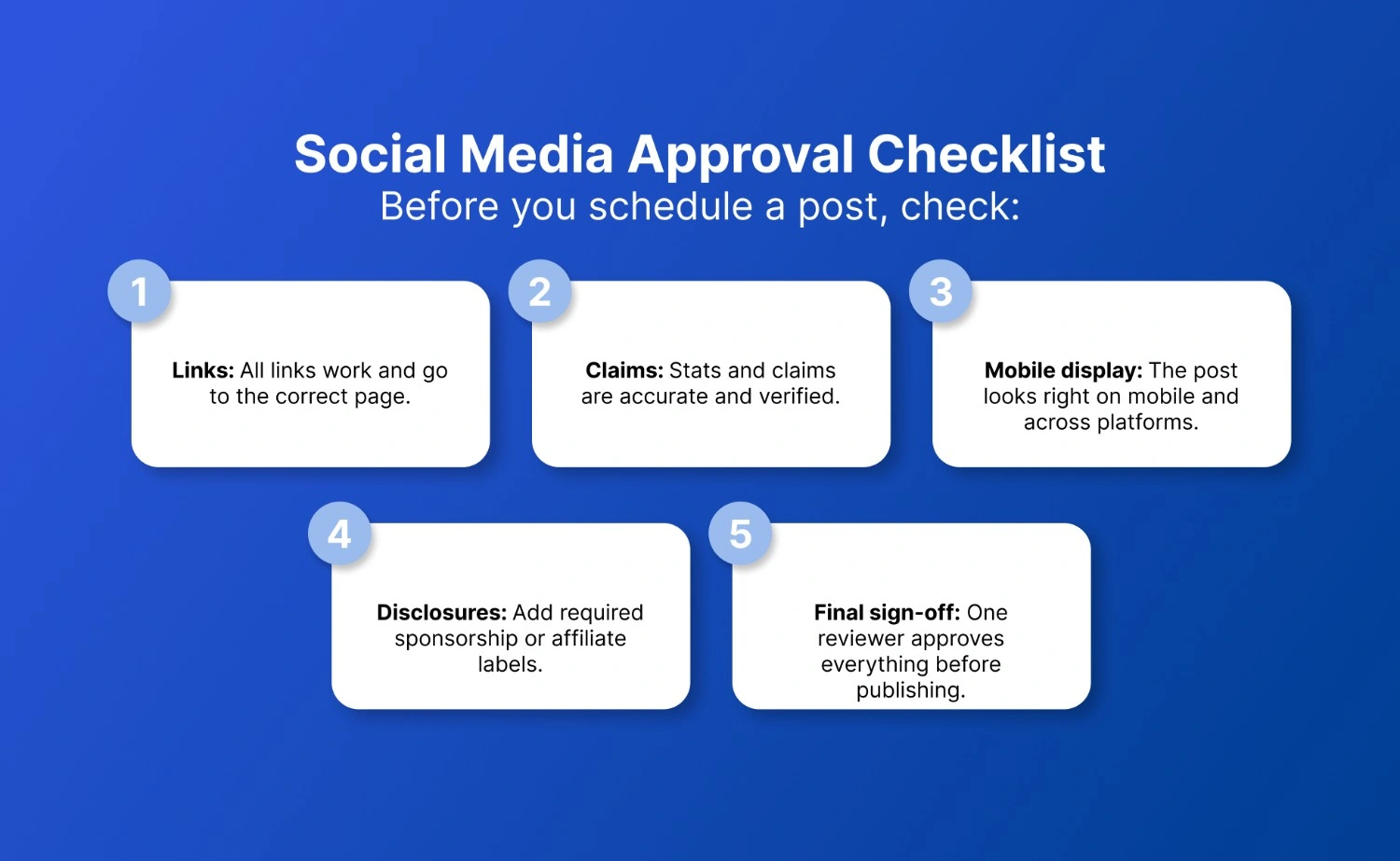
A working checklist covers five recurring failure points, links, claims, mobile display, disclosures, and final sign-off. Run it as the last gate before scheduling, and copy it directly into your content calendar or task tool:
1. Links: every link is live, correct, and points where the caption says it does.
2. Claims: every stat, comparison, or guarantee is something the team can back up.
3. Mobile display: the post renders correctly on the platforms and devices the audience actually uses.
4. Disclosures: sponsorships, affiliate links, or paid partnerships are flagged where required.
5. Final sign-off: one named person has confirmed items 1 through 4, not just tone and grammar.
What the industry keeps pointing to
Sprout Social’s guidance on approval workflows points out that multiple reviewers catch issues like broken links, inappropriate content, misinformation, and poorly timed promotions, which lines up closely with the five-point checklist above, just organized differently. (Sprout Social, “How to build a seamless social media approval process”)
Agorapulse’s guide to building a team approval process notes that teams without a defined workflow lose time in back-and-forth email and messaging threads while figuring out who still needs to sign off, and that ambiguity is often where a checklist item like link-checking gets skipped entirely rather than deliberately owned by someone. (Agorapulse, “Social Media Approval Process: A Checklist for Your Team”)
Sprinklr’s breakdown of approval workflow types describes the standardized system a workflow is meant to enforce, so content aligns with a company’s branding, legal, and messaging guidelines before it reaches the public, putting legal and compliance review on the same footing as brand and tone review, a distinction plenty of informal approval habits skip. (Sprinklr, “5 Types of Social Media Approval Workflows”)
Why do reviewers miss things even when a process exists?
Reviewers miss things because most approval processes define roles without defining what each role is checking for. When approval steps aren’t clearly assigned, team members are left checking in with everyone on a contact list instead of following a defined review path, and under that kind of ambiguity, specific checks like link validation or disclosure compliance are the first things to get skipped, since they take more deliberate attention than a quick tone read.
Who should be involved in the approval process?
The people involved depend on team size, but the recurring roles are a content creator, a reviewer checking brand and copy accuracy, someone confirming legal or disclosure compliance, and a final approver who signs off before publish. In practice, the mix of contributors ranges from content creators and managers to legal professionals and senior leadership, depending on how much regulatory or brand risk the content carries.
How is a pre-publish checklist different from a full approval workflow?
Scope is the difference: a pre-publish checklist covers only the last-stage quality gate immediately before content goes live, while a full approval workflow covers the entire path content takes to get there, including drafting, internal feedback, and any legal or compliance review. The checklist is one checkpoint inside the workflow, not a replacement for it, and skipping straight to a pre-publish check without earlier review stages tends to push all of the workload onto whoever runs that final gate.
What can teams learn from checklist failures?
Most checklist failures trace back to unclear ownership rather than a missing item on the list itself. If a broken link makes it to publish, the more useful question isn’t “why didn’t the checklist catch it” but “whose job was it to click every link before approval.” Naming that owner, rather than adding another line to the checklist, is usually what fixes the recurring miss.
What causes an approval process to break down?
Approval processes tend to break down at hand-off points: when a piece of content moves from creator to reviewer to approver without a clear trigger for each transition. Without an established process, teams often can’t tell at any given moment whether a piece of content is ready to publish, which is usually a hand-off problem, not a content quality problem.
Where hand-offs break down
Each transition between people tends to drop a specific thing. Naming it makes the gap easier to close than adding another generic checklist item.
Hand-off | What often gets lost |
|---|---|
Creator to reviewer | Context on why a claim or link was included, so the reviewer skips checking it |
Reviewer to compliance | The assumption the reviewer already checked disclosures, when that wasn’t their job |
Compliance to final approver | The approver assumes compliance covered mobile display, which it wasn’t scoped to |
Final approver to publish | No confirmation step separate from sign-off, so nothing catches a last-minute edit made after approval |
What does a good approval process look like at different team sizes?
A solo creator or single-person team needs a personal pre-publish checklist more than a multi-person workflow. A small team benefits from one reviewer confirming the full checklist before a single approver signs off. Larger teams and agencies typically need staged review, brand and copy first, then compliance, then a named final sign-off, so no single person is expected to catch every category of error alone.
Review type comparison
Review type | What it checks | Who typically owns it | Runs at what stage | Best use | Main limitation |
|---|---|---|---|---|---|
Link and claims check | Broken links, wrong URLs, unverified stats or promises | Content reviewer or copy editor | Before scheduling | Any post with a link, stat, or specific claim | Easy to skip under time pressure |
Mobile display check | How the post renders on the platforms and devices the audience uses | Content creator or reviewer | Just before scheduling | Posts with cropped images, buttons, or long captions | Requires an actual preview, not just the draft text |
Disclosure and compliance check | Sponsorships, affiliate links, required legal disclosures | Compliance or legal reviewer (or team lead) | Before final sign-off | Paid partnerships, regulated industries, contests | Often assumed to be someone else’s job |
Final sign-off | Confirms every prior check was actually completed | Named approver | Last step before publish | Every post, regardless of size or urgency | Meaningless if it isn’t a distinct, named step |
Two simple examples
These are illustrative examples, not benchmarks or required formats.
Example 1: small in-house team. A content creator drafts a post and shares it in a shared doc. The social media manager reviews copy, checks every link, and previews the post on mobile before marking it “ready.” A marketing lead gives final sign-off, confirming the checklist was followed, not just re-reading the caption.
Example 2: agency managing client accounts. A content creator drafts posts for three client accounts. Each client’s account has its own reviewer, who opens that client’s profile from a shared dashboard, previews exactly how the post will render on that client’s TikTok or Instagram, and checks brand voice and disclosure requirements specific to that client. A single agency lead does final sign-off across all three, checking that each reviewer’s checklist was completed before anything goes on the calendar.
Best practices
- Assign a named owner to each checklist item, not just a named owner to the overall approval step.
- Preview every post on mobile before final sign-off, since text-only review misses most display issues.
- Separate final sign-off from content review, so approval isn’t assumed just because someone read the caption.
- Document the approval process in writing, so new team members and clients know exactly what happens between draft and publish.
- Review the checklist itself periodically, since new platforms, disclosure rules, and content formats change what needs checking.
Keeping approval organized across multiple accounts and clients
Checklists and sign-off steps get harder to enforce once a team is running multiple social media accounts across TikTok, Instagram, Facebook, Reddit, and YouTube for different brands or clients at once, especially when mobile app previews, browser-based content, and login access are all split across separate tools and devices.
For creator teams managing multiple brand or client profiles, Multilogin can help keep daily account work organized without turning your approval workflow into a login mess.
Each social profile runs in its own environment: mobile-first platforms like TikTok, Instagram, and the Facebook app run on a dedicated Android cloud phone, a cloud-based Android environment accessed remotely, while web-first work like Reddit, YouTube channel management, and Facebook web run in an isolated browser profile with its own session and IP address. Reviewers previewing mobile display as part of the checklist above can do it from the same dashboard used to manage the account itself.
Team access controls mean sign-off can stay with one named approver even across dozens of client accounts, and Multilogin’s free plan has no time limit and no credit card required, so a team can test that workflow with up to five profiles before committing to a paid plan.
Multilogin is not a way around platform rules; the safest approach combines clean account separation with original content, real engagement, and platform-compliant activity.
Conclusion
A social media approval process only works if it tells reviewers what to check, not just whose turn it is to check it. The five-item checklist above, links, claims, mobile display, disclosures, and a distinct final sign-off, closes most of the gap between “someone approved this” and “this was reviewed.”