


Creating one polished AI character image is relatively easy. Turning that image into a consistent Instagram creator is much harder.
The difficult part of building an Instagram AI influencer is maintaining the same identity across a complete content and account workflow. The face must remain recognizable. The character also needs a stable voice, personality, audience and content style.
Someone must disclose that the featured person is AI-generated, review every post, respond to followers, measure performance and keep the account separate from other personas or client profiles.
This guide explains how to build that system, from the first character brief to daily account operation.
Key takeaways
- An Instagram AI influencer is an AI-generated character presented and managed as a creator on Instagram.
- A consistent character needs documented visual, verbal, behavioral and commercial rules.
- Creating an AI character and operating its Instagram account are separate parts of the workflow.
- Instagram provides an “AI-generated profile” label for profiles featuring AI-generated people.
- AI-generated profiles and content remain subject to Instagram’s standards, terms and branded-content requirements.
- A human remains responsible for approval, disclosures, audience interaction and campaign decisions.
What is an Instagram AI influencer?
An Instagram AI influencer is an AI-generated character that publishes content, develops an audience and may participate in marketing campaigns through an Instagram profile.
Definition: An Instagram AI influencer is a fictional creator whose presented identity is produced substantially through AI-generated images, video, voice or writing. A person or team directs the character, reviews its content, manages the account and handles commercial relationships.
An AI influencer can have a name, appearance, personality, subject area, writing style and fictional background. The character may appear in static images, carousels, Stories and Reels.
The important word is “influencer,” not simply “AI.” A generated character becomes an influencer when it is used to publish content and develop an audience around a recognizable identity.
Searchers often use phrases such as “AI influencer girl,” “AI female influencer” and “AI model influencer.” These describe only some possible character formats. A virtual creator could instead represent a fictional fitness coach, fashion commentator, product guide, gaming personality or brand character.
What is the difference between an AI influencer a virtual influencer and a digital avatar?
An AI influencer is a type of virtual influencer, while a digital avatar is the visual representation rather than the complete creator operation.
These terms overlap, and different sources may use them differently. The following distinctions provide a practical way to plan a campaign.
Term | Practical meaning | How it may be created | Creator? | Human role |
|---|---|---|---|---|
AI influencer | A creator identity produced substantially with generative AI | AI-generated images, video, voice or writing | Yes | Defines, reviews, publishes and manages |
Virtual influencer | A broader computer-created fictional creator | CGI, animation, AI or mixed production | Yes | Creates and controls the character |
Digital avatar | A visual representation of a person or fictional character | Illustration, 3D design, animation or AI | Not necessarily | Decides where and how the avatar is used |
Human creator using AI | A real person who uses AI during content production | Human-led content with AI assistance | Yes | Remains the represented creator |
A virtual influencer does not have to be created primarily with generative AI. Some virtual characters use CGI, animation, motion capture or mixed production methods.
A digital avatar is not automatically an influencer. It could appear in a game, customer-support interface, presentation or advertisement without having its own creator profile or audience.
A human creator also does not become an AI influencer merely because they use AI to edit an image, improve a caption or create a background. The distinction depends on whether the account represents a real person or an artificial character as the creator.
How do you create an Instagram AI influencer?
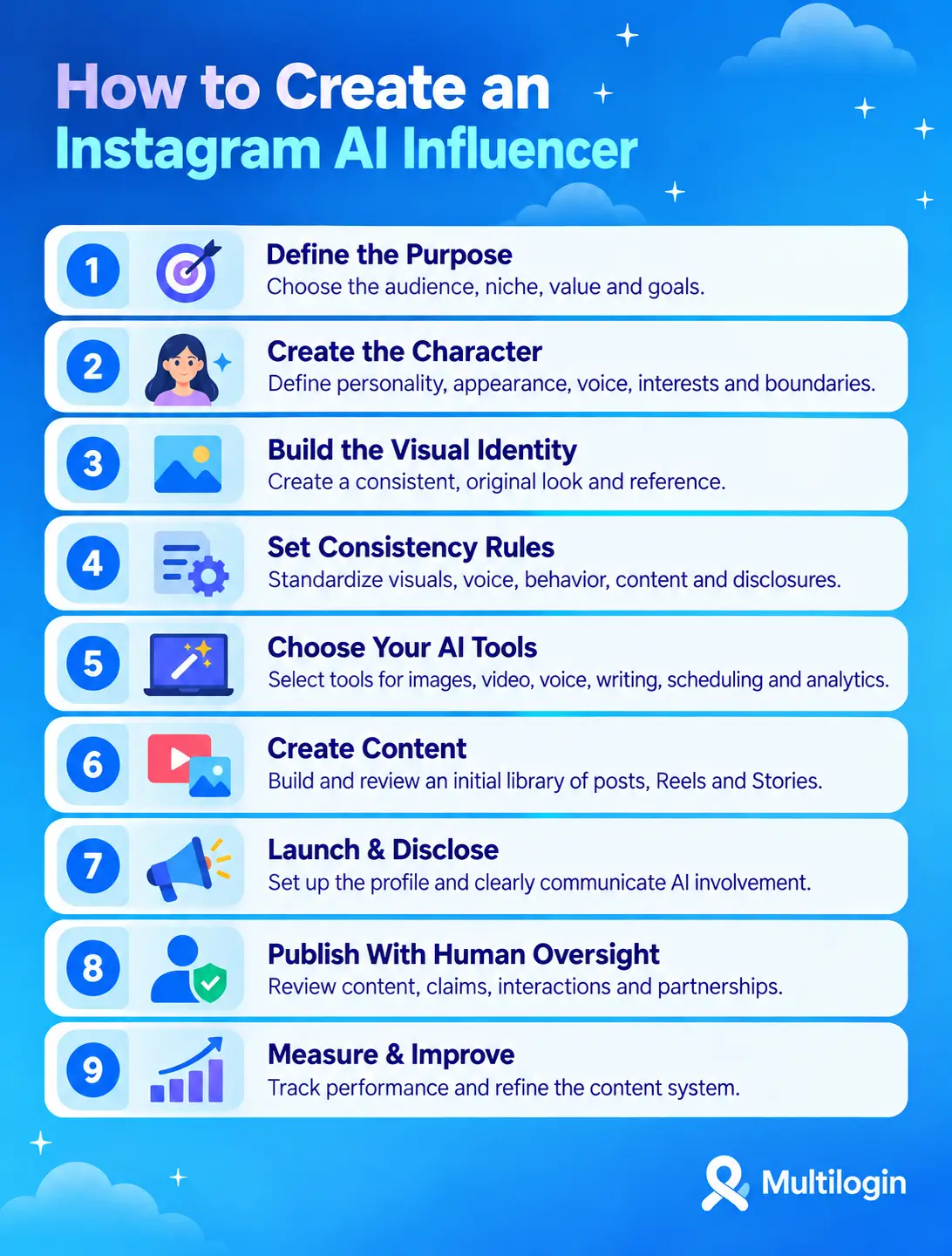
You create an Instagram AI influencer by defining the character, building a repeatable content process, establishing disclosure rules, launching the profile and reviewing its performance.
1. Define the audience and purpose
Start by deciding who the character serves and why someone would follow it.
- Who is the intended audience?
- Which subjects will the character cover?
- What will people receive from following?
- Will the account educate, entertain, demonstrate products or support campaigns?
- Which subjects should the character avoid?
- What business purpose, if any, should the profile support?
“AI model influencer” describes a format, not a complete purpose. A narrower position, such as an AI-generated character explaining sustainable fashion, gives the production team clearer criteria for content and collaborations.
2. Write a character profile
Create a character document before producing a large content library.
- Name and presented role
- Visual traits
- Personality
- Interests
- Vocabulary and tone
- Content themes
- Fictional background
- Values and boundaries
- Disclosure wording
- Commercial rules
Avoid fictional statements that could mislead people about qualifications, product experience or real-world events. If the character recommends a product or service, a human reviewer should check whether the claim and commercial relationship are clear.
3. Create an original visual reference
Select an original base representation that the team is permitted to use.
The approved search results and user discussions repeatedly focus on the difficulty of creating the same recognizable character across multiple images. A base reference gives image and video tools a stable starting point instead of asking them to invent the character again for every post.
- Face shape and features
- Hair
- Body proportions
- Typical clothing
- Color palette
- Lighting
- Camera style
- Locations
- Image composition
Before using a face, voice, photograph, design or other creative asset, confirm the applicable license, consent and permission requirements.
4. Build a consistency guide
Turn the character profile into production rules that everyone working on the account can follow.
Consistency includes more than preserving the same face. The character should also maintain a recognizable voice, set of interests, visual world and pattern of behavior.
Layer | Questions to document |
|---|---|
Visual identity | Which features must remain recognizable across images and video? |
Verbal identity | Which tone, vocabulary, expressions and caption style fit the character? |
Character facts | Which background details are fixed, flexible or prohibited? |
Behavior | How does the character reply to comments and handle sensitive subjects? |
Commercial activity | Which products, industries, claims and partnerships fit the character? |
Disclosure | How will the profile and individual content explain AI involvement? |
Keep one approved version of the guide. Update it deliberately instead of allowing the identity to change with each prompt or campaign.
5. Choose tools by production task
Choose AI influencer tools according to the job they perform rather than expecting one platform to manage the entire workflow.
Tool category | Main job | Typical input | Typical output | Main review need |
|---|---|---|---|---|
Image generation | Produce still visuals | Prompts and reference images | Posts and carousel assets | Character and scene consistency |
Video generation | Add scenes and movement | Image, video, script or prompt | Reels and Stories | Motion, continuity and visual errors |
Voice generation | Produce narration | Script and an approved voice | Voiceovers | Pronunciation, tone and permission |
Writing assistant | Develop ideas and draft copy | Character guide and content brief | Captions and scripts | Accuracy and character voice |
Scheduler | Organize publishing | Approved content | Scheduled posts | Correct profile and timing |
Analytics tool | Review performance | Profile and campaign data | Reports | Metric definitions and interpretation |
Operating environment | Keep profile work separate | Account and workflow settings | Persistent profile access | Correct persona, client or campaign |
Some products cover several categories. Review each tool’s current documentation, licensing terms, privacy controls and commercial-use conditions before adding it to the workflow. An operating environment should not be confused with a character generator, scheduler or analytics platform. These tools solve different parts of the process.
6. Prepare the first content library
Build a small, reviewed content library before launching the profile.
The initial library should demonstrate the range of content the character will publish. It could include an introduction, recurring educational or entertainment series, short videos, Stories and audience questions.
Review the collection as one group. A set of posts makes identity changes and contradictions easier to notice than a single asset does.
- The character remains recognizable.
- The captions sound like the same speaker.
- The scenes fit the defined visual world.
- Disclosures are understandable.
- Product appearances are appropriate.
- No post implies a false real-world experience.
- The content gives the intended audience a reason to return.
7. Create and disclose the Instagram profile
Create the profile with clear identity information and the relevant Instagram disclosure settings.
Instagram renamed its earlier “AI creator” label to “AI-generated profile” to clarify when a profile features an AI-generated person. Instagram provides separate guidance about AI-generated profile labels.
The bio should help visitors understand what they are viewing. Do not depend on a character name or occasional caption to communicate that the represented person is artificial.
Profile-level labeling and content-level disclosure are related but separate. Meta may add AI information to qualifying media based on detected industry signals or a creator’s disclosure. Its misinformation policy also requires use of the AI disclosure tool for certain organic content containing photorealistic video or realistic-sounding audio that was digitally created or altered.
Adding a label does not make every type of content compliant. Meta’s Community Standards apply to AI-generated content as well as other content.
8. Publish and interact with human oversight
Publish through a reviewed content calendar and keep a responsible person involved in audience interaction.
AI tools can support caption, script or reply preparation. A human should still check factual statements, commercial claims, disclosures, tone and sensitive responses before publication.
- Who approves posts?
- Who reviews comments and messages?
- Which questions can receive a prepared response?
- Which subjects require escalation?
- How will errors be corrected?
- Who approves sponsorships and product claims?
The people behind the character remain accountable for what the account publishes.
9. Measure and refine the system
Measure whether the content reaches the intended audience and supports the purpose defined at the beginning.
Do not judge the profile only by follower count. Review content attention, audience response, campaign actions, brand clarity and operating effort together.
How do you keep an AI influencer consistent?
You keep an AI influencer consistent by using approved identity references and reviewing every asset against a documented character guide.
Visual consistency receives much of the attention because changes to a face are easy to notice. However, the identity can also become inconsistent when its vocabulary, background, interests, opinions or commercial behavior changes without explanation.
- Visual control: Reuse approved references, descriptions, colors, styling and composition rules.
- Voice control: Maintain a defined tone, vocabulary, caption structure and approach to comments.
- Character control: Record fixed facts and check new content for contradictions.
- Commercial control: Define which partnerships, claims and calls to action fit the character.
A shared prompt library can support production, but prompts are not a substitute for review. Compare the final asset with the approved character reference before publishing it.
How do you grow an AI influencer on Instagram?
You grow an AI influencer by publishing useful, recognizable content for a defined audience and refining the approach through account and campaign data.
An artificial character does not remove the need for a clear content proposition. People still need a reason to watch, follow, save, share, comment or visit the profile again.
Start with a narrow group of recurring content themes. For example, a virtual fashion creator might publish styling explanations, themed visual stories, product-focused campaigns and audience questions. Recurring formats can make the account’s purpose easier to recognize.
Review which topics and formats produce relevant responses. Look beyond raw views. Saves, shares, profile visits, relevant comments and campaign actions can provide more context about whether the content is connecting with its intended audience.
Responses should fit the character while remaining transparent about its artificial identity and human-led management. Do not fabricate customer experiences, personal product use or real-world events.
No posting schedule, visual style or tool guarantees growth. Test changes against the account’s own purpose and performance rather than treating a general benchmark as a promise.
How can an Instagram AI influencer make money?
An Instagram AI influencer can be used in several commercial models, but none guarantees income.
Options to evaluate include:
- Sponsored content
- Branded campaigns
- Affiliate partnerships
- Brand-owned virtual ambassadors
- Licensed character appearances
- Promotion of a company’s products or services
Treat commercial posts as advertising activity when the relationship and content meet Instagram’s branded-content conditions. Review every product claim and avoid suggesting that the virtual character personally used, experienced or tested something when that did not happen.
Paid or otherwise material brand relationships should follow Instagram’s current branded-content requirements. The operator should also confirm the applicable permissions for the character, production assets, voice, music, products and brand materials involved.
There is no universal Instagram AI influencer campaign price that can be used as a reliable benchmark. A team should define its own pricing criteria based on the work, content format, usage arrangement, campaign length, distribution, exclusivity and revision requirements.
What should marketers measure?
Marketers should measure content response, audience quality, campaign actions, brand clarity and operating effort together.
Measurement layer | Example signals | Question it answers |
|---|---|---|
Content attention | Reach, views, watch time and saves | Which formats and subjects attract attention? |
Audience response | Shares, comments, profile visits and follower relevance | Is the character connecting with its intended audience? |
Campaign action | Link clicks, qualified visits, leads and attributed sales | Does the campaign support its defined business goal? |
Brand quality | Comment sentiment, disclosure questions and audience confusion | Is the character clear and suitable for the brand? |
Operations | Production time, review time, revisions and publishing errors | Is the workflow sustainable? |
Use the same metric definitions across reporting periods. A post with many views may still be a weak campaign result if it reaches the wrong audience or produces no relevant action.
There is no universal “good” engagement rate, follower count or conversion rate for an Instagram AI influencer. Compare performance with the account’s purpose, previous content, campaign conditions and suitable alternatives.
How do AI influencers compare with human influencers?
AI influencers and human influencers use different production and representation models, so neither is automatically the better choice.
Factor | AI influencer | Human influencer |
|---|---|---|
Represented creator | Fictional or AI-generated character | Real person |
Production | Generated or assembled through AI and creative tools | Built around human appearance, voice and activity |
Human presence | Operated by a person or team behind the character | The represented person participates directly |
Creative control | Character rules can be planned centrally | Creator retains their own identity and judgment |
Real-world experience | Cannot personally experience a product or event | Can directly use products and attend events |
Disclosure | Artificial identity and commercial relationships may require clarification | Commercial relationships still require disclosure |
Interaction | Replies are written or approved by operators | Creator may interact directly |
Main concern | Misleading presentation or inconsistent synthetic identity | Misalignment between creator, brand and campaign |
Potential fit | Fictional storytelling, owned brand characters and visual concepts | Personal experience, expertise, community relationships and human storytelling |
A human creator may fit campaigns where lived experience, personal credibility or direct product use is central to the message. An AI influencer may fit a campaign built around fictional storytelling, an owned character or a controlled visual concept.
Choose according to the campaign goal rather than the novelty of the production method.
What could an AI influencer workflow look like?
An AI influencer workflow can range from one brand-owned character to several separately managed client or regional profiles.
Hypothetical example 1 One brand launches a virtual product guide
A skincare brand plans a fictional character that explains general product categories and appears in campaign visuals.
The team defines the character’s appearance, voice, permitted subjects and disclosure wording. Reviewers check that the character does not claim to have skin, use a product personally or report a personal result. The campaign tracks relevant content responses and product-page actions.
This example is hypothetical. It is not a performance benchmark or proof that the approach will produce sales.
Hypothetical example 2 An agency operates three regional characters
An agency plans three clearly disclosed virtual characters for separate client or regional campaigns.
Each character receives its own visual reference, language rules, content calendar, approved assets, profile access and reporting view. Team members follow a handoff checklist so posts, comments and login workflows remain connected to the intended client and persona.
This example is hypothetical. It is not evidence that operating more characters will improve performance.
How can teams organize several creator client or regional profiles?
Teams can organize several AI-influencer workflows by giving each persona or client a separate Social Profile, persistent environment, content record and access structure.
Multilogin is a cloud phone platform for social media marketers. For Instagram mobile workflows, each Social Profile can run in a dedicated Android cloud phone with persistent app data and login history. Browser profiles are available for web-based work, with separate cookies, sessions and IP addresses.
This structure can help a team organize work by character, client, campaign or region. Team access and permissions can support handoffs. Tags and notes can record practical information about each profile and workflow.
AI workflow builders can also connect approved processes through supported API and ADB access. The availability of automation access does not mean every automated Instagram activity is appropriate. Each workflow should remain supervised and follow applicable platform rules.
Multilogin does not create the AI character, images, videos, voice, captions, content strategy or campaign. It provides an environment for operating separate Social Profiles after the creative system has been built.
Related resources explain managing multiple Instagram accounts, creating multiple Instagram accounts, using AI for social media management and comparing social media management tools.
For creator teams managing multiple brand or client profiles, Multilogin can help keep daily account work organized without turning your analytics workflow into a login mess.
Multilogin is not a way around platform rules; the safest approach combines clean account separation with original content, real engagement, and platform-compliant activity.
Five best practices for running an Instagram AI influencer
1 Define the persona before producing content
Document the character’s audience, purpose, appearance, voice, boundaries and commercial role before generating a large asset library.
2 Document visual and verbal consistency rules
Keep one approved guide for the character’s reference images, visual style, vocabulary, background, content themes and response patterns.
3 Disclose the artificial identity and commercial relationships clearly
Use Instagram’s current profile, media and branded-content tools where they apply. Write profile information that people can understand without searching through previous posts.
4 Review every post and interaction with a responsible human
Check factual claims, permissions, visual errors, disclosures, product statements and sensitive responses before publication.
5 Measure audience quality and business outcomes
Evaluate whether the account reaches its intended audience and supports its defined purpose instead of treating followers or views as the only result.
Conclusion
An Instagram AI influencer is not just a generated face. It is a managed creator system with an identity, content process, disclosure framework, audience strategy, measurement plan and responsible human operator.
Start with the audience and character rules. Build consistency before volume. Make the artificial identity clear, review what the character says and measure whether the profile creates meaningful value for its intended audience.