


You’ve done everything right. Proxies are clean, accounts are warmed up, campaigns are ready to launch. Then the card gets declined before a single dollar of spend goes through.
A lot of media buyers assume the problem is the browser fingerprint or the proxy. Sometimes it is. But sometimes the issue is further back in the stack: the payment method itself, and specifically the BIN attached to it.
Advertising networks flag BINs the same way they flag fingerprints. If a BIN has been associated with suspicious activity across enough accounts, it gets flagged — and any new account using it inherits that risk. No matter how clean everything else looks.
That’s the gap most teams don’t think about until it costs them. And that’s exactly the problem LuckyCards was built to solve.
What is LuckyCards?
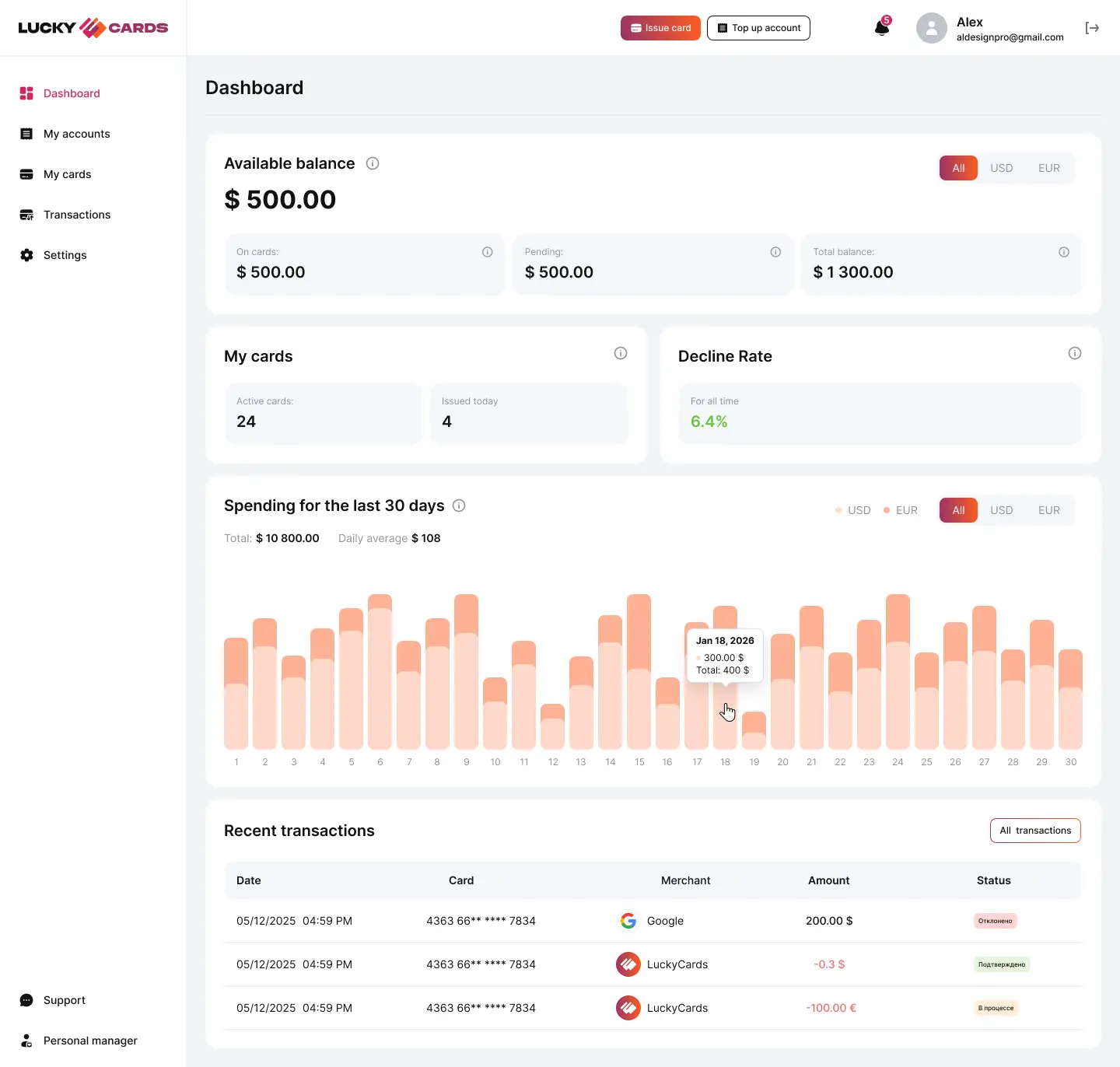
LuckyCards is a virtual card service built specifically for affiliate marketing teams and media buyers. It’s part of LuckyGroup, a holding company with about a decade of experience in the affiliate space — running their own media buying teams, operating affiliate networks, and managing multi-million-dollar ad budgets.
The product wasn’t built for the market first. It was built internally, tested on real campaigns with real spend, and only opened to external users once the team confirmed it actually worked at scale.
That backstory matters more than it might seem. A lot of fintech products are built by people who understand payments but have never managed a media buying operation. LuckyCards was built by people who’ve been on the buyer side — who know what a problematic BIN actually costs a team, what a card declined mid-campaign does to your momentum, and how hidden service fees quietly eat into ROI month after month.
The result is a product that’s shaped around how media buyers actually work, not how a payments company assumes they do.
What LuckyCards offers
25+ exclusive BINs
This is the core differentiator and the reason most teams switch.
LuckyCards maintains a pool of 25+ BINs specifically curated for advertising and business expense payments. Over 90% of cards in the pool have verified linking rates on the platforms that matter most: Google Ads, Facebook Ads, TikTok Ads, MGID, Taboola, and others.
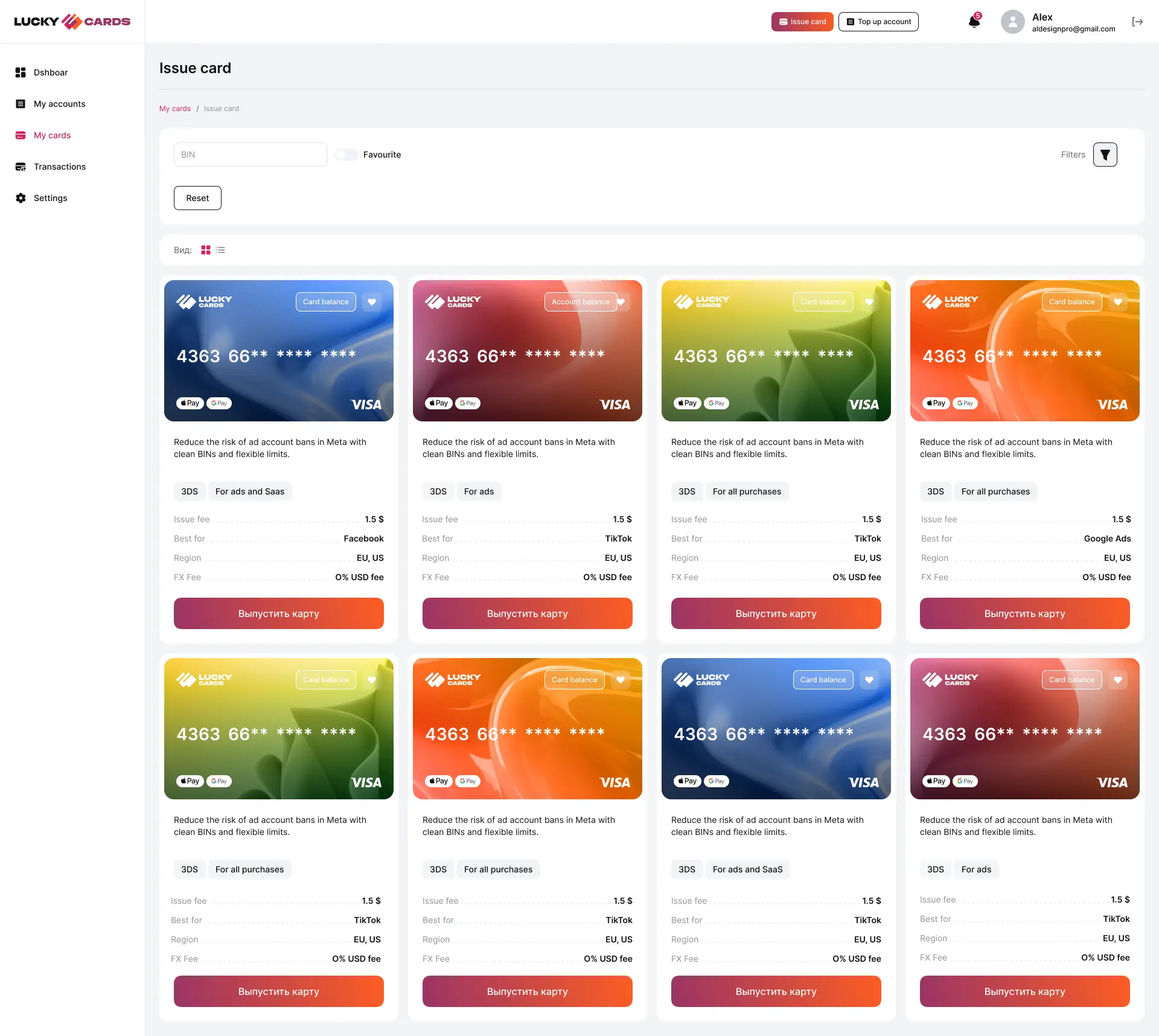
What that means in practice: you’re not stuck relying on a single card type across all your accounts and GEOs. Different BINs for different accounts, different regions, different platforms. You can match cards to account profiles the same way you match proxies to locations — deliberately, not by default.
For teams running significant volume, this is the difference between a payment setup that holds up under scale and one that becomes a bottleneck.
Two card types
LuckyCards offers limit-based cards and account-linked cards.
Limit-based cards let you cap spend per campaign or per buyer — useful when you need hard controls on budget without manual oversight. Account-linked cards draw directly from your balance and work better for buyers who need flexibility across multiple campaigns at once.
Most teams use a mix of both depending on the campaign type.
Team features and role management
If you’re managing multiple buyers, you need more than just a pool of cards. You need to be able to see who’s spending what, set limits per buyer, and control access without having to manually approve every transaction.
LuckyCards handles this with configurable permissions and roles. You can structure it by buyer, by campaign, or by team — however your operation is organized. Budget allocation stays clean, spending stays auditable, and you’re not chasing down receipts at the end of the month.
API access
Full RESTful API for card management and issuance. If you want to automate card creation as part of a larger workflow, or integrate it with an internal CRM or campaign management system, the API covers it. For teams running high volume across many accounts, this removes a significant amount of manual work.
Apple Pay and Google Pay support
Cards can be linked to Apple Pay or Google Pay. This extends their usefulness beyond ad platforms — subscriptions, SaaS tools, and general business expenses all work the same way. One card infrastructure for the whole operation.
Direct integrations with the LuckyGroup ecosystem
If you’re already working with LuckyOnline or LuckyFeed, you can top up your LuckyCards balance directly from affiliate network payouts at a reduced fee. It’s a tighter loop between what you earn and what you spend on advertising.
Dedicated support
24/7 support via Telegram with a dedicated manager. Not a generic ticket queue — someone who understands affiliate marketing terminology and can actually help when something goes wrong mid-campaign. The support contact is @Aleksandra_LuckyCards.
LuckyCards Pricing & Fees
This is where a lot of virtual card services quietly lose you. Headline rates look fine, then you start noticing monthly card fees, transaction markups, and decline charges that add up fast at volume.
| Operation | Fee |
| Successful payment | 0% |
| Refund | 0% |
| Internal transfer | 0% |
| Card service | 0% |
| Decline (if decline rate < 20%) | $0 |
| Card issuance | $1–$2 |
| Top-up via crypto | 4% |
| Top-up via WIRE | 3% |
Zero fees on payments, refunds, internal transfers, and card maintenance. Issuance costs $1–$2 per card depending on the BIN. Top-up fees apply when you load funds, not when you spend them.
To put that in context: on $100,000 in ad spend, the difference between a service with embedded transaction fees and one without can be anywhere from $3,000 to $6,000. That’s real budget that either goes toward more campaigns or disappears into a payment provider’s margin. At scale, the fee structure isn’t a minor detail — it’s a meaningful cost center.
You can top up via crypto (4%), WIRE (3%), or directly through LuckyOnline or LuckyFeed payouts (3%) if you’re already in the LuckyGroup ecosystem.
Who is LuckyCards for?
LuckyCards makes the most sense for teams and individuals who are already running at some level of scale and have hit payment infrastructure as a real problem — not a hypothetical one.
Specifically:
- Affiliate marketing teams and media buying agencies running multiple ad accounts across different GEOs. You need a pool of cards with varied BINs, and you need team controls that let you allocate and track budget without the operation falling apart.
- Media buyers scaling campaigns who want payment costs to stay predictable as spend goes up. Hidden fees that look manageable at $10,000/month become a serious drag at $100,000/month.
- Team leads managing multiple buyers who need spend visibility and limit controls without micromanaging every transaction.
- Anyone who’s been burned by a flagged BIN. If you’ve had an account review or a wave of declines that traced back to your payment method rather than your profiles or proxies, you already understand the problem LuckyCards is solving.
If you’re a solo buyer running low volume, the product works fine — but the team features and API are designed for operations bigger than one person. The card issuance model and BIN pool will still be useful; the rest is probably more infrastructure than you need right now.
How to get started
Getting set up is straightforward:
- Sign up at luckycards.io
- Top up your account via crypto or WIRE
- Issue your first cards and start linking them to your ad accounts
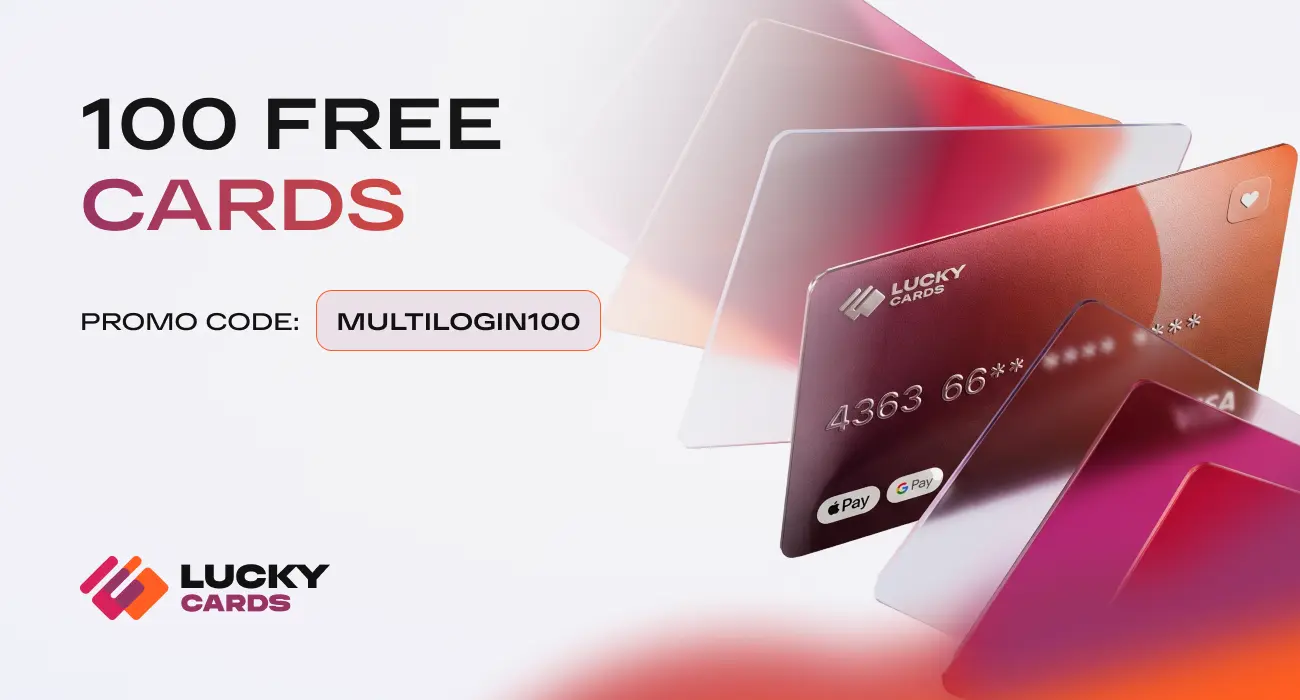
Multilogin users get 100 free virtual cards at signup using the promo code MULTILOGIN100 during registration.
If you have questions before signing up or want to talk through how to structure your card setup, reach the LuckyCards team directly via Telegram: @Aleksandra_LuckyCards.
The bottom line
Most media buyers think about account protection in terms of browser fingerprinting and proxies. Those matter. But payment infrastructure is its own layer of the same problem, and it’s one that often gets ignored until something breaks.
A flagged BIN can trigger declines and account reviews regardless of how clean your profiles are. A payment service with opaque fees can quietly drain margin that should be going toward ad spend. Neither of these is a small problem at scale.
Multilogin handles the browser fingerprinting side. LuckyCards is a strong option for the payment side — 25+ BINs with real linking stats, a transparent fee structure, team controls built for agency-scale operations, and support that actually understands the industry.
If you’ve already sorted profiles and proxies, this is the logical next layer to get right.