If you need to target Instagram users by location, give each target market its own cloud phone profile, set with a mobile proxy located in that country, and localize the language, hashtags, and content around it. Instagram doesn’t give organic creators a setting to restrict posts to one country. What you have instead is a set of signals, language, hashtags, location tags, trending audio, and the country your account already looks like it belongs to, plus a paid ads system that lets you target countries directly. Combining a dedicated profile with the right signals is what actually moves the needle.
This guide covers why location matters for Instagram distribution, which content and account signals actually shift where you get seen, and how to set up a mobile profile with the right location in Multilogin. It also breaks down which locations tend to work best for different niches, because the honest answer to “which country should I pick” is always the same: it depends on your content, your audience, and what you’re selling.
Why location matters for Instagram growth
Instagram’s distribution runs on two different systems, and they behave differently by geography.
Your feed and Stories reach your existing followers first, regardless of where they live. If most of your followers are in the United States, a post aimed at a Mexican audience still goes to your American followers by default. Location tags, captions, and hashtags influence discovery beyond that base, but they don’t override it.
Reels work more like an interest-based recommendation engine that can push content to people who don’t follow you yet, through the Reels tab and Explore. This is the closest thing Instagram has to a cross-border discovery surface, but it still leans on the language of your account, the geographic concentration of your current audience, and the audio you use. An account whose audience already skews toward one country will keep getting shown to that same country, even on content aimed elsewhere. This is also why growing your Instagram reach in a new market rarely happens by accident, it takes a profile built around that market from the start.
That’s the core problem with trying to enter a new market from an existing account: the algorithm has already formed an opinion about who your audience is. According to Statista’s country-level Instagram data, India, the United States, and Brazil carry the largest Instagram audiences worldwide, but audience size alone doesn’t tell you where your specific account will get traction. A fresh, single-purpose profile that looks and behaves like it belongs to a market gets a fairer shot at that market than a general account trying to speak to everyone at once.
How Instagram decides who sees your content by location
A few signals combine to shape geographic distribution:
- Follower concentration. The country where most of your followers already live is the strongest signal Instagram has.
- Language. Captions, on-image text, and Reels audio in a market’s dominant language tell the algorithm who the content is for.
- Hashtags. Local-language hashtags surface in that market’s discovery feeds; translated versions of your usual English tags often don’t carry the same search volume or community.
- Location tags. Tagging a city, neighborhood, or landmark gives users browsing that location page a way to find you, and reinforces geographic relevance.
- Engagement source. Early likes, comments, and shares from a given country signal to Instagram that the content resonates there.
None of these guarantee placement. Together, they shift the odds. That’s why the strongest approach isn’t a single setting, it’s a profile built from the ground up to look native to one market.
Why one account can’t credibly represent every market
Running one account across five countries creates a mixed signal that Instagram, and your audience, can both tell isn’t quite right. A caption in English with a Brazilian hashtag stapled on the end doesn’t read as local. And running everything through one account eventually hits the platform’s daily caps on DMs, follows, and comments, which puts a ceiling on how much international testing you can actually do at once.
The more durable approach is to give each market its own account, and each account its own device. Multilogin’s cloud phones exist for exactly this: an isolated Android environment per Social Profile, with its own storage, apps, and mobile proxy, so accounts running in different countries don’t share device history that could link them together in Instagram’s records. This is the same principle covered in how to create multiple Instagram accounts with Multilogin cloud phones: scaling into new markets comes from adding isolated accounts, not from pushing one account past what it can safely carry.
Start your trial and run each Instagram account in its own cloud phone!
How to create a mobile profile and set its location in Multilogin
Setting up a location-specific Instagram profile takes a few minutes once your account is ready. Here’s the process from your Multilogin dashboard.
Step 1: Create a new cloud phone profile. From the dashboard, click create, then name the profile, add any tags or notes, and optionally attach a use-case icon so it’s easy to tell your profiles apart at a glance.
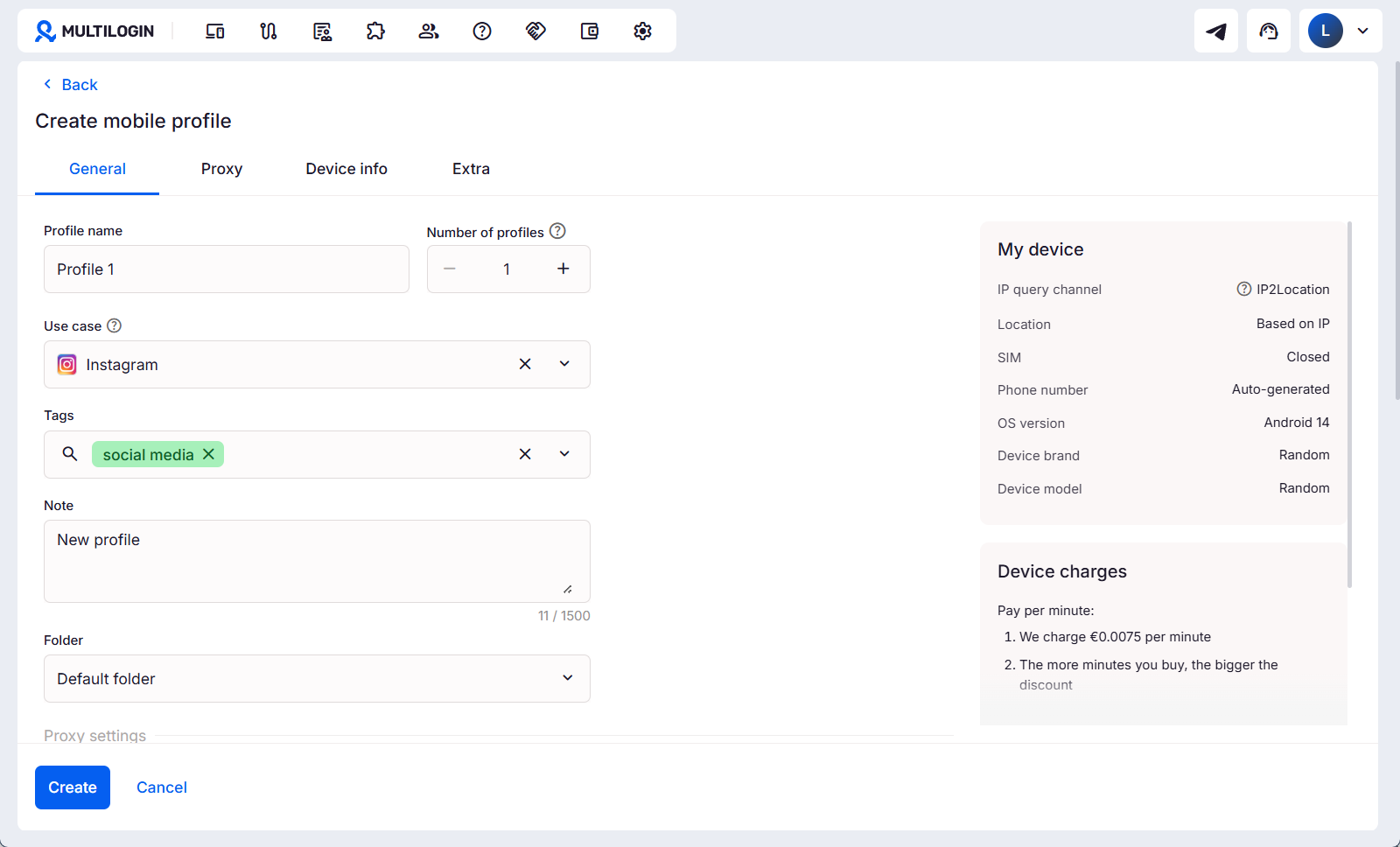
Step 2: Select the location for your profile. This is the step that determines which market your account will look like it belongs to. Choose a mobile proxy for the profile from Multilogin’s list of more than 150 locations. Pick the country, and where available, the city closest to the audience you’re trying to reach. This proxy location is what gives the profile a local IP address, separate from every other profile you run.
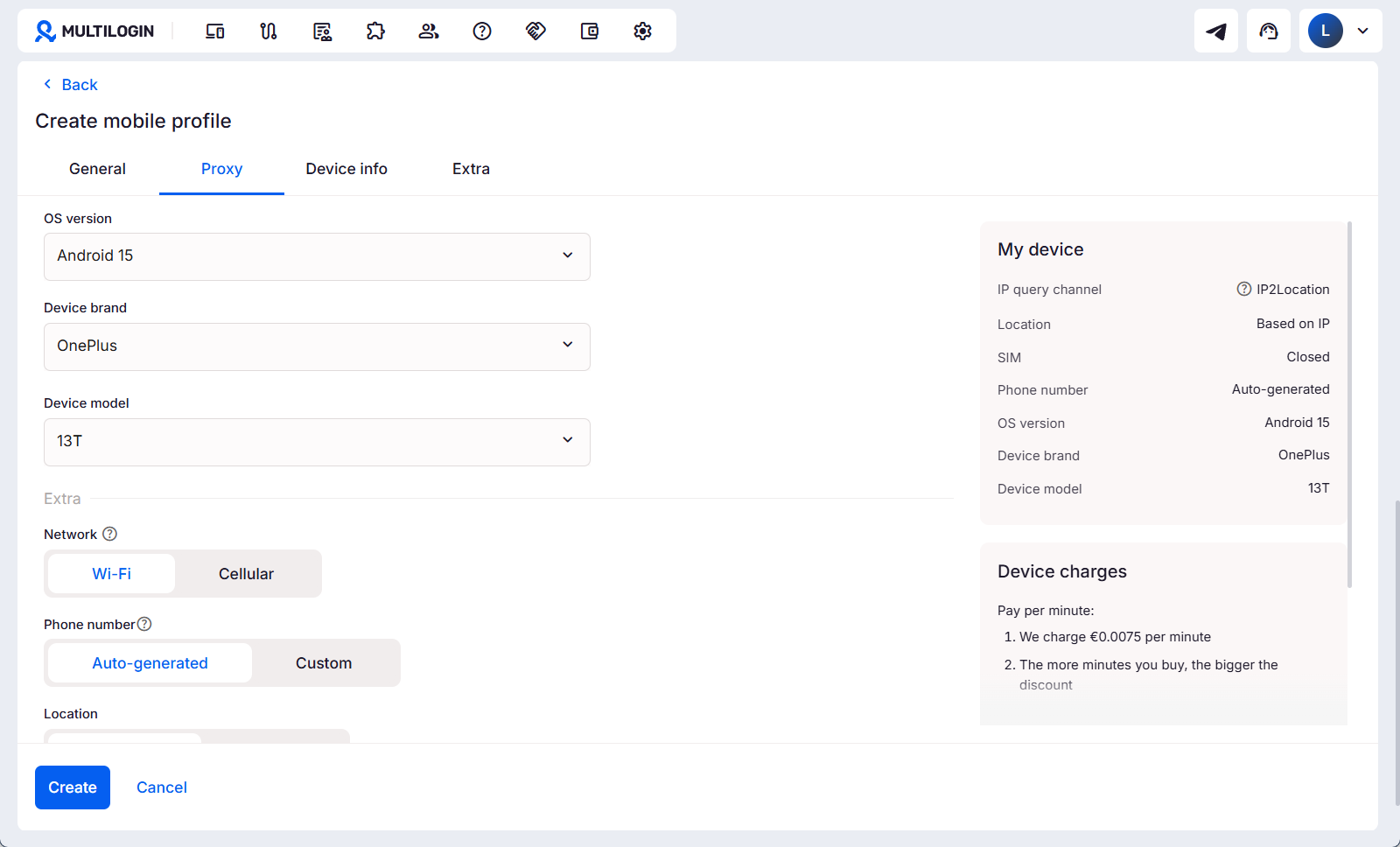
Step 3: Configure the device. Set the device brand and Android version for the profile. Matching common devices in your target market (for example, budget Android models are far more common in parts of Southeast Asia and Latin America than in the US) helps the profile look natural for that region.
Step 4: Launch the profile and install Instagram. Click play to open the profile, open the built-in app store, search for Instagram, and install it directly inside that cloud phone.
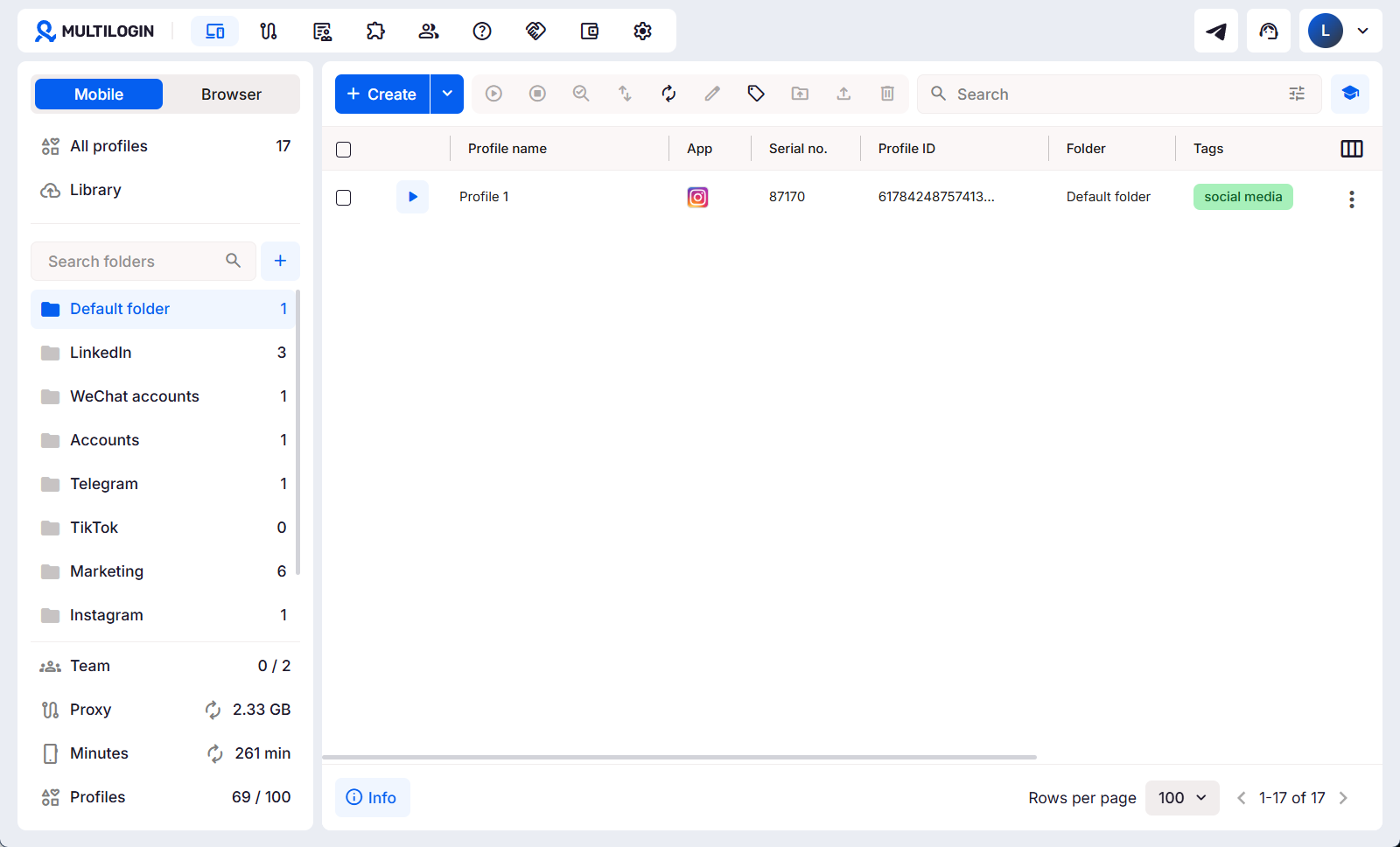
Step 5: Set up the account inside that profile only. Create or log into the Instagram account for that market inside this one cloud phone, and keep it there. Avoid logging any other account into the same profile, and avoid opening this account from any other device or browser.
Step 6: Localize the account itself. Once the account is live, set the bio, highlights, and first posts in the local language, using local hashtags and, where relevant, local location tags on posts.
Step 7: Repeat per market. Create a new profile with a new proxy location for each additional country, and treat each one as its own account with its own content plan, not a copy-paste of the others. This is the same setup covered in our broader guide to creating multiple Instagram accounts, just applied one market at a time.
Which location should you choose?
There’s no single “best” country. The right location depends on three things: where your actual audience or customers are, what language your content already works in, and what your product or offer supports. A skincare brand shipping only within the EU gains nothing from an Indonesian audience, no matter how large that market’s Instagram usage is. A B2B software account, meanwhile, does better looking like it belongs to a handful of major business hubs than to a broad consumer market.
With that caveat in place, here’s how location choice tends to break down by niche, based on where each type of content typically performs and where the underlying market exists.
Niche | Locations worth testing | Why |
E-commerce and dropshipping | United States, United Kingdom, Australia, Germany | Established Instagram Shopping features, strong card-payment adoption, and higher average order values support paid and organic testing alike. |
Beauty and fashion | Brazil, Turkey, Indonesia | All three have large, highly engaged beauty and fashion communities with strong Reels and hashtag activity, and Turkey shows an unusually high share of its population active on Instagram. |
Fitness and wellness | United States, Australia, Poland | Consistent demand for coaching, programs, and supplements, with active fitness-hashtag ecosystems and comparatively lower ad costs in Poland for early testing. |
Finance, trading, and crypto content | United Arab Emirates, Singapore, United States | Markets with strong finance-creator communities, high purchasing power, and generally clearer rules around financial content promotion. |
Gaming and esports | Philippines, Brazil, Indonesia | Large mobile-first gaming audiences with high engagement rates on gaming Reels and clips. |
Local business, restaurants, real estate | The specific city or metro area you serve | These niches don’t need a country at all. A location tag and proxy matched to the actual city outperform a broad national account. |
B2B and SaaS | United States, United Kingdom, Germany | Mirrors Meta’s own advice for B2B ad targeting toward business hubs; these markets have the deepest concentration of the buyer roles most B2B content is written for. |
Travel and lifestyle | Spain, Italy, Thailand, United Arab Emirates | Consistently high-interest travel-search markets with strong visual content cultures that reward Reels and carousel formats. |
Content creators and UGC | United States, Brazil, Philippines, Nigeria | A spread of high-volume, high-engagement markets often used to test which audience responds best before committing to one primary market. |
Treat this table as a starting point, not a rule. Run a small test in your top candidate market first, using a dedicated profile and a modest ad budget through Meta’s location targeting, before building out a full content calendar for that country. Content and engagement data from that test should decide whether you scale the market or move to the next candidate.
Common mistakes when targeting Instagram by location
- Running multiple country accounts from one device. This is what links accounts together in Instagram’s records, and it’s usually the reason a whole batch of accounts gets flagged at once instead of just one. Our guide to managing multiple Instagram accounts without linking them covers this in more depth.
- Mismatching language and location signals. A profile with a US proxy, an Indonesian bio, and English captions sends Instagram three different answers to “where is this account from.”
- Ignoring proxy quality. A datacenter IP or a proxy that doesn’t match the mobile carrier ranges common in that country is a weaker signal than a genuine mobile proxy tied to that market.
- Skipping the local audio and hashtag research. Translating your usual hashtags rarely performs as well as using the hashtags a market’s own creators actually use.
- Treating one test post as proof. A single post in a new market tells you very little. Give a new location’s profile a few weeks of consistent posting before judging whether the market is worth the investment.
Connect Multilogin cloud phone for free
and isolate each Instagram account properly.
FAQ
Can you target a specific country organically on Instagram?
Not directly. Instagram doesn’t offer a setting to restrict organic posts to one country. You influence geographic reach through language, local hashtags, location tags, and the country your account’s existing audience is already concentrated in.
Do I need a separate mobile profile for each location I target?
Yes, if you want each market to build its own clean signal. A dedicated cloud phone profile with its own proxy location keeps device history and IP separate, so growth in one market doesn’t put accounts in another market at risk.
Which proxy type should I use for Instagram location targeting?
A mobile proxy matched to the target country gives the most natural signal, since it reflects the IP ranges real mobile users in that market carry. This matters more than picking a proxy purely by price.
How many locations can I target with Multilogin?
Multilogin offers mobile proxy locations across more than 150 countries, so you can build a dedicated profile for essentially any market you want to test.
Does changing a profile's location affect my existing followers?
No. Followers stay with the account regardless of the profile’s proxy location. What changes is how the account looks to Instagram going forward, and how new, non-following users in that market are likely to discover it.
Should I run one account per language instead of per country?
Only when several target countries genuinely share both language and audience behavior, such as multiple Spanish-speaking markets with similar content expectations. Once posting volume or offers start to differ by country, separate profiles work better than one shared account.