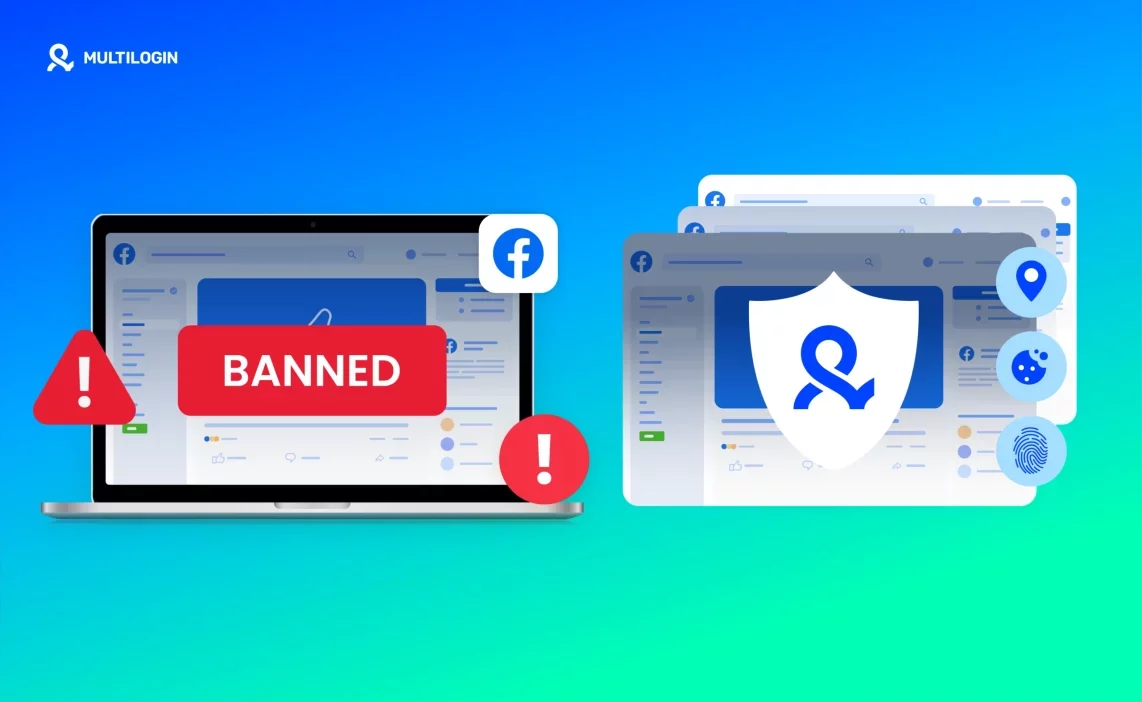

When you see Facebook Account Suspended, it often happens without much explanation. One day the account works. The next, access is limited or gone. What catches people off guard isn’t just losing one account — it’s seeing the same thing happen again after trying to start fresh, especially when trying to manage multiple Facebook accounts.
If your Facebook account gets suspended, these are usually the reasons:
- It’s rarely caused by one post or one action
- Repeat suspensions usually mean accounts are being linked
- Facebook tracks signals like IP addresses, browser data, and login behavior
- Creating a new account without fixing those signals often leads to the same result
This guide is about breaking that pattern. It doesn’t focus on appeals or moderator decisions. It explains how Facebook detects accounts and how fixing the setup behind them helps prevent a Facebook account suspended notice from becoming a cycle.
What “Facebook account suspended” actually means
When Facebook shows Facebook account suspended, access to the account is restricted by the platform. Posting, messaging, advertising, or account management may stop fully or partially. Sometimes access returns after a review period. Sometimes it doesn’t.
A suspension is not a warning. It’s an enforcement step.
Facebook often applies restrictions in stages. First, certain actions are limited. Then the account is suspended. If the same signals appear again, the account can be disabled permanently. Many permanent bans start as repeated suspensions.
Facebook relies heavily on automated systems. With billions of users, decisions are based on patterns, not individual explanations. Those systems don’t just look at what you post. They look at how and from where you log in.
If one account is suspended and the next one follows quickly, content is rarely the issue. The system is recognizing the same environment again.
Facebook account suspended vs disabled
A facebook suspended account and a disabled one are not the same, even though the result feels similar.
A suspended account usually still exists. Access is limited, sometimes temporarily. In some cases, features return after review. A disabled account is removed completely. There’s no access and no reset.
Repeated suspensions often lead to disablement. When Facebook keeps detecting the same signals behind different accounts, enforcement escalates. At that point, starting over without fixing the setup almost always fails.
Understanding this difference matters. After a suspension, you still have room to prevent the next step. After disablement, the system has already decided.
Why was my Facebook account suspended?
Most Facebook accounts aren’t suspended because of one mistake. It usually happens when patterns start to repeat.
Login behavior looks familiar. Devices don’t change. IPs overlap. From Facebook’s side, different accounts begin to look like the same person.
Common reasons include:
- Policy violations that build up over time
- Logging into multiple accounts from the same IP or device
- Reusing the same browser or environment
- Automation-like activity or unnatural behavior patterns
If a Facebook account suspended message appears again on a new account, content is rarely the cause. Facebook is reacting to technical and behavioral signals that haven’t changed.
How Facebook detects linked accounts
When Facebook account suspended happens more than once, Facebook has usually linked the accounts already. Not through names or emails, but through patterns.
Facebook looks at:
- IP reuse and predictable IP rotation
- Browser fingerprints that match across accounts
- Cookies and local storage carrying over
- Login timing and behavior that repeats
Content is only one layer. You can change what you post and still hit the same result. If the environment behind the account stays the same, Facebook treats the activity as coming from the same source.
Why Facebook account suspension issues often repeat
After a Facebook Account suspension notice, many people try the same fix. New account. New email. Fresh start.
From Facebook’s side, nothing changed.
The same browser, the same device, and the same connection recreate the same identity. That’s why a facebook suspended account often leads to another one shortly after.
When this happens more than once, enforcement accelerates. Accounts don’t last weeks anymore. Sometimes they don’t last days. The system is no longer testing. It’s confirming a pattern.
Changing usernames doesn’t stop that. Changing the environment does.
How Multilogin helps prevent repeat Facebook account suspended events
When a Facebook account suspended message keeps coming back, Facebook has stopped seeing your accounts as separate people. Multilogin is built to fix that problem at the root.
Multilogin doesn’t hide activity or push limits. It separates accounts properly. Each account runs in its own environment, with its own browser data, network setup, and history — the way platforms expect real users to exist.
This approach works whether you manage one account or more than 10,000 profiles.
Full profile isolation
In a normal setup, accounts mix quietly. Cookies overlap. Local storage survives. Browser data is reused.
Multilogin removes that overlap completely.
One profile equals one Facebook identity.
- Cookies stay locked inside one profile
- Local storage belongs only to that profile
- Browser fingerprints never overlap
Multilogin also includes Cookies Robot, which helps profiles start with realistic browser history instead of a blank state. New, empty environments stand out. A lived-in profile doesn’t.
If one account gets suspended, the others aren’t affected. There’s nothing shared for Facebook to connect.
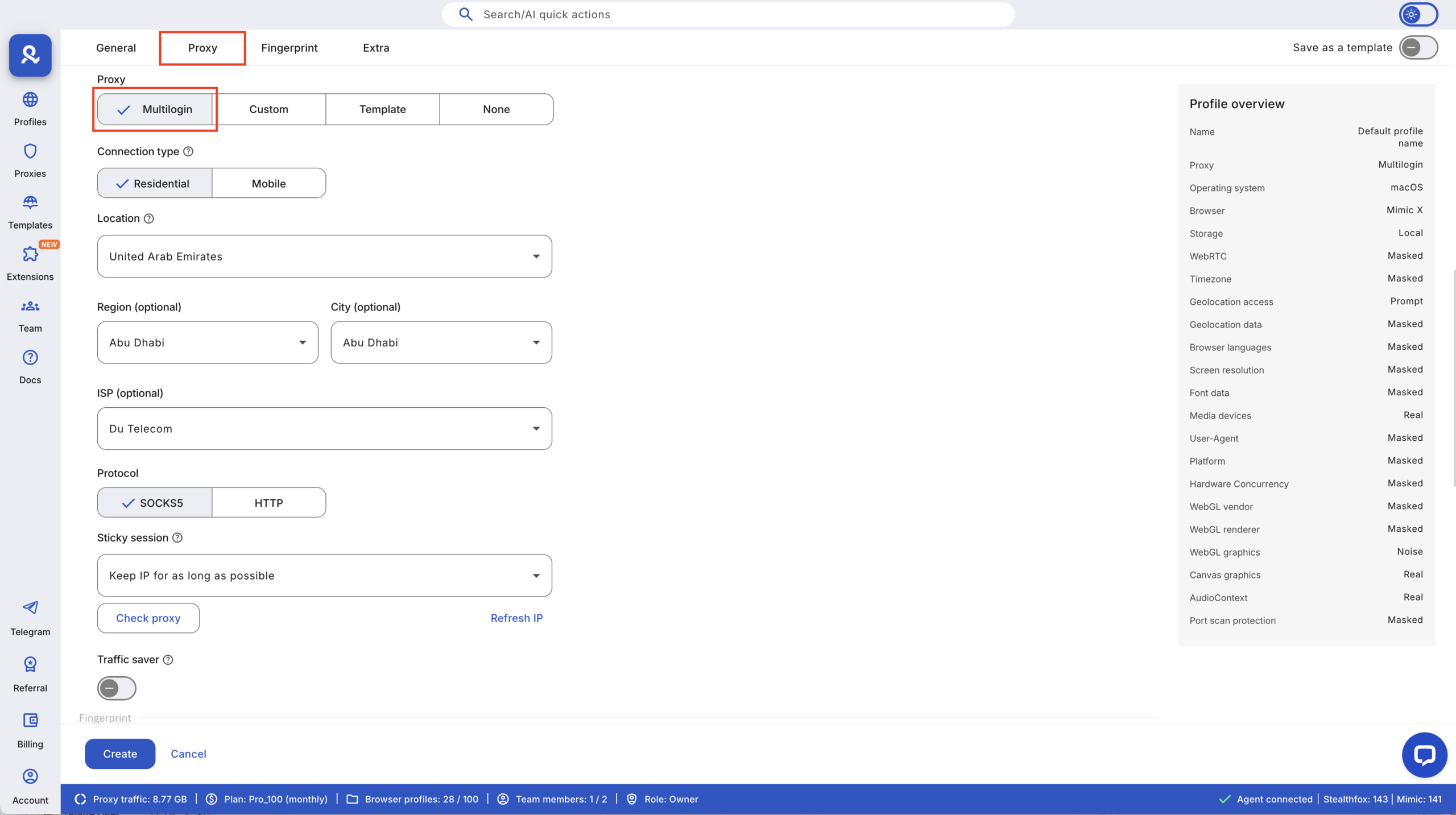
Stable IP and profile pairing (Built-In residential proxies)
Facebook doesn’t judge IPs alone. It watches how they’re used over time.
Fast rotation, reused IPs, or connections that don’t match user behavior raise flags.
Multilogin pairs each profile with its own stable IP:
- Built-in perimum residential proxies
- No accidental reuse across accounts
- Long-term connection history
Consistency matters more than speed. When a profile connects from the same place over time, it looks normal instead of noisy.
Fingerprint consistency over time (Desktop + Android)
Another common trigger is fingerprint drift. An account looks one way today and different tomorrow. Screen size changes. System traits shift.
Facebook notices.
Multilogin keeps fingerprints consistent:
- Same browser signals every session
- Stable system traits
- Profiles age naturally instead of resetting
This applies to desktop profiles and Android mobile emulation. Mobile accounts stay mobile. Desktop accounts stay desktop. That consistency reduces reviews caused by mismatched environments.

Team access without shared signals (Multilogin X App – Desktop)
Most repeat suspensions in teams come from small mistakes. Someone logs in from the wrong browser. Someone shares credentials. Signals overlap.
Multilogin prevents this with role-based access and the Multilogin X app (desktop):
- Profiles always open in the correct environment
- No accidental logins from regular browsers
- Stable sessions during heavy daily use
Teams can scale without creating overlap — whether it’s two people or two hundred.