


Finding YouTube channel ideas isn’t usually the hard part. Most creators can name five or six ideas off the top of their head within a minute. The hard part is knowing which one is worth the next six months of your time, and finding that out without burning through a niche you can’t undo.
That’s the gap this guide tries to close. Below are 33 proven channel ideas organized by category, a look at what the creator community and YouTube’s own data actually say about picking one, and a practical way to test a niche cheaply before you fully commit to it.
Key takeaways
The single biggest mistake new creators make isn’t picking the wrong topic; it’s skipping the step where they check whether an idea has an audience before building a whole channel around it. The points below summarize what actually moves the needle, based on the categories that keep showing up in current niche research, YouTube’s own creator program requirements, and how real creators describe their own pivots.
- Faceless and on-camera formats can both work. The right choice depends on your comfort level and the niche, not a universal rule.
- Popular 2026 categories include tech and gadget reviews, finance and money explainers, travel and destination content, gaming, true-crime and story narration, comedy, food and cooking, DIY and home projects, and wellness or spiritual content.
- Low-competition micro-niches (a narrow slice of a bigger category) tend to be easier entry points than broad, saturated topics.
- A channel idea, a niche, and a content pillar are three different planning layers, and mixing them up is a common early misstep.
- YouTube’s own Partner Program thresholds (1,000 subscribers plus 4,000 watch hours, or 1,000 subscribers plus 10 million Shorts views) are a useful early reality check, since they tell you how much sustained output a niche needs before it can even apply for monetization.
- Testing a niche in a separate, isolated environment before committing your main channel to it can help you try an idea without folding it into your main account’s history.
Niche, content pillar, and channel concept: the core difference
A niche is the broad subject area you cover (finance, gaming, travel). A content pillar is a recurring format within that niche (weekly gadget teardown, monthly budget breakdown). A channel concept is the combination of the two, expressed as a single sentence a viewer could repeat back to a friend. New creators often pick a niche without settling on a content pillar, which tends to leave the channel with a topic but no consistent format for viewers to follow.
- Niche: the subject (example: personal finance)
- Content pillar: the recurring format inside it (example: a weekly “real budget breakdown” series)
- Channel concept: the two combined into one describable sentence (example: “a weekly show that breaks down real people’s budgets”)
30+ YouTube channel ideas by category
Current niche guides ranking for this topic in 2026 cluster around six broad categories. Each includes both faceless-friendly and on-camera options, and each is broad enough to support the kind of niching-down the community consistently recommends: pick the category first, then narrow to a specific angle inside it before you commit.
Tech and gadgets
Tech is one of the most consistently searched categories on YouTube, but it’s also one of the most saturated at the general level. The creators who break through tend to pick a specific buyer question or price bracket rather than reviewing everything, since that narrower framing is what separates a channel from the dozens of general tech-review channels already covering the same product launches.
- Budget phone and gadget comparisons
- Home office and productivity gear reviews
- AI tool and app breakdowns, including automation-focused channels
- Smart home gadget testing
- Software tutorial and how-to channels
- Unboxing and first-impression videos
Finance and money
Finance content draws some of the highest-paying advertisers on the platform, which is part of why it’s a repeated recommendation in niche guides for revenue potential. It also rewards a faceless format well, since viewers are usually there for the numbers and the explanation rather than a personality, which lowers the production bar for a first-time creator.
- Personal budgeting explainers (faceless-friendly)
- Investing basics for beginners
- Side-hustle and passive income breakdowns
- Money-mistake story narration, in the style of forum or community-board readings
- Deal-alert and comparison shopping channels
Travel and lifestyle
Travel content is naturally visual, which makes it one of the more forgiving categories for a first channel: strong footage can carry a video even if the narration or on-camera delivery is still developing. It also splits cleanly into faceless (drone and stock footage with voiceover) and on-camera (vlog-style) approaches, so it’s a good category to test both formats inside the same niche.
- Destination guides narrated over drone or stock footage (faceless-friendly)
- City-break series (for example, a structured “48 hours in one city” format)
- Digital nomad and remote-work lifestyle content
- Combined food and travel series
- Travel gear and packing reviews
Gaming and entertainment
Gaming remains one of the largest categories on YouTube by sheer volume of channels, which means differentiation matters more here than almost anywhere else. Current guides consistently point to analysis, reaction, and commentary formats as the more defensible angle, since raw gameplay footage alone is the easiest thing for a viewer to find elsewhere.
- Walkthroughs and let’s-plays
- Reaction and commentary formats
- Channel or game analysis breakdowns
- Mobile and free-to-play game coverage
- Esports and tournament recaps
Story, culture, and commentary
This category covers some of the fastest-growing faceless formats on the platform right now, particularly story narration sourced from forums and community boards. It also covers the supporting keywords for this brief most directly: comedy, cricket, and Islamic content all sit inside this category as specific, well-searched sub-niches rather than needing their own separate grouping.
- True-crime and Reddit-style story narration (faceless-friendly)
- Comedy sketches and comedic commentary
- Cricket highlights and match analysis
- Islamic content and reflection channels
- Creator and channel analysis breakdowns
- Reaction commentary on viral clips and trends
Home, wellness, and family
This is the most evergreen category on the list: DIY, cooking, and educational content for kids tend to keep attracting search traffic long after the original video was published, since the underlying problem a viewer is searching for doesn’t go out of date the way a trend-based video does. It’s also one of the more forgiving categories for a beginner because the format (before/after, recipe, tutorial) is already well understood by viewers.
- DIY and home improvement transformations
- Cooking and recipe channels
- Wellness content and guided affirmation channels
- Kids’ educational or storytime channels
- Space and science explainer content
- Budget-friendly meal-prep series
Choosing among these: format and audience come before topic
Once you’ve shortlisted a category, the format and audience decision matters more than the exact topic. Tech reviews, finance explainers, and story narration can each be built faceless or on-camera; gaming and comedy formats tend to favor a mix of both depending on whether commentary or personality is the draw. Sponsorship interest generally follows a clearly describable audience: narrowing your niche until you can describe your typical viewer in one sentence tends to make a channel more attractive to sponsors, regardless of which category you pick.
- Pick the category first, then the format (faceless or on-camera), then the specific angle inside it, in that order.
- If you can’t describe your typical viewer in one sentence yet, that’s a sign to narrow further before you start filming.
- Sponsorship and brand-deal interest tends to follow audience clarity, not subscriber count alone.
Channel approach comparison
The table below lines up the four most common approaches side by side. It’s meant to be a quick reference once you’ve picked a category: the same tech, finance, or story niche can usually be built with any of these four approaches, so use this to decide how, not just what.
Approach | What it requires | Who it’s best for | Face required? | Best use | Main limitation |
|---|---|---|---|---|---|
Faceless narration | Scriptwriting, voiceover or AI voice, stock or licensed visuals | Creators who value privacy or dislike being on camera | No | Story, finance, and explainer formats | Harder to build a personal brand or parasocial following |
On-camera personal brand | Comfort on camera, consistent presence | Creators building long-term audience loyalty | Yes | Vlogging, tutorials, personality-driven niches | Slower to grow without the creator’s direct involvement |
Tutorial and educational | Subject expertise, clear structure | Creators targeting evergreen search traffic | Either | Software walkthroughs, how-to guides | Requires ongoing updates as tools or information change |
Reaction and commentary | Fast turnaround, opinion, editing speed | Creators who can react quickly to trends | Either | Gaming, entertainment, culture commentary | More exposed to platform copyright and fair-use review |
What the creator community actually says about picking a niche
Beyond the listicle format most niche guides use, creator Q&A communities on Quora surface a more consistent, less promotional pattern: don’t chase a niche for popularity alone, and treat the first few months as a structured experiment rather than a final decision. Two real, publicly documented creator paths illustrate the same pattern in practice, and are used here in place of invented examples.
- A frequently repeated answer on Quora’s niche-selection thread argues creators already have a workable niche in what they know, and that chasing a popular topic over a familiar one is a common early mistake.
- A separate Quora thread on multi-interest creators describes a structured 70/20/10 split: 70% of videos in a primary niche, 20% in an adjacent topic, and 10% in an experimental one, with the niche allowed to shift based on which videos actually earn watch time rather than which the creator expected to perform.
- Ethan Chlebowski built his channel around food science rather than general recipes, quitting a corporate analytics job in 2019 to focus on it full time; the channel crossed 1 million subscribers in April 2022 and has since grown past 1.7 million, built almost entirely on the narrower science angle rather than broad cooking content.
- Adam Ragusea followed a similar path in the same broad category, quitting a job as a journalism professor after his food-science channel grew, which suggests the science-explainer angle inside cooking is a repeatable pattern rather than a one-off success.
What YouTube’s own data says
Independent of community opinion, YouTube publishes exact eligibility thresholds and metric definitions that are worth checking a niche idea against before investing months into it. These numbers don’t tell you which niche to pick, but they do set a concrete bar for how much consistent output any niche needs before it can be monetized.
Route | Subscribers | Watch hours / views | Window |
|---|---|---|---|
Standard (long-form) | 1,000 | 4,000 valid public watch hours | Last 12 months |
Shorts route | 1,000 | 10,000,000 valid public Shorts views | Last 90 days |
- Source: YouTube’s official Partner Program eligibility page, current as of this writing.
- YouTube defines audience retention as the percentage of viewers still watching at each moment of a video, with the “Intro” segment specifically measuring what percentage of viewers are still watching after the first 30 seconds, which is why the first 30 seconds gets disproportionate attention in creator advice.
- Average view duration (AVD) is total watch time divided by number of views, and is tracked separately from the percentage-based retention curve; both live in the same Engagement tab in YouTube Studio.
- Neither of these figures is niche-specific. What counts as a strong retention curve varies by video length and format, so the only reliable baseline is a creator’s own back catalog, not a generic industry number.
Five best practices for choosing a channel idea
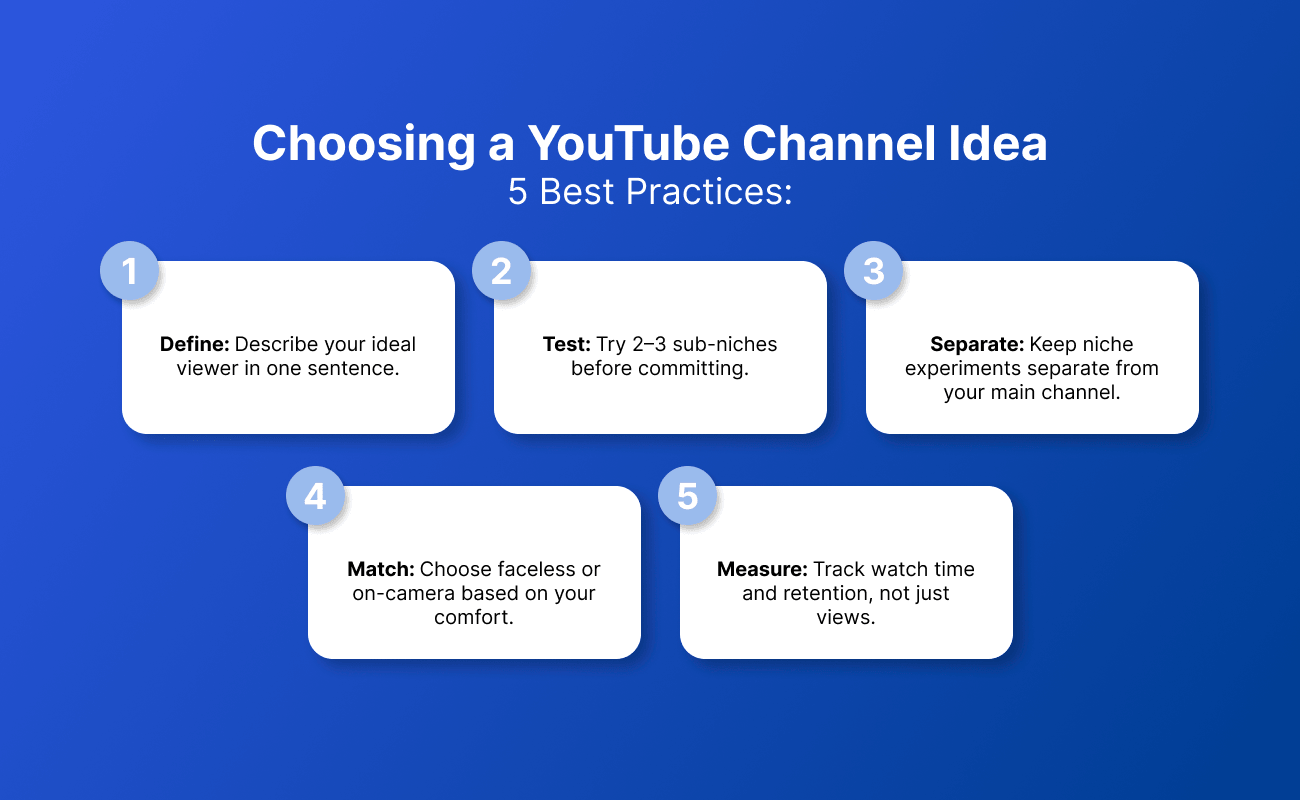
These five practices are pulled directly from the patterns above: the community advice to test rather than guess, YouTube’s own thresholds as a reality check, and the category research earlier in this guide.
- Narrow your first niche idea until you can describe your typical viewer in a single sentence.
- Test two or three sub-niches with a handful of videos each before picking one to commit to long-term.
- Separate your test content from your main channel’s account and recommendation history where possible.
- Match your format (faceless or on-camera) to your actual comfort level rather than what’s trending.
- Track early watch-time and retention per niche test, not just view counts, before deciding which one to grow.
Testing a niche without tangling your main channel
New creators and small teams often run a few candidate niches side by side before committing to one. Multilogin is a cloud phone platform for social media marketing, and it gives each channel its own environment so a test channel’s history, recommendations, and login state stay separate from your main account.
Each browser profile keeps its own cookies, session, and matched proxy for channel management, comments, and web workflows. Android cloud phones cover the mobile app side when a niche depends on Shorts or in-app publishing. Everything runs from one dashboard, with built-in proxies included in every plan.
The free plan is enough to run this kind of test without spending anything up front. It includes 5 profiles (one cloud mobile profile and four browser profiles), a one-time bonus of 200 MB of premium proxy traffic, and a one-time 30 minutes of cloud-phone time, with no time limit on the plan itself and no credit card required to start. The one condition worth knowing: free-plan profiles are deleted after 7 days of inactivity, so a test niche needs at least occasional log-ins to stay set up.
- Free plan: 5 profiles (1 cloud mobile, 4 browser), no time limit, no credit card, 200 MB one-time proxy bonus, 30 one-time mobile minutes. See the Multilogin pricing page
- Paid plans start from $7.08/month (billed annually) once a test niche outgrows the free tier, adding more profiles, monthly proxy traffic, and monthly mobile minutes
- Extra proxy traffic runs from $3.50/GB, and extra mobile minutes run from roughly $0.011/minute at smaller volumes down to about $0.0073/minute at the largest bulk package; both roll over instead of expiring
- Annual billing saves roughly 35% compared to paying monthly, worth factoring in once a test niche is confirmed and you’re ready to commit to it long-term
For creator teams managing multiple brand or client profiles, Multilogin can help keep daily account work organized without turning your analytics workflow into a login mess.
Multilogin is not a way around platform rules; the safest approach combines clean account separation with original content, real engagement, and platform-compliant activity.