
Selecting the right usage-based billing software requires understanding how different platforms address the unique challenges of consumption pricing. Solutions vary significantly in metering accuracy, pricing model flexibility, integration of ecosystems, and total cost of ownership. The landscape includes established enterprise players evolved from traditional subscription billing, purpose-built usage platforms, and hybrid solutions—each presenting distinct trade-offs between feature depth, implementation ease, and long-term flexibility.
1. UniBee
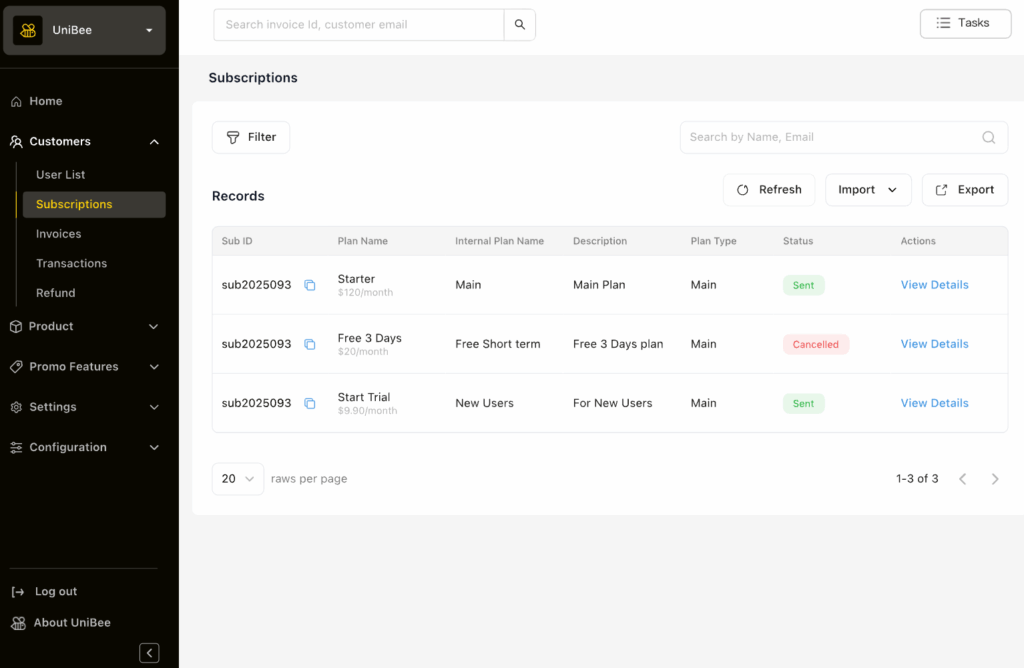
UniBee is an open-source usage-based billing platform designed specifically for SaaS, fintech, B2B, and AI companies implementing consumption pricing models. Unlike legacy billing systems retrofitted for usage tracking, UniBee was engineered from the ground up to handle the complex metering, rating, and invoicing demands that consumption-based businesses require. The platform emphasizes developer experience, pricing flexibility, and scalability without enterprise complexity.
The platform supports multi-dimensional metering, allowing businesses to track and bill based on any combination of usage metrics API calls, data storage, compute hours, transactions, or custom events. UniBee’s real-time rating engine processes usage events as they occur, providing immediate visibility into consumption and costs while supporting sophisticated pricing strategies including tiered pricing, volume discounts, hybrid models, and commitment-based contracts with overage handling.
Strengths
- Rapid implementation with comprehensive APIs
- Flexible deployment options (self-hosted or cloud)
- Unlimited pricing flexibility and configurations
- Enterprise scalability at competitive pricing
- Real-time usage tracking and transparency
Limitations
- Designed for efficiency rather than enterprise bureaucracy
- Focused primarily on usage-based and subscription billing
- Newer market presence means evolving partnership ecosystem
- Self-hosted open-source version requires technical expertise
2. StripeBilling
Stripe Billing is a comprehensive billing solution from the payments giant Stripe, offering both subscription and usage-based billing capabilities as part of its broader payment processing ecosystem. Leveraging Stripe’s robust payment infrastructure, the platform provides businesses with an integrated approach to handle recurring revenue, metering, invoicing, and payment collection. Stripe Billing appeals particularly to companies already using Stripe for payment processing who want to consolidate their billing operations within a single vendor.
The platform supports consumption-based pricing through its metering API, allowing businesses to track usage events and bill customers accordingly. Stripe Billing handles complex pricing scenarios including tiered pricing, graduated pricing, and hybrid models that combine subscriptions with usage charges. With its developer-first approach, extensive documentation, and global payment support across 135+ currencies, Stripe Billing offers a familiar and trusted solution for companies seeking to implement usage-based pricing without adding new vendors to their stack.
Strengths
- Seamless integration with Stripe payments
- Global payment support across currencies
- Extensive developer documentation and tools
- Trusted brand with enterprise reliability
Limitations
- Higher processing fees than competitors
- Complex pricing for advanced features
- Steeper learning curve for configurations
- Limited customization for specialized billing
3. Chargebee
Chargebee is a subscription and usage-based billing platform designed for SaaS and subscription businesses seeking an all-in-one revenue management solution. The platform has evolved from its subscription billing roots to support consumption-based pricing models, offering businesses the flexibility to implement hybrid billing strategies that combine recurring subscriptions with usage charges. Chargebee provides comprehensive features including automated invoicing, revenue recognition, dunning management, and detailed analytics to support the entire subscriber lifecycle.
The platform’s usage-based billing capabilities allow businesses to meter consumption across multiple dimensions and apply flexible pricing rules. Chargebee integrates with popular payment gateways, accounting systems, CRM platforms, and business intelligence tools, creating a connected ecosystem for revenue operations. With support for multiple currencies, tax compliance automation, and self-service customer portals, Chargebee positions itself as a growth-focused solution for companies scaling their subscription and usage-based revenue models globally.
Strengths
- Comprehensive subscription and usage billing
- Strong revenue recognition capabilities
- Extensive third-party integrations available
- Robust analytics and reporting tools
Limitations
- Pricing complexity increases with scale
- Steeper implementation curve than alternatives
- Can be overkill for simple models
- Some advanced features require upgrades
4.Orb
Orb is a modern usage-based billing platform built specifically for companies with complex consumption pricing models. Designed with a data-first approach, Orb focuses on handling high-volume usage metering with precision and flexibility, making it particularly well-suited for infrastructure, API, and data-intensive businesses. The platform emphasizes real-time billing accuracy and transparent pricing calculations, allowing businesses to implement sophisticated rating logic without compromising on performance or customer visibility.
Orb’s architecture supports granular usage tracking across unlimited metrics with powerful aggregation and rating capabilities. The platform excels at handling complex pricing scenarios including commitments, credits, tiered structures, and custom billing periods. With its developer-friendly APIs, SQL-based pricing configuration, and focus on billing observability, Orb appeals to technical teams seeking fine-grained control over their usage-based pricing implementation while maintaining the flexibility to iterate on pricing strategies as business needs evolve.
Strengths
- High-volume usage metering capabilities
- SQL-based pricing for maximum flexibility
- Strong billing accuracy and transparency
- Excellent developer experience and APIs
Limitations
- Requires technical expertise for setup
- Limited pre-built payment gateway integrations
- Smaller ecosystem than established platforms
- May be complex for simpler needs
5. Metronome
Metronome is an enterprise-grade usage-based billing platform purpose-built for companies with sophisticated consumption pricing requirements. The platform specializes in handling complex, high-volume metering scenarios common in cloud infrastructure, AI/ML services, and data platforms. Metronome emphasizes billing accuracy, transparency, and flexibility, enabling businesses to implement intricate pricing models while maintaining complete visibility into how charges are calculated and applied.
The platform’s architecture supports real-time usage aggregation, flexible rating rules, and comprehensive audit trails that satisfy enterprise compliance and financial reporting requirements. Metronome offers powerful contract management capabilities including commitments, drawdowns, and multi-dimensional pricing structures. With its focus on enterprise needs, the platform provides detailed analytics, revenue forecasting, and integration capabilities designed for companies operating at significant scale with demanding billing complexity.
Strengths
- Enterprise-grade metering and accuracy
- Powerful contract and commitment management
- Comprehensive audit trails and compliance
- Advanced analytics and revenue forecasting
Limitations
- Enterprise pricing may limit accessibility
- Longer implementation timelines than competitors
- Designed primarily for large-scale operations
- Potentially over-engineered for smaller businesses
6.Lago
Lago is an open-source usage-based billing platform that provides businesses with full control and transparency over their billing infrastructure. As an open-source solution, Lago offers companies the flexibility to self-host, customize, and extend the platform according to their specific requirements while avoiding vendor lock-in. The platform supports comprehensive usage metering, flexible pricing models, and real-time billing calculations with a focus on developer autonomy and cost transparency.
The platform handles complex consumption pricing scenarios including tiered pricing, package pricing, volume-based discounts, and hybrid subscription-usage models. Lago’s open-source nature means businesses can inspect the billing logic, contribute improvements, and integrate deeply with their existing technology stack. With both self-hosted and cloud-hosted deployment options, Lago appeals to companies seeking billing infrastructure control, cost predictability, and the ability to customize billing workflows beyond what proprietary platforms typically allow.
Strengths
- Open-source with full code transparency
- No vendor lock-in or restrictions
- Self-hosting option for complete control
- Cost-effective for technical teams
Limitations
- Requires technical resources for management
- Smaller community than proprietary solutions
- Self-hosted deployments need infrastructure expertise
- Limited enterprise support compared to competitors
7. Zenskar
Zenskar is a modern billing platform designed for B2B SaaS and infrastructure companies implementing sophisticated usage-based pricing models. The platform combines flexible metering capabilities with contract management features, enabling businesses to handle complex enterprise deals alongside standardized consumption pricing. Zenskar emphasizes billing accuracy, customer transparency, and revenue operations efficiency, providing tools that bridge the gap between usage tracking, invoicing, and revenue recognition.
The platform supports multi-dimensional usage metering with configurable rating rules that accommodate tiered pricing, commitments, credits, and custom billing arrangements. Zenskar’s contract lifecycle management capabilities allow businesses to manage negotiated terms, amendments, and renewals while maintaining automated billing workflows. With integrations to popular payment processors, accounting systems, and data warehouses, Zenskar positions itself as a revenue infrastructure solution for companies scaling their usage-based business models with enterprise customers.
Strengths
- Strong contract lifecycle management capabilities
- Flexible multi-dimensional usage metering
- Revenue operations focused feature set
- Good balance of automation and customization
Limitations
- Newer platform with evolving ecosystem
- Limited public pricing information available
- Smaller integration library than competitors
- May require customization for edge cases
8. Maxio
Maxio is a comprehensive billing and revenue management platform formed from the merger of SaaSOptics and Chargify, combining subscription billing with robust financial operations capabilities. The platform serves B2B SaaS companies seeking an integrated solution for billing, revenue recognition, and financial reporting. Maxio supports both subscription and usage-based pricing models, offering businesses the flexibility to implement hybrid approaches while maintaining compliance with accounting standards like ASC 606.
The platform’s usage-based billing features allow companies to meter consumption and apply flexible pricing rules alongside traditional subscription plans. Maxio emphasizes financial operations with built-in revenue recognition automation, SaaS metrics tracking, and reporting tools designed for finance teams. With integrations to popular accounting systems, CRM platforms, and payment gateways, Maxio appeals to growing B2B companies that need billing capabilities tightly coupled with financial operations and reporting.
Strengths
- Integrated revenue recognition and reporting
- Strong SaaS metrics and analytics
- Comprehensive financial operations tools
- Good for B2B subscription businesses
Limitations
- Usage billing not the primary focus
- Higher price point than specialists
- Complex setup for advanced features
- Can feel enterprise-heavy for startups
9. Recurly
Recurly is an established subscription management platform that has expanded to support usage-based billing alongside its core recurring revenue capabilities. With over a decade in the subscription billing market, Recurly offers a mature platform with proven scalability and reliability for businesses managing recurring revenue streams. The platform emphasizes subscriber retention through intelligent dunning, flexible billing options, and optimization tools designed to reduce involuntary churn.
Recurly’s usage-based billing features enable businesses to track consumption and apply metered charges to customer accounts, supporting hybrid models that combine subscriptions with usage components. The platform provides extensive customization options for billing cycles, trial periods, and promotional campaigns while maintaining strong payment gateway integrations and global payment support. With its focus on subscription retention and revenue optimization, Recurly serves companies that view usage-based pricing as a complement to their primary subscription business model.
Strengths
- Mature platform with proven reliability
- Strong dunning and retention tools
- Extensive payment gateway support
- Good for hybrid subscription-usage models
Limitations
- Usage features less advanced than specialists
- Pricing can escalate with volume
- Interface feels dated compared to competitors
- Better suited for subscription-primary businesses
10. Zuora
Zuora is an enterprise billing platform that pioneered the subscription economy movement and has evolved to support complex usage-based pricing models. As one of the most established players in recurring revenue management, Zuora serves large enterprises and high-growth companies with sophisticated billing requirements spanning subscriptions, consumption pricing, and hybrid revenue models. The platform emphasizes order-to-revenue automation, revenue recognition compliance, and enterprise-grade scalability for organizations managing complex product catalogs and global operations.
Zuora’s usage-based billing capabilities support high-volume metering, flexible rating engines, and intricate pricing structures required by enterprises. The platform handles multi-entity accounting, revenue recognition under ASC 606 and IFRS 15, and integrates with enterprise ERP and finance systems. With comprehensive APIs, workflow automation, and extensive customization options, Zuora positions itself as a complete monetization platform for large organizations willing to invest in implementation and ongoing management for enterprise-grade billing infrastructure.
Strengths
- Enterprise-grade scalability and reliability
- Comprehensive revenue recognition and compliance
- Multi-entity and global operations support
- Extensive customization and workflow automation
Limitations
- Enterprise pricing limits smaller company access
- Complex implementation requiring significant resources
- Steep learning curve for users
- Can be over-engineered for simpler needs
Use Case Recommendations
Choose UniBee if you:
- Need rapid deployment of usage-based billing
- Want transparent, affordable pricing—or $0 self-hosting
- Require multi-dimensional metering flexibility
- Serve global customers
Choose Stripe Billing if you:
- Already use Stripe for payments
- Need global payment processing
- Want a trusted, familiar platform
- Prioritize payment integration simplicity
Choose Chargebee if you:
- Need comprehensive subscription + usage features
- Require strong revenue recognition tools
- Want extensive third-party integrations
- Operate a mature SaaS business
Choose Orb if you:
- Have technical teams comfortable with SQL
- Need maximum pricing flexibility
- Require high-volume metering accuracy
- Value billing transparency and control
Choose Metronome if you:
- Operate at enterprise scale
- Have complex contract requirements
- Need comprehensive audit trails
- Require advanced revenue forecasting
Choose Lago if you:
- Want to avoid vendor lock-in
- Have technical resources for self-hosting
- Need to customize billing logic
- Prioritize cost control and transparency
Choose Zenskar if you:
- Manage complex B2B enterprise contracts
- Need contract lifecycle automation
- Balance usage and negotiated pricing
- Focus on revenue operations efficiency
Choose Maxio if you:
- Prioritize financial operations integration
- Need built-in SaaS metrics tracking
- Require revenue recognition automation
- Operate a B2B subscription business
Choose Recurly if you:
- Run a subscription-primary business
- Need strong retention and dunning tools
- Want a proven, mature platform
- Add usage as secondary revenue stream
Choose Zuora if you:
- Operate a large enterprise with complex needs
- Require multi-entity global operations
- Need comprehensive compliance capabilities
- Can invest in extensive implementation
Platform Comparison Overview
| Platform | Type | Overall Rating | Best For |
|---|---|---|---|
| 🥇 UniBee | Open-source / SaaS | ★★★★★ | AI/SaaS/Fintech, rapid deploy |
| Stripe Billing | Payments + Billing | ★★★★☆ | Existing Stripe users |
| Chargebee | Subscription + Usage | ★★★★☆ | Mature SaaS businesses |
| Orb | Usage-first | ★★★★☆ | Technical teams, API/infra |
| Metronome | Enterprise Usage | ★★★★☆ | Large-scale cloud/AI ops |
| Lago | Open-source | ★★★☆☆ | Teams avoiding vendor lock-in |
| Zenskar | B2B + Contracts | ★★★☆☆ | Complex B2B enterprise deals |
| Maxio | RevOps + Billing | ★★★☆☆ | Finance-focused B2B SaaS |
| Recurly | Subscription-first | ★★★☆☆ | Subscription + usage hybrid |
| Zuora | Enterprise Suite | ★★★★☆ | Large enterprises, global ops |