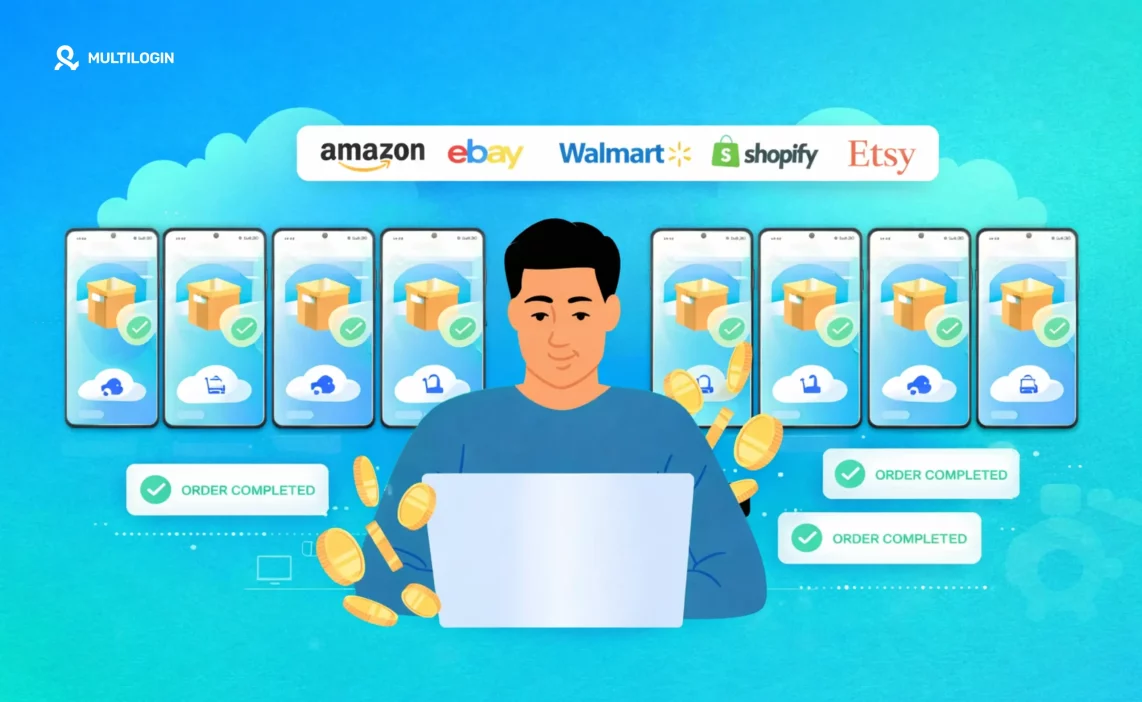

Running one e-commerce store is hard enough.
Running five stores across three marketplaces for multiple clients while keeping accounts separate, inventory synced, listings optimized, and platforms none the wiser that it’s all one person behind the curtain?
That’s a different kind of hard. The kind that breaks cobbled-together setups and sends agencies scrambling for solutions.
This guide is for e-commerce sellers and agencies dealing with real scale: multiple storefronts, multiple platforms, multiple clients, and the constant challenge of keeping everything organized and compliant without triggering the account flags that can wipe out months of work.
Cloud phones are a significant part of that solution, and by the end of this guide, you’ll understand exactly why.
The Real Problem with Multiple E-commerce Stores
Let’s name the specific problems before we talk solutions, because “managing multiple stores” is vague and the actual pain points are concrete.
Platform Detection and Account Linking
Amazon, eBay, Etsy, Shopify, and every major e-commerce platform have systems designed to detect when multiple accounts are operated from the same person or entity.
They’re looking for:
- Same device accessing multiple seller accounts
- Same IP address across different accounts
- Matching behavioral patterns between accounts
- Shared payment methods or business information
When they find it, the response ranges from flags to complete account suspension. On Amazon especially, account suspension is catastrophic. It doesn’t just pause your sales. It freezes your inventory, holds your payouts, and can take months to resolve.
The business need to manage multiple Amazon accounts safely requires genuine account isolation, not just different browsers.
Managing Product Variants Across Multiple Marketplaces
Keeping product listings consistent and optimized across Amazon, eBay, Etsy, Walmart, and your own Shopify store is a logistics nightmare without the right tools.
Managing product variants across multiple marketplaces for e-commerce businesses means:
- Different image requirements per platform
- Different character limits for titles and descriptions
- Different category structures
- Different SEO keyword priorities
- Different pricing strategies per platform
- Inventory that needs to stay synchronized
A product with 12 color variants, 5 sizes, and 3 platform-specific versions creates 180 unique listings to manage. Multiply that across a catalog of 200 products and you understand why this breaks people.
E-commerce Multiple Storefronts: The Operational Overhead
Each storefront has its own:
- Customer service queue
- Order management system
- Return and refund processes
- Review management
- Analytics and reporting
- Promotional calendars
Managing multiple e-commerce sites manually doesn’t scale. The operational overhead grows faster than the revenue.
Best E-commerce Platform for Multiple Stores: Platform Overview
Before getting into tools and infrastructure, let’s cover what each major platform offers for multi-store management.
Shopify for Multiple E-commerce Websites
Shopify doesn’t natively support multiple stores under one account, but their Shopify Plus tier allows multiple storefronts managed from one dashboard.
For agencies or sellers operating multiple brands, Shopify Plus (which starts at $2,300/month) allows:
- Multiple stores with separate branding
- Centralized team management
- Shared app installations
- Unified reporting
For those not on Shopify Plus, each store requires a separate account. Tools for Shopify integration and multiple e-commerce platforms like LitCommerce, Synder, or Codisto help connect multiple Shopify stores with other marketplaces.
Open Source E-commerce for Multiple Stores
For enterprise clients who want more control, open source e-commerce platforms offer multi-store capabilities:
WooCommerce (WordPress-based): Requires separate WordPress installations per store or a multisite setup. Highly flexible but requires technical management.
Magento/Adobe Commerce: Built with multi-store management as a core feature. Ideal for enterprise e-commerce multiple stores where full control is needed. Higher technical overhead.
PrestaShop: Supports multi-store natively. Good for businesses needing separate front-ends with centralized back-end management.
OpenCart: Multi-store support built in. Lighter weight than Magento.
Multi-Tenant E-commerce for Multiple Brands
Multi-tenant e-commerce platforms host multiple independent storefronts on shared infrastructure, giving each brand its own environment while centralizing management:
- BigCommerce Multi-Storefront: Manage multiple storefronts from one account, each with unique URLs, catalogs, and branding
- Salesforce Commerce Cloud: Enterprise-grade multi-tenant platform for global brands
- Elastic Path: Headless e-commerce with strong multi-brand support
These platforms are built for this use case but come with enterprise pricing.
Enterprise E-commerce Platform for Multiple Stores
At enterprise scale, the requirements shift: global inventory management, multi-currency, multi-language, complex tax logic, and integration with ERP systems.
Enterprise platforms that handle this include:
- Salesforce Commerce Cloud
- SAP Commerce Cloud
- Oracle Commerce
- Adobe Commerce (Magento Enterprise)
For most small to mid-market agencies and sellers, these are overkill. Shopify Plus, BigCommerce, or a well-configured WooCommerce multi-site covers the majority of real-world needs.
Best Practices for Managing Multiple E-commerce Stores for Agency Clients
Running e-commerce stores for agency clients adds another layer: you’re managing someone else’s business, which means the stakes for account health are even higher.
Account Isolation Is Non-Negotiable
The most critical practice: every client account must be completely isolated from every other client account and from your personal accounts.
This means:
- Different login credentials (obvious)
- Different devices or virtual environments
- Different IP addresses
- Different browser fingerprints
- No shared payment methods
- No shared contact information
When client accounts share infrastructure, a problem on one account can cascade to others. Amazon’s systems, in particular, are aggressive about linking associated accounts. If one account gets suspended and Amazon determines it’s linked to others, all linked accounts face suspension simultaneously.
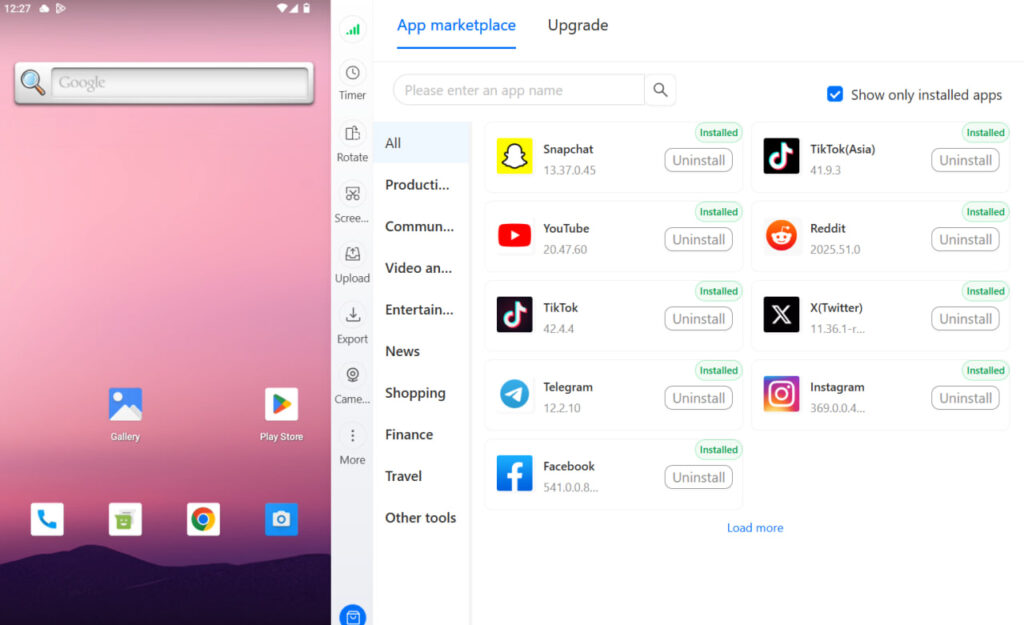
Cloud phones solve this problem by giving each client account its own genuine Android environment with unique hardware identifiers and location-matched proxy connections. Each store appears to come from a different device in a different location.
Managing Multiple E-commerce Sites: The Tools Stack
A functional multi-store management setup typically combines:
Inventory Management:
- Linnworks (multichannel inventory and order management)
- Sellbrite (inventory sync across Amazon, eBay, Etsy, Walmart, Shopify)
- ChannelAdvisor (enterprise-grade multichannel management)
Listing Management:
- Codisto (sync listings across Amazon, eBay, Google)
- LitCommerce (budget-friendly multichannel listing)
- Feedonomics (data feed management for paid shopping channels)
Order Management:
- ShipStation (shipping and fulfillment across channels)
- Skubana/Extensiv (operations platform for complex multichannel)
Bookkeeping:
- A2X (e-commerce accounting for Amazon, Shopify, eBay)
- Link My Books (connects e-commerce platforms to Xero/QuickBooks)
- Webgility (automated bookkeeping across multiple platforms)
For best bookkeeping tools for multiple e-commerce platforms, A2X is generally considered the most robust for marketplace reconciliation, while Link My Books is preferred for UK-based sellers using Xero.
Best Practices for Integrating Multiple Couriers in E-commerce
Multi-carrier shipping is one of the highest-leverage operational improvements for multi-store sellers:
- Compare carrier rates per shipment automatically
- Use zone-skipping strategies for domestic shipping
- Maintain redundancy (if one carrier has delays, switch to another)
- Different carriers for different product types (fragile, heavy, expedited)
Tools like EasyPost, ShipBob, or ShipStation’s carrier management handle multi-courier integration. For international e-commerce, freight forwarders and customs management tools become essential.
How Modern E-commerce Platforms Manage Multiple Warehouse Inventories
Multi-warehouse inventory management is a critical challenge when operating at scale:
- Real-time inventory sync across warehouses
- Intelligent order routing (fulfill from nearest warehouse)
- Reserve stock per channel (prevent overselling)
- Buffer stock management
- Returns processing per warehouse
Platforms like Brightpearl, Cin7, or Extensiv (formerly 3PL Central and Skubana) handle multi-warehouse operations well. For Shopify users, the native Shopify Locations feature handles basic multi-location inventory without third-party tools.
E-commerce Multiple Storefronts: The Account Safety Challenge
Here’s where all the platform discussion intersects with the account isolation problem.
You have multiple stores. You have multiple clients. You have multiple platforms. And every single one of those stores needs to be operated from an environment that appears to be a genuine, separate user to the platform.
Why Regular Tools Aren’t Enough
Incognito mode doesn’t change your device fingerprint.
VPNs change your IP address but not your browser fingerprint, device identifiers, or behavioral patterns.
Multiple browsers on the same computer share the same hardware and operating system signature.
Even different computers on the same office network share an IP address, which can trigger platform linking.
Multiple Vendor E-commerce: Managing Marketplace Accounts
For agencies managing e-commerce with multiple vendors or multiple client brands on the same marketplace (particularly Amazon), the account linking issue becomes existential.
Amazon’s Seller Central Terms of Service state that sellers may not operate multiple seller accounts unless granted explicit permission and “a legitimate business need.” In practice, this means the accounts must be operated as genuinely separate entities with no shared infrastructure.
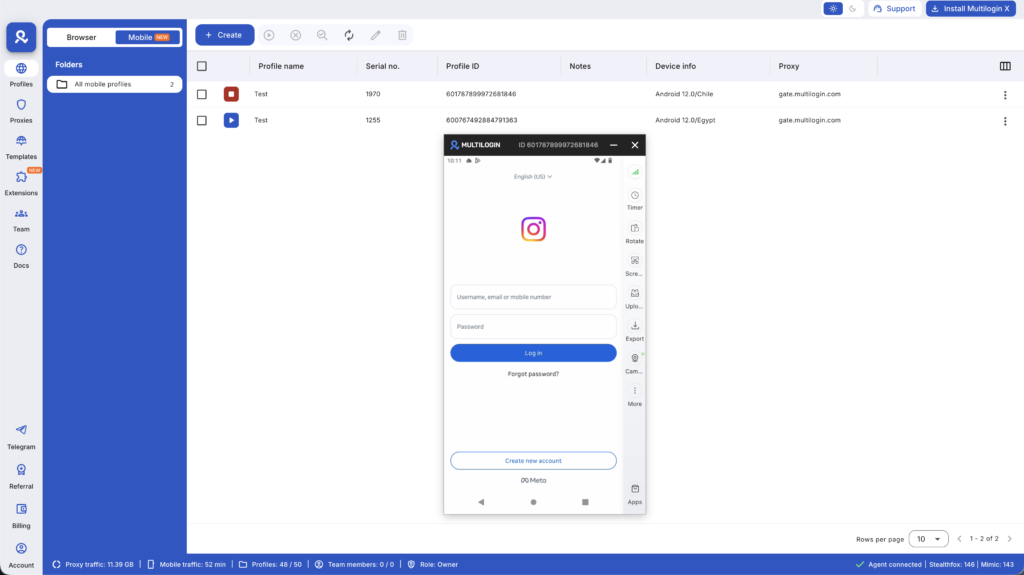
Cloud phones provide the cleanest solution:
Each client store gets its own cloud phone with:
- Genuine Android hardware identifiers (IMEI, Android ID, MAC address)
- Location-matched mobile-grade proxy (matching the business’s registered location)
- Persistent app sessions (consistent login behavior over time)
- Separate app data and cache
To Amazon, Etsy, or eBay’s detection systems, each account appears to come from a completely separate device used by a separate person in a separate location.
Multilogin Cloud Phones specifically provides approximately 30 real device types including Samsung, Google, OPPO, and OnePlus, so you can vary device types across client accounts for additional authenticity.
Best E-commerce Platforms for Small Businesses with Multiple Product Lines
For smaller operations managing multiple product lines (rather than multiple client accounts), the isolation requirements are less strict but the operational requirements remain:
- Shopify: Clean interface, strong app ecosystem, manageable for multiple product categories with proper collection structure.
- WooCommerce: More complex but extremely flexible for businesses needing specific functionality.
- BigCommerce: Good native multichannel features included in base pricing, making it cost-effective for small businesses selling on multiple channels.
- Squarespace Commerce: Limited but user-friendly for very small businesses starting to sell online.
For SEO, optimizing product listings with multiple color options requires careful use of variant structure (not creating duplicate pages for each color) and proper structured data markup. Each color variant should be a variant of the main product rather than a separate URL wherever possible.
How to Onboard Multiple Users in E-commerce Accounts
For agencies where multiple team members need access to client e-commerce accounts, proper user management prevents both operational confusion and security issues.
Platform-Level User Access
Most major platforms support multi-user access with role-based permissions:
- Shopify: Staff accounts with customizable permissions (read-only, order management, full access)
- Amazon Seller Central: User permissions with granular control over which reports, tools, and functions each user can access
- eBay: No native multi-user support for standard accounts; sellers use third-party tools or Seller Hub with care
- Etsy: Pattern and Shop Manager support limited team member access
Best practice: give team members the minimum permissions needed for their role. Marketing team doesn’t need access to financial reports. Fulfillment team doesn’t need access to listing tools.
Cloud Phone Access for Teams
For mobile-based account management, Multilogin’s team features allow:
- Assigning specific cloud phones to specific team members
- Granular permissions for who can access what
- Unlimited team seats on business plans
- Activity visibility across all accounts
This means client account security without password sharing and without everyone operating from the same infrastructure.
Cloud Phones for E-commerce: The Multilogin Advantage
Pulling everything together: here’s what Multilogin Cloud Phones specifically deliver for e-commerce sellers and agencies.
- Real Android Environments: Each cloud phone runs genuine Android (versions 10-15) with real hardware identifiers. E-commerce platform apps see genuine devices, not emulators.
- Location Matching: If your client’s business is registered in Dallas, their cloud phone connects from Dallas with Dallas-appropriate mobile network data. Location consistency reduces security flags.
- Persistent Sessions: Marketplace apps maintain natural login patterns. No suspicious rapid logins or session gaps that trigger security reviews.
- Full App Compatibility: Amazon Seller, eBay, Etsy, Shopify, and every other marketplace app installs and runs normally.
- 2-in-1 Platform: Cloud Phone subscription includes the leading antidetect browser. Manage marketplace app-based tasks on cloud phones and web-based tasks (inventory management, reporting, advertising) in isolated browser profiles. One subscription covers both environments.
- Scalability: Add cloud phones as you onboard new clients. Usage-based pricing at €0.009 per minute means costs scale with activity, not fixed overhead.
- 24/7 Support: Expert support in 5 languages for when things need resolving fast.
For a deeper look at how professional sellers use this approach, see our guides on creating multiple Amazon seller accounts and managing multiple eBay accounts. For Shopify-specific setup, our guide on managing multiple Shopify stores covers the workflow in detail.
Need a better way to manage multiple eCommerce stores? Try Multilogin Cloud Phones.
The Bottom Line for E-commerce Sellers and Agencies
Managing multiple e-commerce stores isn’t just an operational challenge. It’s an account health challenge and a growth infrastructure challenge.
The sellers and agencies winning at scale in 2026 have solved three things:
- Operations: The right multichannel tools for inventory, listings, orders, and bookkeeping.
- Growth: The right marketing and SEO strategies per platform.
- Infrastructure: The right account isolation to keep accounts healthy, unlinked, and protected.
Cloud phones are the infrastructure layer most agencies ignore until they get burned. Accounts get linked. Stores get suspended. Clients leave.
Multilogin Cloud Phones gives you the infrastructure to prevent that, with real Android environments, built-in location-matched proxies, persistent sessions, and a complete antidetect browser included.
✅ Real Android cloud phones with genuine hardware IDs
✅ Built-in proxies matched to each account’s location
✅ Persistent sessions that build natural account history
✅ Complete antidetect browser in the same dashboard
✅ Team collaboration with granular permissions
✅ Usage-based pricing from €0.009 per minute
👉 Try Multilogin Cloud Phones today and protect the accounts you’ve spent months building.
Frequently Asked Questions About Managing Multiple E-commerce Stores
Shopify Plus offers the cleanest multi-store management for agencies, BigCommerce Multi-Storefront provides strong native multichannel support, and Magento/Adobe Commerce is the best option for enterprise clients needing full customization. For open source, WooCommerce multisite or PrestaShop multi-store cover most mid-market needs.
Use proper account isolation: each store needs its own device environment with unique hardware identifiers and a location-matched IP address. Cloud phones provide genuine Android environments per account, which marketplace platforms see as separate devices. Do not use the same browser, computer, or IP address across multiple marketplace accounts.
The critical requirement is complete account isolation: each client account runs in its own environment with unique device parameters, separate IP addresses, and no shared infrastructure. Cloud phones paired with an antidetect browser give agencies one platform to manage all client accounts without risking account linking.
Amazon’s TOS requires explicit permission for multiple seller accounts and a “legitimate business need.” Where permitted, accounts must be operated as genuinely separate entities. Cloud phones with unique device identifiers and location-matched proxies provide the technical separation that keeps accounts unlinked in Amazon’s systems.