


TikTok Shop has become one of the fastest-growing commerce platforms for independent sellers, creators, and brands — and for good reason. It collapses the gap between content and purchase, letting viewers buy products directly from videos, lives, and a storefront tab on your profile without ever leaving the app.
Sellers who figure out how it works early are building real revenue streams, some with no inventory and no following to start.
This guide covers everything you need to know about how to sell on TikTok Shop in 2026: requirements, setup, product sourcing, how to sell without inventory, how the affiliate program works, and how operators managing multiple seller accounts keep everything running without getting flagged.
If you’re planning to run multiple TikTok seller accounts across different niches or markets, learn how to manage multiple TikTok accounts safely before account linking becomes a problem that shuts down your whole operation.
What TikTok Shop actually is and why it matters in 2026
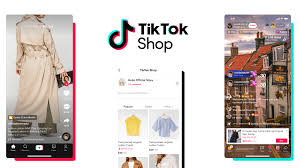
TikTok Shop is an in-app commerce layer built directly into TikTok. Sellers list products on TikTok Seller Center, and those products can appear in shoppable videos, LIVE shopping streams, a dedicated shop tab on the seller’s profile, and the TikTok Shop marketplace where buyers can browse independently of any specific creator.
The platform works across three seller models that can be used independently or together:
As a brand or business seller, you list your own products, manage inventory, handle fulfillment, and sell directly to TikTok’s audience. This is the standard e-commerce model on TikTok.
As an affiliate seller, you don’t hold any inventory at all. You promote other sellers’ products through your TikTok content and earn a commission on each sale. Products link directly from your videos and live streams.
As a dropshipping seller, you list products from third-party suppliers, collect the orders, and have the supplier ship directly to the customer — no warehouse, no stock management.
Understanding which model fits your situation is the first decision to make before anything else.
TikTok Shop seller requirements in 2026
TikTok has tightened its requirements over the past two years, and 2026 requirements differ slightly from what older guides describe. Here’s the current picture:
For business/brand sellers (US): You need to be 18 or older, have a valid US address, provide a government-issued ID or business registration documents, and have a US bank account for payouts. No follower count requirement — you can start selling on TikTok Shop with zero followers as a seller.
For creators using the affiliate program: You need 1,000 followers minimum in most markets to access TikTok Shop affiliate links. No follower minimum is required to apply to the seller program as a business.
For the UK, Australia, and Southeast Asian markets: Requirements are similar, though document requirements vary by country. TikTok Shop availability and specific rules differ — sellers in the US, UK, Malaysia, Singapore, Thailand, and Indonesia have the most established programs, while markets like France, Ireland, and Brazil have more limited rollouts or are still expanding.
Age requirement: 18 years old minimum across all markets.
So to answer the most common question directly: you do not need followers to sell on TikTok Shop as a business seller. The affiliate program requires 1,000 followers, but the seller program itself has no follower threshold.
How to start selling on TikTok Shop: step by step
Step 1: Apply to TikTok Seller Center
Go to seller.tiktok.com and select your region. Click “Sign Up” and either create a new account or link an existing TikTok account. You’ll need to verify your identity with a government-issued ID (for individual sellers) or submit business registration documents (for registered businesses). US sellers also need to provide an Employer Identification Number (EIN) or Social Security Number depending on how the business is structured.
Approval typically takes one to three business days. Some applications take longer if document verification requires manual review.
Step 2: Set up your TikTok Shop storefront
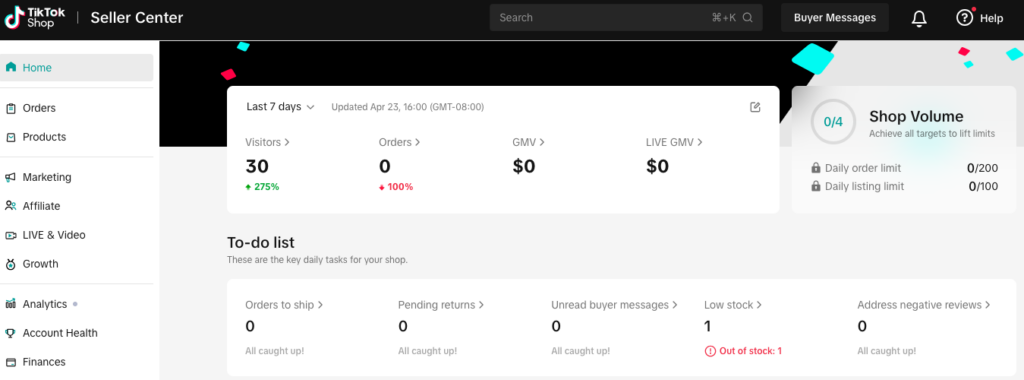
Once approved, you’ll be inside TikTok Seller Center. Set up your storefront name, write a shop description that’s clear about what you sell, and upload a shop logo. This is the profile buyers see when they visit your shop tab.
Set up your shipping configurations next. TikTok offers two shipping methods: seller shipping (you manage your own carrier accounts and ship yourself) and TikTok shipping (TikTok’s integrated fulfillment option with negotiated carrier rates). Most new sellers use TikTok’s integrated shipping for simplicity until volume justifies setting up their own carrier accounts.
Configure your payout account — a US bank account for US sellers, linked through Seller Center.
Step 3: Add your products
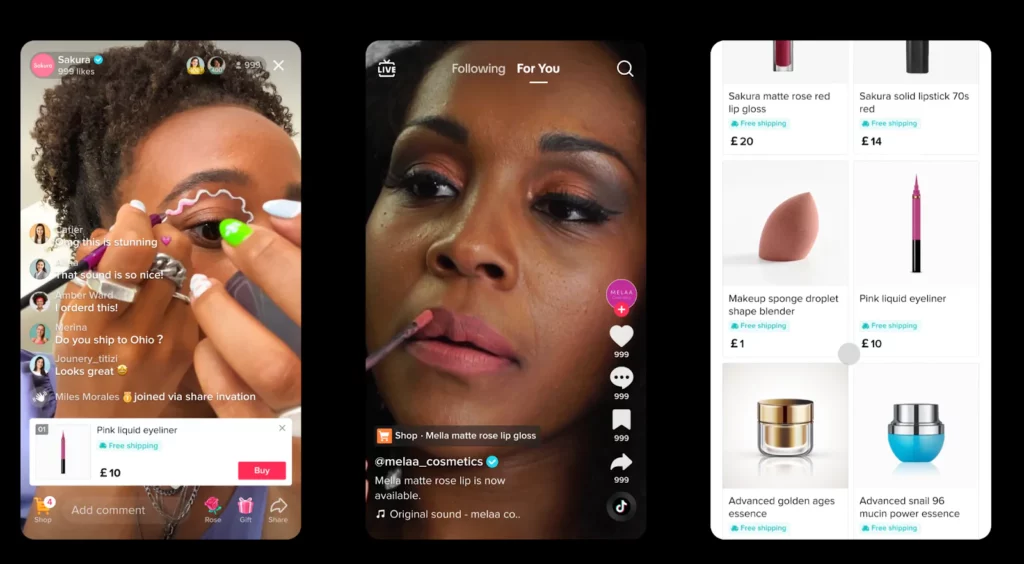
Go to Products in Seller Center and click Add Product. You’ll need product title, description, price, inventory count, product photos (minimum 3, recommended 8+), and category selection. Product categorization matters for how TikTok surfaces your items to relevant buyers, so pick carefully.
Products go through a review process before going live — typically 24 to 48 hours for standard categories, longer for restricted categories (supplements, food, health products, electronics).
Step 4: Connect your TikTok account
Link the TikTok account that will post content promoting your products. Once connected, you can tag products directly in videos and LIVE sessions. When viewers click a tagged product, they go directly to the product listing without leaving TikTok.
Step 5: Start creating shoppable content
This is where most sellers either build momentum or stall. Product listings alone don’t generate sales — TikTok’s algorithm favors content that drives native engagement, not just static product pages. The sellers doing well on TikTok Shop in 2026 are posting product demonstration videos, unboxing content, before/after comparisons, and honest reviews of their own products. LIVE shopping sessions — where you present products in real time and viewers can buy directly during the stream — are particularly effective for driving fast sales volume.
For a deeper look at how to grow your TikTok presence alongside your shop, antidetect browsers for TikTok growth covers the technical side of keeping multiple accounts healthy and growing.
How to sell on TikTok Shop without inventory
This is one of the most searched questions, and there are two legitimate paths to answer it.
Path 1: TikTok Shop affiliate program
The affiliate program is the cleanest zero-inventory model. You apply to become an affiliate through TikTok Seller Center or directly through the TikTok app. Once approved, you get access to the TikTok affiliate marketplace, where you can browse thousands of products from registered TikTok sellers and request to promote their items.
When a seller approves your affiliate request, you can add their product links to your videos and live sessions. You earn a commission — typically 5% to 20% depending on the product and seller — on every sale made through your link.
You hold no inventory, process no orders, handle no shipping. The seller manages all of that. Your job is content creation and driving traffic to the product link.
The TikTok Shop affiliate program guide goes into detail on how to find high-converting products, negotiate commission rates, and structure content for maximum affiliate revenue.
Path 2: TikTok Shop dropshipping
As a seller (not affiliate), you list products on TikTok Shop but fulfill orders through a third-party supplier who ships directly to the customer. You pay the supplier cost after receiving the customer’s order, keeping the margin as profit.
The mechanics work similarly to dropshipping on any other platform — the main difference is that TikTok Shop requires you to have a registered seller account, meet fulfillment time requirements, and maintain product quality standards. TikTok is stricter about fulfillment timelines than some other platforms, and late shipments can result in account penalties.
Product sourcing for TikTok Shop dropshipping: most sellers use Alibaba, CJ Dropshipping, or US-based suppliers for faster domestic shipping times. TikTok’s audience is increasingly impatient with long delivery windows, so sourcing from suppliers who can fulfill within five to seven days is a meaningful competitive advantage.
How to sell on TikTok Shop as a creator vs. as a business
These are meaningfully different approaches with different setups and income mechanics.
As a creator: You apply for the affiliate program, promote other sellers’ products through your content, and earn commission without managing a shop. This model works well if you already have an audience or are building one. The income ceiling depends on your content reach and the products you choose. Some creators earn more from TikTok Shop affiliate than from Creator Rewards Program.
As a business seller: You register a seller account, list your own products, and build a storefront. This model has higher operational complexity but also higher margin potential — you’re keeping the full product margin rather than a commission percentage.
Many serious TikTok operators combine both: they run a seller account for their own products and also participate as affiliates for complementary products that their audience would find relevant.
How to sell digital products on TikTok Shop
Digital products are allowed on TikTok Shop in specific categories, including online courses, ebooks, templates, and digital downloads. The setup process is the same as physical products — you list them in Seller Center — but delivery is handled through a digital download link rather than physical shipping.
TikTok’s product review process for digital products can be more thorough than for physical goods, particularly for anything in the education or information category. Make sure your product description clearly states it’s a digital product and sets accurate expectations for what buyers receive.
Selling books on TikTok Shop — including KDP (Kindle Direct Publishing) books and self-published ebooks — follows the same process. Authors have found TikTok’s “BookTok” community to be one of the strongest organic audiences for book sales currently active on any platform.
How to sell on TikTok Shop: country-specific notes
USA: The most developed TikTok Shop market with the broadest product category access and the most established seller support infrastructure. Most of the guides and tutorials you’ll find online are US-focused.
UK: TikTok Shop launched earlier in the UK than the US and has a mature seller ecosystem. UK sellers face similar requirements to US sellers, with UK-specific document requirements (Companies House registration for businesses).
Malaysia, Singapore, Thailand, Indonesia: Southeast Asian markets were TikTok Shop’s earliest testing grounds and remain among its most active. Local seller support is strong and category restrictions are somewhat different from Western markets.
Australia, France, Ireland, Brazil: These markets have TikTok Shop availability but with more limited features and seller support compared to the core markets. Check TikTok Seller Center for current availability in your specific region before investing time in setup.
How to find products to sell on TikTok Shop
Product research is one of the most important and most underinvested steps for new TikTok sellers. The platform has its own trend velocity — products that go viral on TikTok can sell thousands of units in days, then plateau just as quickly. Finding products with genuine staying power versus one-week viral spikes requires looking at multiple signals.
TikTok’s own Creative Center (ads.tiktok.com/creative-center) shows trending products and top-performing ad creatives. This is a free tool that most new sellers overlook. Browsing the TikTok Shop marketplace and sorting by bestsellers within a category shows what’s actually moving. Looking at what established TikTok Shop affiliates are promoting — especially creators with consistent sales — points toward products with proven conversion.
For any product you consider, run the math on margin after TikTok’s commission fee (currently 2% for most categories, higher for some), shipping costs, and return rates. TikTok Shop has a higher return rate than some other platforms in certain categories.
The account management problem when scaling TikTok Shop
Once you understand how TikTok Shop works and want to scale beyond a single account — whether to test different niches, serve different geographic markets, or separate affiliate income from direct seller income — you run into TikTok’s account linking detection.
TikTok uses browser fingerprinting and device-level signals to connect accounts that share infrastructure. When multiple TikTok accounts are operated from the same device, same IP address, or same session environment, TikTok’s systems identify them as related. A policy violation on one account can cascade to others in the linked cluster — including your seller account.
This isn’t theoretical. Sellers who have run multiple TikTok accounts from the same phone or computer report that violations on content accounts have triggered reviews and restrictions on their associated Seller Center accounts. The risk is real and compounds as you add more accounts.
How to not get banned on TikTok — long-term prevention covers the full picture of what triggers TikTok account bans and how to structure your operation to avoid them. And if you’re already dealing with a suspended account, TikTok account suspended — preventing repeat issues explains how to recover and rebuild without making the same infrastructure mistakes.
How Multilogin solves the multi-account problem for TikTok Shop sellers
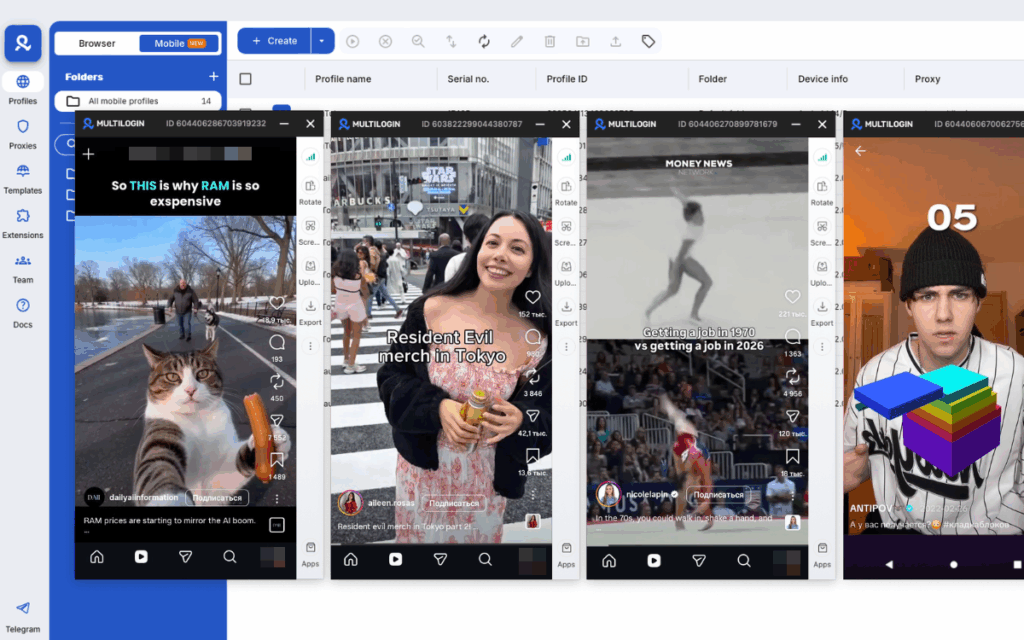
Multilogin cloud phones give each TikTok account and seller operation its own real Android environment in the cloud — with a unique IMEI, Android ID, MAC address, and dedicated mobile-grade residential proxy. TikTok’s detection systems see each cloud phone as a separate physical device in a separate location. Nothing links across accounts unless you configure it to.
This is the correct infrastructure for anyone running more than one TikTok seller account, managing multiple affiliate accounts across different niches, or running content accounts that promote products separately from the seller accounts themselves.
Persistent sessions matter for seller accounts. TikTok Seller Center and the TikTok app both build usage history over time — login patterns, device consistency, session behavior. Accounts that keep re-authenticating from different environments, or that look like they’re being accessed from constantly changing devices, trigger TikTok’s security review processes. Cloud phones maintain consistent session data between uses, so your seller accounts accumulate natural-looking account history over time.
Proper warmup before activating selling features. New TikTok accounts benefit from a warmup period of natural-looking activity before being activated for selling or affiliate links. Warming up your TikTok account before turning on Shop features reduces the chance of early-stage flags that can delay seller approval or restrict affiliate access. Cloud phones handle this naturally because the account history and app data persist across sessions.
Scale without hardware overhead. Running a physical phone farm for TikTok Shop management creates hardware costs, maintenance complexity, and the same fingerprinting risks when devices share network infrastructure. Cloud phones eliminate the physical device problem entirely. You manage every account from a single desktop dashboard, launch the cloud phone you need, do your work, and close it — with each account staying fully isolated from the others.
Multilogin cloud phones: real Android devices in the cloud →
For operators running dropshipping or e-commerce operations across multiple platforms alongside TikTok Shop, Multilogin’s dropshipping and ecommerce tools cover the broader multi-platform management picture. The best antidetect browser for dropshipping breaks down which setup works best depending on your operation size.
How to get started with Multilogin for TikTok Shop
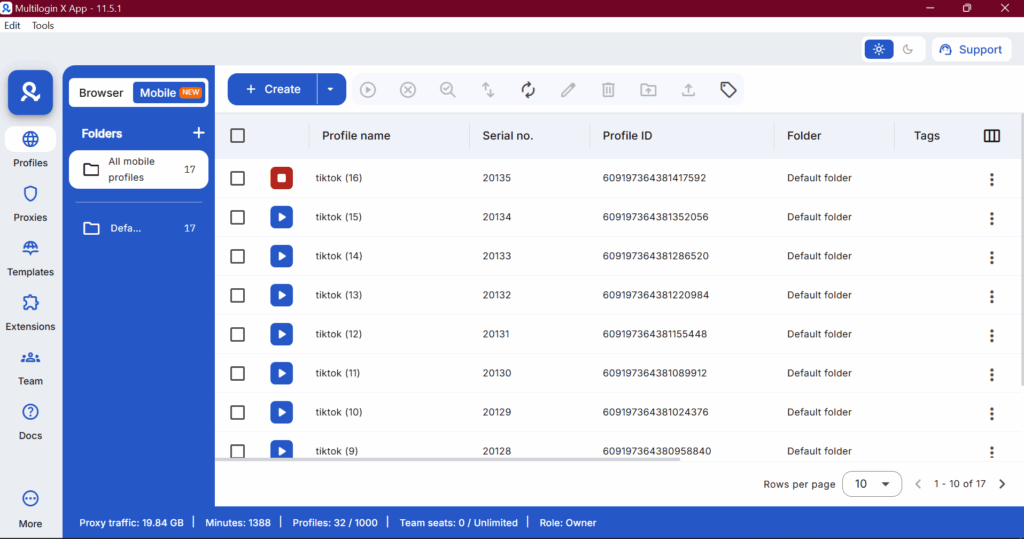
Getting set up is straightforward. Cloud phone pricing is usage-based at €0.009 per minute with bonus minutes included when you start. Every cloud phone plan also includes full access to Multilogin’s leading antidetect browser, so your desktop-based Seller Center management and your mobile TikTok account management all run from one dashboard.
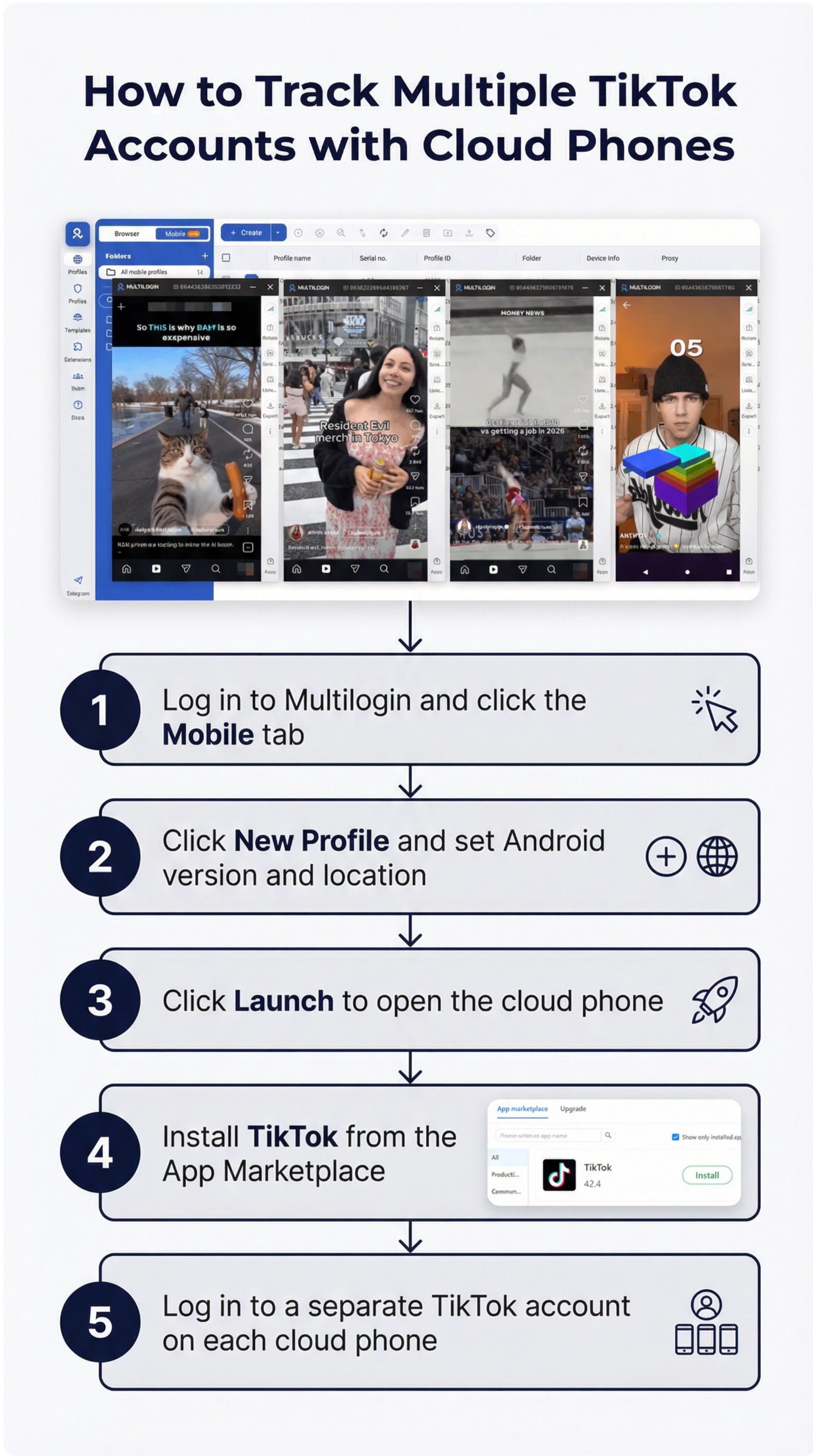
Create a cloud phone profile for each TikTok account you want to run. Select the Android device type — Multilogin supports approximately 30 real device models across Samsung, Google, Redmi, OPPO, OnePlus, and vivo. Assign a residential proxy with city-level targeting that matches the account’s intended location. Each profile maintains persistent app storage: login states, TikTok session data, and Seller Center access all carry over between sessions.
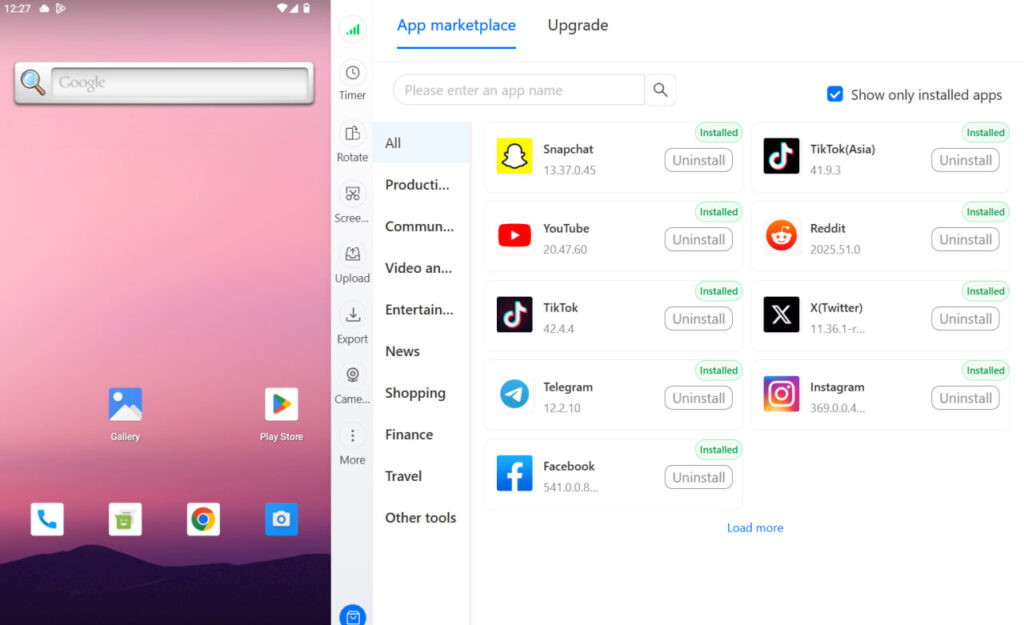
Install TikTok from the built-in app store within the cloud phone, complete account setup, and run your warmup period before activating Shop features. Every account operates in full isolation — no shared signals, no linking risk.
For teams managing multiple seller accounts or multiple client TikTok operations, Business plans include unlimited team seats with granular permission controls. You assign specific cloud phones to specific team members without exposing the entire operation.
Checklist: before you launch your TikTok Shop
- Seller Center account approved with valid ID and bank account.
- Storefront name, description, and logo configured.
- Shipping method selected and tested.
- First product listings submitted and approved.
- TikTok account connected and linked to shop.
- Product tags tested in a video before publishing publicly.
- Each account running from its own isolated device environment if managing multiple seller accounts.
- Warmup period completed on any new TikTok accounts before activating selling features.
Need to manage multiple Tiktok accounts? Try Multilogin Cloud Phones.
Key takeaways
Selling on TikTok Shop in 2026 is a genuine opportunity — one of the few platforms where content and commerce are integrated tightly enough that a creator or small business with real products and solid content can build meaningful revenue without a large ad budget.
The zero-follower requirement for seller accounts lowers the barrier to entry significantly, and the affiliate model makes it accessible for anyone who wants to start without inventory.
What separates the operators who build sustainable TikTok Shop businesses from the ones who keep getting knocked back by bans and account issues is infrastructure. Running multiple TikTok accounts — whether for separate niches, different markets, or affiliate content alongside a seller account — requires proper isolation between accounts. Shared devices, shared IPs, and shared session environments create account linking that turns one violation into an operation-wide problem.
Multilogin cloud phones handle the infrastructure correctly: real Android environments, genuine hardware identifiers, isolated residential proxies, persistent sessions, and desktop management at scale. Starting with the right setup means your seller accounts and content accounts grow without constantly fighting platform enforcement.
Frequently asked questions About How to sell on TikTok Shop
Zero followers are required to register as a business seller on TikTok Shop. You can list products and run a storefront with no audience at all — though you’ll need content to drive traffic to those listings. The affiliate program requires 1,000 followers to access affiliate product links.
There’s no monthly fee to be a TikTok Shop seller. TikTok charges a commission on sales — currently around 2% for most categories in the US, though this varies by category and has been gradually increasing. You’ll also pay payment processing fees. Shipping is an additional cost unless you use TikTok’s subsidized shipping rates for new sellers.
Two options: the TikTok Shop affiliate program (promote other sellers’ products for a commission, no inventory needed) or dropshipping (list products you source from third-party suppliers who ship directly to customers). Both approaches require a seller or affiliate account but no physical stock.
Use TikTok’s Creative Center for trending product data, browse TikTok Shop bestsellers by category, and research what established affiliates are promoting. For dropshipping, source from suppliers who can fulfill within five to seven days to meet TikTok Shop’s fulfillment expectations.
Views attributed to Personal Profile came from users visiting your profile page directly rather than seeing the video on their For You page or through discovery features.
Approximately every 24 hours. New videos may update more frequently in the first few hours. Follower activity data updates on a rolling basis every few days.