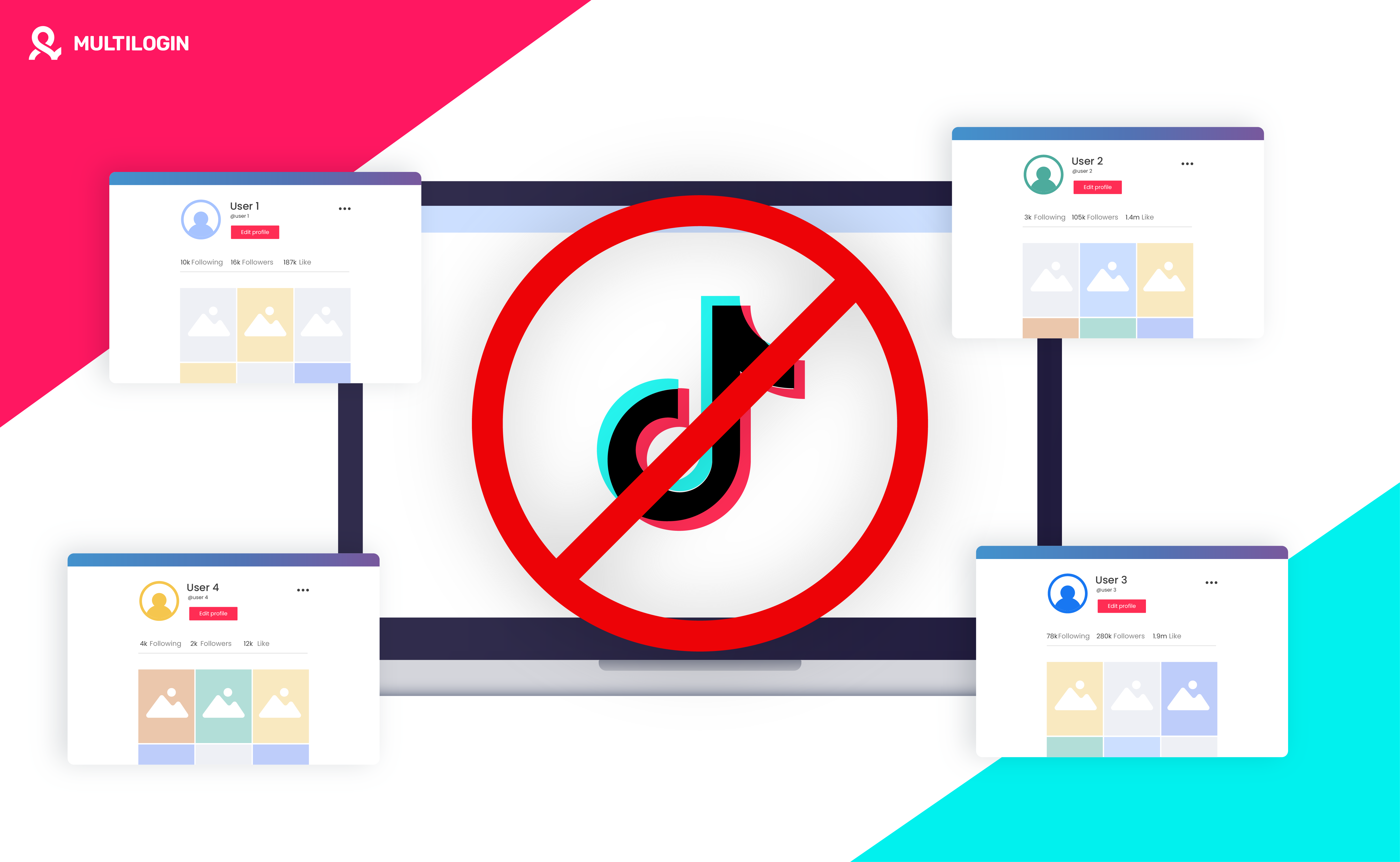



Multiple TikTok accounts can be useful for managing different clients, brands, niches, or regional campaigns, but keeping them clearly separated becomes harder as your workflow grows. In this guide, you will learn how TikTok connects accounts through device, network, session, and behavioral signals, compare the main management methods, understand their risks and limitations, and choose a setup that can scale with your operation.
You can use TikTok’s built-in account switching for simple personal use, dedicated browser profiles for web-based tasks, or Android cloud phones for native app workflows. Multilogin Cloud Phones are especially relevant for social media marketers because they let you run separate TikTok environments with independent device data, sessions, and network locations from one dashboard.
Read on to find the most practical way to manage multiple TikTok accounts for clients, brands, and markets without mixing workflows.
👉 Start with Multilogin Cloud Phones and build a more organized TikTok account management setup.
Why managing multiple TikTok accounts gets complicated
For social media marketers, agencies, creators, and online sellers, running multiple accounts is often essential. Different clients, niches, brands, languages, and target markets need separate sessions, credentials, content plans, and access environments.
The platform can evaluate browser fingerprinting and device fingerprinting signals to understand whether accounts share the same environment. Shared signals can lead to additional verification checks, session interruptions, or closer review of connected accounts.
Here’s what TikTok tracks to link accounts together:
- IP address monitoring – Every login gets logged with your IP
- Device fingerprinting – Your phone’s unique hardware and software signatures
- Behavioral patterns – Scrolling speed, posting times, engagement habits
- Account switching frequency – Rapidly bouncing between accounts raises immediate red flags
If you can’t verify accounts when challenged, you risk suspensions or a TikTok shadow ban—where your content quietly stops reaching anyone.
How to add another TikTok account to your main account
TikTok actually makes it pretty easy to add a second account through the app itself.
Here’s how:
- Open TikTok and go to your Profile tab
- Tap the three lines (menu) in the top right corner
- Select “Settings and privacy”
- Scroll down and tap “Switch account” or “Add account”
- Choose to either log in to an existing account or create a new one
Once added, you can switch between accounts by tapping your profile icon and selecting the account you want to use.
The catch? TikTok knows these accounts are linked. They’re all tied to the same device, same phone number (if you used one), and same behavioral patterns. For personal use—like having one account for watching content and another for posting—this is fine.
But if you’re managing accounts for business, clients, or trying to build separate brand identities that shouldn’t be connected, this method creates exactly the kind of linkage that can cause problems down the road.
How to create another TikTok account on the same device
Creating a new TikTok account on the same device you already use is straightforward, but comes with risks most people don’t think about.
The basic method:
- Open TikTok and go to your profile
- Tap “Add account” in the settings
- Select “Sign up” to create a new account
- Use a different email, phone number, or social login than your main account
- Complete the signup process
Now here’s what TikTok sees: two accounts on the same device, with the same device fingerprint, same IP address, and often similar usage patterns. For casual users, this usually isn’t a problem.
For anyone running accounts professionally—managing client accounts, building niche pages, or operating e-commerce brands—this shared device signal is a liability. If one account gets flagged, TikTok’s systems may look at other accounts on the same device with increased scrutiny.
How to have 2 TikTok accounts on the same device Android
Android users have a few more options than iPhone users when it comes to running multiple TikTok accounts, but each approach has trade-offs.
Method 1: TikTok’s built-in account switching
The simplest approach—add accounts directly in the app as described above. TikTok allows up to 3 accounts per device through this method. Easy to set up, but all accounts are clearly linked.
Method 2: Android’s built-in dual app feature
Some Android phones (Samsung, Xiaomi, OnePlus, and others) have a built-in “Dual Apps” or “App Clone” feature:
- Go to Settings > Apps > Dual Apps (location varies by manufacturer)
- Find TikTok and enable dual app
- A second TikTok icon appears on your home screen
- Log into different accounts on each app instance
This creates some separation, but TikTok can still detect both instances are running on the same physical device through device fingerprinting.
Method 3: Third-party app cloners
Apps like Parallel Space or Dual Space let you clone TikTok multiple times. The risks:
- Battery drain from multiple app instances
- Security concerns with third-party cloning software
- TikTok can often detect cloned app environments
Method 4: Cloud phones (the professional approach)
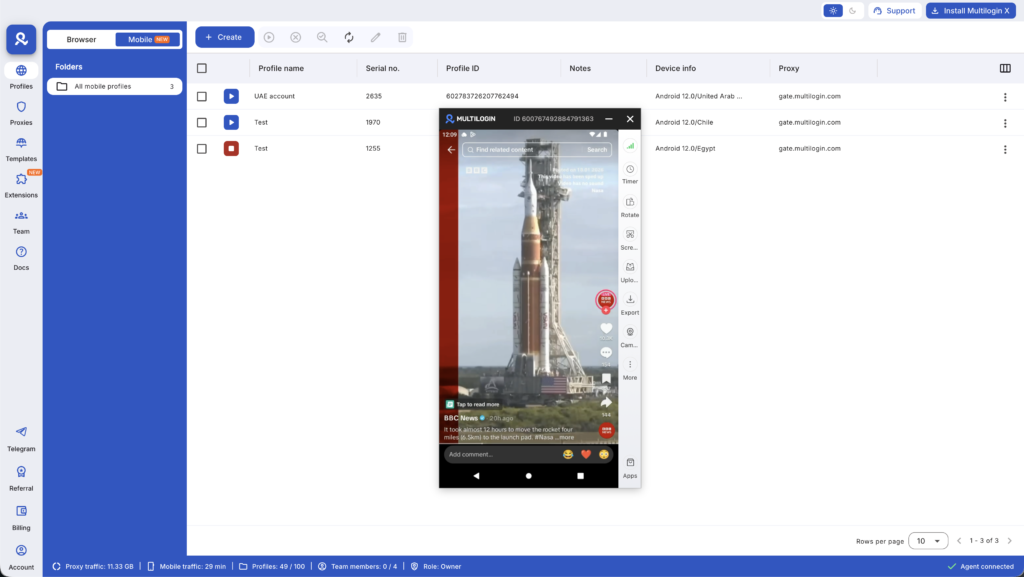
For anyone managing multiple TikTok accounts professionally and needing independent Android environments, cloud phones are the answer. Instead of trying to run multiple accounts on one physical device, you access real Android devices hosted in the cloud—each with its own unique hardware identifiers.
More on this below, because it’s genuinely the most reliable solution for professional multi-account management.
Can you have 2 TikTok accounts with the same phone number?
No. TikTok only allows one account per phone number. If you try to use a phone number that’s already associated with an account, you’ll either log into that existing account or get an error.
This is one of TikTok’s primary ways of limiting multiple accounts. They know if you have 5 accounts all tied to the same phone number, you’re probably not 5 different people.
Your options for creating multiple accounts:
- Email signup – Create accounts using different email addresses instead of phone numbers
- Social login – Use different Google, Facebook, or Apple accounts to create TikTok accounts
- Multiple phone numbers – If you have access to multiple numbers (work phone, Google Voice, etc.), you can use each for a different account
Keep in mind that even if you use different emails or phone numbers, TikTok still tracks the device you’re signing up from. Creating 10 accounts from the same phone, even with different emails, creates a pattern their systems can detect.
Multiple TikTok accounts same phone: What actually happens
Let’s be real about what TikTok sees when you run multiple accounts on the same phone.
Every time you open TikTok, the app collects information about your device: the model, operating system version, installed apps, screen resolution, and dozens of other signals that create a unique digital fingerprint. This fingerprint is the same whether you’re logged into Account A or Account B.
TikTok also logs your IP address with every session. If both accounts always connect from the same IP, that’s another data point linking them together.
What this means in practice:
- For personal users – Usually not a problem. TikTok allows multiple personal accounts.
- For creators with separate niches – Can work, but engagement may be affected if TikTok thinks your accounts are promoting each other.
- For businesses and agencies – Risky. Client accounts shouldn’t be linked to each other or to your personal accounts. If one gets restricted, the connection could affect others.
- For e-commerce operators – Dangerous. TikTok Shop accounts that get linked can all face restrictions if one violates policies.
The safest approach for professional use is ensuring each account appears to come from a completely separate device and network. That’s where specialized tools come in.
How to make another TikTok account with the same email
Short answer: you can’t. TikTok requires unique email addresses for each account, just like phone numbers.
But there are workarounds:
Gmail’s “+” trick
If your email is [email protected], you can use:
All emails still arrive in your main inbox, but TikTok treats them as separate addresses. This works on some platforms, but TikTok has been known to reject the “+” format in some cases.
Create email aliases
Services like Gmail, Outlook, and ProtonMail let you create email aliases. Each alias can be used for a separate TikTok account while all emails go to one inbox.
Use different email providers
The most reliable approach: create separate email accounts. A Gmail for one TikTok account, an Outlook for another, a ProtonMail for a third. More accounts to manage, but zero confusion about which email goes with which TikTok.
Remember, even with different emails, the device fingerprint issue remains. Different login credentials don’t help if TikTok can see all accounts are on the same phone.
TikTok multiple accounts shadowban
Here’s the scenario nobody talks about until it happens to them: you’re running multiple TikTok accounts, everything seems fine, and then suddenly all of them stop getting views. Not banned. Not restricted. Just… invisible.
A shadowban is TikTok’s quiet punishment. Your content stops appearing on the “For You” page—which is how most TikTok users discover anything—but you don’t get any notification. Your videos still post. Your account still works. You just stop reaching people.
Why multiple accounts trigger shadowbans
TikTok’s bot detection systems are looking for coordinated behavior. When multiple accounts on the same device:
- Like or comment on each other’s content
- Post similar content or use the same hashtags
- Follow the same accounts or show identical engagement patterns
- Post at the exact same times
…TikTok’s algorithm interprets this as manipulation. Even if you’re not intentionally gaming the system, the patterns look suspicious.
Signs your accounts are shadowbanned
- Views drop dramatically – Your videos suddenly get a fraction of normal views
- No For You page visibility – Content doesn’t appear on anyone’s FYP
- Engagement tanks – Likes, comments, and shares plummet
- Hashtags don’t work – Posts don’t show up in hashtag searches
- Even followers don’t see you – Your existing audience stops seeing your content
How to avoid multi-account shadowbans
- Keep accounts completely separate – Different devices, different IPs, different fingerprints
- Never cross-engage – Don’t have your accounts like, follow, or comment on each other
- Vary content and timing – Each account should have distinct content strategies and posting schedules
- Use independent account environments – Dedicated browser profiles or cloud phones help keep cookies, sessions, device signals, and IP settings separate for every account
The shadowban usually lifts after 1-2 weeks if you stop the triggering behavior. But prevention is far better than waiting it out.
TikTok multiple accounts Reddit: What users actually report
If you spend any time on Reddit threads about TikTok multiple accounts, you’ll see the same stories over and over:
“I had 3 accounts on my phone and they all got shadowbanned at once”
This is the most common complaint. Users don’t realize TikTok links accounts by device until all of them lose reach simultaneously.
“My client’s account got restricted and now my personal account is flagged too”
Agency workers managing client accounts from their personal phone learn the hard way that account problems can spread across linked devices.
“I tried using a VPN and it made things worse”
VPNs change your IP but do nothing about device fingerprinting. TikTok sees the same device + new suspicious IP = potential bot activity.
“App cloners worked for a while, then all my accounts got hit”
Cloning apps provides surface-level separation, but TikTok’s detection software can identify cloned environments.
“The only thing that actually worked was using completely separate devices”
This is the consensus solution on Reddit—but it’s expensive and impractical for anyone managing more than 2-3 accounts.
What Reddit users often miss is the practical middle ground: cloud phones and independent browser profiles provide separate account environments without requiring a collection of devices or a fragmented set of tools.
Cloud phones: The professional solution for TikTok multiple accounts
Here’s something most guides completely miss: TikTok is a mobile-first platform. The vast majority of users access it through the app, not a browser. And TikTok’s detection systems know the difference.
Browser-based management works for some things, but for maximum authenticity—especially on a platform like TikTok—you want your accounts to show genuine mobile app behavior.
That’s where Multilogin cloud phones change everything.
What are cloud phones?
Cloud phones aren’t emulators or simulators. They’re real Android devices hosted in data centers—actual hardware with genuine device identifiers. You’re controlling a real phone remotely from your desktop, not running software that pretends to be a phone.
Traditional Android emulators (BlueStacks, NoxPlayer, LDPlayer) use spoofed device fingerprints. TikTok has gotten very good at detecting these emulator signatures—which is why emulator-based accounts almost always trigger verification or get restricted.
Cloud phones use native Android environments and genuine device-level identifiers instead of desktop emulator signatures. Account outcomes still depend on platform rules, proxy quality, account history, content, and user behavior, but the environment provides a more natural mobile workflow for TikTok.
Why cloud phones work for TikTok
- Real hardware IDs – Genuine IMEI, Android ID, and MAC address. Not spoofed signatures that TikTok can detect.
- Native TikTok app – You’re using the actual TikTok app, not a browser or modified version. Every interaction looks exactly like a normal user on their phone.
- Persistent sessions – App data, cache, and login sessions persist between uses. Your accounts build natural history over time, just like they would on a real phone.
- Real device variety – About 30 different device models available (Samsung, Google Pixel, OPPO, Xiaomi, OnePlus). Each account can appear on a different phone model.
- Mobile-grade proxies – Built-in mobile proxies with geolocation matching, so your IP signals match your device’s apparent location.
- Desktop control – Manage everything from Multilogin’s dashboard. No physical phones to juggle, charge, or maintain.
Cloud phones vs. other methods
| Method | Detection risk | Scalability | Cost |
| Multiple physical phones | Low | Poor | High ($200-800 per phone) |
| App cloning | Medium-High | Limited | Free |
| Android emulators | High | Good | Free-Low |
| VPN + same device | High | Poor | $5-15/month |
| Cloud phones | Very Low | Excellent | Free plan available; paid plans start at $11/month or $7.08/month billed annually |
Cloud phones vs. emulators: The technical difference
| Factor | Emulators | Cloud phones |
| Device identity | Spoofed (detectable) | Real hardware IDs |
| Detection risk | High | Very low |
| App behavior | Mimicked | Genuine native app |
| Session persistence | Usually resets | Data persists |
| Device variety | Limited profiles | ~30 real models |
| Management | Separate instances | One dashboard |
For TikTok specifically, cloud phones are ideal because the platform is designed around mobile use. Accounts that show authentic mobile behavior—real app interactions, genuine device signals, natural usage patterns—get treated better by TikTok’s algorithms.
This approach also works for phone farming and managing accounts across other mobile-first platforms like Instagram and Snapchat.
How Multilogin helps with TikTok multiple accounts
Multilogin offers two complementary approaches for managing multiple TikTok accounts:
Browser profiles for TikTok Web
For web-based TikTok management, including analytics, advertising, research, and content scheduling, Multilogin’s browser profile technology creates independent environments for each account. Every profile is easy to set up, works out of the box, and includes:
- Unique digital fingerprint (canvas, WebGL, fonts, hardware signatures)
- Separate cookies and session storage
- Individual residential proxy assignment
- Persistent session management
Each profile keeps its own cookies, storage, fingerprint settings, and proxy assignment, helping teams maintain separate TikTok Web sessions without repeatedly logging in and out of one shared browser.
Cloud phones for native app management
For authentic mobile TikTok use—posting content, engaging, building accounts naturally—cloud phones provide:
- Real Android devices with genuine hardware IDs
- Native TikTok app access (not browser-based)
- Persistent app data and login sessions
- Built-in mobile proxies with geolocation matching
- Desktop control through Multilogin’s dashboard
The 2-in-1 advantage
With Multilogin, you get both browser profiles and cloud phones in one platform. Use browser profiles for web tasks, cloud phones for mobile engagement—all managed from a single dashboard.
This 2-in-1 setup reflects Multilogin’s updated positioning for social media managers: start with a clear, beginner-friendly workflow, then expand from a few profiles to large client operations without changing platforms. Each account can have its own independent profile, location, session history, and residential IP, while teams can organize mobile and desktop work from the same interface.
Multilogin now starts with a free plan that has no time limit and requires no credit card. It includes up to five profiles, 200 MB of one-time residential proxy traffic, and one cloud phone profile with 30 one-time mobile minutes. Paid Pro 10 is $11/month, or $7.08/month when billed annually. For more details, read the Multilogin Free Plan guide, compare the top cloud phones for social media marketing, and explore this practical guide to managing multiple social media accounts.
Additional features that matter for multi-account management:
- Built-in residential proxies – Included with every plan, no extra purchases needed
- Pre-made cookies – Give new accounts established browsing history from day one
- Team collaboration – Share account access with team members without cross-contaminating sessions
- Fingerprint masking – Advanced protection against canvas and WebGL fingerprinting
Start with Multilogin for free with no credit card and no time limit. When you need more capacity, Pro 10 costs $11/month or $7.08/month when billed annually. Browser profiles, Android cloud phones, residential proxies, and account management features are available in one platform, so beginners, small teams, and growing agencies can start simply and scale without rebuilding their workflow.
Step-by-step: Setting up TikTok multiple accounts properly
- Get your tools ready – Start with Multilogin to create isolated environments (browser profiles or cloud phones)
- Create separate profiles/phones for each account – Never share environments between TikTok accounts
- Assign unique residential IPs – Each account should have a different IP from a relevant location
- Use different signup credentials – Unique emails or phone numbers for each account
- Space out account creation – Don’t create all accounts on the same day
- Develop unique content strategies – Different niches, posting schedules, and engagement patterns per account
- Never cross-engage – Don’t have your accounts interact with each other
- Monitor account health – Watch for sudden drops in views or engagement
How many TikTok accounts can you have?
TikTok doesn’t publish an official limit, but here’s what works in practice:
- Through the app’s account switching – Up to 3 accounts per device
- Casual users without tools – 2-3 accounts is the safe limit
- With independent browser profiles – 10–50+ accounts can be organized with separate sessions, cookies, fingerprints, and proxy assignments
- With cloud phones – Unlimited, constrained only by your subscription tier
The number matters less than how well you isolate and manage them. Ten properly isolated accounts will outperform fifty that share device signals and get shadowbanned.
Common mistakes that get TikTok accounts banned
- Cross-engaging between your own accounts – Don’t have your accounts like, follow, or comment on each other
- Identical posting times – Accounts on the same schedule look automated
- Reusing content immediately – Wait days between posting similar content across accounts
- Rapid account switching – Constant switching on the same device looks robotic
- Using free VPNs or datacenter proxies – These IPs are often already flagged
- Ignoring timezone consistency – Your posting times should match your apparent location
- Mass actions – Bulk following, liking, or commenting triggers bot detection
The cost of getting banned
Before cutting corners on account security, think about what you’d lose:
- Followers and engagement – Months of growth, gone instantly
- Revenue – TikTok Shop, Creator Fund, brand deals all disappear
- Client trust – If you’re managing accounts for others, bans hurt your reputation
- Time invested – All those hours creating content and building presence
You can begin with Multilogin’s free plan to test independent TikTok workflows before committing. Paid access starts with Pro 10 at $11/month or $7.08/month when billed annually, giving growing teams a predictable way to combine browser profiles, cloud phones, and residential proxies in one account management platform.
Cross-platform multi-account management
The same isolation principles that work for TikTok apply across platforms:
- Instagram – Create multiple Instagram accounts with the same techniques
- YouTube – Manage multiple YouTube accounts for content repurposing
- Facebook – Avoid Facebook bans when managing business pages
- Twitter/X – Scale with multiple Twitter accounts
- Discord – Build communities across multiple Discord accounts
Multilogin brings these workflows into one dashboard, combining browser profiles for desktop tasks with Android cloud phones for mobile apps. The interface is designed to be approachable for beginners and small teams, while profile organization, automation, permissions, and scalable plans support larger agency and business operations.