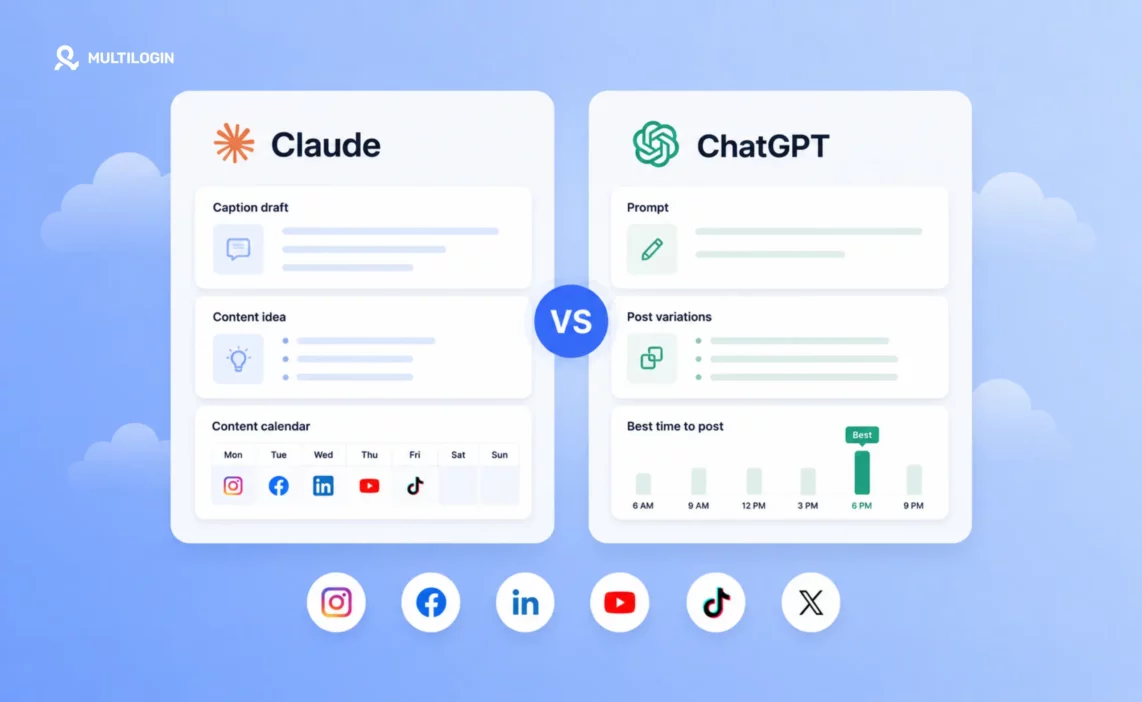



If you manage social media, you have almost certainly opened both ChatGPT and Claude, pasted in the same prompt, and wondered which one to actually pay for. Scroll Reddit and you will see the same debate on repeat: people cancelling ChatGPT for Claude, then bumping into Claude’s usage limits and missing ChatGPT. They look similar from the outside. In daily content work, they are not. This is a practical Claude vs ChatGPT comparison for social media in 2026, built around the jobs you actually do: writing captions, holding a brand voice, making visuals, planning content, and doing it without blowing your budget.
Short version up front, then the detail.
Claude vs ChatGPT for social media: the quick answer
ChatGPT is the better all-rounder for social media, mainly because it makes images and video inside the same app, which is half of social content. Claude is the better writer, the one whose captions and long-form copy sound the least like a robot. Most social media managers who can afford it end up using both: ChatGPT for visuals, short-form punch, and brainstorming, Claude for long-form copy that needs to sound human. If you must pick one and your work is visual, pick ChatGPT. If your work is words first, pick Claude.
What each one is built for
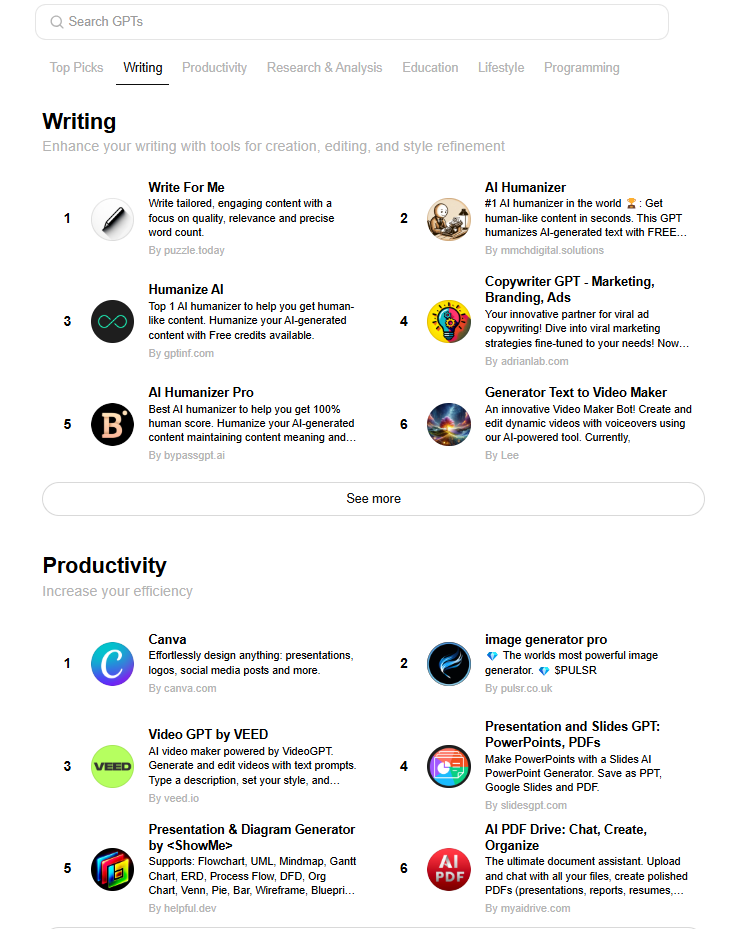
ChatGPT, from OpenAI, has grown into an everything app. As of 2026 its default model is GPT-5.5, and the paid plans bundle native image generation (ChatGPT Images 2.0), Sora for video, voice, custom GPTs, and a large library of connectors. For a social media manager that matters, because you can draft a caption, generate the post image, and storyboard a short video without leaving the window.
Claude, from Anthropic, is narrower on purpose. Its 2026 lineup is Claude Opus 4.8, Sonnet 4.6, and Haiku 4.5, and it is built around reasoning and writing rather than a wide feature surface. It does not generate post images or video inside the chat. What it does instead is write, and it tends to write copy that needs less cleanup before it sounds like a person wrote it. It also carries a very large context window, up to a million tokens, useful when you want to feed it a brand’s whole tone guide and past posts.
Claude vs ChatGPT for writing: long-form vs short-form
This is where the two genuinely differ, and the split is sharper than most people expect. A useful way to think about it, popularized by creators who tested both side by side, is long-form versus short-form.
For long-form writing, articles, newsletters, threads, captions with a story, Claude usually wins. Its copy has rhythm and restraint, flows like full sentences instead of bullet points dressed up as paragraphs, and needs less editing to remove the AI tone. For short-form punch, hooks, headlines, one-line captions, and fast volume, ChatGPT often wins. Ask it for thirty caption options and you get thirty usable ones in seconds. One famous test framed it perfectly: ask both for a quick punchy post, and ChatGPT delivers the snack you asked for while Claude serves a beautiful three-course meal you did not order. Great writing, wrong format. So match the tool to the length: Claude for the long pieces, ChatGPT for the short, snappy ones.
Brand voice and consistency
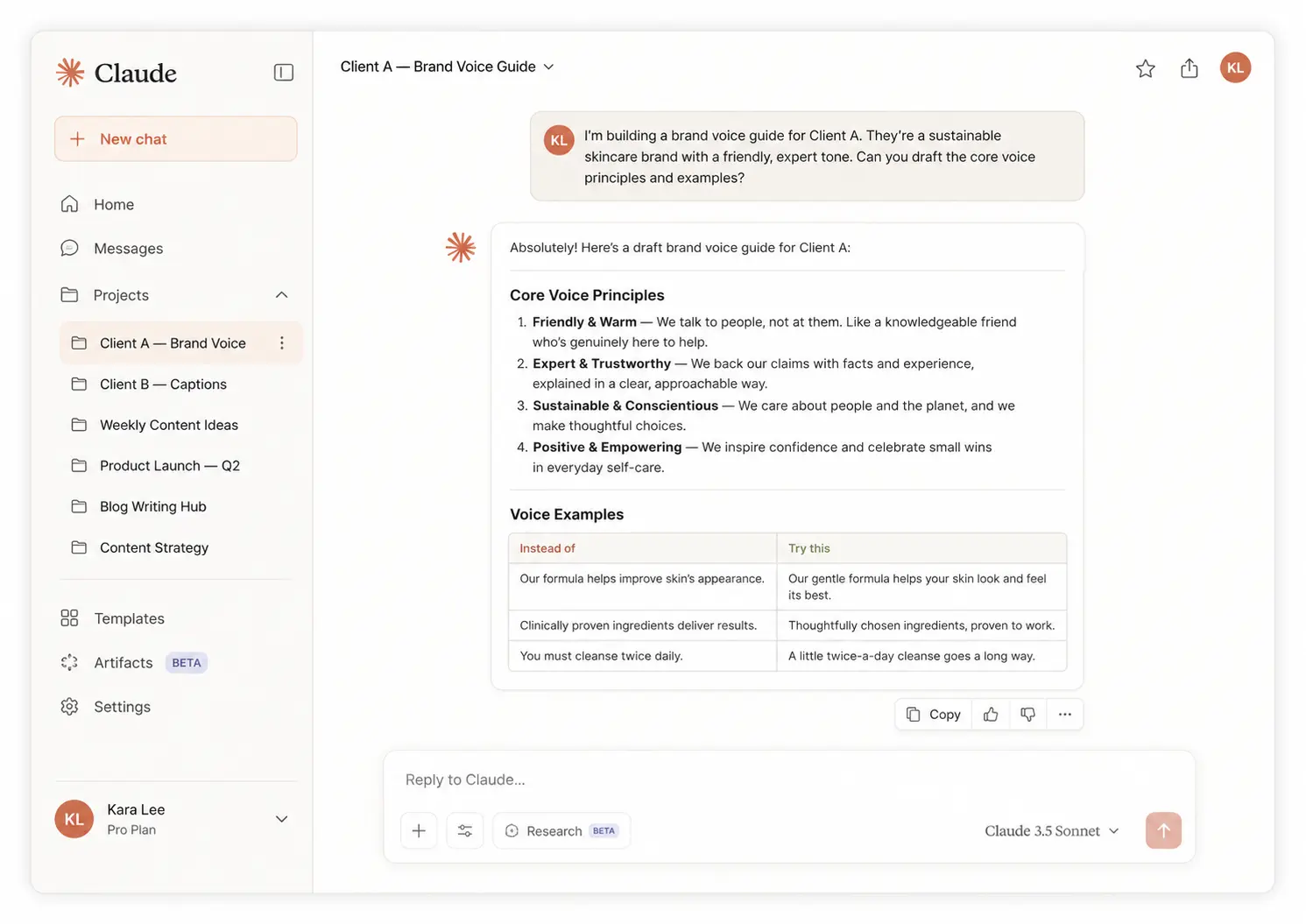
Holding one voice across many posts is the hardest part of scaled content. Both tools help in different ways. ChatGPT lets you build a custom GPT loaded with your brand guidelines, so anyone on the team can use the same configured assistant. Claude leans on its large context and Projects, where you keep brand guidelines, examples, and rules in one place and have every chat draw from them.
In practice, ChatGPT’s custom GPTs are easier to share across a team, while Claude’s large context holds a nuanced voice more faithfully within a session. If you run a team, the shareability of custom GPTs is handy. If you are a solo manager protecting a delicate brand voice, Claude’s consistency tends to win.
Visual content: images and video
This is the clearest gap, and it favors ChatGPT heavily. ChatGPT generates post images natively and makes short video through Sora, all inside the paid plans. For a social media manager that is enormous, because so much of the job is visual and you can stay in one tool from idea to image.
Claude does not generate images or video for posts. It can write the brief, the shot list, or the prompt you then take to an image or video tool, but the visual itself happens elsewhere. So if your content is image and video heavy and you want one tool to do most of it, ChatGPT is the obvious pick. If you pair Claude with a design tool like Canva anyway, this gap matters less.
Ideas, strategy, and brainstorming
Here the split flips back toward ChatGPT for one specific job: broad brainstorming. Many heavy users notice that Claude, for all its writing strength, can feel a little narrow when you want to explore wide, generating the “right” answer rather than twenty directions. ChatGPT tends to throw out more raw options to pick from. So a common workflow is to brainstorm broad in ChatGPT, then take the best angle into Claude to write it well. For the thinking layer, building a content strategy or reasoning through a campaign, Claude’s more deliberate, structured style is strong. Use ChatGPT to widen, Claude to deepen.
Claude vs ChatGPT for marketing
For marketing specifically, the division holds. ChatGPT is the faster workhorse for ad copy variations, quick social posts, images, and campaign brainstorming at volume. Claude is the better choice for the pieces where voice and nuance sell, long-form emails, landing-page copy, brand storytelling, and thoughtful repurposing of one asset into many. A lot of marketing teams run both and route work by type.
Claude vs ChatGPT for coding
Not strictly social media, but it comes up. Both have dedicated coding systems, OpenAI’s Codex and Anthropic’s Claude Code. The rough consensus in 2026 is that they are close, with ChatGPT often praised for speed and quick fixes and Claude praised for structured, readable code and explaining its reasoning. For the light scripting a social media manager might do, like automating a posting flow, either is fine.
Claude vs ChatGPT for everyday use and studying
For everyday questions and studying, ChatGPT is the more beginner-friendly all-rounder, with web browsing, voice, images, and a familiar interface, which is why it remains the default for most casual users. Claude shines for studying dense material: it handles long PDFs and documents well thanks to its large context, and explains complex topics in a calm, teacherly way that many learners prefer. If you summarize long readings or work through nuanced topics, Claude is worth a look. If you want one tool for a bit of everything, ChatGPT fits.
What people say on Reddit
If you read Claude vs ChatGPT threads on Reddit, two themes dominate. The praise for Claude is almost always about tone: people say it sounds more natural and direct, and skips the filler that annoys them in ChatGPT, the “you’re not crazy,” “let’s take a breath,” over-reassuring style that many find condescending. For writing-heavy users, that alone is the reason they switch.
The complaint about Claude is just as consistent: usage limits on the $20 Pro plan. Heavy users report hitting caps mid-task and having to wait or switch tools, and there is no middle tier between Pro at $20 and Max at $100, which frustrates people who want more headroom without a big jump. ChatGPT’s $20 Plus plan tends to feel more generous on limits for the same money. So the community pattern is clear: people love Claude’s writing and tone, and leave or supplement it because of the limits.
Claude vs ChatGPT pricing in 2026
Pricing is close at the entry level, where most social media managers live. Both start their main paid plan at $20 a month. The differences show up at the edges.
| Plan | ChatGPT (OpenAI) | Claude (Anthropic) |
|---|---|---|
| Free | $0, shows ads in the US, GPT-5.3 | $0, no ads, daily limits |
| Low-cost tier | Go, $8/mo (ad-supported) | None |
| Main paid plan | Plus, $20/mo | Pro, $20/mo ($17 annual) |
| Power tiers | Pro, $100 and $200/mo | Max, $100 and $200/mo |
| Teams | Business, about $25/seat ($20 annual) | Team, $25/seat ($20 annual) |
| Native images and video | Yes (images and Sora video) | No |
Two things worth knowing. ChatGPT now shows ads on its Free and Go plans in the US, while Claude’s free plan has no ads. And on the main $20 plans, the value split is simple: ChatGPT gives you more tools and more generous limits, Claude gives you better writing. For a working social media manager, the $20 Plus or Pro tier is the right starting point either way.
What about Gemini and Grok?
ChatGPT and Claude are not the only options. In a Claude vs ChatGPT vs Gemini comparison, Google’s Gemini is the one to watch for anyone living in Google Workspace, with strong multimodal features and tight Docs and Gmail integration. In a Claude vs ChatGPT vs Grok comparison, xAI’s Grok is built into X (Twitter) and leans real-time and casual, which suits social listening and trend-spotting on that platform. For pure writing quality Claude still tends to lead, and for all-in-one content ChatGPT still tends to lead, but Gemini and Grok are worth a look depending on which ecosystem you already work in.
Privacy and your client data
If you handle client accounts, this matters. On ChatGPT’s Free and Plus plans, your conversations may be used to improve OpenAI’s models unless you turn that off in settings. Claude’s consumer plans also involve a training choice you control. For either tool, if you are pasting in sensitive client material, check the data setting first, or use a business or enterprise plan, where training on your data is off by default. This is a habit worth building regardless of which tool you choose.
Which is better for social media in 2026?
Here is the honest verdict, by the kind of work you do. Choose ChatGPT if your content is visual, you want one tool from idea to image to video, you value speed, volume, and broad brainstorming, or you want shareable custom GPTs for a team. Choose Claude if your work is long-form and writing first, brand voice is everything, you repurpose long content often, or you want copy that needs the least editing. And if you can run both at $20 each, that is what a lot of social media managers actually do. There is no single winner, only the right fit for your workflow.
Where a cloud phone fits into the picture
One thing neither tool does is post for you across many accounts safely. AI writes the caption and makes the image, but something still has to log into each account and publish, without linking them all to one device. That is the job of a cloud phone: a real Android device in the cloud for each account, so your AI-made content goes out cleanly across every profile. If you run accounts at scale, the full picture is AI for creation and a cloud phone for social media on the posting side, working together to keep managing multiple social media accounts safe.