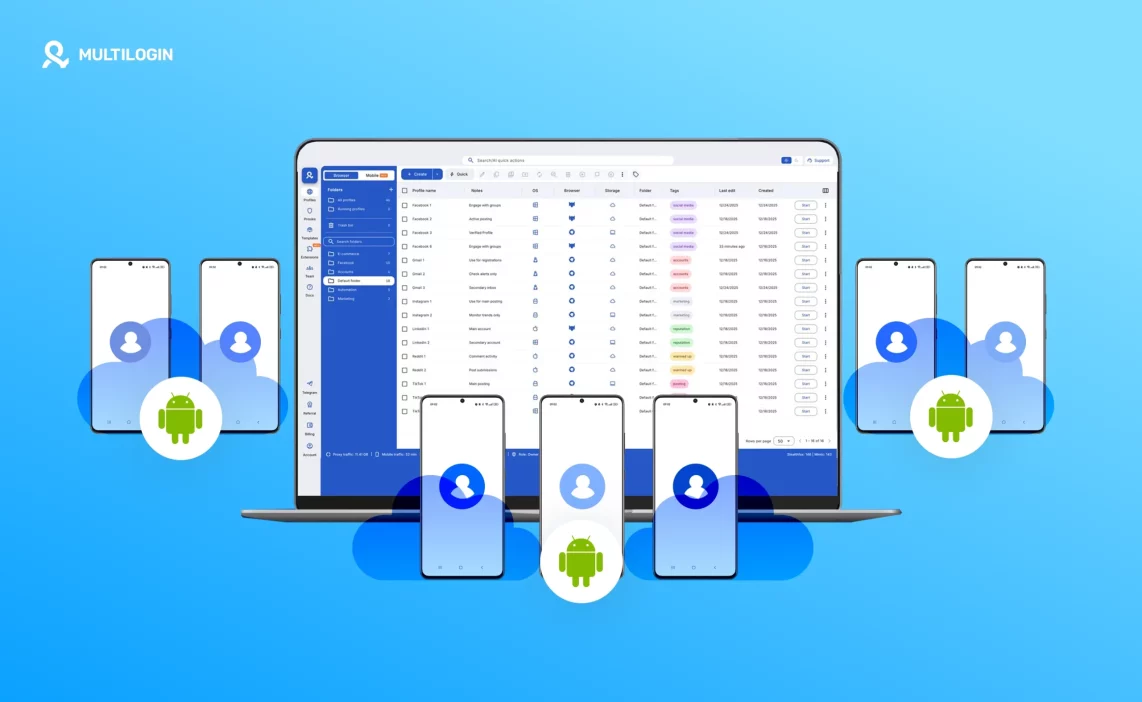

Mobile farming breaks the moment platforms connect your accounts to the same device signals. One ban turns into many. Sessions disappear. Work gets wiped. Buying more hardware only repeats the cycle. The issue is not scale. It is instability.
Phone farming with Multilogin changes the structure. Instead of juggling fragile devices, you work with cloud Android environments that keep their identity over time. Each environment stays isolated. Sessions remain intact. If one account gets flagged, you fix that environment without burning the rest.
This approach turns mobile farming into something predictable. You stop rebuilding setups after every ban and start maintaining mobile environments that can be reused, controlled, and scaled without losing everything you already built.
What is mobile farming
Mobile farming is the practice of managing multiple mobile accounts over time without letting them collide with each other.
It is not about creating as many accounts as possible. It is about keeping each account stable, separate, and reusable.
In mobile farming, every account needs its own mobile environment. Sessions must stay intact so platforms see the same identity every time you log in. When sessions reset or device signals overlap, bans follow. If you get banned and have to start from zero again, that is not mobile farming. That is rebuilding after failure.
Modern mobile farming focuses on three things:
- Managing multiple mobile accounts over time: Accounts are reused, not recreated. You log in today, tomorrow, and next week from the same mobile environment, not a fresh one.
- Keeping sessions stable: Login state, app data, and session history remain intact. This prevents platforms from treating every login as suspicious or new.
- Avoiding overlap between mobile identities: Each account runs in its own isolated environment. No shared signals. No accidental cross login. No chain bans.
If your setup collapses as soon as you add more accounts, the issue is not scale. It is consistency. Mobile farming only works when every mobile environment behaves predictably over time.
Why do some of the mobile farming setups collapse
Most mobile farming setups collapse for the same reason: the structure cannot survive repeated use over time. Accounts do not disappear because someone clicked the wrong button or acted too fast. They disappear because the environment behind them stops looking consistent, and once that happens, platforms begin connecting accounts that were supposed to stay separate.
Device signal overlap
Device signal overlap is one of the most common failure points in mobile farming. When multiple accounts share system data, reuse the same environment, or are accessed from the wrong place even once, platforms start seeing patterns instead of isolated identities. These overlaps often happen quietly, without any visible warning, until several accounts are already linked.
If one account gets flagged in this situation, the rest are already exposed. Fixing a single account does not stop the damage, because the problem lives in the shared structure behind it. If you keep seeing multiple accounts disappear after logging them into similar environments, this is not a coincidence. It is signal overlap catching up with the setup.
Session loss and forced rebuilding
A stable mobile account depends on session continuity. When sessions are wiped, login states disappear and platforms treat the account as if it has never existed before. Every new login raises questions, triggers extra checks, and increases the chance of suspension.
This is how teams end up rebuilding instead of maintaining. Accounts work for a short time, sessions get lost, and everything has to be recreated from scratch. If bans happen after restarts, updates, or environment resets, the issue is not the account itself. It is the loss of session history that breaks trust and forces the platform to reassess the identity.
Scaling multiplies risk
Scaling a weak mobile farming setup does not increase efficiency. It increases exposure. Every new environment adds another point where signals can leak, settings can overlap, or mistakes can propagate across the system. In unstable setups, one broken environment is often enough to affect the rest through shared patterns.
Why replacing devices does not fix mobile farming
Replacing devices feels like a fix because it looks like change, but in mobile farming it usually repeats the same failure in a new form. When the underlying setup stays the same, accounts continue to share patterns, sessions get lost, and identities never settle into something stable. Adding more devices or rotating them faster does not address why bans happened in the first place. It only restarts the cycle and delays the next collapse.
- Reusing environments keeps hidden links alive even when accounts look separate on the surface
- Reset loops wipe session history and force platforms to treat accounts as new again
- Identity instability makes every login look unfamiliar, increasing checks and suspensions
More devices do not create separation. Better structure does.
How mobile farming works with cloud Android environments
This is where mobile farming changes direction. Instead of tying accounts to devices that break, reset, or get reused by mistake, each account runs inside its own cloud Android environment built to last. Every environment carries a persistent mobile identity, so the platform sees the same signals every time the account is accessed. System data stays consistent. Mobile fingerprints do not shift between sessions. The account is not forced to reintroduce itself again and again.
These environments are isolated by design. One account does not leak into another. One mistake does not spread across the setup. If an account gets flagged, you deal with that single environment instead of watching everything fall apart. That separation is what keeps the rest of the operation intact.
This changes how you think about mobile farming. You stop managing devices and start managing environments. Devices fail. Environments are maintained. When the structure stays stable, accounts stop breaking for reasons you cannot see or control.
How Multilogin solves the core problems in mobile farming
Multilogin approaches mobile farming as an infrastructure problem, not something to patch with workarounds. Instead of juggling separate tools and fragile setups, you work with cloud Android environments and browser profiles inside one platform. Everything lives in the same system, so mobile and web activity stay organized, controlled, and easy to trace back when something goes wrong.
From a single dashboard, you create, launch, pause, and manage mobile environments without rebuilding them every time. When an account gets flagged, you do not start over. You isolate that environment, fix the issue, and keep the rest running. That control is what stops small problems from turning into chain bans.
This is what long term mobile farming looks like. Environments are reused, not recreated. Sessions stay intact. History remains consistent. You are no longer reacting to instability or guessing what broke.
Multilogin solves mobile farming by removing instability, not by adding shortcuts.
Learn more about Multilogin’s cloud phones!
Mobile identity and session persistence with Multilogin
Mobile farming only works when identity stays consistent over time, and this is where many setups quietly fail. With Multilogin, each mobile environment is treated as its own long term identity, not a temporary container that resets after every stop or restart. Sessions do not disappear when you close or relaunch an environment. App data stays in place. Login state remains exactly where you left it. This continuity is what allows accounts to behave normally instead of looking new or unstable every time they are accessed.
- One environment equals one mobile identity: Each account lives inside its own isolated environment with no shared signals.
- Sessions persist across restarts: Closing and reopening an environment does not reset history or force new logins.
- App data and login state remain intact: Accounts keep their context, reducing repeated verification and risk.
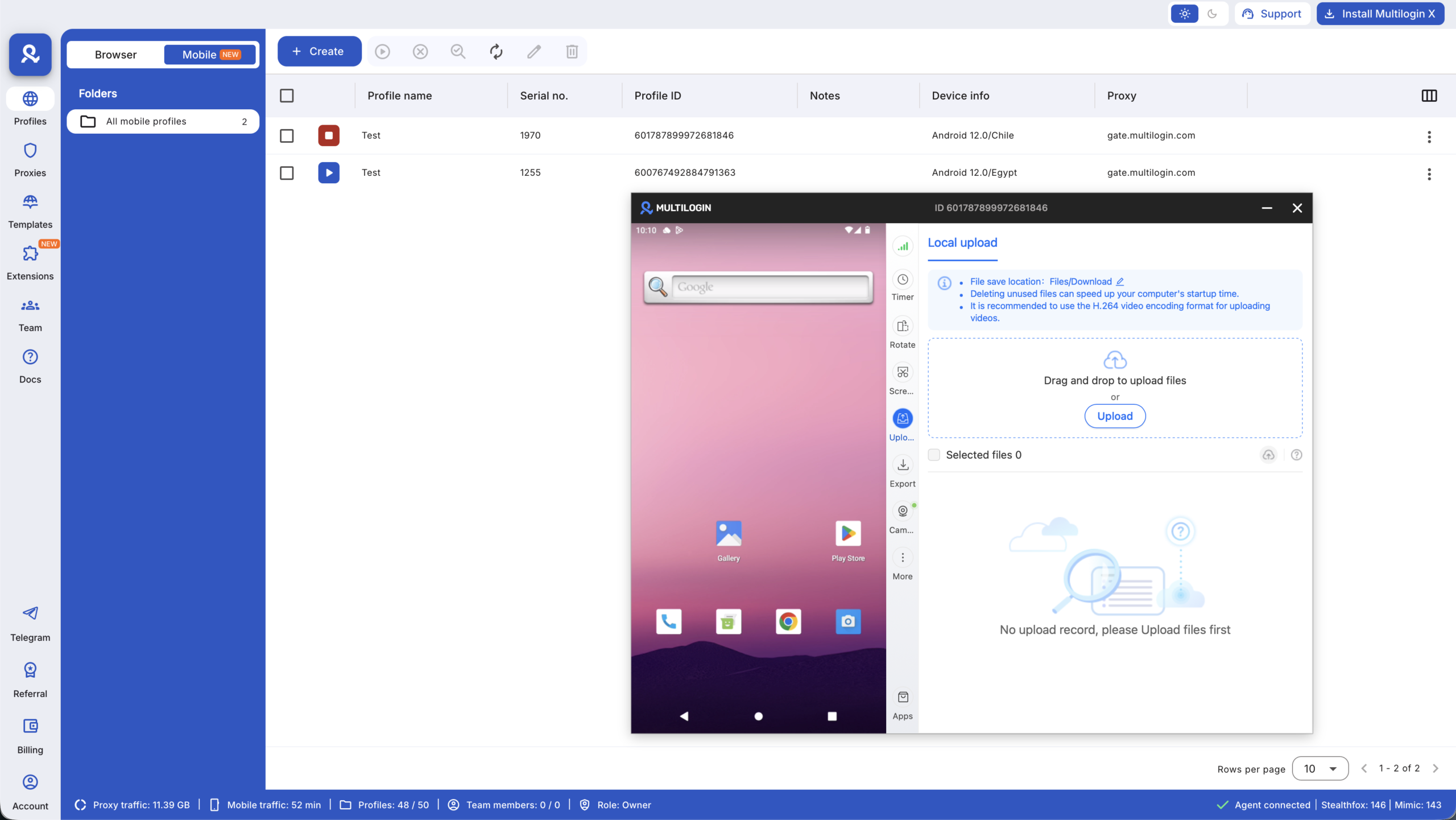
When one account fails, the damage stops there. The rest of the setup continues untouched, because identities are not linked through shared structure.
Network and location control in mobile farming with Multilogin
Network mistakes are one of the fastest ways to break a mobile farming setup, even when everything else looks correct. Multilogin keeps network control tied to each mobile environment, so accounts do not drift into patterns that platforms can connect. This is not about hiding activity. It is about keeping signals consistent so accounts behave the same way every time they are accessed.
- Multilogin assigns proxies at the profile level, so each mobile environment keeps its own network path instead of sharing one
- Multilogin maintains location consistency per environment, preventing sudden shifts that trigger checks
- Multilogin prevents pattern overlap across accounts, stopping one network mistake from affecting the rest
This works as protection, not anonymity. You are reducing structural signals that cause accounts to be grouped together.
Scaling mobile farming without rebuilding everything with Multilogin
Scaling usually breaks mobile farming when growth forces teams to rebuild what already works. Multilogin changes that by letting you add capacity without changing the structure behind existing environments. What works at a small scale continues to work as the setup grows.
- Multilogin lets you launch multiple environments from one dashboard, without switching tool
- Multilogin adds capacity without changing structure, so identities and sessions remain stable
- Multilogin removes the need to rebuild working setups, even as volume increases
With Multilogin, scaling becomes predictable instead of risky because the foundation does not shift under pressure.
Team access and control for mobile farming with Multilogin
Mobile farming often breaks when multiple people touch the same setup without clear boundaries. Multilogin is built to support team access without creating overlap or confusion, even as more people get involved.
- Multilogin allows shared access without sharing credentials, keeping environments secure
- Multilogin defines clear ownership of environments, so responsibility stays visible
- Multilogin enables controlled handoff between team members, without resetting sessions or identity
With Multilogin, teams scale operations without breaking setups that took time to build.