
Facebook has rebuilt its monetization infrastructure significantly over the past two years. What used to be a fragmented collection of programs — in-stream ads here, Stars there, fan subscriptions somewhere else — has been consolidated into a unified system called Facebook content monetization.
If you’ve seen the term in Creator Studio or Meta Business Suite and wondered what it actually covers, how to qualify, and why your content might not be earning, this guide gives you the full picture.
It also covers what agencies and multi-page operators need to know: the eligibility criteria, how the payout system works, what triggers policy issues, and how to manage multiple monetized Facebook pages without putting your entire operation at risk through shared infrastructure.
If you’re already running or planning to run multiple Facebook pages and accounts, see how Multilogin helps you manage multiple Facebook accounts safely before account linking issues undermine the monetization you’ve built.
What is Facebook content monetization?
Facebook content monetization is Meta’s consolidated program for paying creators directly for the content they publish on Facebook. It replaced several separate programs and unifies multiple revenue streams under a single application process, single eligibility review, and single payout system.
Under the current structure, Facebook content monetization covers:
In-stream ads: Short ads that run before, during, or after your video content. You earn a share of the ad revenue based on video views and ad impressions. This is the largest revenue driver for most creators on the program.
Performance bonus: Facebook pays creators a bonus based on content performance metrics — reach, engagement, and views — beyond ad revenue. This component rewards content that performs exceptionally well regardless of ad density.
Stars: Viewers can send Stars to creators during live videos and on regular posts. Each Star is worth $0.01 to the creator. This is Facebook’s equivalent of TikTok’s gifts or YouTube’s Super Thanks.
Branded content: Paid partnerships between creators and brands, disclosed through Meta’s branded content tools. This isn’t a direct Facebook payout but a facilitated monetization path for creator-brand deals.
The shift to a unified system means you apply once and can access multiple revenue streams from the same page, rather than applying separately for each. Facebook content monetization beta — the phased rollout that’s been expanding since 2024 — has been gradually opening to more creators and more countries through 2025 and into 2026.
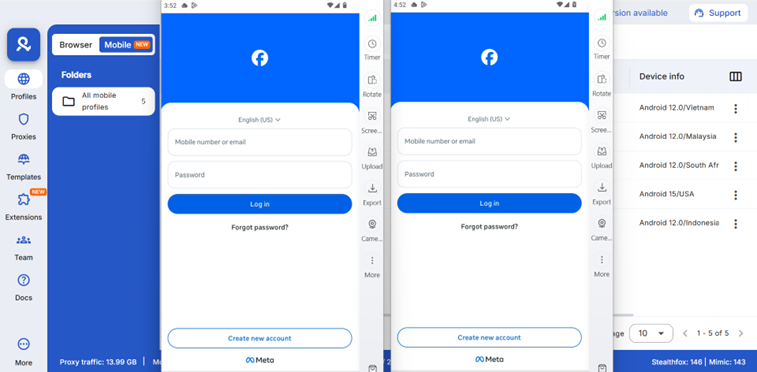
Facebook content monetization requirements and eligibility criteria
Eligibility is evaluated at the page level, not the account level. A Facebook Page (not a personal profile) is what gets monetized. The requirements Meta uses to determine eligibility fall into a few categories.
Follower threshold: Your page needs at least 10,000 followers to be eligible for most content monetization features, though some components like Stars can be accessed at lower follower counts. The performance bonus program has been known to invite pages with as few as 5,000 followers during the beta expansion.
Content volume: Facebook typically requires 5 or more videos in the past 30 days to assess content monetization eligibility. Consistency of publishing is factored into the review.
View threshold: In-stream ads require a minimum of 600,000 total minutes viewed in the past 60 days, with at least 60,000 of those from one-minute+ views. This is the requirement that most creators don’t meet initially and need to build toward.
Page compliance: Your page must be in good standing with no active policy violations. Pages with recent violations, unpublished content, or restricted reach are typically ineligible until the violations are resolved.
Country eligibility: Facebook content monetization is not available everywhere. The program is available across most of North America, Western Europe, Australia, and parts of Southeast Asia and Latin America. The beta expansion has been rolling eligibility to new countries gradually. Checking your specific country’s current status in Creator Studio is the most reliable way to verify current availability.
Age: You must be 18 or older to access payouts.
Facebook content monetization criteria 2026 update: Meta has been adjusting the view thresholds and bonus program criteria throughout 2025 and into 2026. The most current requirements are always shown in your Creator Studio under Monetization → Eligibility. What’s published in third-party guides — including this one — may lag behind the most recent changes, so always verify directly.
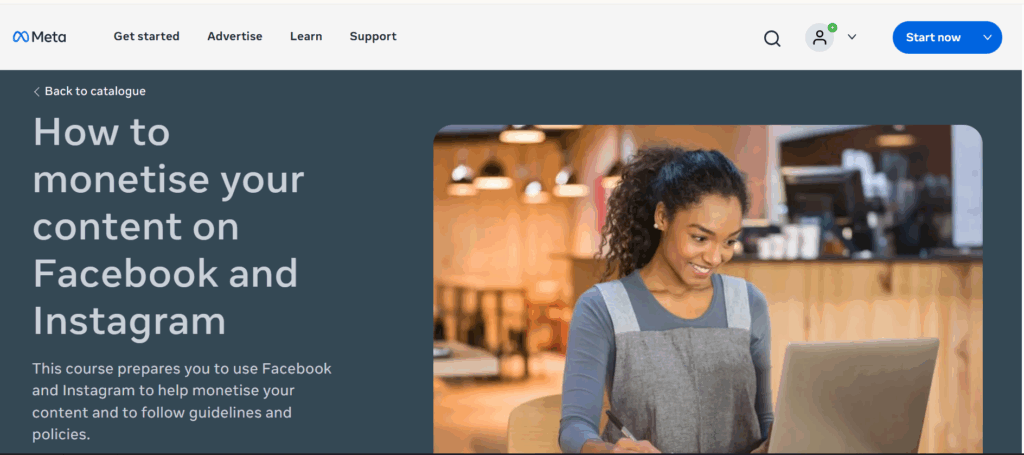
How to apply for Facebook content monetization
The application process is handled entirely through Meta’s creator tools. Here’s how it works in practice.
Go to your Facebook Page and open Creator Studio (studio.facebook.com) or Meta Business Suite. Navigate to the Monetization section in the left panel. If your page is eligible, you’ll see a prompt to apply. If it’s not eligible yet, you’ll see a breakdown of which requirements you haven’t met and what the current gap is — follower count, view threshold, compliance status, or country.
If you’re eligible and haven’t been invited yet, you can submit an interest form. The Facebook content monetization beta interest form has been the entry point for many creators during the phased rollout. Submitting the form doesn’t guarantee immediate access — Meta reviews pages in batches.
Once approved, you’ll go through a setup flow: connect a bank account or PayPal for payouts, accept the Facebook content monetization terms, review the content monetization policies, and configure which types of ads you want enabled.
The setup process typically takes 15 to 30 minutes. Payout processing begins after setup is complete and you reach the minimum payout threshold ($100 for most regions).
How Facebook content monetization actually pays
Understanding how the payout mechanics work helps you set realistic expectations and optimize your content strategy accordingly.
In-stream ad revenue is based on RPM — revenue per thousand views. Facebook’s RPM for in-stream ads varies significantly by niche, audience geography, and content type. Finance, business, health, and technology content generally earns higher RPM ($3–8+ per thousand views) than entertainment or lifestyle content ($0.50–2 per thousand views). US, UK, and Australian audiences generate higher ad rates than audiences in lower-CPM markets.
In-stream ads only run on videos that are at least 3 minutes long. Videos under 3 minutes don’t qualify for mid-roll ads, only pre-roll — which generates significantly less revenue. This is why you’ll notice successful Facebook creators consistently publishing 5–10 minute videos rather than shorter clips.
The performance bonus is paid by Meta directly based on content performance metrics. The exact formula is not publicly disclosed, but page reach, engagement rate, and video completion rate are understood to be key factors. Bonus amounts vary widely — some creators report modest additions to their ad revenue, while others in high-performing niches report bonus payments that match or exceed their ad earnings.
Stars payouts are straightforward: $0.01 per Star received, paid monthly once you hit the minimum threshold.
Facebook content monetization payout schedule: Meta pays out monthly, typically processing payments around the 21st of the month for the previous month’s earnings. Minimum payout threshold is $100. If you don’t hit $100 in a given month, earnings roll over to the next.
Facebook content monetization policies and common issues
The policies section is where most creators run into problems, and where the gap between earning and not earning often lives.
What is a Facebook content monetization policy issue?
A policy issue is a flag on your content or page that restricts or disables monetization on specific posts or across your page. Common reasons include:
Reposted or aggregated content — Facebook’s system detects videos that are primarily someone else’s content. Even licensed content or heavily edited compilations can trigger this. The “limited originality of content” flag is one of the most common monetization restrictions.
Music rights violations — videos with copyrighted music that isn’t cleared through Meta’s licensed music library will be flagged and demonetized.
Content that violates community standards — violence, misinformation, adult content, or other policy violations will restrict monetization on the affected content and, in repeated cases, on the page overall.
Clickbait or engagement bait — content that explicitly asks for likes, shares, or comments (engagement bait) is penalized algorithmically and can trigger monetization restrictions.
How to appeal Facebook content monetization policy issues:
Each flagged piece of content has an appeal option within Creator Studio under the Monetization → Content section. Appeals are reviewed by Meta’s policy team and can take 1–5 business days. Not all appeals succeed — if the violation is genuine, the restriction typically stands.
For page-level restrictions — where your entire page’s monetization is affected rather than individual videos — the appeal process is through Meta’s Appeals section in Creator Studio. These reviews take longer and have a lower success rate because they indicate a pattern rather than a one-off violation.
How to follow Facebook content monetization policy consistently:
Publish original content you own or have proper rights to. Avoid music that isn’t in Meta’s licensed library or that you haven’t cleared separately. Don’t use engagement bait language in captions. Keep content within community standards — even content that’s borderline but technically allowed can reduce distribution and indirectly affect monetization by limiting reach.
What content can be monetized on Facebook?
Not all content types qualify equally. Here’s how the main formats break down:
Standard video content (3+ minutes): The primary monetization vehicle. These qualify for in-stream ads including mid-roll placement, which generates significantly more revenue than pre-roll only.
Short-form video (Facebook Reels): Facebook Reels currently have a separate monetization structure through the Reels Play bonus program, distinct from the standard content monetization program. They don’t qualify for in-stream ads but can participate in bonus programs.
Live video: Live sessions can earn from Stars and, in some cases, from in-stream ads. Live video is also one of the stronger formats for direct Stars engagement because viewers can send them in real time during the session.
Text posts and images: These don’t qualify for in-stream ad revenue directly but can qualify for performance bonuses based on reach and engagement.
Branded content posts: Any post that’s a paid partnership must be disclosed using Meta’s branded content tools. Undisclosed paid partnerships violate policy and can result in monetization restrictions.
Facebook content monetization beta: what it means and current status
The beta label refers to the phased rollout Meta used to expand the unified content monetization program beyond its initial launch group. Rather than opening the program to all eligible creators simultaneously, Meta invited creators in batches — first to specific countries, then to broader regions, then more widely.
As of 2026, the program is no longer in a strict beta for most major markets. The US, UK, Canada, Australia, and most of Western Europe have access to the full program. Some markets are still in a limited rollout phase. If you’re in a market where the beta was announced but you haven’t received access yet, checking Creator Studio directly is the most accurate status check — the interest form submission still applies in markets where rollout is ongoing.
Why your content might not be earning
“Content is not earning” is one of the most searched Facebook monetization phrases, and there are a few common reasons why this happens even when your page is technically enrolled in the program.
Videos under 3 minutes don’t qualify for mid-roll ads. A library of mostly short-form content will generate very little in-stream revenue regardless of view counts.
Low-CPM audience geography. A page with 5 million followers in countries with very low ad rates can out-earn a page with 200,000 followers in high-CPM markets — or the reverse. If your audience is primarily in low-CPM regions, your RPM will reflect that.
Engagement rate drop. Facebook’s distribution algorithm weights recent engagement performance. A page whose recent content is underperforming relative to historical averages will see reduced reach, which directly reduces ad impressions and revenue.
Individual video policy flags. A content flag on one video doesn’t always appear as a prominent alert — some creators don’t notice that specific videos are demonetized until they audit the content list in Creator Studio.
Page-level restrictions that weren’t caught. If your page received a restriction you didn’t notice or didn’t appeal, monetization may be partially or fully disabled without an obvious notification.
For a broader breakdown of how to get paid on Facebook across multiple income streams — not just content monetization — that guide covers the full range of Facebook monetization options including Stars, fan subscriptions, and branded content in more detail.
Facebook content monetization for multiple pages: the account linking problem
Agencies, social media managers, and professional content operators often manage multiple Facebook pages across different niches, brands, or clients. Facebook content monetization can be active across multiple pages simultaneously — there’s no rule against running five or ten monetized pages.
The problem is operational, not policy-based: managing multiple Facebook pages from the same device and IP environment gives Meta’s systems a clear signal that the accounts are related. Browser fingerprinting and device-level tracking connect accounts that share hardware identifiers, IP addresses, or session patterns. When Meta’s systems link accounts this way, a policy violation or ban on one page can cascade to others in the cluster.
This is how agencies lose multiple client pages simultaneously. Not because each page individually violated policy, but because the shared infrastructure created a connection that allowed enforcement action on one account to spread to linked accounts.
Understanding how Facebook shadow bans work matters here too — shadow restrictions that reduce reach without explicit notification can quietly drain monetization revenue across multiple pages before anyone notices there’s a problem. A shadow ban suppresses content distribution without informing you, which directly reduces ad impressions and performance bonus eligibility.
The solution isn’t to stop managing multiple pages — it’s to isolate each page’s operating environment properly. For agencies managing content monetization at scale, Multilogin’s social media marketing tools are built specifically for this workflow.
Understanding why Facebook accounts get banned and why Facebook ad accounts get banned helps build the right operational habits before problems hit rather than after.
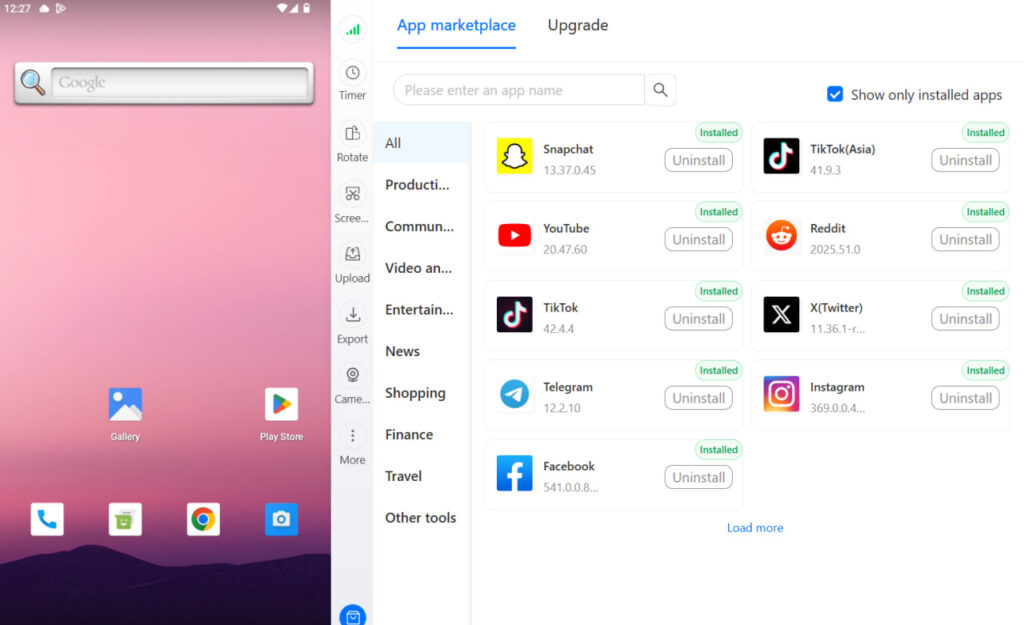
How Multilogin cloud phones protect monetized Facebook operations
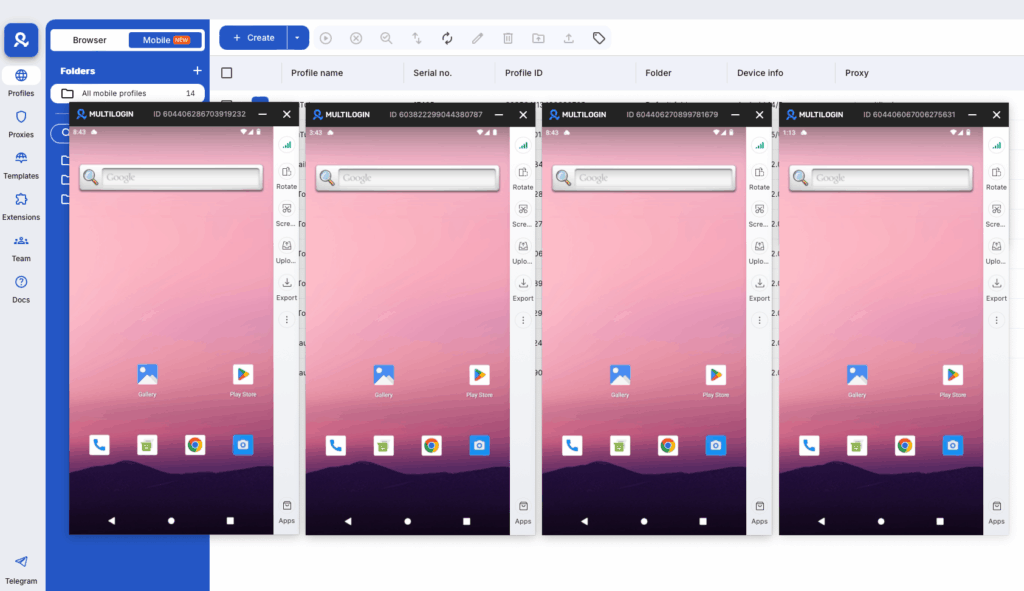
Multilogin cloud phones give each Facebook page operation its own real Android environment in the cloud — with a unique IMEI, Android ID, MAC address, and dedicated mobile-grade residential proxy. Meta’s detection systems see each cloud phone as a separate physical device in a separate location. Nothing links across accounts unless you intentionally configure it.
For agencies managing monetized Facebook pages for clients, this is the infrastructure that prevents a single account enforcement from spreading. Each client’s pages run in their own isolated environment, with their own session history, their own IP, and their own device fingerprint. The pages are genuinely independent from Meta’s perspective.
Persistent session history matters for monetization stability. Facebook’s content monetization review factors in page history — how long the page has been active, whether login patterns are consistent, whether the account shows signs of automation or unusual access. Pages that keep triggering re-authentication from changing devices or IPs accumulate flags that can affect both reach and monetization eligibility over time.
Cloud phones maintain persistent session data between uses. Each Facebook page’s app history, session state, and login continuity carry over naturally. Pages behave like they’re being accessed from a consistent, real device — because they are.
The mobile management advantage. Facebook’s mobile app and Creator Studio on mobile have slightly different behaviors than desktop Creator Studio. Managing pages through the Facebook mobile app on cloud phones mirrors how real individual page managers operate, which produces more natural account behavior patterns than automation-heavy desktop workflows.
Multilogin cloud phones: real Android devices in the cloud →
For operators who also run Facebook ad accounts alongside content monetization pages, best antidetect browsers for Facebook covers the technical setup for keeping ad accounts and organic pages properly separated. And for content creators specifically managing multiple monetized properties, best antidetect browsers for content creators is worth reading before scaling up.
How to get started with Multilogin for Facebook content monetization
Setup takes less time than most people expect. Multilogin’s cloud phone pricing is usage-based at €0.009 per minute with bonus minutes when you start. Every plan also includes full access to Multilogin’s leading antidetect browser — so your desktop Creator Studio workflow and mobile Facebook management run from the same dashboard.
Create a cloud phone profile for each Facebook page you manage. Select the device type — Multilogin supports approximately 30 real Android device models across Samsung, Google, Redmi, OPPO, OnePlus, and vivo. Assign a residential proxy with city-level targeting matched to the page’s primary audience location. Enable persistent storage so session data, app state, and login continuity carry over between sessions.
Install the Facebook app from the built-in store within the cloud phone. Log in with the account associated with that specific page. Manage that page exclusively from that cloud phone. Every page stays isolated — no shared signals, no linking risk, no cascade enforcement exposure.
For teams managing multiple clients’ Facebook pages, Business plans include unlimited team seats with permission controls that let you assign specific cloud phones to specific team members without exposing the full operation.
How to manage multiple Facebook accounts with Multilogin →
How to manage multiple social media accounts with Multilogin →
Checklist: before you apply for Facebook content monetization
Page has 10,000+ followers (or check your specific threshold in Creator Studio). At least 5 videos published in the past 30 days. 600,000+ total minutes viewed in the past 60 days for in-stream ad eligibility. Page in good standing — no active policy violations or content flags. Bank account or PayPal connected and verified. All monetized content is original and rights-cleared (including music). Individual video monetization status reviewed in Creator Studio — check for any demonetized videos. Each page running from its own isolated device environment if managing multiple monetized pages.
Need to manage multiple Facebook accounts? Try Multilogin Cloud Phones.
Frequently asked questions About Facebook content monetization
Check downdetector.com/status/facebook or search “Facebook down” on Twitter/X for real-time reports. If there is a platform-wide outage, wait for Facebook to resolve it on their end.
Facebook content monetization is Meta’s consolidated program for paying creators for original content published on Facebook. It unifies in-stream ads, performance bonuses, and Stars into a single application and payout system managed through Creator Studio or Meta Business Suite.
Open Creator Studio (studio.facebook.com), go to Monetization, and check your page’s eligibility status. If eligible, you’ll see an option to apply. If not yet eligible, Creator Studio shows exactly which requirements — followers, views, compliance — your page still needs to meet.
The standard threshold for most features is 10,000 followers. Some components like Stars have lower requirements. The performance bonus program has been extending invitations to pages with as few as 5,000 followers during the beta expansion.
In-stream ad RPM typically falls between $0.50 and $8+ per thousand views depending on niche, audience geography, and content type. Finance and business content earns significantly more than general entertainment. Performance bonuses vary based on content reach and engagement.
Facebook’s content monetization policies govern what types of content can be monetized. Key rules include: content must be original and not primarily composed of others’ material, music must be cleared through Meta’s licensed library, content must comply with community standards, and paid partnerships must be disclosed using branded content tools.
You can, but running multiple Facebook accounts from the same device causes exactly the kind of inconsistent behavior that triggers Facebook’s security checks. Each account needs its own isolated device environment with its own IP address to avoid repeated login flags and verification requirements.