
Everyone wants the shortcut. The overnight formula. The one hack that makes a video explode before you wake up. And while going viral on TikTok is never fully predictable — even TikTok’s own engineers will admit that — the creators who go viral consistently aren’t getting lucky. They understand what the algorithm rewards and they engineer their content around it.
This guide covers how to go viral on TikTok in 2026 — with no followers, on a new account, overnight, for free, without showing your face, as a musician, as a small business — every variation of this question people actually search. Because the core mechanics apply across all of them, with a few specific adjustments for each.
If you’re managing multiple TikTok accounts to multiply your chances of going viral, learn how to run multiple TikTok accounts without bans before platform detection becomes a problem that kills your accounts before any video gets traction.
How many views does it take to go viral on TikTok?
There’s no official threshold, and TikTok has never defined “viral” publicly. But from observed patterns across creators in different niches, a video that reaches 500,000 views is generally considered viral. Videos between 100,000 and 500,000 are often described as “trending” rather than fully viral. Some creators in smaller niches consider 50,000 views viral given their audience size.
How many likes to go viral on TikTok? Likes matter less than you’d think. The metric TikTok actually weights most heavily in its distribution algorithm is watch-through rate — the percentage of viewers who watch your video all the way to the end. A video with 10,000 views and 80% completion will get pushed further than one with 100,000 views and 15% completion.
How many views on TikTok to go viral overnight? A video that gains 50,000+ views within the first 12 hours after posting is showing strong viral signals. TikTok’s algorithm uses those early hours to test distribution on a small audience before deciding whether to push it wider. If the signals are strong — high completion, shares, comments — distribution scales fast.
How the TikTok algorithm decides what goes viral
Understanding this changes how you make every video. TikTok’s algorithm doesn’t primarily reward accounts with large followings. It rewards content performance. That’s why going viral on TikTok with no followers or with a new account is genuinely possible — and happens constantly.
When you post a video, TikTok shows it to a small initial test group. The algorithm measures four signals in roughly this order of importance:
Watch-through rate comes first. If people watch your video all the way through — or rewatch it — TikTok interprets that as strong content and expands distribution. This is why short videos that loop cleanly often outperform longer ones that trail off. Every second of your video needs to earn the next one.
Comments are weighted heavily because they indicate genuine engagement rather than passive scrolling. A video that provokes a response — whether agreement, debate, curiosity, or humor — signals to TikTok that the content is conversation-worthy. Creators who frame videos as questions or leave something slightly incomplete to prompt replies see this work in their favor.
Shares extend your reach outside the platform and into other distribution channels — text messages, Instagram stories, Twitter. TikTok treats shares as a strong quality signal because sharing requires active intent. A video that people share is one they found valuable enough to pass on.
Likes and follows matter but are the weakest signal of the four. TikTok knows people double-tap on autopilot. What matters is whether they actually watched.
The geographic and interest-based matching layer is also important. TikTok serves content to users based on their prior engagement patterns, device settings, and location. A video about coffee shop aesthetics in Seoul isn’t going to go viral with a US-only audience — TikTok will test it with users who have engaged with similar content.
How to post on TikTok to go viral: the hook is everything
The first one to three seconds of your video determine whether it goes viral or disappears. TikTok users scroll fast. If your video doesn’t create an immediate reason to stop scrolling, the algorithm never gets a chance to amplify it.
Strong hooks for viral TikTok videos fall into a few reliable patterns. The pattern interrupt — something visually or audibly unexpected in the first frame — stops the thumb. The bold claim — “This is why you’re not getting views on TikTok” — creates a reason to keep watching to find out if it applies. The visual payoff promise — showing a transformation result in the first second and then cutting back to the beginning — hooks on curiosity.
What kills a hook: slow intros, text-heavy title cards that take three seconds to load, starting with “Hey guys so today I wanted to talk about…”, or anything that looks like the beginning of a tutorial rather than the beginning of something interesting.
After the hook, your job is to keep delivering on the promise the hook made. Every section of the video needs to give viewers a reason not to skip. The ending should make them feel like they got what was promised — or leave them wanting one more piece, which drives comments.
How often should you post on TikTok to go viral?
Posting frequency matters because it gives the algorithm more chances to find what resonates. But there’s a common misunderstanding here: more posts doesn’t automatically mean more virality. One high-quality video per day with a strong hook and 80%+ watch-through rate will outperform five rushed videos with poor retention.
For new accounts, daily posting for the first 30 to 60 days is worth the effort. You’re teaching the algorithm what your content is, who responds to it, and what niche you belong in. This “category assignment” matters for long-term distribution — TikTok needs to learn who to show your content to before it can scale it.
For established accounts, posting two to four times per week is sustainable while maintaining quality. Going viral on TikTok is a consistency game over time, not a single-video lottery — though single videos can absolutely hit unexpectedly. The creators who go viral repeatedly post often enough that their videos have frequent chances to catch.
How long does it take to go viral on TikTok? For most creators, a first viral video happens between one and six months of consistent posting. Some accounts hit on their first video. Some grind for a year before something breaks through. The variables are niche competition, content quality, and frequency of attempts.
How to go viral on TikTok with no followers or a new account
This is one of the most asked questions around TikTok, and the answer is genuinely encouraging: follower count has almost no effect on distribution for new videos. TikTok’s For You Page algorithm shows content based on content signals, not account authority.
Accounts with zero followers have gone viral in every niche imaginable. What matters is:
The content itself — hook strength, watch-through, shareability. Sound selection — using trending audio dramatically increases distribution potential because TikTok actively pushes content using popular sounds to users who’ve engaged with those sounds. Posting timing — posting when your target audience is active improves early engagement velocity, which feeds the algorithm’s expansion decision. Niche clarity — new accounts that stay in one consistent topic area get categorized and distributed faster than accounts that post randomly across unrelated topics.
If you’re trying to go viral on TikTok overnight with a new account, your best lever is trending audio combined with a hook that plays on something culturally relevant at that exact moment. Trend-based content can go viral within hours because TikTok is actively looking for new content to pair with trending sounds.
How to use hashtags on TikTok to go viral
Hashtags on TikTok work differently than on Instagram. They’re not primarily a discovery mechanism the way Instagram hashtags are — they’re a content categorization signal for the algorithm.
The research on how many hashtags to use on TikTok to go viral points to three to five relevant hashtags being more effective than ten to twenty generic ones. Using #FYP or #ForYouPage adds nothing — TikTok has confirmed these don’t affect distribution. What actually helps is a mix of: one niche-specific hashtag (small community, but highly targeted), one broader category hashtag, and one or two trending topic hashtags if the content genuinely connects to them.
For small businesses trying to make their business go viral on TikTok, location hashtags can help route content to local audiences who are more likely to become customers.
For artists and musicians trying to make their music or song go viral on TikTok, using the sound directly in your video is more powerful than any hashtag. When you use your own original audio and it gets picked up by other creators, every video using that sound links back to your profile — exponential exposure.
How to go viral on TikTok without showing your face
This is entirely achievable and has spawned entire content categories. Some of the most consistent viral TikTok creators never appear on camera.
Formats that work without a face: screen recording content (software tutorials, reaction commentary, app walkthroughs), voiceover with B-roll or footage (a strong voiceover on relevant visual content can be extraordinarily engaging), text-on-screen with music or trending audio, POV content from a first-person perspective, product demonstrations where the product is the focus, animation or motion graphics, pet and animal content, aesthetic lifestyle shots.
The hook mechanics apply exactly the same way. What changes is that you’re leading with visual interest and audio rather than personal presence. Make the first frame beautiful, unusual, or immediately relevant to something your target viewer cares about.
How to make your small business go viral on TikTok
Business content on TikTok performs best when it doesn’t look like advertising. The formats that consistently go viral for small businesses fall into a few categories.
Behind-the-scenes content outperforms product showcases almost universally. Showing how a product is made, how orders are packed, how a service is delivered — these humanize a business and tap into TikTok’s appetite for authentic, unpolished content.
The “I’m a small business and here’s what I learned” format generates enormous shares because it provides value and creates empathy simultaneously. Vulnerability about mistakes, unexpected challenges, or real numbers (revenue, costs, profit margins) drives comments because people are curious about the real story behind businesses.
Customer reactions and testimonials shown in native TikTok style — not polished advertisement format — work well. Trending sound application to product content is underused by small businesses. Matching your product showcase to a trending audio creates reach far beyond your existing audience.
For businesses running multiple accounts across different niches or markets, Multilogin’s social media marketing tools help manage the workflow without account linking risk.
How to go viral on TikTok as a musician or artist
Musicians have a structural advantage on TikTok that other creators don’t: original audio. When your original sound goes viral, every video using it sends traffic back to your profile.
The key is making your sound easy to use. That means a strong, memorable hook section — typically the first 15 to 30 seconds — that creators can overlay on their own content. Instrumentals or tracks with a clear beat drop that works with a trend format get picked up faster than complex arrangements.
To make your song go viral on TikTok, seed it yourself by creating multiple videos using your own sound — different content formats, different contexts, different visuals — to establish it as active audio before encouraging other creators to use it. A sound with 15 existing videos is more likely to be picked up than one with zero.
Making your music go viral on TikTok as an artist also means collaborating. Duets and stitches with established creators who use your sound create social proof and expand distribution to their audiences.
The same logic applies to making your edits go viral on TikTok — using the right audio, trending formats, and early distribution velocity matters more than production quality in most cases.
How to go viral on TikTok Live
Going viral on TikTok Live is a different mechanism from going viral with a recorded video. Live sessions appear on the For You Page based on activity signals — how many viewers are watching simultaneously, how many gifts are being sent, and how high the comment velocity is.
To make a TikTok Live session go viral, start by warming up your existing audience with a pre-live post promoting the session. Begin the live with something immediately compelling rather than a slow intro. Keep the energy consistent — dead air kills live reach. Ask questions that get comments coming in, because comment velocity is a major distribution signal during live sessions.
Trending formats for live content that go viral include skill demonstrations, Q&As where you answer questions in real-time, challenges that viewers can participate in, and countdowns to something happening in the session.
Why your videos aren’t going viral (and what to fix)
A TikTok shadow ban is one of the most common reasons videos stop getting reach — and most creators don’t realize it’s happening. Shadow bans suppress your content in search results and on the For You Page without explicitly notifying you. Signs include sudden dramatic drops in views across all videos, content not appearing under hashtags you used, and your profile not showing in search.
Shadow bans are typically triggered by community guideline violations, using banned sounds, or behaviors that trigger TikTok’s automated detection systems — including patterns that look like bot activity or account manipulation.
Beyond shadow bans, the most common technical reason videos don’t get reach is a weak first three seconds. The second most common is posting at the wrong time — when your audience isn’t active, early engagement is slow, and the algorithm doesn’t amplify. Third is niche inconsistency — accounts that post wildly different content types confuse TikTok’s categorization and get distributed poorly.
Properly warming up your TikTok account before trying to go viral is important, especially on new accounts. An account with natural engagement history — varied activity, realistic behavior patterns — gets more initial distribution on new videos than an account that appears to have been created purely for posting.
Scaling virality: running multiple TikTok accounts
Going viral on one TikTok account is good. Building a system where multiple accounts can go viral in different niches simultaneously is how content operators and agencies build serious TikTok businesses.
Each account can target a different audience, test a different content strategy, and generate income through a separate monetization stream — TikTok Shop affiliate, brand partnerships, or Creator Rewards Program. When one account goes viral, the others keep running. When something works on one, you can apply the same format across all of them.
The operational challenge is keeping accounts isolated. TikTok’s browser fingerprinting and device detection systems link accounts that share hardware identifiers, IP addresses, or behavioral signals. If accounts get linked and one receives a violation, the others are at risk.
Multilogin cloud phones solve this at the infrastructure level. Each cloud phone is a genuine Android environment in the cloud — with real hardware identifiers (IMEI, Android ID, MAC address) that TikTok reads as a separate physical device. Each runs on its own mobile-grade residential proxy with city-level geolocation matching, so location signals are consistent per account. You control everything from a single desktop dashboard.
For operators running content at scale, phone farming with Multilogin explains how to structure high-volume TikTok operations without the hardware overhead of physical device farms.
The account management workflow becomes significantly simpler when each account has its own persistent storage — app data, login states, and session history carry over between sessions. Accounts warm up naturally and behave like real devices that have been in use over time, rather than fresh installs that TikTok treats with skepticism.
Multilogin cloud phones: real Android devices in the cloud →
How to get started with Multilogin for TikTok
Getting set up takes less time than most people expect. Multilogin’s cloud phone pricing is usage-based at €0.009 per minute, with bonus minutes when you start. Every cloud phone plan includes full access to Multilogin’s antidetect browser — so you’re managing both mobile and web-based TikTok operations from one dashboard.
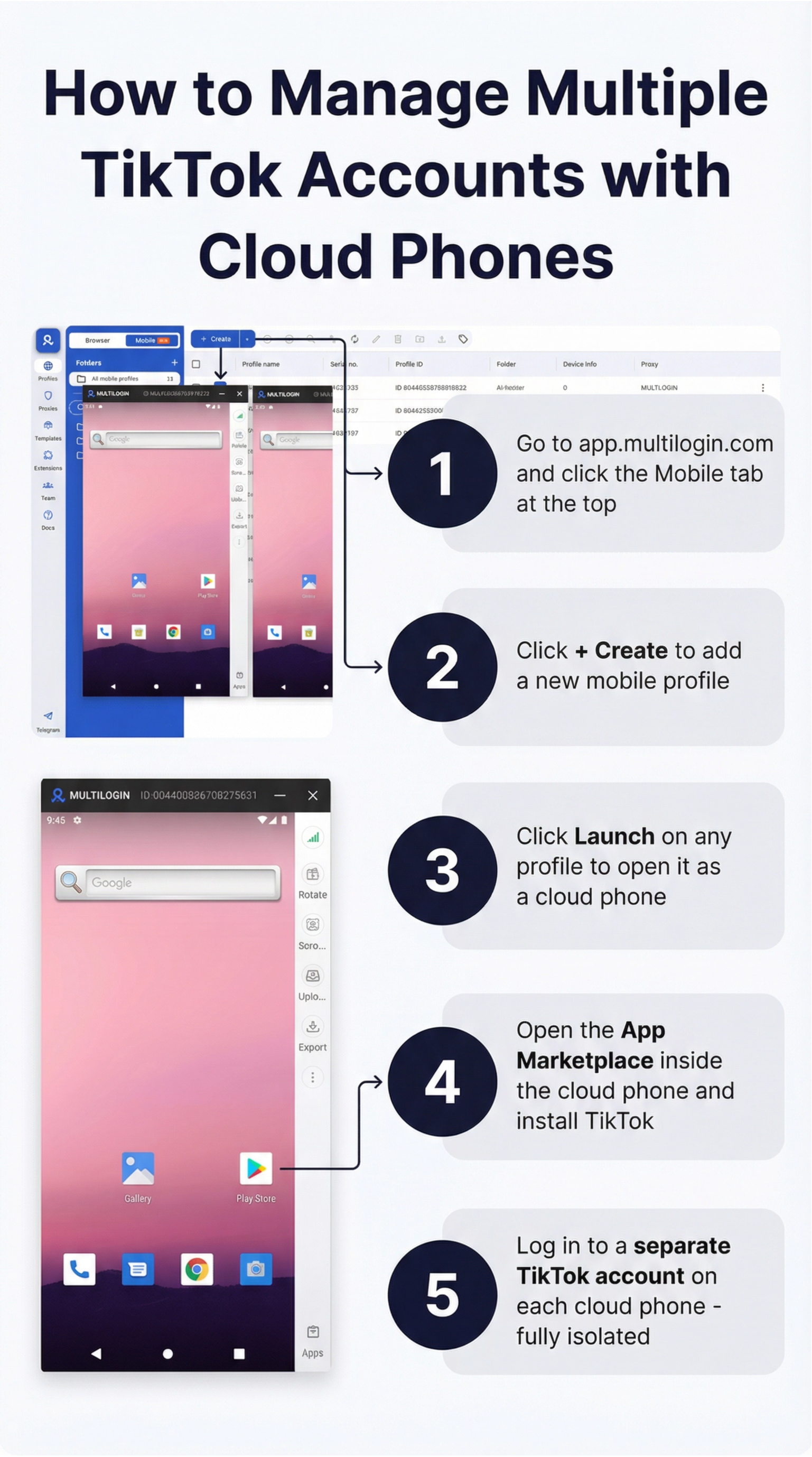
Create a cloud phone profile from the desktop app. Select the Android device type — Multilogin supports approximately 30 real device models across Samsung, Google, Redmi, OPPO, OnePlus, and vivo. Assign a residential proxy with city-level targeting matched to the account’s operating location. Each profile maintains persistent app storage, so session history, login states, and cache stay consistent across uses.
Install TikTok from the built-in app store within the cloud phone, log in or create the account, and you’re running a fully isolated mobile environment with no shared signals to other accounts.
For teams managing multiple creators or multiple client accounts, Business plans include unlimited team seats with permission controls that let you assign specific cloud phones to specific team members without exposing the full operation.
Managing multiple social media accounts with Multilogin →
Quick checklist: before you post your next video
- Hook is strong within the first two seconds — not a slow intro.
- Video runs between 30 seconds and two minutes, designed for maximum watch-through.
- Trending audio selected and properly applied.
- Three to five relevant hashtags (not just #FYP).
- Posting at a time when your target audience is active.
- Caption adds context or asks a question that encourages comments.
- Account in good standing with no active shadow ban.
- Each account running from its own isolated device and IP if managing multiple.
Need to manage multiple Tiktok accounts? Try Multilogin Cloud Phones.
Key takeaways
Going viral on TikTok in 2026 is still possible for anyone — new account, zero followers, any niche, any content format. The platform genuinely rewards content performance over account authority, which means the opportunity is more equal than most social platforms.
What separates creators who go viral consistently from those who post and wonder why nothing happens is understanding the mechanics: watch-through rate over likes, hook strength over production quality, trending audio over follower count, and content consistency over occasional effort.
For operators who want to multiply their chances across multiple accounts and niches, the infrastructure matters as much as the content. Isolated environments per account, matched proxies, persistent session data, and desktop management at scale — that’s the difference between a multi-account TikTok operation that works long-term and one that gets everything flagged after the first viral video.
Multilogin cloud phones are built for exactly that. Real Android environments, genuine hardware identifiers, isolated proxies with city-level targeting, desktop control, and usage-based pricing that scales with your operation.
Start running multiple TikTok accounts safely with Multilogin →
TikTok analytics are genuinely powerful once you know where to find them and what each metric is actually telling you. Average watch time and the For You page percentage are the two metrics that matter most for organic growth, because they are the two signals TikTok’s algorithm weights most heavily when deciding how widely to distribute a video. Everything else, followers, likes, comments, is downstream from those two.
For creators and businesses running a single account, TikTok Studio gives you everything you need for free. For more advanced competitive analysis, trend monitoring, or cross-channel reporting, tools like Pentos, Exolyt, and Sprout Social fill the gaps.
For anyone managing multiple TikTok accounts, the analytics question has an extra layer: are the numbers you are seeing actually accurate for each individual account, or are they contaminated by linked-account bleedover? Running multiple accounts from the same device does not just risk enforcement actions. It actively distorts the analytics data you use to make content decisions.
Multilogin Cloud Phones solve this at the foundation. Each account runs on its own isolated Android device with its own IP, its own session history, and its own independent relationship with TikTok’s algorithm. The analytics for each account are clean, accurate, and genuinely useful for strategy. That is the operational standard that serious multi-account TikTok work requires.
Explore Multilogin Cloud Phones
TikTok slideshows are one of the most versatile and time-efficient content formats on the platform in 2026. A well-made swipe slideshow with strong images and a well-chosen sound can outperform far more expensive video content, and the creation process is accessible to anyone with a phone and a folder of photos.
For basic slideshows, TikTok’s native editor handles everything: photo selection, music, text, timing, and posting. For more precise control, especially over timing and transitions, creating the slideshow as a video in CapCut and uploading it gives you frame-level precision. For green screen, interactive, and mixed format slideshows, the mobile app has everything built in.
The production side is genuinely easy. The harder challenge for creators working at scale, managing multiple accounts across different niches or for different clients, is keeping those accounts isolated so that a consistent posting schedule does not trigger the coordinated behavior detection that gets accounts banned in clusters. Each account needs its own device environment, its own IP, and its own independent history with TikTok’s algorithm. Multilogin Cloud Phones provide that at the hardware level, which means your slideshow strategy runs on a foundation that does not collapse when you add a fourth or fifth account to the operation.
Frequently asked questions About How to go viral on TikTok
There’s no official number, but 500,000+ views is widely considered viral. Early signals — high watch-through rate and shares within the first few hours — matter more than any view threshold. TikTok uses early performance to decide whether to expand distribution.
Daily posting is recommended for new accounts in the first 30 to 60 days. For established accounts, two to four times per week maintains quality while giving the algorithm frequent opportunities to push new content.
It can happen on the first video — or take six to twelve months of consistent posting. Most creators who go viral for the first time do so between one and six months in. Consistency and posting frequency directly affect how quickly it happens.
Views attributed to Direct Messages came from someone sharing your video to another user via TikTok’s DM system, and that recipient watching it. High DM shares indicate content people want to send specifically to friends.
Views attributed to Personal Profile came from users visiting your profile page directly rather than seeing the video on their For You page or through discovery features.
Approximately every 24 hours. New videos may update more frequently in the first few hours. Follower activity data updates on a rolling basis every few days.