


Growth hacking is not a buzzword. It is a mindset, a process, and when done right, it is the difference between a business that quietly flatlines and one that explodes into a market.
The term was coined by Sean Ellis in 2010 to describe a type of marketing entirely focused on growth, often using low-cost, creative, and data-driven experiments instead of traditional advertising budgets. Companies like Dropbox, Airbnb, LinkedIn, and PayPal all used growth hacking techniques to build massive user bases before most people had heard of them.
This guide gives you 50 of the most effective growth hacking techniques across every stage of your funnel, from getting your first users to retaining and monetising them at scale. Whether you are a solo founder, a startup team, or a social media manager handling multiple brand accounts, these techniques apply.
And if part of your growth strategy involves managing multiple social media profiles, ad accounts, or affiliate platforms, you will want to read about how Multilogin’s antidetect browser and cloud phones keep each account isolated, fingerprint-safe, and fully operational without bans or flags getting in the way.
What Is Growth Hacking?
Growth hacking sits at the intersection of product, marketing, data, and engineering. A growth hacker’s single focus is: how do we grow faster, cheaper, and more sustainably than our competitors?
Unlike traditional marketers who focus on brand awareness or long-term positioning, growth hackers run rapid experiments, measure everything, double down on what works, and cut what does not. The approach is iterative, data-led, and obsessively focused on one metric at a time.
The 50 Best Growth Hacking Techniques
Acquisition: Getting People in the Door
1. Viral Referral Loops Give users a compelling reason to invite others. Dropbox gave extra storage for every referral. PayPal paid cash. Uber gave ride credits. The mechanic is simple: make sharing beneficial to the referrer, and your users become your acquisition channel. The best referral programs feel like a favour, not a promotion.
2. Product-Led Growth (PLG) Let the product sell itself. Freemium models, free trials, and self-serve onboarding get users experiencing value before they ever speak to a salesperson. Notion, Slack, and Figma all scaled this way. The product does the heavy lifting while your team focuses on retention.
3. SEO Content Flywheel Publishing high-quality, keyword-targeted content consistently builds compounding organic traffic. Unlike paid ads, good content keeps delivering results for years. Focus on search intent, not just search volume, and build topic clusters around your core product pages.
4. Cold Outreach With Personalisation at Scale Generic cold emails are dead. Hyper-personalised cold email outreach that references the recipient’s recent content, company news, or specific pain points consistently outperforms batch-and-blast campaigns by a wide margin. Tools that pull live data from LinkedIn and company websites make personalisation at scale achievable.
5. Social Proof Stacking People follow people. Collect and display testimonials, case studies, user counts, press mentions, and star ratings at every touchpoint. The more proof you stack, the lower the friction to convert. Third-party review platforms add credibility that self-published testimonials alone cannot match.
6. Community-Led Growth Build or participate in communities where your target users already spend time. Reddit threads, Facebook groups, Discord servers, and niche forums are full of people actively seeking solutions you provide. Consistent, genuine participation builds trust faster than any ad campaign.
7. Launch on Product Hunt and Hacker News A well-prepared Product Hunt launch can drive thousands of signups in 24 hours. Prepare your hunter, gather upvotes from your network on launch day, and have your community ready to comment. The spike in visibility often leads to media coverage that extends well beyond launch day itself.
8. Influencer Seeding Identify micro-influencers with highly engaged audiences in your niche. Send them your product with no strings attached. Genuine reviews from trusted voices convert better than paid placements from celebrities, and the cost per acquisition is significantly lower.
9. Strategic Partnerships and Co-Marketing Partner with complementary brands targeting the same audience. Co-create content, bundle offers, or run joint promotions. Both sides get reach they could not build alone. The best partnerships feel natural to the shared audience and create genuine value rather than just cross-promotional noise.
10. Multi-Account Social Media Presence Running presence across multiple niche accounts or profiles dramatically widens your reach. Social media managers using Multilogin browser profiles can manage dozens of accounts simultaneously without platform detection or bans. Each profile gets a unique fingerprint, making the operation fully sustainable at scale.
AI Image Generators
You no longer need a designer for every piece of visual content. AI image generators produce graphics, product mockups, branded visuals, and ad creatives in seconds. Here are the ones worth knowing.
- Midjourney consistently produces the most visually impressive results. It excels at artistic, editorial, and lifestyle aesthetics. It runs through Discord, which takes a little getting used to, but the output quality is genuinely the standard other tools are measured against. Social media managers use Midjourney for brand content, campaign visuals, and anything that needs to look polished and creative.
- Adobe Firefly is built into Photoshop and Adobe Express. Its biggest advantage is that it is trained on licensed content, which makes it the safest option for commercial use. If you’re creating visuals that will run as paid ads or be used in client campaigns, Firefly reduces copyright risk significantly. The quality is solid and improving with every release.
- DALL-E 3 is integrated directly into ChatGPT, which makes it easy to go from drafting a caption to generating a matching visual without switching tools. It follows detailed text prompts well and is a practical option if you’re already working in the ChatGPT ecosystem.
- Canva’s AI image generator is the most accessible option for social media managers already working in Canva. You can generate images, edit existing ones with AI, and use the generative fill feature to extend or change parts of an image, all within the design tool you’re already using for templates and scheduling. And if you ever need to double-check your Instagram post size before exporting, Canva handles that too without switching apps.
- Ideogram stands out for one specific reason: it can generate images that include legible, readable text. Most other AI image generators struggle badly with words inside images. If you need quote graphics, promotional tiles, or any visual with copy baked in, Ideogram handles this far better than the alternatives.
- Flux is gaining popularity for photorealistic outputs. It’s a strong choice when you need images that are meant to look like real photographs rather than illustrations or artistic renders.
- Leonardo AI has strong character and style consistency tools. If you’re running a campaign where a specific character, person, or visual look needs to appear the same across multiple posts, Leonardo’s consistency features give you more control than most other generators.
- Stable Diffusion is an open-source model that can be run locally or through platforms like DreamStudio. It requires more technical setup but gives you more control and no subscription cost if you have the hardware to run it yourself.
- Freepik’s AI image generator integrates with its library of existing assets. Useful if your workflow involves mixing AI-generated visuals with stock photography or existing design elements.
- Microsoft Designer is a free option integrated into Microsoft 365 and accessible through the web. It has improved significantly and is worth knowing about for teams already working in the Microsoft ecosystem.
Activation: Turning Visitors Into Users
11. Onboarding Email Sequences The first seven days after signup determine whether a user stays or churns. Build a triggered email sequence that guides new users to their first meaningful moment of value as quickly as possible. Every email should serve one purpose and move the user one step closer to activation.
12. Interactive Onboarding Checklists Checklists inside your product keep users engaged, show progress, and drive completion of key setup steps. The psychological pull of completing a checklist is powerful. Users who complete onboarding checklists have dramatically higher 30-day retention rates than those who skip them.
13. Reduce Time to First Value (TTFV) Every unnecessary step between signup and the moment a user gets value is a potential dropout. Audit your onboarding and ruthlessly remove friction. Fewer clicks, faster wins. If your product requires setup before value is delivered, build guided shortcuts that compress the setup time.
14. Personalised Onboarding Flows Ask two or three qualifying questions at signup and route users to different onboarding paths based on their answers. A freelancer and an enterprise user need completely different first experiences. Personalised flows consistently outperform one-size-fits-all onboarding sequences.
15. Live Chat and Chatbots at Key Moments Place live chat or AI chatbots at high-drop-off points in your funnel. Catching a user at the moment of confusion and resolving their question in real time dramatically improves conversion. The goal is to eliminate the gap between a question arising and an answer appearing.
Retention: Keeping Users Coming Back
16. Habit Loops and Push Notifications Design your product around daily or weekly habits. Use push notifications strategically to bring users back at the right moment, not randomly. Duolingo’s streak mechanic is a masterclass in habit loop design. The goal is to make using your product feel like part of a routine rather than a deliberate decision.
17. Re-engagement Email Campaigns Segment lapsed users and send targeted win-back campaigns. Acknowledge the gap, offer something new or valuable, and make it easy to return. A small percentage of lapsed users are always recoverable, and those recoveries compound over time into significant retained revenue.
18. Net Promoter Score (NPS) Surveys Ask users how likely they are to recommend your product and follow up with everyone who responds. Promoters become case studies and referral sources. Detractors give you your most honest product feedback. NPS surveys are most valuable when the follow-up conversation actually happens.
19. In-App Milestones and Rewards Celebrate user milestones inside the product. The first successful campaign, the 100th follower, the first sale. These moments of recognition create emotional investment in continued use and give users a reason to keep pushing toward the next milestone.
20. Customer Success Touchpoints Proactive outreach from a customer success team at key moments prevents churn before it happens. Identify the leading indicators of churn in your data and intervene early. A five-minute check-in call at the right moment is worth more than a dozen renewal emails sent too late.
Revenue: Monetising Your Users
21. Upsell and Cross-Sell at the Right Moment Trigger upsell prompts when users hit a natural ceiling or achieve a success moment. The best time to offer a higher plan is immediately after a user experiences the value of the current one. Timing is everything, and bad timing on an upsell creates resentment rather than revenue.
22. Annual Plan Discounts Offer a meaningful discount for annual billing. This improves your cash flow, reduces churn, and locks in revenue. Most SaaS companies see significant plan upgrades when the annual offer is positioned prominently at the right point in the user journey.
23. Tiered Pricing With a Clear Middle Option Price anchoring works. A three-tier pricing page with the middle tier positioned as “most popular” consistently drives users toward that option. Make the premium tier feel like an upgrade, not a wall, and make the entry tier feel like a genuine starting point rather than a trap.
24. Lifetime Deals for Early Adopters Lifetime deals drive early revenue and create a loyal base of power users who invest deeply in your product’s success. Use platforms like AppSumo selectively and only when your product is ready. Early adopter feedback from lifetime deal buyers is often your most actionable product input.
25. Affiliate and Partner Programs Let others sell for you. A well-structured affiliate program with competitive commissions can become one of your largest acquisition channels. Affiliates managing multiple campaigns use Multilogin for affiliate marketing to run separate accounts cleanly across networks without detection or cross-contamination.
Referral: Making Users Your Growth Engine
26. Double-Sided Incentive Programs Both the referrer and the new user get a reward. This lowers the barrier for the referrer to share and gives the new user an immediate reason to sign up. Airbnb’s original referral program used this mechanic to accelerate growth faster than any paid channel could.
27. Referral Widgets and Shareable Links Make sharing frictionless. Every user should have a personal referral link accessible in one click, with pre-written share copy ready to go for social media, email, and messaging apps. The harder you make sharing, the less of it happens.
28. Social Sharing Built Into the Product If your product produces an output, let users share it directly. Canva’s share button, Spotify’s Wrapped, Wordle’s result grid. When users share their product output, they market your brand without thinking about it. This is the most scalable form of word-of-mouth growth available.
Content and SEO Growth Hacks
29. Programmatic SEO Build thousands of keyword-targeted landing pages automatically using templates and structured data. Tripadvisor, Zillow, and Yelp built enormous organic traffic through programmatic SEO at scale. The key is ensuring each page delivers genuine value rather than thin, repetitive content.
30. Content Repurposing Across Channels One long-form blog post becomes a LinkedIn article, a Twitter thread, a short-form video script, an email newsletter, and a podcast talking point. Repurposing multiplies reach without multiplying effort. A good content repurposing system is one of the highest-leverage operations a small team can build.
31. Skyscraper Technique Find the top-ranking piece of content for your target keyword, create something definitively better, then promote it to everyone who linked to the original. Brian Dean popularised this approach and it continues to work, particularly in niches where most existing content is outdated or shallow.
32. Answer Engine Optimisation (AEO) Optimise content specifically for AI search engines and featured snippets. Structure your content with clear questions and concise answers. As AI-powered search grows, AEO is becoming as important as traditional SEO for maintaining organic visibility.
33. Guest Posting on Authority Sites A single guest post on a high-authority publication in your niche can drive targeted traffic and backlinks that compound over months. Pitch to publications your target audience actually reads, not just the ones with the highest domain authority scores.
34. Link Building Through Data and Research Original research and proprietary data attract backlinks naturally. Conduct a survey, publish the results, and other publications will cite and link to your findings. This is one of the most durable link-building strategies available and consistently produces links that no outreach campaign could replicate.
Social Media and Viral Growth
35. Short-Form Video at Volume TikTok, Instagram Reels, and YouTube Shorts reward consistent volume. Post daily, test formats relentlessly, and let the algorithm surface your best content. One viral video can add thousands of followers overnight. Learn how to go viral on TikTok and apply the same principles across platforms.
36. Multi-Account Content Testing Running the same content across multiple accounts or profiles lets you test what resonates before pushing it to your main audience. Social media managers use Multilogin cloud phones to run multiple mobile profiles simultaneously, testing content and managing accounts without cross-contamination or platform flags.
37. Engaging Niche Hashtag Communities Consistent, high-quality engagement in niche hashtag communities builds visibility with exactly the right audience. Comment thoughtfully, add value, and let your profile draw curious followers to your page. Depth of engagement in a small community beats shallow engagement across a large one.
38. Twitter and X Threads for Authority Building Long-form threads that teach something specific consistently outperform short posts for reach and follower growth. Pick one concept, go deep, and end with a clear call to action. The best threads feel like a mini-course, not a promotional piece.
39. Social Listening and Real-Time Engagement Monitor mentions of your brand, competitors, and relevant topics. Engaging in real-time conversations where your product is relevant builds visibility and trust without paid spend. Managing multiple social media accounts makes it possible to monitor and engage across every platform simultaneously.
40. Strategic Account Collaboration Co-create content with accounts that share your audience but do not compete with you. Instagram Lives, YouTube collaborations, and podcast cross-promotions expose your brand to warm, relevant audiences. The best collaborations feel genuinely useful to both audiences rather than transactional.
Product and Technical Growth Hacks
41. A/B Testing Every Element Headlines, CTAs, button colours, pricing page layouts, email subject lines. Test one variable at a time, measure statistically significant results, and implement winners consistently. The compounding effect of dozens of small A/B test wins is one of the most reliable paths to conversion rate improvement.
42. Exit-Intent Popups Trigger a targeted offer or lead magnet when a user is about to leave your page. Exit-intent popups consistently recover a percentage of traffic that would otherwise bounce without converting. The offer needs to be genuinely relevant to what the user was looking at to perform well.
43. Free Tools as Lead Magnets Build a free tool that solves a real problem for your target user. A free calculator, generator, or audit tool attracts organic traffic, builds email lists, and demonstrates product value simultaneously. Free tools also earn backlinks naturally because people share useful resources.
44. Waitlists and Artificial Scarcity Launching with a waitlist creates perceived demand and urgency. Notion, Clubhouse, and Robinhood all used waitlists to generate buzz and signups before their official launches. A well-run waitlist also lets you warm up your most engaged early adopters before anyone else gets access.
45. Frictionless Social Login Every extra field in a signup form is a potential dropout. Offering Google, Apple, or Facebook login removes friction and dramatically improves signup conversion rates. The data consistently shows that reducing signup steps from five to two can double or triple completion rates.
Data and Analytics Growth Hacks
46. Cohort Analysis for Retention Group users by the week or month they signed up and track their behaviour over time. Cohort analysis reveals exactly when and why users churn, giving you precise targets for product improvement. Without cohort data, retention efforts are guesswork.
47. Funnel Visualisation and Drop-Off Analysis Map your entire conversion funnel and identify where users drop off at the highest rates. Even small improvements at a high-traffic drop-off point can produce significant conversion gains. The biggest wins are usually hiding in the steps most teams take for granted.
48. Heatmaps and Session Recordings Tools like Hotjar and Microsoft Clarity show you exactly how users interact with your pages. Where they click, where they scroll, where they get confused. This data is invaluable for conversion rate optimisation and often reveals problems that no amount of user surveys would surface.
49. Predictive Churn Modelling Use your behavioural data to predict which users are most likely to churn before they do. Build automated re-engagement triggers that fire when users show early warning signs. Preventing churn is almost always cheaper and faster than acquiring a replacement user.
50. North Star Metric Focus Every growth team needs one metric that captures the core value being delivered to users. For Airbnb it was nights booked. For Spotify, it was time listening. Define yours, and orient every growth experiment around moving it. Clarity on the North Star prevents the team from optimising vanity metrics at the expense of real growth.
Quick Reference: Growth Hacking Techniques by Stage
| Funnel Stage | Top Techniques |
|---|---|
| Acquisition | Viral referrals, SEO content, cold outreach, influencer seeding |
| Activation | Onboarding sequences, reduce TTFV, live chat, personalised flows |
| Retention | Habit loops, NPS surveys, re-engagement campaigns, milestones |
| Revenue | Upsells, annual plans, tiered pricing, affiliate programs |
| Referral | Double-sided incentives, shareable links, social sharing |
| Technical | A/B testing, exit-intent popups, free tools, frictionless login |
How Multilogin Supports Your Growth Stack
Many of the techniques above, particularly anything involving social media management, affiliate marketing, multi-account content testing, or traffic arbitrage, require the ability to operate multiple accounts cleanly and without risk of bans.
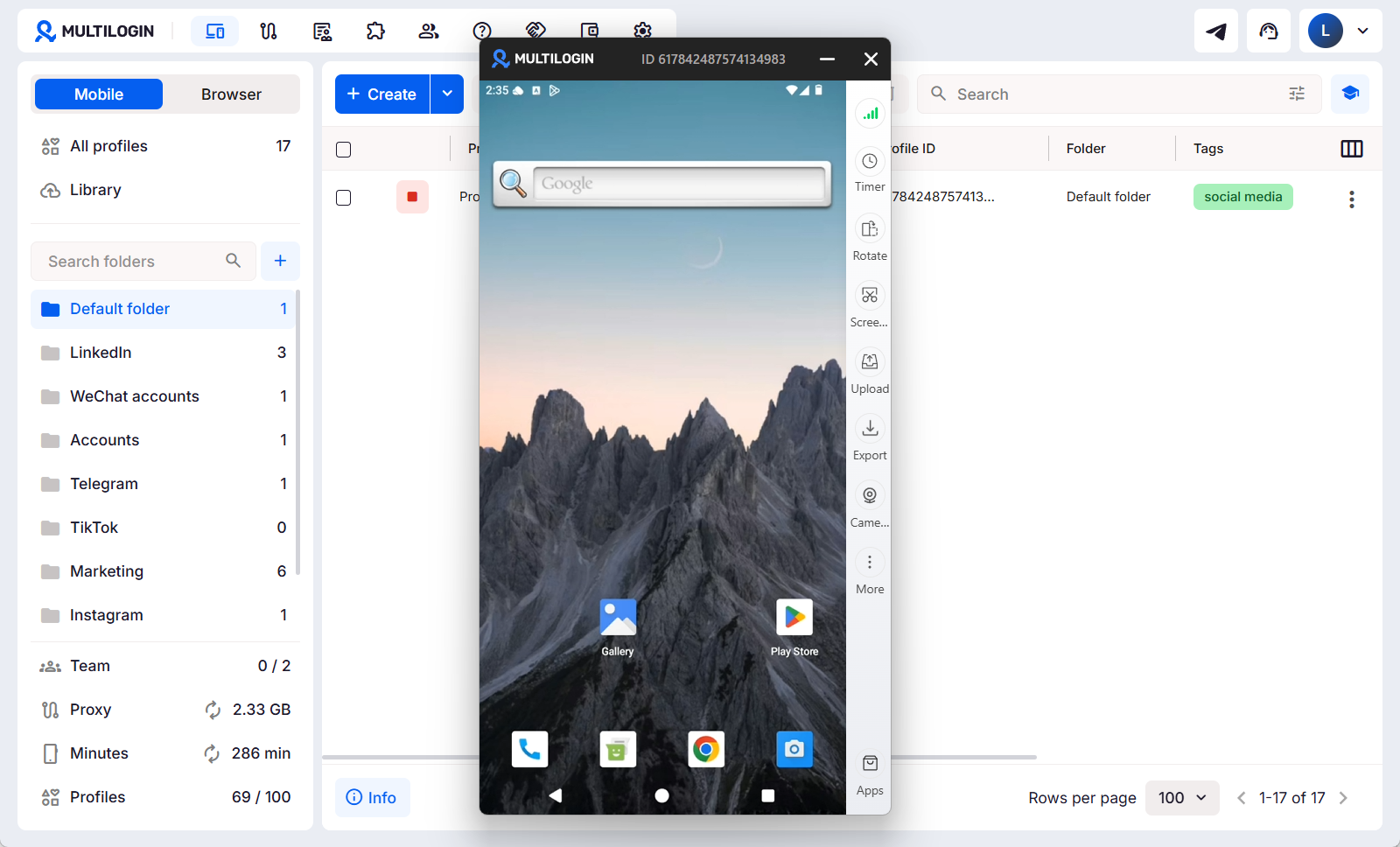
Multilogin’s mobile browser gives each account a unique, isolated browser fingerprint so platforms cannot link your profiles together. The cloud phone feature lets you run multiple Android environments simultaneously from any device, which is particularly powerful for mobile-first social media growth strategies.
Whether you are managing 5 accounts or 500, multi-account management with clean account isolation is a non-negotiable part of a serious growth stack.

Need to manage multiple social media accounts? Try Multilogin Cloud Phones.
Frequently asked questions
There is no single answer because it depends on your product, audience, and stage. Referral programs and product-led growth tend to deliver the highest leverage for most early-stage companies.
No. While the term originated in the startup world, the techniques apply to any business that wants to grow faster and more efficiently, including agencies, e-commerce brands, SaaS companies, and content creators.
The content itself is not the issue platforms are flagging. What platforms detect is how accounts are managed technically: shared devices, shared IPs, linked browser fingerprints. That’s an infrastructure problem, not a content problem. Tools like Multilogin address the infrastructure side.
Canva has the most practical free tier for social media managers because it combines image generation, design templates, and scheduling in one place. ChatGPT’s free version is strong for caption writing and content ideation. CapCut is free and powerful for short-form video.
It depends on the tool. Adobe Firefly is explicitly trained on licensed content and grants commercial use rights on output. Most other tools have varying policies and some restrict commercial use on free plans. Always read the terms of service before using AI-generated visuals in paid advertising or client deliverables.
Multilogin lets you manage multiple client accounts from one machine without the accounts being linked or detected by platform systems. Each account gets its own isolated browser profile or Cloud Phone with a unique device fingerprint and IP. It also has AI-powered automation features and integrations that make creating and organizing large numbers of profiles faster.
Real Android devices hosted in the cloud, each with a unique device identity, hardware fingerprint, and residential proxy IP. You access and control them through the Multilogin desktop app. Social media managers use them to run mobile-first accounts on platforms like TikTok and Instagram without those accounts being linked to each other. You can read the full breakdown of how cloud phones work to understand what’s happening under the hood.