


If you are still manually posting every piece of content, manually responding to comments, and manually pulling reports for each social media account you manage, you are leaving enormous amounts of time and efficiency on the table.
Social media automation has matured significantly. The tools available in 2026 are not just basic schedulers with a publish button. They cover content generation, approval workflows, performance analysis, and multi-account operations at a level that would have required a full team a few years ago.
This guide covers the best social media automation tools in 2026, what each one is genuinely good at, and what the right automation stack looks like for agencies, creators, and brands operating at scale.
What Social Media Automation Actually Covers
Automation in social media is not a single function. It spans several distinct workflows:
- Content scheduling and publishing: Queuing posts in advance so they go out at optimal times without manual intervention
- Content creation assistance: Using AI to draft captions, suggest hashtags, repurpose content across formats
- Inbox and engagement automation: Auto-replies, sentiment filtering, priority flagging for DMs and comments
- Analytics and reporting: Automated performance summaries that do not require you to manually pull data
- Cross-platform distribution: Publishing one piece of content across multiple platforms simultaneously
- Account warmup and activity simulation: Relevant for multi-account operators who need organic-looking engagement patterns before scaling
Understanding which of these you actually need is the first step to choosing the right tools.
Best Social Media Automation Tools in 2026
1. Buffer (Scheduling and Publishing)
Buffer is one of the most reliable scheduling tools available and its automation features have improved steadily. The platform now includes AI-assisted caption writing, a content ideas feature, and post recycling that keeps evergreen content circulating without manual re-queuing.
For creators and small businesses that want straightforward, reliable automation without complexity, Buffer is a strong default choice. It supports Instagram, Facebook, LinkedIn, Twitter/X, TikTok, Pinterest, and YouTube.
Best for: Scheduling automation, small teams
Pricing: Free plan available. From $6 per channel/month on paid plans.
2. ManyChat (Engagement Automation)
ManyChat is specifically built for automating DMs and comment responses on Instagram, Facebook, and WhatsApp. If someone comments a keyword on your post, ManyChat can automatically send them a DM with a link, a resource, or a follow-up question.
This kind of engagement automation significantly increases conversion rates from social posts, particularly for creators promoting digital products or running lead generation campaigns.
Best for: DM automation, comment reply flows, lead generation from social
Pricing: Free plan available. Paid from $15/month.
3. Zapier (Workflow Automation)
Zapier is not a social media tool in isolation, but it is one of the most powerful automation layers you can add to any social media stack. It connects your social platforms to your CRM, email marketing tools, spreadsheets, and project management apps.
A basic example: every time someone fills out a lead form on your Facebook ad, Zapier automatically adds them to your email list and sends a notification to your team in Slack. No manual steps required.
For agencies managing multiple client workflows, Zapier reduces the operational overhead of running everything manually.
Best for: Cross-platform workflow automation, connecting social tools to business systems
Pricing: Free plan available. From $19.99/month.
4. SocialBee (Content Recycling and Scheduling)
SocialBee’s category-based scheduling system is one of the most useful automation features in the market. Instead of a linear content queue, you define content categories (educational, promotional, behind-the-scenes, evergreen) and the platform rotates through them automatically.
This means your publishing schedule always looks balanced without you manually reordering posts. Evergreen content gets recycled on a set schedule so your best-performing posts keep generating reach long after their first publication date.
Best for: Evergreen content automation, agencies with multiple content categories
Pricing: From $29/month.
5. Metricool (Analytics Automation)
Metricool automates the reporting side of social media management. You can schedule automated reports that go directly to clients or stakeholders, set up competitor tracking that runs in the background, and get performance alerts when key metrics change.
For agencies that spend hours every month manually building client reports, Metricool’s automated reporting alone justifies the subscription cost.
Best for: Automated analytics, client reporting, competitor monitoring
Pricing: Free plan available. From $22/month.
6. n8n (Advanced Workflow Automation)
For teams with technical resources, n8n is an open-source automation platform that gives you significantly more flexibility than Zapier. You can build complex multi-step workflows that connect social platforms to internal tools, databases, and APIs.
It is overkill for most individual creators, but for agencies or brands running sophisticated automation at scale, n8n is a powerful option that keeps costs down on high-volume workflows.
Best for: Technical teams, complex automation at scale
Pricing: Self-hosted free. Cloud version from $20/month.
7. viaSocket (Workflow Automation)
viaSocket is an AI-assisted, no-code workflow automation platform. Instead of manually mapping triggers and actions, you describe the outcome you want and viaSocket builds the workflow for you, flattening the learning curve for non-technical teams.
It connects with thousands of apps across CRM, marketing, and communication tools, supporting conditional logic, webhooks, and custom APIs. For social media, it’s commonly used to route Instagram and WhatsApp DMs, comments, and form submissions into CRMs or Slack, all without writing any code.
Best for: Budget-conscious workflow automation, AI-assisted workflow building
Pricing: Free plan available (2,000 tasks/month). Pay-as-you-go credits beyond that.
Comparison Table: Best Social Media Automation Tools 2026
| Tool | Primary Automation Focus | Free Plan | Best For | Starting Price |
| Buffer | Scheduling and publishing | Yes | Small teams, creators | $6/channel/month |
| ManyChat | DM and comment automation | Yes | Lead gen, engagement | $15/month |
| Zapier | Cross-platform workflows | Yes | Agency operations | $19.99/month |
| SocialBee | Content recycling | No | Batch-scheduling | $29/month |
| Metricool | Analytics and reporting | Yes | Client reporting | $22/month |
| n8n | Advanced workflow automation | Yes (self-hosted) | Technical teams | $20/month |
| viaSocket | AI-assisted workflow automation | Yes | No-code workflow automation for growing teams | Free (2,000 tasks/month), pay-as-you-go |
The Part of Automation Most Tools Ignore
Scheduling, content generation, and reporting automation are all well-covered by the tools above. What is almost never discussed is the layer that sits underneath all of it: the account infrastructure.
Here is the problem. Most social media automation tools work at the application level. They authenticate once per account and then push actions through the API or simulate user interactions. What they do not do is protect the device-level and browser-level identity of each account.
For anyone running multiple accounts (multiple client accounts, multiple brand accounts, multiple creator profiles), this creates real risk. Platforms like Instagram, TikTok, and Facebook use browser fingerprinting, cookie tracking, and behavioural signals to detect when multiple accounts share the same device or operator. When they detect it, they restrict or ban the accounts.
No amount of scheduling automation saves you if the accounts get flagged.
How Multilogin Completes Your Automation Stack
Multilogin is the infrastructure layer that makes multi-account automation safe. Each browser profile in Multilogin has its own isolated fingerprint, session, cookies, and storage. From the platform’s perspective, each account looks like it belongs to a completely different device and user.
For a social media agency or creator running social media automation across multiple accounts, the setup works like this:
- Create one Multilogin browser profile per account
- Assign a dedicated residential proxy to each profile so each account has its own IP and geographic identity
- Log into each social account exclusively within its assigned profile
- Run your scheduling and automation tools through those profiles
The result is that every account behaves as an independent entity. No shared fingerprint, no shared cookies, no traceable connection between them.
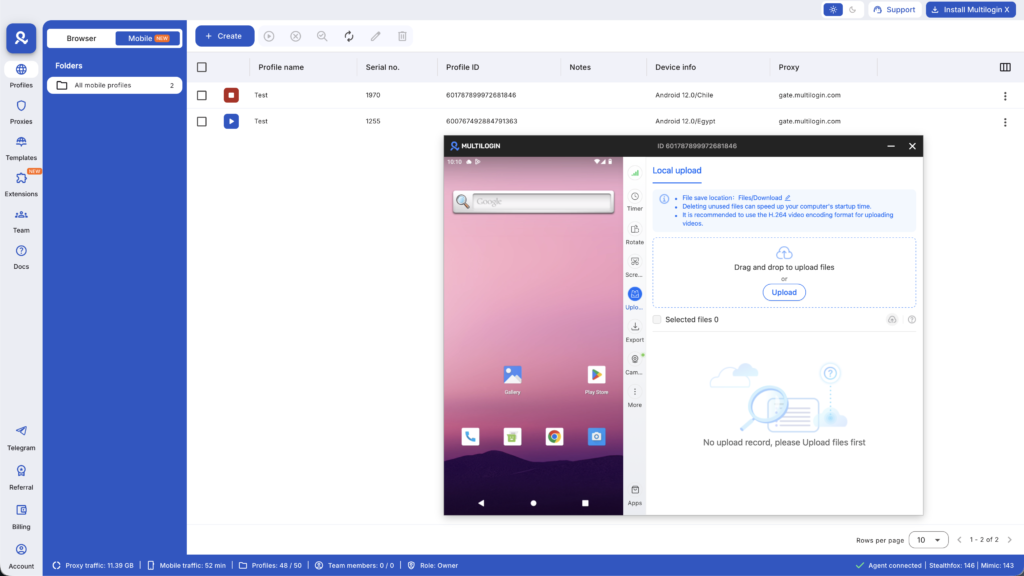
For creators or agencies working with TikTok, Instagram, or any platform where the mobile app experience is primary, cloud phones add another dimension. Each cloud phone is a fully isolated virtual Android device that runs the mobile app natively. You can manage multiple TikTok accounts, Instagram profiles, or Facebook pages from separate cloud phones, each with its own device identity, without any physical hardware.
This matters particularly for automation that involves account warming. When you are building a new account before scaling activity on it, the warmup behavior needs to look organic. Running that activity through a dedicated cloud phone or browser profile, with consistent device signals, is what makes it convincing to platform detection systems.
Building a Full Social Media Automation Stack
A properly built automation stack in 2026 looks something like this:
- Scheduling and publishing: Buffer, SocialBee, or Later for content queuing
- Engagement automation: ManyChat for DM flows and comment replies
- Workflow automation: Zapier or n8n for connecting your tools to each other
- Analytics automation: Metricool for automated client reports
- Account infrastructure: Multilogin for browser-level isolation between accounts
- IP management: Residential proxies for geographic isolation of each account
Each layer handles a specific function. Most brands and agencies start with a scheduling tool and work their way up. The ones that scale without hitting ban walls are the ones that get the account infrastructure right early.
Multilogin supports browser automation workflows directly, which means your automation scripts can run inside isolated browser profiles. Whether you are using Puppeteer, Selenium, or a visual automation tool, Multilogin’s profiles give your automation a clean, human-like device identity to operate from.
Want to manage multiple social media accounts? Try Multilogin Cloud Phones.
Frequently asked questions About Best Social Media Automation Tools
What is the best social media automation tool for agencies?
Facebook and Instagram through Meta Ads Manager are the most versatile and work for almost any business type. TikTok is best for reaching younger audiences with video content. LinkedIn is the go-to for B2B. Pinterest performs well for visual product categories like home, fashion, and food. The best platform is the one where your target audience spends the most time.
For agencies, the most effective combination is SocialBee or Hootsuite for scheduling, Metricool for reporting, and Multilogin for account isolation. The scheduling tool handles content. Multilogin keeps the accounts safe.
Social media automation covers any technology that reduces manual effort in managing social accounts, including scheduling posts, auto-responding to messages, generating performance reports, and distributing content across platforms.
Use a combination of a scheduling tool (where TikTok’s API supports it) and cloud phones for activity that requires the native app. Each TikTok account should run from its own isolated device or browser profile, paired with a dedicated proxy, to avoid detection.
Social media marketing is the broader practice of building a presence and audience on social platforms, including both organic content and paid ads. Social media advertising specifically refers to the paid component, where you pay the platform directly for guaranteed placement to audiences beyond your existing followers.