
Phone farming with Multilogin exists because physical phone farms no longer scale the way they used to. What once worked with shelves of Android phones now breaks under pressure, devices fail, identities get tied to hardware, and one reset can wipe out weeks of work. When accounts disappear, it’s rarely because of activity. It’s because the same mobile identity shows up again and again.
This is where the shift happens. Phone farming with Multilogin replaces fragile hardware with controlled Android environments that keep their identity over time. Each phone stays isolated, sessions persist, and problems can be fixed without burning the rest of the setup. Instead of managing devices, you manage environments, and that’s what makes modern phone farming stable instead of risky.
What does phone farming really mean
Phone farming today is not about running as many apps as possible or pushing activity at scale. It is about maintaining multiple, independent mobile identities over time. Each identity needs to behave like a real phone that returns consistently, keeps its data, and doesn’t collide with others. When that foundation is missing, volume only speeds up failure.
Modern phone farming focuses on stability, not output. Mobile platforms track behavior differently than desktop platforms. They pay close attention to device signals, session history, and long-term consistency. Mobile users are expected to come back from the same device, the same environment, and often the same region. When mobile activity resets too often or looks reused, trust drops quickly.
That is why phone farming is no longer about doing more. It is about keeping mobile identities intact. Stable environments last. Unstable ones get flagged—no matter how careful the activity looks on the surface.
The real problem with traditional phone farming setups
Traditional phone farming breaks not because teams lack effort, but because the setup itself is fragile. As soon as scale increases, the weaknesses show up fast—and they compound.
Physical phone farms break under scale
Physical phone farms rely on hardware staying alive and consistent. In reality, the opposite happens. Devices overheat. Batteries degrade. Storage fills up. Operating system updates change behavior overnight. When a phone fails, the mobile identity tied to it often fails too. Accounts don’t just lose access—they lose their history.
Scaling doesn’t solve this. It makes it worse. Adding more phones increases cost, space, power usage, and maintenance. You end up managing hardware instead of mobile identities. When a device dies, the work attached to it usually dies with it.
Why emulators and reused devices fail
Emulators and reused devices try to remove hardware from the equation, but they introduce a different problem: identity reuse. System signals repeat. Mobile behavior looks inconsistent. Sessions reset too often. Over time, platforms connect these patterns and trust drops.
Because sessions don’t persist and identities don’t stay stable, detection builds gradually. What looks fine at first starts failing weeks later, often without a clear trigger.
The issue is not the number of phones. It’s the reuse of identity.
Why phone farming accounts get banned
Phone farming accounts get banned when platforms stop seeing them as separate mobile users. This usually happens quietly, long before any rule is broken. When the same device identity appears across multiple accounts, or when session data leaks between environments, platforms connect the dots. At that point, removing one account doesn’t solve the problem because the environment behind it is already flagged.
Detection is pattern-based. Mobile platforms look at how devices behave over time, not at single actions. When network signals don’t match the device, when sessions reset too often, or when multiple accounts return from what looks like the same phone, trust drops. Once one account is flagged, others tied to the same setup are already exposed.
The most common reasons phone farming accounts get banned:
- Multiple accounts sharing the same device identity
- Cookies, storage, or session data reused across environments
- IP or location signals that don’t align with the device behavior
- One flagged account revealing the shared setup behind the rest
Platforms don’t ban accounts. They ban environments.
What a sustainable phone farm actually requires
A phone farm only works when mobile identities remain intact over time. Not temporarily. Not until the next update or restart. Sustainability comes from structure, not scale. When environments are rebuilt too often or identities overlap, phone farming turns fragile fast.
A stable phone farm is built on a few non-negotiables. These aren’t optimizations. They are requirements.
What a sustainable phone farm must have:
- One mobile identity per account: Each account must return as the same phone every time. No shared device signals. No rotation between identities.
- Persistent Android environments: Android systems need to keep their state, storage, and behavior across restarts instead of resetting constantly.
- No shared storage, fingerprints, or sessions: Cookies, app data, and device signals must stay isolated so activity in one environment never affects another.
- Network control per profile: IP address, location, and network behavior must align with the mobile identity instead of changing randomly.
- Safe reuse of environments: Mobile environments should be reusable without burning identity or starting from scratch after issues.
Without these conditions, phone farming collapses under its own weight. With them, phone farming stops being a risky setup and becomes infrastructure.
How Multilogin phone farming works
Phone farming with Multilogin is designed as infrastructure, not a workaround. Instead of forcing mobile activity through fragile hardware or unstable emulators, it provides controlled environments that behave like real phones and remain consistent over time. Every part of the setup focuses on keeping mobile identities separate, persistent, and manageable as scale increases.
Cloud android phones instead of physical devices
Multilogin replaces physical phones with cloud-based Android environments. Each cloud phone runs a full Android system with its own storage, system data, and device signals. These environments are managed directly from a desktop interface, removing the need to buy, store, charge, or maintain hardware. Because the environment persists, accounts return as the same device instead of starting over after each session.
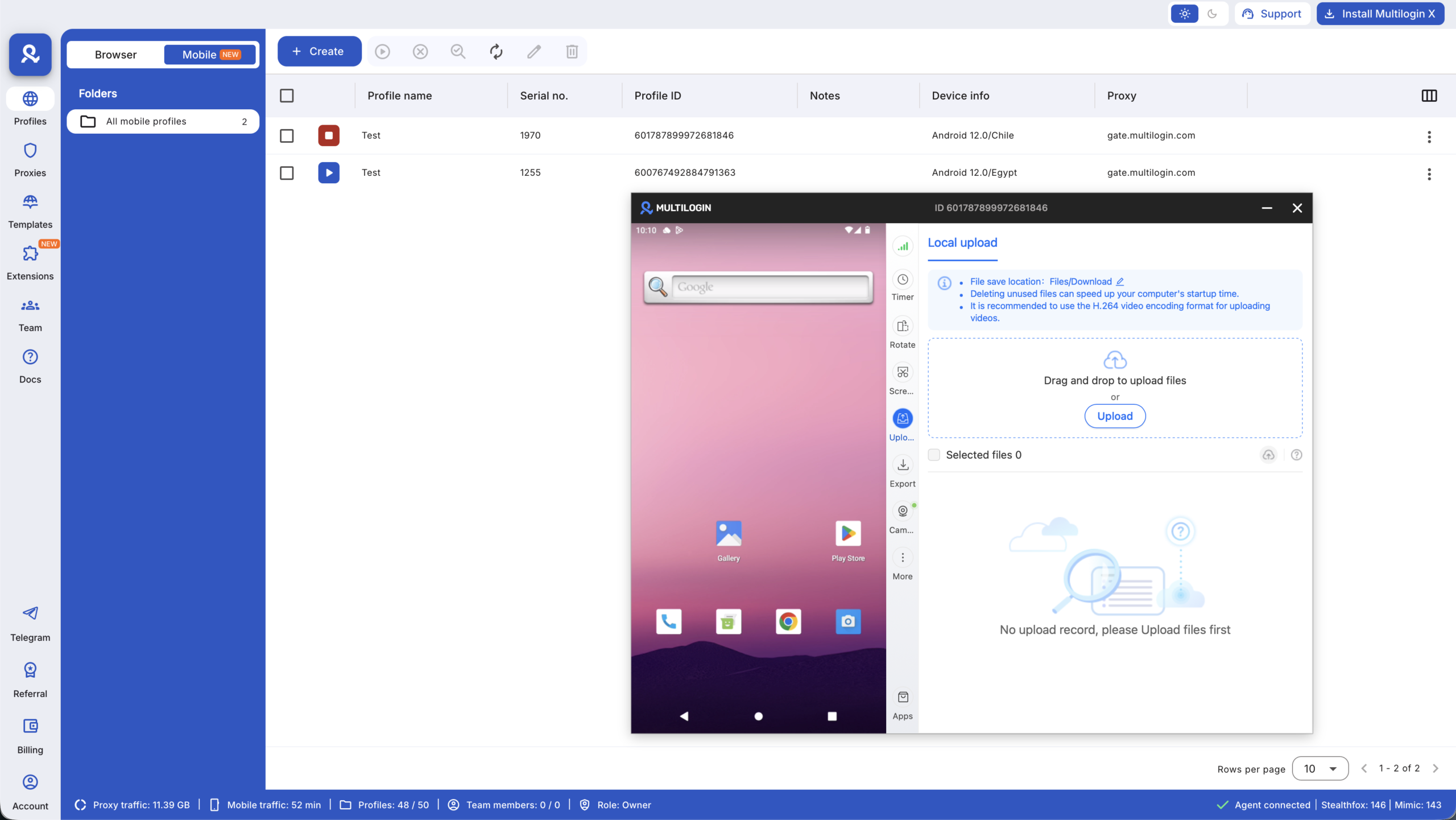
Phone farm without hardware overhead
Traditional phone farms scale by adding more devices. Multilogin scales by adding environments. Cloud profiles replace racks of phones, allowing teams to grow without increasing physical complexity. Mobile identities can be reused safely, issues can be fixed without burning devices, and scaling no longer means rebuilding everything from scratch.
Mobile antidetect browser for mobile web workflows
For mobile web activity, Multilogin antidetect browser includes Android-style mobile browser profiles. Each profile runs in isolation with its own cookies, fingerprints, and session data. Mobile websites see consistent mobile behavior without relying on emulators or resized desktop browsers. This keeps mobile web accounts stable while avoiding identity overlap.
Proxy-aligned mobile identities
Every mobile environment can be connected to its own proxy at the profile level. Network location stays aligned with the device signals and session history. Instead of random IP changes, mobile identities remain coherent over time, which is critical for long-term trust on mobile platforms.
Together, these layers turn phone farming into a controlled system where environments stay intact, identities remain separate, and scale doesn’t introduce chaos.
Who Multilogin phone farming is built for
Multilogin phone farming is built for teams that rely on mobile environments and need them to stay stable over time. It’s designed for operations where one broken setup can mean lost accounts, stalled workflows, or weeks of recovery.
- Teams running mobile-first platforms: For workflows that behave differently on mobile, persistent Android environments make it possible to test, operate, and manage accounts without relying on unstable devices.
- Agencies managing multiple mobile accounts: Each client account runs in its own isolated mobile environment, reducing the risk of one issue affecting multiple brands or campaigns.
- Businesses operating across regions: Profile-level network and location control allows mobile identities to match regional behavior without conflicting signals or repeated resets.
- Anyone replacing fragile phone farms: If physical devices, emulators, or reused setups keep breaking, this approach removes hardware dependency and replaces it with controlled, reusable mobile environments.
This setup is meant for people who need predictability instead of constant rebuilds.