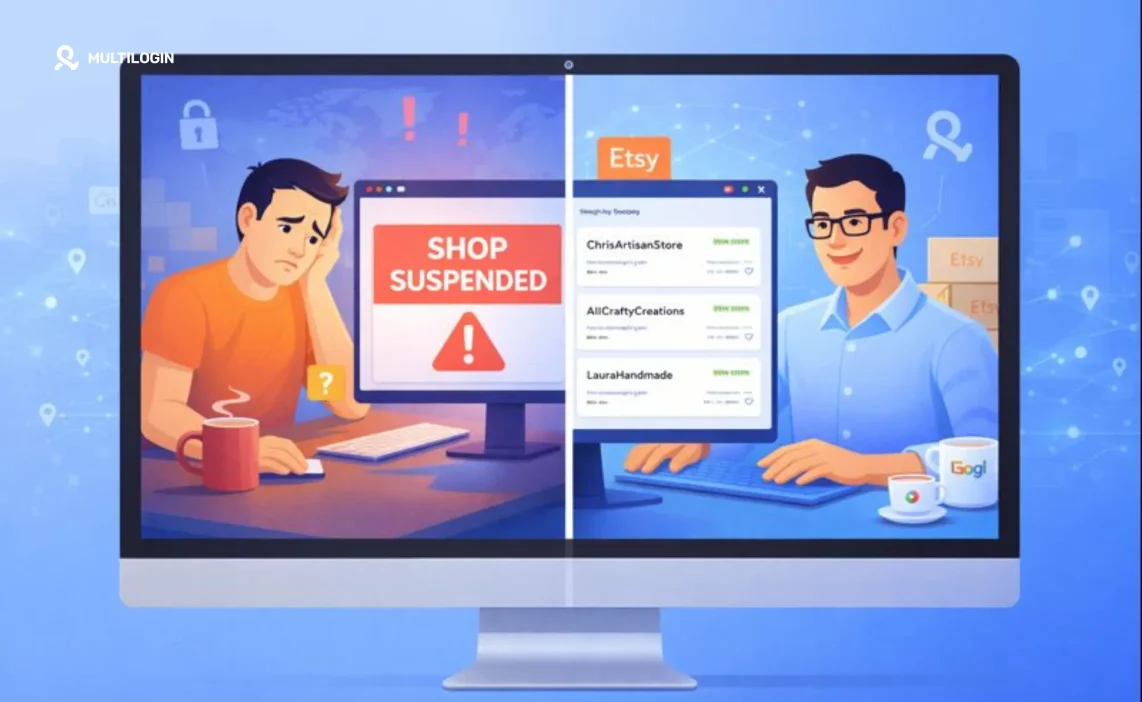

So, your first Etsy shop is a hit. The orders are rolling in for your handmade jewelry, and now a brilliant idea for a second shop, this time for digital printables, is keeping you up at night.
But a nagging question is holding you back: Can I create multiple Etsy shops without getting shut down? You’ve heard the horror stories of linked accounts and sudden suspensions, and the last thing you want is to jeopardize the business you’ve worked so hard to build.
Let’s clear this up right away. Yes, you absolutely can have more than one Etsy shop. It’s not against the rules. However, doing it wrong is a fast track to getting your accounts suspended. The key isn’t if you can do it, but how you do it safely.
This guide breaks down the exact process, from the hidden risks of linked accounts to the step-by-step method for setting up your second, third, or even tenth shop without a hitch. We’ll cover the official rules, the common mistakes that get sellers banned, and how to manage multiple accounts like a pro.
Ready to expand your Etsy empire the right way? Compare our plans and see how professionals manage multiple accounts securely.
Why sellers hesitate to open a second Etsy shop
The biggest fear isn’t about breaking a specific rule, it’s about the unknown. Etsy, like many online platforms, uses sophisticated systems to link accounts. If one of your shops gets a policy violation, that negative reputation can instantly transfer to your other shops, even if they’re in perfect standing. This is called account linking, and it’s the primary reason sellers hesitate to expand.
Here’s a scenario that happens more often than you’d think: Your new digital printable shop gets flagged for a copyright issue you weren’t even aware of. Because Etsy has linked your accounts behind the scenes, they don’t just suspend the new shop. They suspend your successful jewelry shop too. Your income vanishes overnight, all because the platform saw both shops as a single entity.
The thing is, this problem isn’t unique to Etsy. If you’ve ever run multiple Amazon seller accounts or managed multiple eBay accounts, you’ve probably encountered similar linking issues. E-commerce platforms are getting smarter at detecting when the same person operates multiple storefronts.
How Etsy actually connects your shops (the technical side)
Etsy doesn’t publicly detail its detection methods, but based on years of seller experiences, we know they track several data points to connect accounts. This goes far beyond just your name and address.
Here’s what Etsy’s detection systems are actually looking at:
Your IP address is the most basic link. If you log into multiple shops from the same home or office Wi-Fi, Etsy knows they’re connected. But that’s just the starting point.
Browser fingerprinting is where things get more sophisticated. This is a unique profile of your device that includes your browser type, operating system, screen resolution, installed fonts, and even your graphics card. It’s a highly accurate way to identify you, even if you switch to a different IP address.
Then there’s cookies and cache, data stored in your browser that tracks your activity across sessions. And don’t forget financial information: while you can use the same bank account for multiple shops, it creates another strong link between them.
Any overlap in these areas tells Etsy that the same person is behind multiple shops. While this is allowed, it means that a problem with one shop can instantly become a problem for all of them.
The real fix: isolating your shops for true security
The only way to truly protect your Etsy empire is to ensure each shop operates in a completely isolated environment. This means each shop needs its own unique digital identity, making it impossible for Etsy to link them together.
This is where simply using a different email address falls short. You need to control the deeper digital signals your browser sends out. Understanding how your digital fingerprint works is the first step toward protecting your business.
The antidetect browser approach
Multilogin is an antidetect browser designed specifically for this problem. It allows you to create and manage multiple, completely separate browser profiles from a single computer. Each profile has its own unique browser fingerprint, cookies, and storage—making it appear to platforms like Etsy as a distinct, genuine device.
Here’s how it solves the core issues:
Problem | How Multilogin Solves It |
Linked IP Addresses | Each browser profile can be assigned a different residential proxy, giving each shop its own unique IP address. |
Browser Fingerprinting | Multilogin generates a real, natural browser fingerprint for each profile, so your shops never share the same digital DNA. |
Shared Cookies | Each profile has its own isolated cookie jar, so your activity in one shop is never visible to another. |
Management Chaos | Instead of juggling different browsers or devices, you can manage all your shops from a single, organized application. |
By using Multilogin, you’re not just hiding your connection—you’re creating fundamentally separate and unlinkable online identities for each of your Etsy shops.
For mobile-first sellers: cloud phones change the game
Now, here’s something worth mentioning if you manage your Etsy shops through the mobile app. Traditional antidetect browsers work great for desktop operations, but what about when you need to manage shops on mobile?
This is where cloud phones come in. These are real Android devices hosted in the cloud—not emulators or simulated environments, but genuine Android hardware with authentic identifiers like IMEI, Android ID, and MAC addresses.
Why does this matter for Etsy sellers? Because platform detection on mobile apps goes deeper than web browsers. Mobile apps can access device-level identifiers that browser-based solutions can’t mask. With a cloud phone, each of your Etsy shops can operate on what appears to be a completely separate physical device—without you needing to buy and manage multiple actual phones.
The practical benefit: you can manage your shops from one desktop dashboard while each shop appears to be running on its own dedicated mobile device. Combined with built-in mobile-grade proxies that match your location, this creates the kind of genuine device separation that keeps accounts truly isolated.
See all pricing plans and choose the best fit for your growing business.
How to create a second Etsy shop (the safe way)
Now that you understand the risks and the professional solution, here’s the step-by-step process for opening another Etsy shop.
Before you start, make sure you have:
- [ ] A distinct product line for the new shop (no duplicate listings)
- [ ] A new, unique email address (use a different provider if possible)
- [ ] Your new shop name decided
- [ ] Shop branding prepared (banner, logo)
- [ ] A separate browser profile set up in Multilogin for the new shop
Step-by-step setup
- Step 1: Create a new browser profile. Before you even visit Etsy’s website, open Multilogin and create a new browser profile for your new shop. Assign a residential proxy to give it a unique IP address.
- Step 2: Register a new email. Inside this new, clean browser profile, create a brand-new email address. Don’t link it in any way to your existing emails—this means no recovery emails pointing to your main address either.
- Step 3: Sign up for a new Etsy account. Still within the same Multilogin profile, go to Etsy.com and register for a new account using your new email address. This ensures the account creation fingerprint stays isolated.
- Step 4: Set up your shop. Follow Etsy’s prompts to set up your new shop. You can use the same personal information and bank account if you choose, but remember that this creates a link. For maximum separation, using different financial details is ideal, though not required by Etsy.
- Step 5: Disclose your shops. This is crucial and something many sellers forget. In the public profile section of both your old and new shops, you must state that you own and operate other shops. Simply list the shop names. It’s a sign of transparency that Etsy appreciates and actually requires.
- A quick trade-off to consider: Using the same bank account is convenient, but it’s the strongest link you can create between your shops. If your goal is maximum security and insulation from risk, consider opening a separate bank account for your new shop. It adds some administrative work but provides a powerful layer of separation.
The mistakes that get Etsy sellers in trouble
- Getting lazy with emails. Using variations of the same email (like [email protected] and [email protected]) is a huge red flag. Gmail ignores dots, so these are literally the same email address. Always use completely different ones.
- Forgetting to disclose. Sellers often skip disclosing their shops, either because they forget or they think it’s better to hide the connection. This is a direct policy violation and can get you suspended even when everything else is done correctly.
- Cross-contaminating products. Don’t list the same or very similar items in multiple shops. Each shop should have a distinct and unique inventory. Etsy specifically watches for this.
- Logging in from the wrong browser. Accidentally logging into your new shop from your regular browser—or vice versa—can instantly link the accounts. This is exactly why session management matters. Discipline is key, and having dedicated browser profiles for each shop makes this almost impossible to mess up.
If you only do one thing… Always use a dedicated, isolated browser environment for each of your Etsy shops. This single action prevents the vast majority of account linking issues.
No more juggling physical devices or risking account links. Try Multilogin's cloud phones now.
Frequently Asked Questions About Can I Create Multiple Etsy Shops
Yes, absolutely. Etsy’s policy allows it, provided you follow the rules: use a separate account and email for each shop, and disclose all your shops on your public profiles. The key is doing it transparently and keeping your shops properly isolated.
There’s no official limit. You can create as many as you can successfully manage. The practical limit is determined by your ability to maintain unique products and provide excellent customer service for each shop. Many successful sellers run 3-5 shops focused on different niches.
No—this is the most important rule. Every new Etsy shop requires a new Etsy account, which requires a unique email address. There’s no way around this.
Yes, Etsy allows you to use the same bank account and credit card for multiple shops. However, be aware that this creates a strong link between your accounts. If one account faces financial issues (chargebacks, disputes), it can affect the others.
You can open a new shop at any time using the standard process: create a new account with a new email address. If your previous shop was suspended though, opening a new one is much riskier and may be against Etsy’s policies on ban evasion. In that case, proper account farming practices become essential.
No, Etsy doesn’t provide a way to merge two separate shops. You’d have to manually move your listings from one shop to the other and then close the old one. This can be time-consuming but is sometimes necessary when consolidating your business.
Start expanding your Etsy business
Creating multiple Etsy shops is a powerful way to grow your e-commerce business, but it comes with real risks if not done correctly. By understanding how Etsy links accounts and by taking proactive steps to isolate each shop’s digital identity, you can scale your operations without fear.
The sellers who successfully run multiple shops aren’t just lucky—they’re using the right tools. Whether you’re managing everything from desktop browsers or need mobile antidetect solutions for app-based management, the principle is the same: true isolation beats hoping you won’t get caught.
Ready to scale your Etsy business with confidence? View pricing and plan options and start managing your shops like a pro.