


The TikTok algorithm 2026 decides whether your video reaches 200 people or 200,000.
This guide is for marketers, creators, and teams who run TikTok accounts: how ranking works this year, how much each signal weighs, and exactly what to do about it.
TL;DR
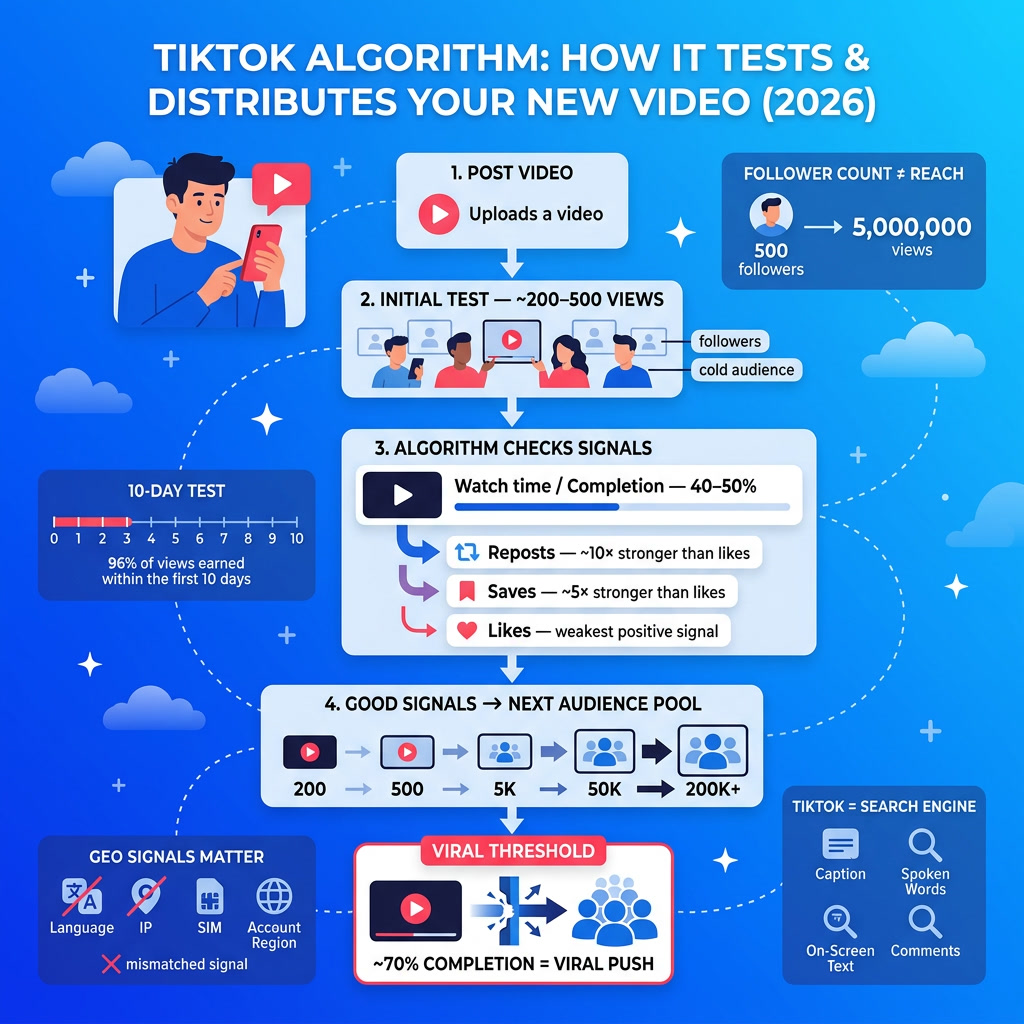
- TikTok now tests new videos on your followers first, then rolls them out to cold audiences in pools of roughly 200-500 views.
- Watch time rules everything: completion rate carries 40-50% of the algorithm’s weight, and the bar for viral pushes is now around 70% completion (it used to be ~50%).
- Reposts weigh about 10x more than likes. Saves weigh about 5x more. Likes are now the weakest positive signal.
- Follower count is not a ranking factor. A 500-follower account can reach 5 million people.
- A video earns 96% of its views in the first 10 days. Every post is a 10-day test.
- TikTok is now a search engine: it indexes captions, spoken words, on-screen text, and even comments.
- Mismatched geo signals (language, IP, SIM, account region) quietly kill distribution.
That’s the short version. Keep reading for the full breakdown: exact numbers behind every factor, the myths that waste your time, a five-part action plan, and a pre-publish checklist you can steal.
How the TikTok Algorithm Works in 2026: What’s New
The core mechanic hasn’t changed: cascade testing. Every new video gets a test pool of roughly 200-500 views. Pass the test, and you get the next, bigger wave. Fail it, and distribution fades. The chain repeats all the way up to millions.
Here’s what’s new in 2026:
- Follower-first testing. Tests used to start on a random cold audience. Now the platform shows your video to your followers first, and only their reaction unlocks wider reach. The uncomfortable conclusion: a “dead” or botted audience now actively sinks your new videos.
- TikTok became a search engine. Nearly 40% of Gen Z search on TikTok instead of Google. The algorithm indexes captions, spoken speech, on-screen text, and even comments. Every video is now a search asset.
- The completion bar went up. In 2024, roughly 50% completion was enough for a push. In 2026, aim for 70% and above.
- Local feeds. Since February 2026, TikTok has been testing geo feeds with city-level precision (US and parts of Europe for now). Local content got its own distribution channel.
- Faster update cycles. The algorithm used to shift noticeably once a quarter; now updates land roughly every month. Which means the reliable strategy is optimizing the metrics themselves (completion, reposts, saves) rather than hacking a specific formula.
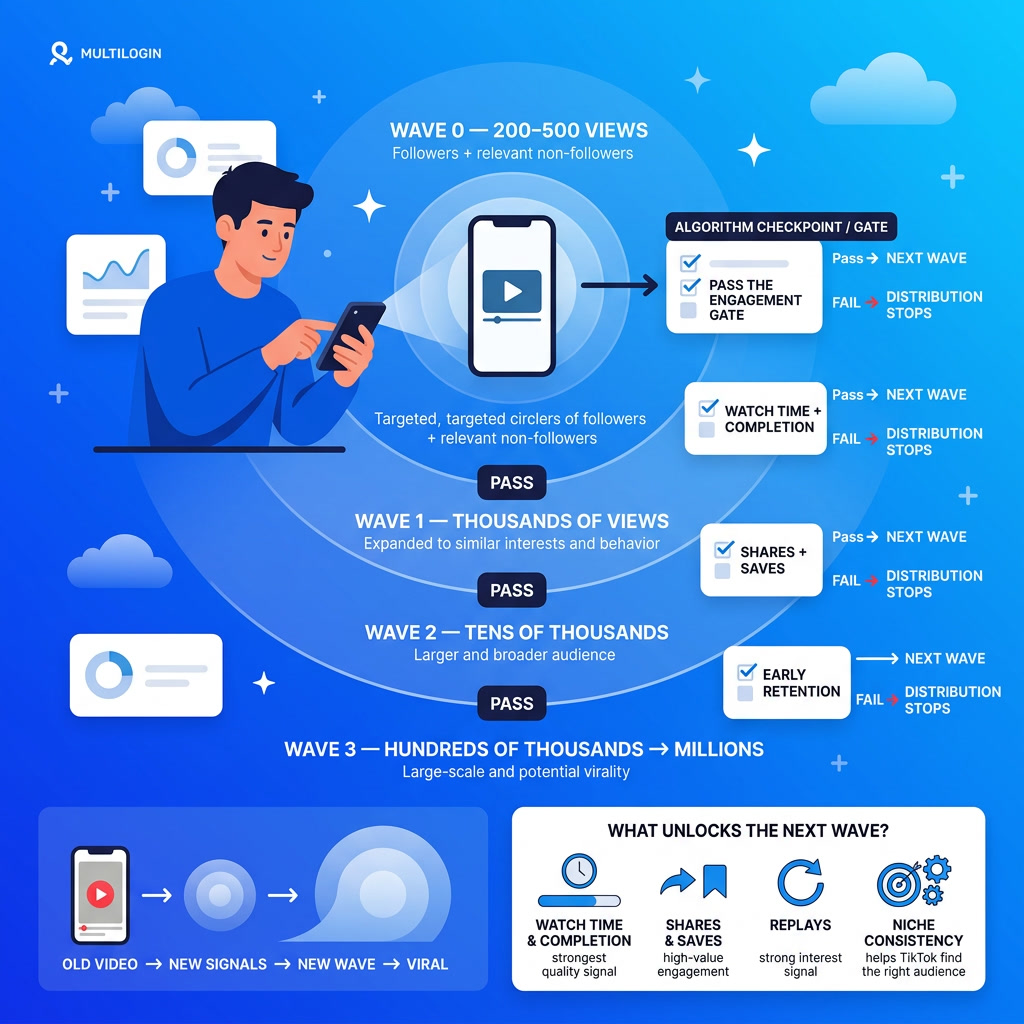
Diagram of how the TikTok algorithm 2026 tests videos in audience waves.
One more thing worth knowing: TikTok runs at least three separate ranking systems.
The For You feed looks at completion and reposts. The Following feed looks at freshness and your history with each specific viewer.
LIVE plays by its own rules. Optimizing one video for all of them at once is a mistake. You grow on the For You feed, and that’s what this article is about.
Every Ranking Factor in Numbers
First, the big picture. An analysis of 2.3 million videos surfaced two fundamental numbers: a video earns 96% of all its views in the first 10 days, and 98% of all interactions land in the same window. Every video is a separate 10-day test. If it didn’t take off, the window closed; you publish the next one.
Now the signals, in descending order of weight:
| Factor | Weight / effect in numbers | What it means in practice |
|---|---|---|
| Completion and watch time | 40-50% of algorithm weight; viral bar at ~70% completion | Cut everything unnecessary; hook in the first 1-2 seconds |
| Reposts | Roughly 10x stronger than a like | Make content people send to friends |
| Saves | Roughly 5x stronger than a like | Checklists, tutorials, “save for later” content |
| Follower reaction in the first hours | Your first test circle | Post when your audience is online |
| Account niche consistency | Single-format accounts grow multiples faster | One account = one topic |
| Video length | 60-180 sec: +43% reach and +64% total watch time | But a short video at 90% completion beats a long one at 40% |
| Search signals | First 50 characters of the caption matter most | Keyword in the caption, speech, and on-screen text |
| Geo signals | Conflicting signals push videos to passive regions | Language, IP, and settings must point to one region |
And here are the behavior numbers that surprise people most:
- Posts that directly ask for likes get roughly 60% fewer interactions than average. It’s a one-sided deal: you ask, the viewer gets nothing.
- Posts with a genuine question collect 26% more comments.
- 90% of a video’s success is decided in the first 1-2 seconds, at the hook.
- The share of views coming through hashtags doubled in a year. Hashtags didn’t die; they changed jobs. They’re context clarification now, not a ticket to the FYP.
What Doesn’t Matter (and What Gets Penalized)
| Myth | 2026 reality |
|---|---|
| “You need lots of followers” | Follower count is not a direct ranking factor. A 500-follower account can pull 5M views |
| “#fyp and #viral help” | They carry no search signal and dilute your topic. Optimum: 3-5 niche tags |
| “Rewatch your own videos” | Classic myth, zero effect |
| “Expensive production wins” | The algorithm cares about retention, not polish |
| “Post 4 times a day” | A 2024 pattern; in 2026 it gets penalized at cold start. Optimum: 3-5 posts a week |
| “Crosspost from Reels/Shorts” | Watermarks trigger automatic distribution penalties |
| “A trending sound will carry the video” | Reusing sounds with no added value costs about 60% of reach |
Every Way to Influence the Algorithm: A Step-by-Step Plan
Now the practical part, split into five blocks with concrete actions in each.
1. Retention: Win the First 2 Seconds
- Build the hook as a promise: a striking visual, a question, or in-frame action from second one. Without a hook, nothing else matters.
- Aim for 70%+ completion. Open your analytics, find the retention graph, and cut the moment where viewers drop.
- For longer videos, use an “open loop”: a promise at the start, the payoff at the end.
- Test length: 60+ seconds for reach and monetization, 11-30 seconds for pure virality.
2. Metadata: Tell the Algorithm What the Video Is About
TikTok cross-checks your topic in several places at once. Your job: make the keyword match everywhere.
| Where the keyword must appear | Example for a ChatGPT video |
|---|---|
| On-screen text (hook) | “ChatGPT is wasting your time” |
| Spoken speech | You say “ChatGPT” out loud (the algorithm transcribes audio) |
| Caption, first 50 characters | “I tested how ChatGPT handles…” |
| Hashtags | 3-5 niche tags, including the video’s topic |
| Comments | Ask viewers to comment a word tied to the topic |
| Profile name and bio | Niche keywords people actually search for |
| Playlists | Playlist names get read as metadata too |
A real example: a video where “ChatGPT” matched on screen, in the voiceover, caption, hashtags, and comments pulled about 195,000 views. Meanwhile, a creator who asked viewers to comment words unrelated to the video’s topic saw her on-topic videos collect 2-3x more views than the ones with a random comment word.
One nuance: don’t replace the word with a logo. The algorithm reads the text “TikTok”; the icon, not always.
3. Posting Rhythm: Frequency Depends on How “Warmed Up” You Are
Two camps of data here, and they don’t contradict each other:
- Account not warmed up yet (post, flop, post, flop, occasionally 10K): publish one well-crafted video per day. Mass-posting weak content locks in low reach.
- Account warmed up (most videos collect solid views): keep a rhythm of 3-5 quality posts per week and increase frequency gradually.
An example from the 2.3M-video analysis: the app Inflow posts more than once a day and gets 19x more interactions than the average account of their size. But they already found their format and warmed their audience. Format first, frequency second.
On timing: the overall sweet spot across accounts is 6:00 PM to 9:00 PM, peaking around 8:00 PM. Day of the week barely matters. The first hour after publishing is critical: stay online and reply to comments immediately.
4. Niche: One Account = One Topic
The algorithm shows content by interest, not by follows. When you make the same type of content again and again, the system learns exactly who you’re “for.”
Example: the brand Wild Hats films a single format, the process of making cowboy hats. Their average video collects 95,000 interactions: 31x more than a typical account of their size. They simply record the work they’d be doing anyway.
The practical takeaway: test formats, but once you find one that works, give it several weeks. That’s exactly when the algorithm “assembles” your audience.
What if you have several topics? Don’t mix them in one profile. Multi-topic content became the enemy of growth, so each niche or region deserves its own account. We broke down how to do that safely in our guide on how to run multiple TikTok accounts without bans.
5. Geo Signals and Account Health
The most underrated block. If your signals conflict (say, Russian speech with a US SIM card), the algorithm can route the video to “passive” regions where it dies fast. Content language, IP, SIM, and account settings must point to one region.
What to check:
- Account Check in TikTok settings. If the status says your account is at risk, fix the violations first, then keep posting. Otherwise your reach burns for nothing. If views dropped to zero with no warning, check for restrictions: we covered the signs in our article on the TikTok shadow ban.
- Geo consistency. Align the content language, the IP you post from, and your account region before you publish, and keep them stable.
- Warm-up. Accounts that post at high volume right away get flagged. Natural, gradual activity builds long-term account health.
How to Find Trends and Ride Them
Trends in 2026 work differently than in 2020: blindly copying viral hooks and sounds gets penalized. What works is embedding a trend into your niche.
Step by step:
- Catch sounds before the peak. Pick tracks that are just gaining momentum and adapt them to your topic. Track sound growth in TikTok Creative Center.
- Monitor competitors. Watch which videos in your niche are breaking out right now: topic, hook, structure. Copy the mechanics, not the content: watermarked copies and low-effort reuploads get downranked.
- Join conversations via Duet and Stitch. A ready-made way to plug into existing traffic with your own expertise.
- Write captions in search language. TikTok is a search engine, which means you can catch trends through queries. Phrase captions the way people actually search: “how to remove video background,” not “my new life hack.”
- Think community, not hype. The algorithm prioritizes content embedded in communities (think #BookTok) over random virality. Deep resonance in a narrow group beats wide reach. Check hashtag trends here.
- Test niches in parallel. A professional move: run one format across several niches or regions on separate accounts, then scale the winner.
And remember comments are a topic signal too. End your video with a genuine question you’d want to answer yourself. Not “was this helpful?” but “which one would you pick?” That’s +26% comments without a single like beg.
How to Make Videos Go Viral on TikTok in 2026: Conclusion
Let’s assemble the formula. The TikTok algorithm 2026 rewards creators who:
- hold 70%+ completion and win the first 2 seconds;
- make content people share and save (repost = 10x a like, save = 5x);
- align metadata: one keyword across on-screen text, speech, caption, hashtags, comments, profile name, and playlists;
- run one account per topic and post 3-5 times a week at their peak hour (roughly 6-9 PM);
- keep followers “warm,” because they’re now the first test circle;
- align geo signals: language, IP, SIM, and settings point to one region;
- treat every video as a 10-day test: 96% of views arrive in that window.
Pre-publish checklist:
| Check | Done? |
|---|---|
| Hook in the first 1-2 seconds | ✅ |
| Keyword: on-screen + spoken + first 50 caption characters | ✅ |
| 3-5 niche hashtags, no #fyp | ✅ |
| A comment-bait question tied to the topic | ✅ |
| Published at your audience’s active hour | ✅ |
| Account Check: account in good standing | ✅ |
| Geo signals aligned (language, IP, region) | ✅ |
The exact signal weights are closed and change monthly, so the most reliable strategy is optimizing the metrics themselves rather than chasing a formula.
One last thing for teams working at scale. If you run multiple TikTok profiles, test content hypotheses across niches, or analyze how the TikTok market behaves in different countries, Multilogin fits that workflow well.
Each profile gets its own isolated environment, and built-in proxies with matched geolocation let you run and compare profiles across regions from one dashboard.
That makes it a practical setup for multi-accounting, A/B testing formats, and researching what the algorithm favors in each country.
There’s a Free plan with no time limit, and paid plans start at $7.08/month. And once your accounts start growing steadily, check out our guide on how to make money on TikTok.