


I’ve been watching this space for a while now, and the people making real money with CapCut in 2026 are not just the ones editing videos for clients. The ones pulling in consistent income are the template creators: editors who build a CapCut template for reels once, publish it, and then earn every single time someone else uses it.
It’s one of the cleanest passive income models in the creator economy right now, and most people still don’t know it exists.
This article breaks down exactly how the money works, which template niches are worth your time in 2026, and how using Cloud Phones to run multiple CapCut accounts is the scaling move that separates the creators earning $50 a week from the ones earning $500 or more.
How CapCut Actually Pays You for Templates
Let’s start with the mechanics because this is where a lot of people get confused.
CapCut pays template creators through its Creator Program. You earn money based on how often your templates are used and exported by other users. The program runs across three tiers:
- Explorer for creators building their foundation,
- Emerging for rising creators with growing usage numbers, and
- Elite for the top tier, which comes with template boosting, cash rewards from a larger prize pool, CapCut Pro subscription, merchandise, and direct access to CapCut’s marketing campaigns.
The payout model is essentially a per-use royalty. Every time a user applies your template to their own video and exports it, that counts as a use. A template that goes viral and gets used a million times pays you a million times. You made the template once.
The Creator Program also runs daily challenges with cash reward pools for top performers, and once you’re accepted, there’s a referral program where you earn extra cash rewards for bringing in other creators.
Beyond the in-app program, creators can sell customizable templates, video effects, and transition packs as digital products on platforms like Etsy, Gumroad, and Creative Market, building passive income streams separate from CapCut’s internal program.
These two revenue streams can run in parallel: you list your templates in CapCut to earn per-use royalties, and you sell the same templates as downloadable products on Etsy to earn direct sales income from people who want them as standalone files.

And if you build an audience around your editing style, CapCut’s affiliate program pays up to 35% commission on CapCut Pro referrals, with up to $15,000 in total cash rewards available. Teach people to edit using your templates, send them to CapCut Pro, earn on the conversion. That’s a third income stream stacked on top of the first two.
How Much Can You Actually Earn?
Real numbers, not hype. Creators in the Philippines report earning up to $300 weekly through the CapCut Creator Program by producing video templates, text, and stickers. That’s a real number from real creators, not a theoretical ceiling.
On the higher end, Glassdoor data from CapCut template creator submissions shows an estimated average of around $136,000 per year, with top earners in the 90th percentile reporting up to $250,000 annually. Those are salaried creator roles rather than independent freelancers, but they signal what the platform is willing to pay for elite-level template output.
For an independent creator running multiple accounts across different template niches, the realistic income range in 2026 is somewhere between a meaningful side income at the low end and a full-time creative business at the high end.
The variable that determines which end you land on is volume: how many templates you have in circulation, across how many accounts, across how many niches. More on that in a moment.
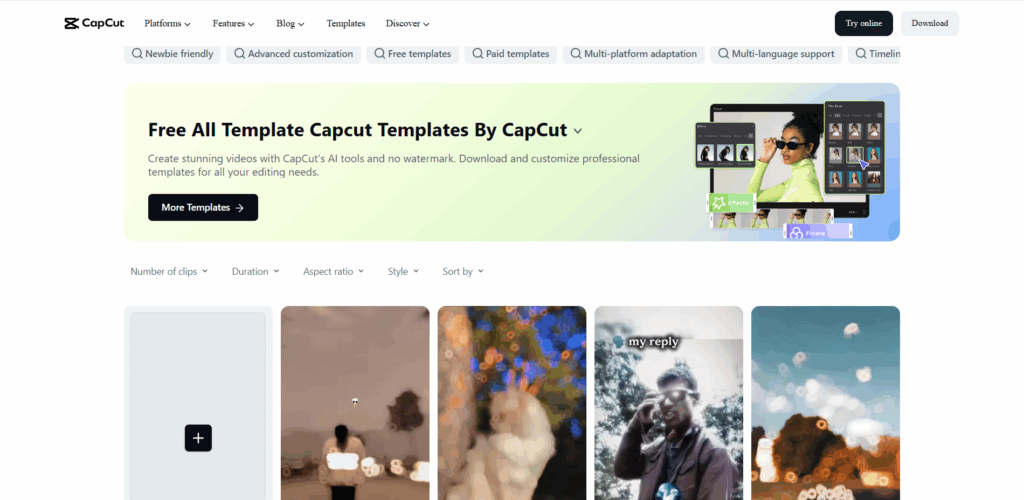
Which CapCut Templates for Reels Actually Make Money?
Not all template niches are equal. Here are the categories with the strongest earning potential right now, and why.
Trending Templates
A CapCut template for reels trending right now gets the most uses in the shortest time. The payout window is front-loaded: a trending template can accumulate tens of thousands of uses in 48 hours if it catches the algorithm. The downside is that trending templates have a shelf life. What’s viral today is background noise in two weeks.
The strategy here is to publish trending templates fast and often, not to try to make each one last forever. Creators who stay consistently in the trending space treat it like a publishing schedule: research what’s gaining traction, build a version of it, publish it, move to the next one.
Slow Motion Templates
A CapCut template for reels slow motion is different from a trending template in one important way: it has longevity. Slow motion with velocity ramps and cinematic color grading is not a trend. It’s a format. Creators making bike reels, gym transformation content, travel highlights, and car showcases have been using slow-motion templates consistently for years and will keep using them.
The new trend CapCut template for reels slow motion in 2026 combines velocity ramps, where the footage shifts between fast and slow playback at deliberate moments, with dramatic audio builds and cinematic grades.
This style works for almost any niche with physical movement or dramatic scenery. A good slow-motion template you publish today can keep earning for months or years because the demand never disappears.
Niche-Specific Templates
This is where the real long-tail money lives. Generic templates compete with thousands of other generic templates. A CapCut template for bike reels sits in a narrower category with a dedicated audience that searches specifically for it.
A CapCut template for gym reels, a CapCut template for travel reels, a CapCut template for car reels, templates built around Hindi songs, Punjabi songs, Bhojpuri songs, and sad or love content for the South Asian creator market, each of these niches has a large, loyal user base that searches by niche name.
When you build a template specifically for that niche, you’re not competing with the entire CapCut template library. You’re competing with a much smaller set of niche-specific creators, and you’re the one the algorithm serves to every person who searches that category.
New reel templates for CapCut in niche categories like real estate, fitness, and regional audio formats are consistently underserved relative to demand.
CapCut reel templates for real estate agents, for example, is a category with a professional user base who will use and reuse good templates repeatedly across client listings. That’s sustained usage from a single template, not a one-time viral spike.
Templates for Instagram Reels
A CapCut template for Instagram reels has specific formatting requirements: vertical aspect ratio, under 90 seconds, and designed to hook in the first two seconds before someone scrolls past. Templates built with these constraints in mind explicitly outperform generic templates when Instagram creators are browsing. If you label and optimize your templates for Instagram specifically, you capture searches from the massive Instagram creator base that uses CapCut as their primary editing tool.
The Multiple Account Strategy: How Serious Creators Scale
Here’s the piece that most guides skip over entirely, and it’s the difference between earning as a hobby and earning as a business.
One CapCut account, one content focus, one niche. That’s the ceiling for most creators. They publish templates in the style they personally like, grow one account slowly, and hope something goes viral. That approach works at small scale. It does not work if your goal is to build meaningful income from templates.
The creators who are earning consistently in 2026 are running multiple CapCut accounts, each dedicated to a different niche. A gym account. A travel account. A Punjabi song template account. A real estate account. A trending velocity edit account. Each one builds its own niche authority, its own usage base, and its own earnings independently of the others.
The math is straightforward. If one niche account earns you $80 a week in template uses, five niche accounts earn you $400 a week. The templates you publish on each account serve different audiences with different algorithmic signals. A gym template creator and a travel template creator are not competing for the same users. Their earnings are additive, not overlapping.
The problem is that running five CapCut accounts from the same device, the same IP address, or the same phone creates risk. CapCut, like every major platform, monitors for signals that indicate multiple accounts belong to the same person: identical device hardware, the same network, similar behavioral patterns. When those signals cluster, accounts get flagged, reach gets suppressed, or accounts get suspended entirely.
This is exactly the problem that Multilogin Cloud Phones were built to solve.
How Cloud Phones Let You Run Multiple CapCut Accounts Safely
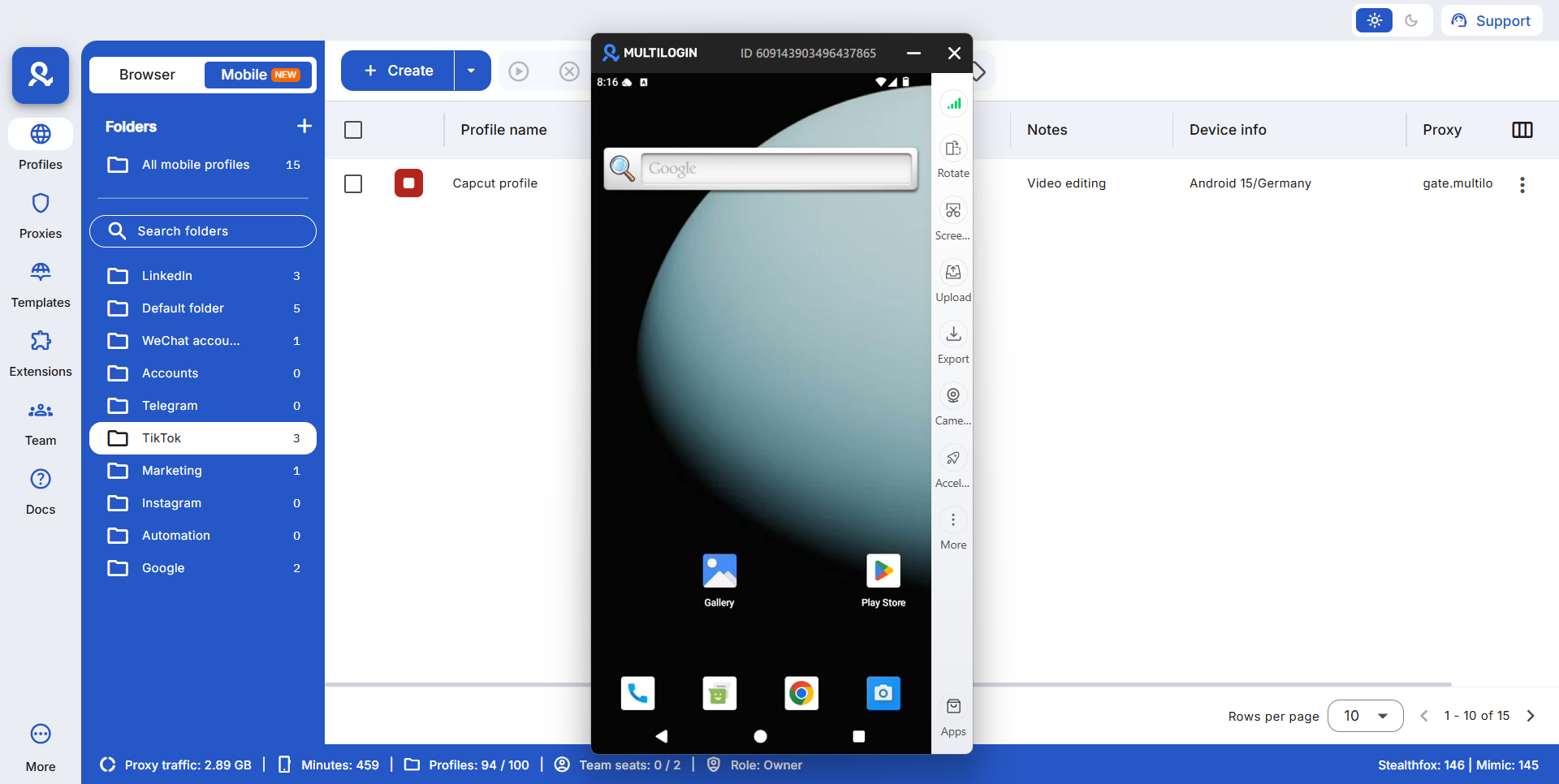
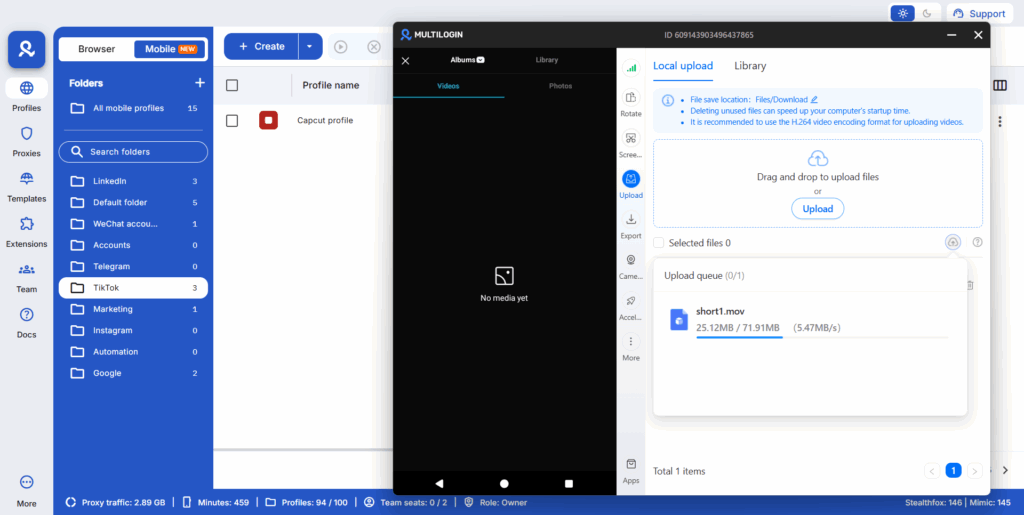
A Cloud Phone is a real Android device running in the cloud. Not an emulator, not a simulated environment. A genuine Android cloud phone with its own IMEI, Android ID, MAC address, GPS settings, and network connection, all matched to a specific country of your choice.
When you run a CapCut account on a Cloud Phone, that account has a completely independent device identity. It has its own hardware fingerprint, its own location, its own IP from a real residential proxy that matches the country the phone is running from. From CapCut’s perspective, it’s a different device in a different location used by a different person. Because, effectively, it is.
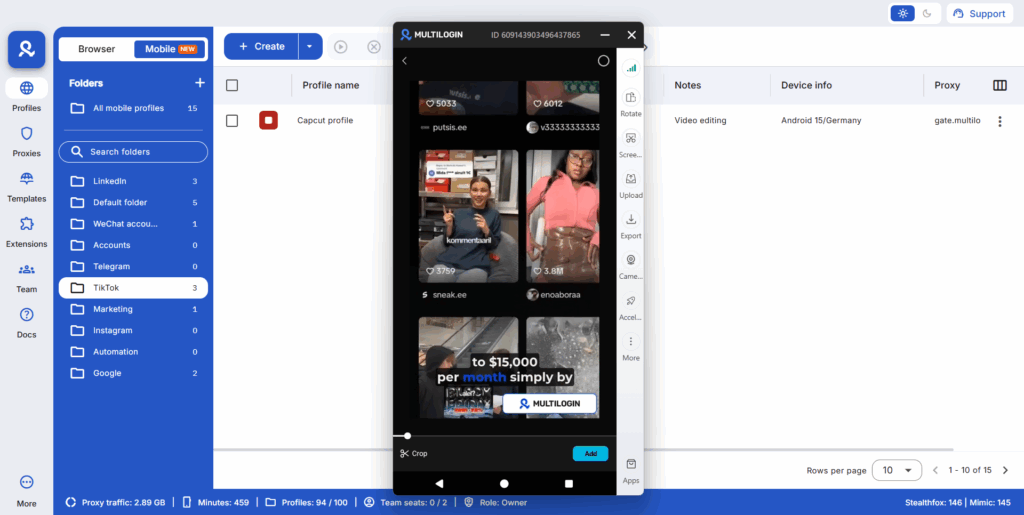
You can run five Cloud Phones, ten Cloud Phones, however many make sense for your template business, all managed from a single dashboard on your desktop. Each phone has its own CapCut account.
Each account has its own niche focus. Each one builds its own usage history, account warm-up record, and earnings independently. App data, login states, and session history all persist between sessions, so each account maintains a natural, consistent activity pattern over time.
You install CapCut on each Cloud Phone exactly the way you would on a physical Android phone, directly from the built-in app store. No sideloading, no workarounds. Then you publish templates from each account into their respective niches and let the earnings compound across all of them simultaneously.
For the step-by-step setup, Multilogin has a full guide at how to install CapCut on Cloud Phones, and you can see the broader Cloud Phones setup at Cloud Phones for CapCut.
Accessing the CapCut Creator Program from Outside the US
There’s a geo-restriction problem that stops a lot of international creators from accessing the Creator Program’s full earning potential. The US CapCut Template Creator Program is specifically for US creators only. UK and select other regions have their own programs, but large markets including India, where CapCut is permanently banned, and many other countries either have limited access or no access to the full monetization features.
A Cloud Phone running from the US or UK gives you a device that appears to CapCut as a genuine device in that country, because it is. The hardware identifiers, the IP, the location signals, and the network all place the device in the country you chose. You get full access to the Creator Program available in that region, including the per-use payouts, the daily challenge reward pools, and the tier progression system.
This is particularly relevant for creators in South Asia, Southeast Asia, and other high-CapCut-usage markets who are currently locked out of the monetization features their creativity could be earning from. The demand for Hindi song templates, Punjabi song templates, Bhojpuri song templates, and Tamil content templates is enormous and mostly served by creators who can access the platform. A Cloud Phone running from an eligible region changes that equation.
Selling Templates on Etsy and Gumroad: The Second Income Stream
The Creator Program is not the only way to monetize your templates. Selling them directly as digital products is a parallel income stream that you control entirely, with no dependency on CapCut’s payout rates or program structure.
Selling customizable video effects, transitions, and niche-specific templates on platforms like Etsy, Gumroad, and Creative Market builds passive income streams that run independently of CapCut’s internal program. A buyer on Etsy pays you a fixed amount for the template file, you deliver it digitally, and the transaction is done. No per-use tracking, no tier requirements, no regional eligibility.
The products that sell best on these platforms are bundle packs: a collection of ten slow-motion templates for a single niche, or a set of five trending velocity templates with different color grades and audio cues. Buyers are looking for ready-to-use libraries, not single templates, because they’re building a content workflow and they want options.
If you’re running multiple CapCut accounts across different niches with Cloud Phones, you can build niche-specific template bundles from each account’s output and list them on Etsy simultaneously. Each niche has its own product page, its own buyer audience, and its own sales independently of the others. Again, the earnings stack.
Need to manage multiple Capcut accounts? Try Multilogin Cloud Phones.
Frequently asked questions About How to Make Money Selling CapCut Templates for Reels
You earn through the CapCut Creator Program, which pays you each time another user applies your template to their video and exports it. You can also sell template packs as digital products on Etsy or Gumroad, and earn affiliate commissions by referring people to CapCut Pro. Running multiple niche accounts multiplies your earnings across all three streams.
It depends on usage. Creators in the Philippines report up to $300 weekly from the Creator Program. A template that goes viral can accumulate hundreds of thousands of uses in a short window. Creators running multiple niche accounts see earnings compound significantly because each account earns independently.
The US program is US-only, but CapCut runs regional programs in other markets including the UK and Philippines. Creators outside eligible regions can access these programs through a Cloud Phone running from an eligible country, which gives the account a genuine device identity in that region.
Yes, and it’s one of the most effective ways to scale template earnings. Each account should focus on a specific niche so the algorithm serves your templates to the right audience. Running multiple accounts on the same device or IP creates detection risk. Multilogin Cloud Phones give each account its own isolated device identity and location, keeping them clean and independent.
Slow-motion velocity templates have long-term evergreen demand across gym, bike, travel, and car content. Trending templates generate high short-term usage spikes. Niche-specific templates for regional audio (Hindi songs, Punjabi songs, Bhojpuri songs) serve dedicated audiences with specific search behavior. Real estate and professional niche templates have professional users who reuse templates repeatedly across multiple projects.
Yes. Running CapCut on a Cloud Phone from a country where it’s available gives you full access to the app, the Creator Program, and all template publishing features. The Cloud Phone appears to CapCut as a genuine device in that location because it is one. Indian creators and others in restricted regions use this approach to participate in the Creator Program and earn from their templates.
Etsy, Gumroad, and Creative Market are the main third-party platforms. Bundle packs of niche-specific templates perform better than individual templates because buyers are looking to build a library, not just purchase a single file. Listing on multiple platforms simultaneously and running a dedicated account for each niche on CapCut maximizes both direct sales and per-use royalties.
CapCut Template Business: What the Full Setup Looks Like
To put it all together, here’s what a properly structured CapCut template business looks like in 2026 for someone using Cloud Phones to run multiple accounts:
You run five to ten Cloud Phones through Multilogin, each set to a different country or region, each running its own CapCut account dedicated to a specific niche.
Each account publishes templates regularly into that niche: slow-motion bike templates, gym velocity templates, travel cinematic templates, trending Hindi song templates, real estate showcase templates. Each account builds its own usage history and earns per-use royalties through the Creator Program in its region.
Simultaneously, you list bundle packs of your best templates from each niche on Etsy and Gumroad. Buyers who find your products through search get a clean, organized library of niche-specific templates. You earn direct sales income on top of the per-use royalties.
If you build any kind of audience around your editing style, you layer the affiliate program on top: teach people how to use CapCut, share your affiliate link, earn commissions on CapCut Pro subscriptions they sign up for.
None of these three income streams interfere with each other. They all grow in parallel. The Cloud Phones are the infrastructure that makes the multi-account, multi-niche structure possible without risk of cross-account detection or regional access restrictions.
You can see how the broader multi-account structure works at best Cloud Phones for social media marketing, and how it compares to other approaches at Cloud Phones vs antidetect browsers.