


Using AI in influencer marketing can make creator research, outreach preparation, content review and reporting faster. But faster work does not automatically produce better creators, stronger content or more revenue.
Marketing teams still need to verify recommendations, review audience data, protect brand standards and connect campaign activity to a meaningful business result. The practical question is not whether AI should replace an influencer marketing team. It is where AI can handle repetitive work without taking over decisions that depend on context, judgment and human relationships.
Key takeaways
- AI can support influencer discovery, initial vetting, outreach preparation, content review, monitoring and reporting.
- AI campaign tools, AI-generated creator content and AI-generated influencers are three different concepts.
- Automated recommendations should be treated as inputs for review, not final decisions about creator quality or brand fit.
- AI influencer campaign costs can include software, creators, production, human review, amplification, compliance, tracking and campaign management.
- AI may reduce repetitive work, but it does not guarantee better influencer marketing ROI.
- Human review remains important for creator relationships, creative quality, disclosures, usage rights and brand safety.
Key definitions
AI in influencer marketing: The use of artificial intelligence to support campaign activities such as creator discovery, data analysis, outreach preparation, content review and reporting.
AI-generated influencer content: Images, videos, audio or written content created or materially altered with AI for an influencer campaign.
AI-generated influencer: A fictional or synthetic creator whose visible identity or content is produced partly or fully with AI.
AI influencer marketing platform: Software that applies AI to one or more campaign tasks. Its campaigns may involve human creators, AI-generated influencers or both.
Five source-backed findings to know
- Commercial relationships still need disclosure. The US Federal Trade Commission says influencers should clearly disclose material connections such as payments, employment relationships, free products or discounts. The disclosure should appear with the endorsement and be hard to miss. FTC disclosure guidance
- AI does not change truth-in-advertising responsibilities. Endorsements must reflect truthful opinions and must not communicate claims that the advertiser could not legally make. FTC Endorsement Guides Q&A
- Profile, content and commercial disclosures serve different purposes. Instagram’s AI-generated profile label identifies a profile featuring an AI-generated person. Instagram’s branded-content tools identify qualifying commercial relationships. A campaign may need more than one form of disclosure. Instagram AI-generated profile guidance and Instagram Branded Content Policies
- AI use extends beyond content generation. Current search results from Sprinklr, Coursera, CreatorIQ and impact.com describe applications across creator discovery, audience analysis, outreach, campaign operations and reporting.
- Software is only one campaign expense. A useful cost calculation also considers creator compensation, production, review, compliance, paid distribution, tracking and campaign management.
What role does AI play in influencer marketing?
AI supports data-heavy and repetitive campaign tasks, while people remain responsible for strategy, relationships and final decisions.
A team might use an AI-powered influencer marketing tool to organize a large creator pool, summarize audience information or prepare an initial outreach draft. After content goes live, the same team might use AI to group results and surface patterns for review.
These uses fall into three broad categories:
- Analysis: Organizing creator, audience, content and performance data
- Automation: Handling repeatable tasks such as categorization, drafting and report preparation
- Generation: Producing or adapting text, images, audio and video
The usefulness of each application depends on its input data and review process. A fast recommendation based on incomplete data is still incomplete.
How can brands use AI in influencer marketing?
Brands can use AI across the campaign workflow, from building an initial creator shortlist to preparing the final report.
The strongest use cases usually involve repeatable tasks with clear criteria. Activities that affect creator relationships, legal obligations or brand reputation need closer human control.
Campaign stage | Useful AI role | Required human check | Main limitation |
|---|---|---|---|
Discovery | Filter and organize a large creator pool | Confirm relevance and brand fit | Recommendations depend on the available data and chosen criteria |
Vetting | Flag unusual audience or engagement patterns | Review context and creator history | An unusual signal is not proof of manipulation |
Outreach | Draft and segment starting messages | Verify facts, terms and tone | Automated messages can feel generic or inaccurate |
Creative support | Generate ideas and content variations | Approve claims, quality, rights and voice | Output may be repetitive, inaccurate or off-brand |
Monitoring | Classify content and flag possible issues | Review context and policy relevance | Automated classification can miss nuance |
Attribution | Organize tracked results | Validate tracking and attribution assumptions | AI cannot correct missing campaign data |
Reporting | Summarize results and recurring patterns | Interpret commercial meaning | Correlation does not prove incremental impact |
AI influencer discovery
AI influencer discovery can reduce the time required to filter and organize a large creator pool.
A platform may sort creators using campaign criteria such as topic, location, audience characteristics, content format or previous activity. This provides an initial shortlist. It does not confirm that each recommendation has a credible relationship with the intended audience.
Before contacting a creator, review:
- Recent content
- Previous partnerships
- Audience relevance
- Communication style
- Content consistency
- Fit with the product and campaign
- Any unusual audience or engagement signals
Discovery software is most useful when the campaign criteria are defined before the search begins.
AI influencer vetting
AI influencer vetting can flag profiles or data patterns that deserve closer investigation.
Examples might include sudden follower changes, repetitive comments or an audience-location pattern that does not match the campaign market. These signals can help teams prioritize manual checks.
They should not be treated as proof of purchased followers or manipulated engagement. Viral content, a platform recommendation or a change in content strategy can also produce unusual patterns.
Vetting also needs judgment that cannot be reduced to a score. A creator may have plausible audience data but still be wrong for the brand’s tone, product or customer expectations.
Influencer outreach
AI can prepare outreach drafts and group creators by campaign segment, but a person should review every message before it is sent.
Poorly reviewed automation can mention the wrong content, make incorrect assumptions or send nearly identical messages to unrelated creators. That saves time at the drafting stage but creates more work when creators ignore or question the message.
A useful outreach brief should include:
- The campaign objective
- Why the creator was selected
- The product or offer
- Expected deliverables
- Compensation
- Schedule
- Usage rights
- Approval requirements
- Required disclosures
AI can turn this information into a starting draft. The campaign manager remains responsible for its accuracy and tone.
Creative support
AI can help develop content ideas, summarize a creative brief and adapt approved material into different formats.
Human review remains necessary for factual accuracy, product claims, brand voice, creator authenticity and usage rights. The team must also decide whether generated or materially altered media needs an applicable platform label.
The purpose is to support production without making every creator partnership look and sound the same.
Content monitoring
AI can organize published campaign content and flag possible issues for human review.
A monitoring workflow might look for missing campaign terms, unapproved product claims, absent disclosure language or differences from the agreed brief. It may also group comments or content themes for analysis.
Automated classification can misunderstand humor, slang, criticism or cultural context. A flag should therefore start a review. It should not automatically be treated as a confirmed violation.
Performance tracking and reporting
AI influencer analytics can organize campaign data and summarize recurring patterns, but the quality of the report depends on the tracking underneath it.
Missing links, inconsistent codes, incomplete sales data and unclear attribution windows cannot be corrected by an AI-generated summary. The team must first decide how each action will be measured and which system owns the data.
AI can then help compare:
- Creators
- Content formats
- Platforms
- Markets
- Campaign stages
- Conversion paths
- Revision and approval patterns
A reported relationship between two metrics does not prove that one caused the other.
How does AI help brands find influencers?
AI helps brands find influencers by filtering and organizing candidates against defined campaign criteria.
This is useful when a team has more potential creators than it can review manually. The tool can narrow the pool, but the team still needs to decide whether a creator is suitable.
A practical selection process includes:
- Define the campaign audience, message and outcome.
- Apply the selection criteria to an initial creator pool.
- Review recent content and previous partnerships.
- Inspect audience and engagement signals.
- Speak directly with shortlisted creators.
- Record why each final creator was selected.
The AI system supports the research. It does not own the final judgment.
Can AI detect fake followers and engagement?
AI can flag audience and engagement patterns that may require investigation, but it cannot conclusively identify every case of fake activity.
Possible signals include irregular follower growth, repetitive comments, unusual audience locations or engagement patterns that differ from the creator’s normal activity.
Each signal needs context. An automated score should not be the sole reason for accusing or rejecting a creator. Teams should compare multiple data points, inspect recent activity and document the basis for the final decision.
How much does AI influencer marketing cost?
AI influencer marketing costs depend on the software, creators, production requirements and human oversight involved.
A small campaign may use one tool for research or reporting. A larger agency program may combine discovery software, creative tools, campaign management, paid media, compliance review and separate profile environments.
Cost category | What to include |
|---|---|
AI software | Discovery, analysis, writing, image, video, voice, monitoring and reporting tools |
Creator compensation | Fees, commissions, gifted products, travel and performance incentives |
Content production | Editing, design, localization, revisions and format adaptations |
Human review | Strategy, creator evaluation, approvals, relationship management and quality control |
Compliance | Disclosure review, contracts, usage rights and legal support |
Paid amplification | Partnership ads, sponsored distribution and approved content reuse |
Tracking | Links, codes, analytics, attribution tools and reporting setup |
Profile infrastructure | Environments used to operate separate brand, creator or client profiles |
Campaign management | Briefing, scheduling, communication, payments and documentation |
Correction work | Revisions caused by inaccurate data, weak output or policy concerns |
A subscription price is not the total cost. Teams should include the work required to review, correct and operate the system.
Example 1: AI-assisted human-creator campaign
This is an illustrative example, not a cost or performance benchmark.
An ecommerce team uses AI to organize an initial creator list, prepare outreach drafts and consolidate campaign reports. Campaign managers review the shortlist, contact creators, negotiate terms, approve content and check disclosures.
The team compares this process with a previous manual workflow. It reviews research time, qualified-creator rate, campaign cost, human-review hours and tracked campaign results.
A reduction in research time would show an operational benefit. It would not by itself prove that the campaign generated more incremental revenue.
Example 2: Brand-owned AI-generated influencer
This is an illustrative example, not a cost or performance benchmark.
A brand creates an AI-generated influencer for a recurring content series. Its costs include character development, content generation, editing, human review, profile operations, disclosure checks and distribution.
The brand tracks production cost and campaign results. It also reviews identity consistency, audience reactions, disclosure clarity, correction work and whether the content supports the campaign objective.
Producing more posts does not prove that audiences value them.
Does AI improve influencer marketing ROI?
AI may improve parts of the campaign process, but it does not guarantee better influencer marketing ROI.
Results depend on the offer, audience, creator fit, content quality, platform, campaign execution and attribution model. A team can send more outreach messages and still recruit unsuitable creators. It can produce more content without creating more sales.
Useful measurements include:
- Cost per qualified creator identified
- Creator response rate
- Creator acceptance rate
- Time from brief to approved content
- Cost per approved asset
- On-time publication rate
- Tracked conversions or revenue
- Customer acquisition cost
- Content reuse value
- Revision and rejection rates
- Human-review hours
- Total campaign cost
Where possible, compare the AI-assisted process with a documented baseline, previous workflow or controlled group. This makes it easier to distinguish operational improvement from ordinary campaign variation.
What is the difference between an AI marketing tool and an AI-generated influencer?
An AI marketing tool supports campaign work, while an AI-generated influencer is the visible synthetic creator presented to the audience.
A campaign-management tool may analyze human creators, prepare outreach or summarize results without creating a fictional person. An AI-generated influencer is a character whose identity, appearance, voice or content is produced partly or fully through AI.
AI-generated content is a third category. A human creator may use AI to edit an image or prepare a caption while remaining the identifiable person behind the Social Profile.
Concept | Main purpose | Usually visible to the audience? | Main review need |
|---|---|---|---|
AI campaign tool | Support discovery, analysis or operations | No | Data quality and recommendation accuracy |
AI-generated content | Produce or modify campaign material | Yes | Quality, rights, accuracy and applicable labels |
AI-generated influencer | Operate a fictional or synthetic creator identity | Yes | Identity disclosure, consistency, rights and audience trust |
The categories can overlap. A campaign may use an AI tool to manage a human creator, use generated media in the creator’s content or operate a fully synthetic character.
For a practical creation workflow, see the guide on how to create an AI influencer.
What are the risks of AI in influencer marketing?
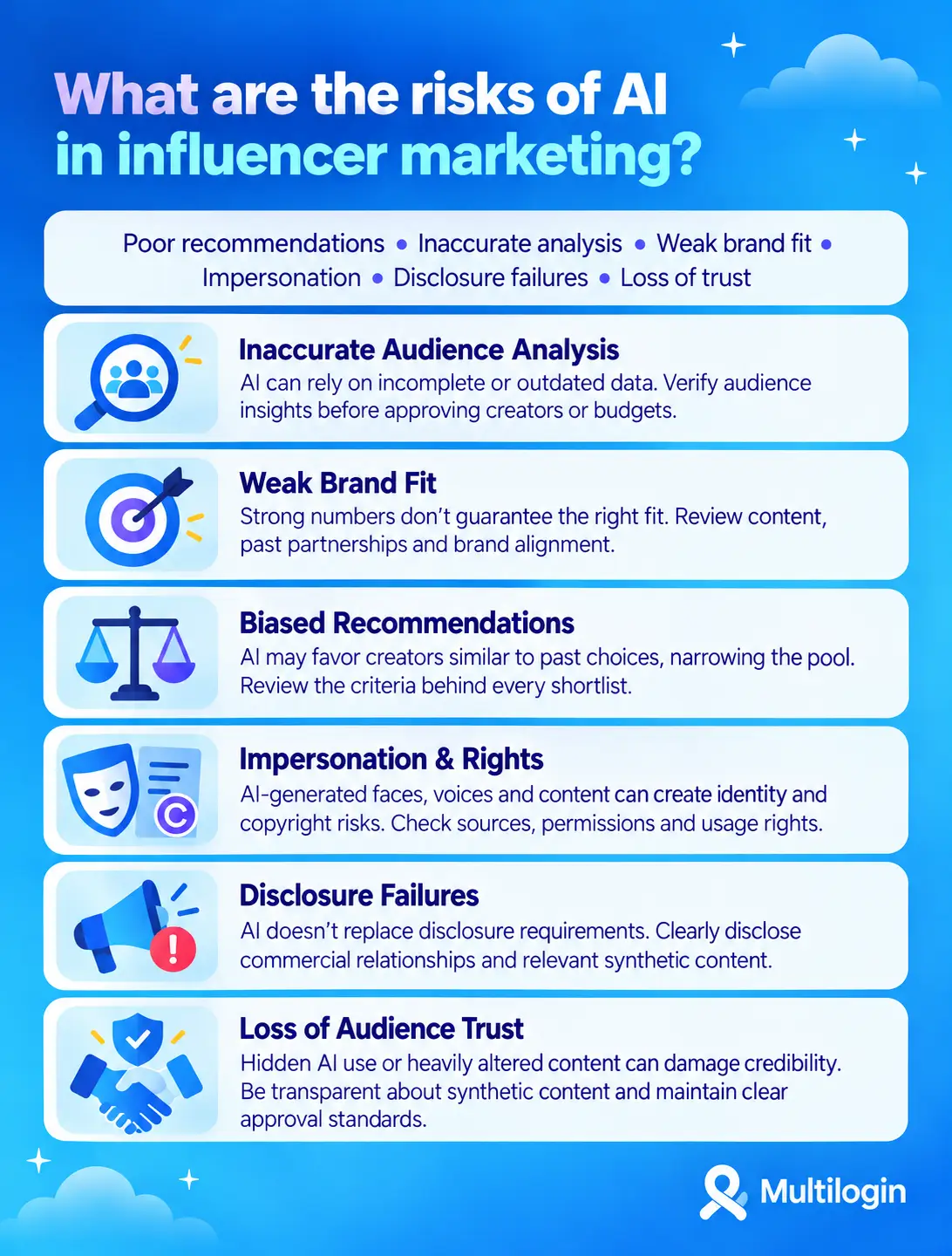
The main risks are poor recommendations, inaccurate analysis, weak brand fit, impersonation, disclosure failures and loss of audience trust.
Inaccurate audience analysis
An AI system may draw conclusions from incomplete, outdated or incorrectly classified information. Important audience claims should be checked before they affect creator approval or budget allocation.
Weak brand fit
A creator can satisfy numerical criteria while being unsuitable for the brand’s tone, product or customer expectations. Recent content, previous partnerships and direct communication still need human review.
Biased recommendations
A discovery system may repeatedly favor creators who resemble previous campaign selections. This can narrow the candidate pool while making the outcome appear objective.
Teams should review which criteria shape the shortlist and whether those criteria exclude relevant creators without a clear campaign reason.
Impersonation and rights concerns
Generated images, voices or videos may resemble identifiable people or include material the brand does not have permission to use.
Teams should document the source, permissions and usage rights for campaign assets. A synthetic character should be presented clearly rather than intentionally passed off as a real person.
Disclosure failures
AI does not remove the need to disclose a commercial relationship or applicable synthetic content.
The FTC says a material connection should be disclosed clearly and with the endorsement itself. It also advises influencers not to assume that a platform’s disclosure tool is sufficient on its own.
Instagram’s AI-generated profile label and branded-content tools address different questions. One identifies a synthetic profile. The other identifies qualifying commercial content.
Loss of audience trust
Audiences may respond negatively when they discover that a seemingly human creator is synthetic or that campaign material was substantially altered without clear context.
Transparent presentation gives people information they can use to evaluate the content. It also gives the brand a clearer standard for approvals and corrections.
When should influencer marketing teams use AI?
Influencer marketing teams should use AI when the task is repeatable, data-heavy and supported by a defined review process.
Situation | Recommended AI role | Human role | Decision |
|---|---|---|---|
Large creator pool with clear criteria | Organize and prioritize candidates | Verify brand fit and unusual data | Strong use case |
Repetitive outreach preparation | Draft and segment starting messages | Review facts, terms and tone | Strong use case |
Multi-market reporting | Consolidate and summarize results | Interpret differences between markets | Strong use case |
Sensitive or regulated campaign | Summarize information and flag issues | Lead compliance and final approval | Human-led |
High-value creator relationship | Support research and documentation | Lead communication and negotiation | Human-led |
Small one-off campaign | Assist with targeted research | Manage the campaign directly | Selective use |
Brand-owned virtual influencer | Support production and monitoring | Control identity, rights and disclosure | Closely supervised |
AI is a poor fit when the team has no clear campaign objective, unreliable input data or no named person responsible for reviewing the output.
Five best practices for AI-powered influencer marketing
- Define the campaign outcome before choosing a tool. Decide whether the campaign needs help with creator discovery, content production, conversions, audience research or reporting.
- Verify every creator recommendation before making contact. Review recent content, audience relevance, previous partnerships and unusual data patterns.
- Document where AI enters the workflow. Record which tools generate recommendations, drafts, content or reports and who approves each output.
- Disclose commercial and synthetic elements clearly. Apply the relevant FTC guidance, platform branded-content tools and AI labels instead of treating one disclosure as sufficient for every purpose.
- Measure campaign value rather than output volume. Compare business results, costs, review time, revisions and creator quality instead of treating more messages or posts as success.
Teams comparing the wider campaign stack can also review social media management tools separately from influencer discovery and analytics platforms.
How can agencies organize creator, brand and client profile workflows?
Agencies can keep campaign operations clearer by giving each brand or client Social Profile a dedicated environment, documented access and an assigned approval process.
Multilogin is a cloud phone platform for social media marketers. Mobile Social Profiles can operate on separate Android cloud phones. Web workflows can run in isolated browser profiles with their own cookies, sessions and IP addresses. People and AI agents can manage these environments from one dashboard.
This setup can support persistent sessions, separate client work and structured team handoffs. It does not replace influencer discovery, creator vetting, outreach, campaign analytics or human approval.
Teams can connect this operational layer with their existing processes for managing multiple Instagram accounts or creating multiple TikTok accounts.
For creator teams managing multiple brand or client profiles, Multilogin can help keep daily account work organized without turning your analytics workflow into a login mess.
Multilogin is not a way around platform rules; the safest approach combines clean account separation with original content, real engagement, and platform-compliant activity.
Conclusion
AI is most useful in influencer marketing when it helps teams handle large amounts of information, repeatable tasks and campaign data.
It is less reliable when asked to make final decisions about trust, creativity, relationships or brand suitability. Start with one clearly defined workflow, keep people at the important approval points and measure the complete cost of the campaign.
The goal is not to automate every task. It is to make better campaign decisions with less unnecessary manual work.