
Need a stable mobile environment for Facebook accounts? Use a real cloud-based Android phone!
Looking for a better cloud phone solution than GeeLark? You’re not alone.
While GeeLark provides basic cloud phone access for managing multiple mobile accounts, many users hit limitations that send them searching for GeeLark alternatives: mobile-only focus when you need browser access too, unclear device authenticity specifications, separate proxy costs, limited team features, and documentation gaps for international users.
This guide breaks down 11 GeeLark alternatives, starting with the most comprehensive solution and covering options for different use cases. Whether you’re managing social media accounts for clients, scaling TikTok operations, running a phone farm, or need unified management for both mobile apps and web-based tools, you’ll find platforms that address what GeeLark lacks.
Understanding what cloud phones are helps frame why these GeeLark alternatives matter: cloud phones provide Android operating systems hosted remotely, eliminating physical device overhead.
The question isn’t whether to use cloud phones — it’s which platform delivers the features, transparency, and reliability your operations require. For context on GeeLark’s positioning in the antidetect space, that background establishes what users typically seek when exploring alternatives.
Why look for GeeLark alternatives?
Users search for GeeLark alternatives when they hit specific operational walls.
- Mobile-only focus creates workflow friction. Most social media operations require both mobile app access (posting Instagram stories, TikTok videos) and web-based tools (Facebook Ads Manager, YouTube Studio, analytics dashboards). GeeLark’s mobile-centric design means managing separate tools for browser work, fragmenting your identity management and increasing account linking risk.
- Unclear device authenticity raises safety questions. GeeLark’s public documentation doesn’t clearly specify whether cloud phones use real hardware identifiers (genuine IMEI, Android ID, MAC addresses) or emulated parameters. Platforms actively detect device emulation vs real hardware, making this transparency gap a serious concern for anyone evaluating GeeLark alternatives.
- Proxy setup complexity and hidden costs add up. If GeeLark requires external proxy configuration, you’re adding separate subscriptions, manual setup, and the risk of mismatched location signals. Built-in proxies that automatically align with device fingerprints eliminate this friction.
- Limited team collaboration features restrict agency operations. Agencies managing client accounts need role-based permissions, profile sharing, and access tracking — features that aren’t prominently documented in GeeLark’s current offerings.
For a detailed Multilogin vs GeeLark comparison, our breakdown covers technical differences and total cost considerations driving users toward alternatives.
What to look for in a GeeLark alternative
When evaluating GeeLark alternatives, focus on factors affecting long-term account safety and operational efficiency.
- Device authenticity matters most. Does the platform use real hardware identifiers from actual Android devices, or emulated parameters? Real hardware identifiers stay stable and pass platform verification. Emulated identifiers risk detection as platforms evolve.
- Proxy integration determines total cost. Built-in proxies that automatically match device geolocation save money and reduce configuration complexity. External proxy requirements add subscriptions and setup friction. Always calculate total cost: subscription + proxy expenses + setup time.
- Unified web + mobile management reduces tool sprawl. Platforms handling both mobile apps and browser-based tools eliminate context switching and reduce account linking risk.
- Automation depth enables scale. Well-documented APIs and framework support (Selenium, Puppeteer, Playwright) let technical teams build custom workflows that don’t require manual repetition.
- Team features matter for agencies. Role-based permissions, profile sharing, bulk operations, and audit trails separate individual tools from platforms built for collaborative work.
Best GeeLark alternatives ranked
1. Multilogin Cloud Phones — best overall GeeLark alternative
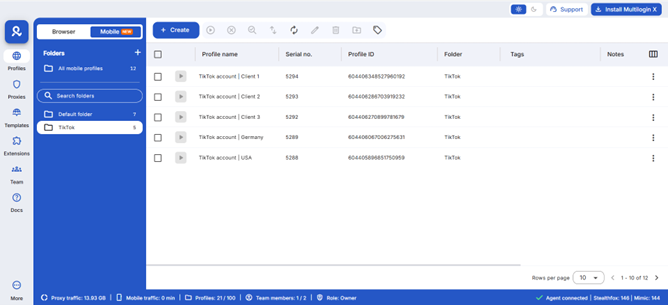
Multilogin Cloud Phones address every major GeeLark limitation while delivering features that set the standard for cloud phone solutions. This isn’t another mobile-only platform — it’s complete infrastructure for managing multiple accounts across both mobile and web environments.
- 2-in-1 platform eliminates tool fragmentation. Subscribe to Multilogin Cloud Phones and get full access to Multilogin’s antidetect browser technology in the same subscription. Manage TikTok accounts in native mobile apps, then switch to browser profiles for Facebook Ads Manager — one dashboard, one subscription, unified identity management.
- Real Android hardware with genuine identifiers. Every Multilogin cloud phone runs with authentic IMEI, Android ID, and MAC addresses from real devices. Approximately 30 supported device types (OPPO, vivo, Samsung Galaxy, Google Pixel, Redmi, OnePlus) use manufacturer-specific parameters matching physical phones.
- Built-in residential proxies included. No separate subscriptions needed. Residential proxies with 30M+ IPs across 195+ countries and 1,400+ cities — with automatic geolocation matching. Device fingerprint, IP address, and location signals align without manual configuration.
- Full automation support. Integrate with Selenium, Puppeteer, Playwright, and Postman. Well-documented API enables custom workflows from 10 accounts to 1,000+.
- Team collaboration with granular permissions. Role-based access controls, profile sharing, usage tracking, unlimited team seats on Business plans, and bulk operations.
- 24/7 expert support in 5 languages. English, Spanish, Portuguese, Russian, or Chinese — across all time zones.
- Transparent EUR pricing. €0.009 per minute of active cloud phone use. No hidden fees. Unused proxy traffic rolls over monthly.
Best for: Social media agencies, teams requiring unified web + mobile management, operations prioritizing device authenticity, international teams, and automation-heavy workflows.
2. DuoPlus
DuoPlus is a cloud phone platform offering multi-language support across English, Chinese, Russian, Portuguese, and Vietnamese, with transparent USD pricing published directly on their website.
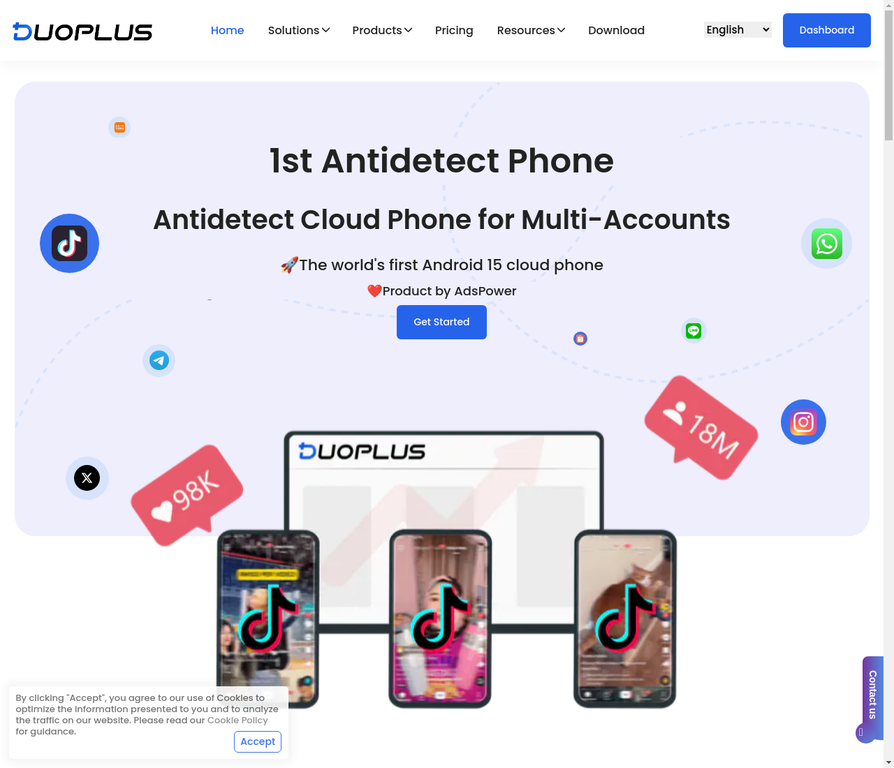
Key features:
- DuoPlus provides Cloud Mobile devices at $1.4/month
- Temporary Startup phones at $0.15 per 30 minutes (capped at $0.9/day)
- Subscription Startup devices at $16.9/month.
- The platform includes RPA automation for repetitive tasks
- API access for programmatic control
- Team collaboration with multi-user management
- Anti-detect phone capabilities, and operation sync across devices
Platform support: Facebook, Google, Instagram, X, TikTok, YouTube, Zalo, and Tinder.
Strengths as a GeeLark alternative: DuoPlus offers more transparent pricing than many competitors, flexible billing options (pay-per-use and subscription), and dedicated phone farm infrastructure for scaling. The multi-language interface makes it accessible to international teams.
Limitations: Device authenticity isn’t clearly documented — whether cloud phones use real hardware IDs or simulated fingerprints remains unclear. Proxies require separate setup and cost. The platform is mobile-only, meaning you’d still need separate browser tools for web-based workflows.
Best for: Budget-conscious operators who want flexible pricing, users comfortable with mobile-only workflows, and teams needing multi-language platform support.
3. VMOS Cloud
VMOS Cloud is more than a basic Android virtualizer. The platform offers AI Agent automation specifically built for TikTok (auto-login, auto-likes, auto-comments, auto-posting, and live broadcast support), Google CTS certification for GMS compatibility, and integrated proxy services through their OwlProxy partnership.
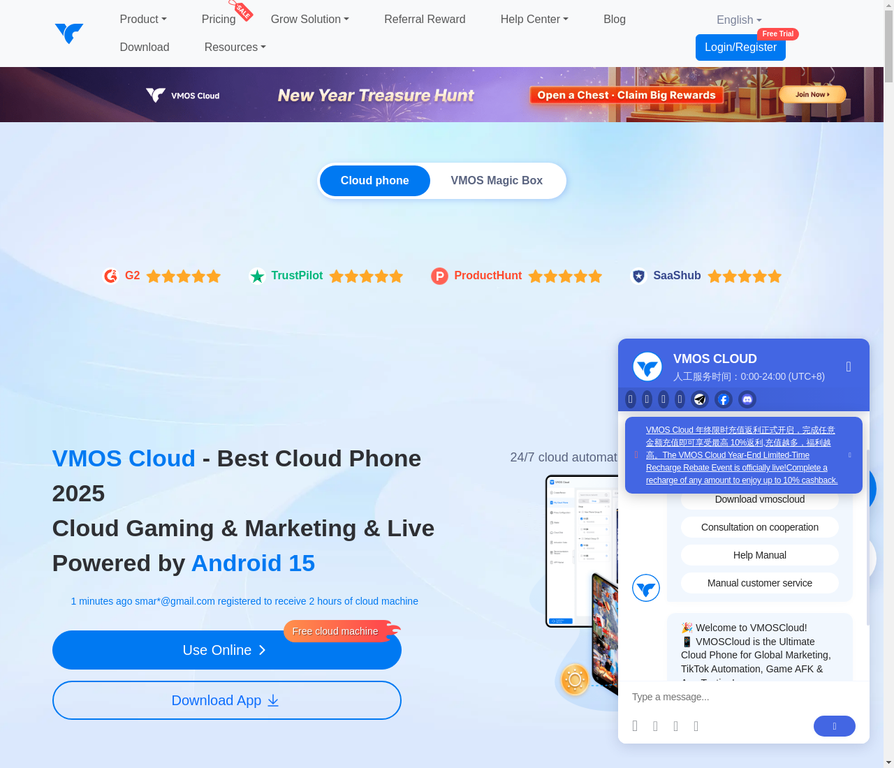
Key features:
- Cloud phone pricing starts at $0.11/day for standard V08 devices
- $0.30/day for Google Pixel 7 Pro models, and $0.006/minute for timing-based V06 devices (capped at $1/day)
- OwlProxy integration provides static residential IPs from $0.15/day
- Dynamic residential from $1/GB, mobile proxies from $1.15/GB, and static datacenter from $0.11/day
- Additional services include SMS receiver ($0.01–$0.38+), email verification ($0.02+), AI creation tools (free 10K points), and cloud storage (100GB for $1.9)
Strengths as a GeeLark alternative: VMOS Cloud’s AI Agent automation goes further than GeeLark’s basic automation for TikTok-specific workflows. Google CTS certification provides some device authenticity assurance. Integrated proxy services through OwlProxy simplify setup compared to external proxy management.
Limitations: Heavy TikTok focus means less optimization for other platforms. AI automation carries inherent detection risks on any platform watching for bot-like behavior. Device fingerprint authenticity beyond CTS certification isn’t clearly documented. Mobile-only platform without web browser management.
Best for: TikTok-focused operations, users wanting built-in AI automation tools, and budget operations where per-day pricing offers cost control.
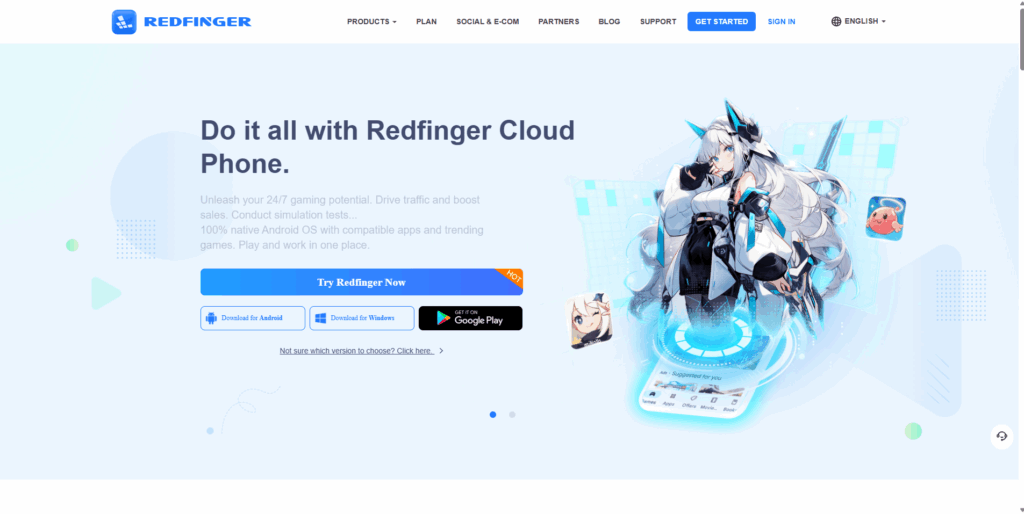
4. Redfinger Cloud Phone
Redfinger provides cloud phone services with always-on device access, meaning your virtual phones remain active even when you’re not actively using them.
Key features:
- 24/7 device availability,
- background app operation,
- multiple device instances, and Android app compatibility
- Redfinger has stronger presence in Asian markets with mobile gaming and social media use cases
Strengths as a GeeLark alternative: Always-on capability matters for operations requiring persistent presence (messaging apps, social media accounts that need to stay “active”). Established track record in the cloud phone space.
Limitations: Device authenticity specifications unclear. English documentation limited compared to global platforms. Proxy integration details not prominently documented. Primarily oriented toward Asian market users.
Best for: Operations requiring always-on cloud phones, Asian market users, and mobile gaming operations needing persistent device access.
5. Nox Cloud
Nox Cloud extends the Nox Android emulator brand into cloud services, primarily targeting mobile gaming operations.
Key features:
- Optimized for mobile game performance
- macro recording for repetitive actions
- multi-instance synchronization
- keyboard mapping for game controls
- resource allocation management
Strengths as a GeeLark alternative: Strong gaming optimization, familiar interface for Nox desktop users, free tiers available for testing.
Limitations: Gaming optimization doesn’t translate to social media account safety. Device fingerprints may not match real phones since emulation is the core technology. Not designed for preventing account linking on social platforms. Limited features for professional multi-account management.
Best for: Mobile gamers, game farming operations, and game testing — not recommended as a social media GeeLark alternative.
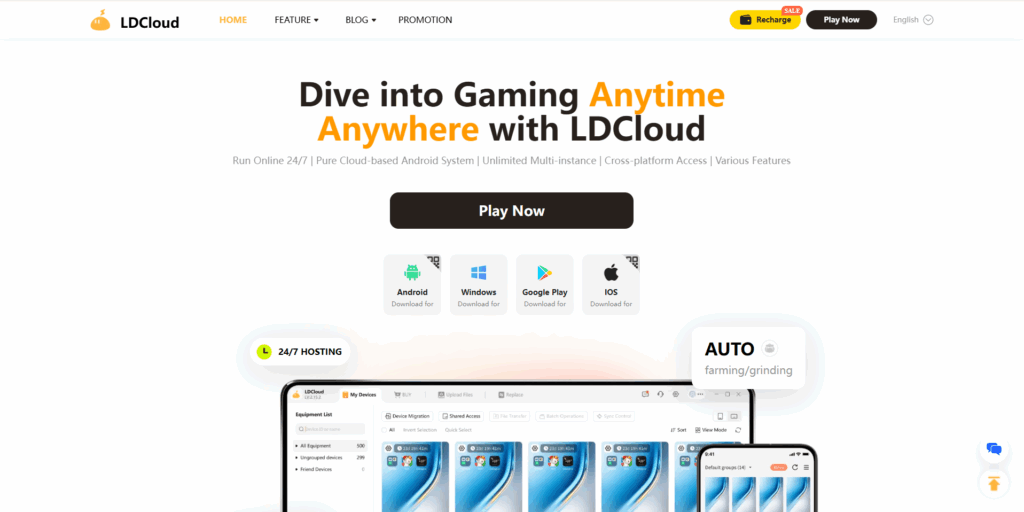
6. LDPlayer Cloud
LDPlayer Cloud brings the LDPlayer emulator experience to cloud infrastructure with performance optimization for mobile games.
Key features:
- High-performance Android emulation
- multi-instance support
- gaming controls optimization
- resource allocation controls
Strengths as a GeeLark alternative: Strong gaming performance, established emulator brand, and multi-instance capabilities.
Limitations: Gaming-centric design doesn’t serve social media multi-accounting needs. Fingerprint consistency for platform detection avoidance unclear. Lacks social media-specific features like proxy integration and account isolation.
Best for: Mobile gaming at scale and game development testing — not a direct GeeLark alternative for social media operations.
7. NBPhone
NBPhone provides cloud-based Android phones with a focus on social media management and multiple account support, primarily serving Asian markets.
Key features:
- Android cloud phone access
- social media app support
- multiple simultaneous instances
- remote device control
Strengths as a GeeLark alternative: Social media management focus aligns better with GeeLark use cases than gaming platforms.
Limitations: Limited English resources and documentation. Device fingerprint authenticity unclear. International support limited. Feature depth for professional operations not well documented.
Best for: Asian market social media operations and users comfortable with regionally focused platforms.
8. MuMu Cloud
MuMu Cloud is NetEase’s cloud gaming platform providing Android emulation optimized for popular mobile games.
Key features:
- Gaming-optimized performance
- cloud-based access
- multiple instance support
- gaming-specific controls
Strengths as a GeeLark alternative: Strong gaming performance backed by major developer (NetEase).
Limitations: Pure gaming focus with no social media management features. Chinese market orientation. Device authenticity for multi-accounting not applicable. No proxy integration for account separation.
Best for: Mobile gaming only — not suitable as a GeeLark alternative for multi-account management.
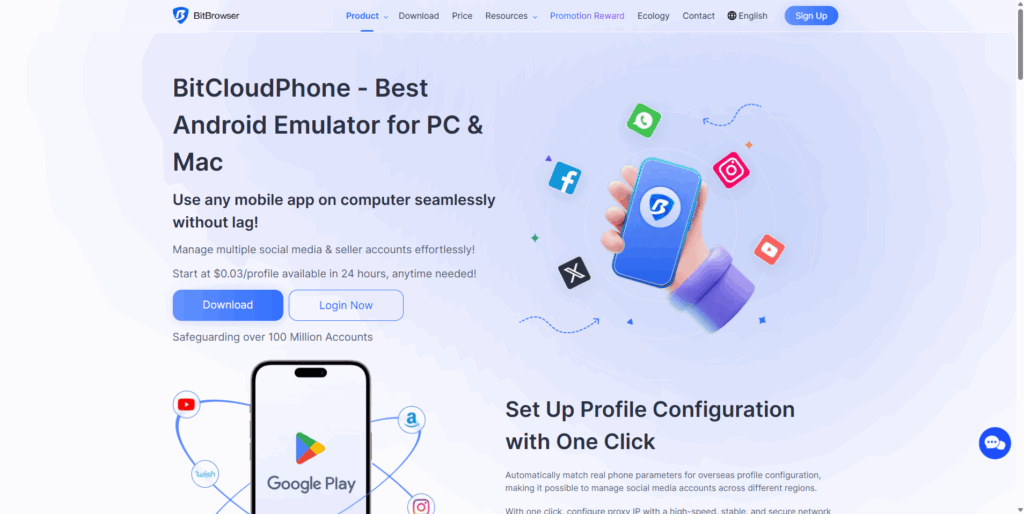
9. BitCloudPhone
BitCloudPhone offers cloud phone services with multiple device instance support for social media and app operations.
Key features:
- Cloud-hosted Android devices
- multiple simultaneous instances
- app installation support
- remote management capabilities
Strengths as a GeeLark alternative: Multi-account focus with social media support.
Limitations: English documentation sparse. Device authenticity unclear. Proxy integration not transparent. Primarily serves Chinese market users.
Best for: Asian market users needing basic cloud phone multi-accounting capabilities.
10. PhoneFarm
PhoneFarm offers management software for physical device farms with cloud integration options for scaling operations.
Key features:
- Physical device farm management
- cloud expansion capabilities
- automation tools
- centralized control dashboard
- large-scale phone farming support
Strengths as a GeeLark alternative: Genuine hardware authenticity through physical devices — no fingerprint questions. Hybrid approach lets you mix physical and cloud devices.
Limitations: Still requires significant physical hardware investment. Complex setup and maintenance. Higher total cost than pure cloud solutions. Scaling requires additional hardware procurement.
Best for: Enterprise-scale phone farming operations and organizations already invested in physical device infrastructure.
11. DIY cloud phone solutions — self-hosted options
Custom Android instances on AWS, GCP, or similar cloud platforms provide complete infrastructure control for technical teams.
Key features:
- Complete customization
- infrastructure ownership
- scalable cloud resources
- no vendor lock-in
Strengths as a GeeLark alternative: Full control over device configuration, fingerprinting, and network setup. No recurring vendor subscriptions beyond cloud server cost.
Limitations: Requires significant DevOps expertise. Setup takes weeks, not minutes. Ongoing maintenance responsibility falls entirely on your team. No support unless self-managed. Must build proxy integration, fingerprint management, and team collaboration from scratch.
Best for: Technical teams with DevOps expertise requiring full infrastructure control and custom automation requirements.
Need a better Geelark Alternative? Try Multilogin Cloud Phones.
Why Multilogin stands out among GeeLark alternatives
Among all GeeLark alternatives evaluated, Multilogin addresses the widest range of limitations in one platform. The 2-in-1 approach (cloud phones + antidetect browser) means you stop juggling separate tools for mobile and web workflows.
Real Android hardware eliminates the device authenticity uncertainty that affects GeeLark and most alternatives. Built-in proxies remove the hidden cost that inflates competitor pricing. Team features and automation support scale from small operations to enterprise.
For operations that need more than what GeeLark offers — and more than what most GeeLark alternatives provide — Multilogin Cloud Phones deliver complete multi-account infrastructure at transparent pricing.
One platform. Cloud phones and antidetect browser included. Real devices. Built-in proxies. Complete control.
Frequently asked questions About GeeLark alternatives
For comprehensive multi-account management, Multilogin Cloud Phones rank first among GeeLark alternatives. Real Android hardware, built-in proxies, unified web + mobile management, full automation, and team collaboration address every GeeLark limitation in one platform.
Gaming platforms like Nox and LDPlayer offer free tiers, but they’re designed for gaming — not social media multi-accounting. VMOS Cloud and DuoPlus offer low-cost entry points. No professional-grade GeeLark alternative is completely free, as real device infrastructure and proxy networks have operational costs.
Multilogin includes residential proxies (30M+ IPs, 195+ countries) in every subscription. VMOS Cloud offers integrated proxy services through OwlProxy at additional cost. Most other GeeLark alternatives require external proxy setup.
Yes. Multilogin, DuoPlus, VMOS Cloud, and Redfinger all support TikTok operations. VMOS Cloud specializes in TikTok with AI Agent automation. Multilogin provides the broadest platform coverage for managing TikTok alongside Instagram, Facebook, and browser-based tools.
Only Multilogin provides a 2-in-1 platform combining cloud phones and antidetect browser access in one subscription. All other GeeLark alternatives listed are mobile-only, requiring separate tools for browser-based workflows.
No. Gaming emulators (Nox, LDPlayer, MuMu) use emulation technology that social media platforms detect. They lack proxy integration, fingerprint consistency features, and account isolation designed for multi-accounting. Use gaming platforms for games, professional tools for social media.