Back to Glossary
  3 min read
 AIGC (Artificial Intelligence Generated Content)
AIGC (Artificial Intelligence Generated Content) is content created by artificial intelligence rather than entirely by humans. It includes text, images, videos, audio, source code, and multimodal content produced by advanced AI models.
Today, AIGC helps individuals and businesses create content faster, automate repetitive tasks, and improve productivity across industries.
In short: AIGC lets AI systems generate original content from a user’s prompt or instructions in seconds.
What Can AIGC Generate?
Modern AIGC technologies can create:
- Articles and blog posts
- Marketing copy and emails
- Images and illustrations
- Videos and animations
- Voiceovers and music
- Source code and software documentation
- Presentations and business reports
- Multimodal content that combines text, images, audio, and video
Example: An AI model can generate a product description, create matching images, and produce a promotional video from a single prompt.
How Does AIGC Work?
AIGC systems generally follow four steps:
- The user gives a prompt or instruction.
- The AI model analyzes the request.
- The system generates original content based on patterns it learned during training.
- AI tools or human editors refine the output.
Human oversight stays important, especially when accuracy, compliance, and content quality matter.
Technologies Behind AIGC
| Technology | Purpose |
|---|---|
| Transformer models | Generate text and source code |
| GANs (Generative Adversarial Networks) | Create realistic images |
| Diffusion models | Generate images and videos |
| Multimodal AI models | Process and generate multiple content types at once |
These technologies let AI systems understand context and produce increasingly sophisticated output.
Where Is AIGC Used?
AIGC has spread across many industries.
Marketing
- SEO content creation
- Advertising copy
- Campaign personalization
Software development
- Code generation
- Documentation creation
- Bug detection and testing
Education
- Personalized tutoring
- Interactive learning materials
- Automated assessments
Creative industries
- Graphic design
- Music generation
- Video production
- Game development
Examples of AIGC
Common applications include:
- Writing product descriptions for eCommerce stores
- Creating social media posts
- Generating AI artwork from text prompts
- Producing automatic voiceovers for videos
- Writing and debugging code
- Creating presentations and business reports
Many organizations already use AIGC to improve efficiency and lower content production costs.
AIGC vs. Generative AI
The two terms are related, but they are not the same.
| AIGC | Generative AI |
|---|---|
| The content created by AI | The technology that creates the content |
| Text, images, videos, and code | AI models and generation algorithms |
| The output | The underlying system |
Put simply: Generative AI is the technology, and AIGC is the content it produces.
AIGC vs. UGC vs. AI UGC
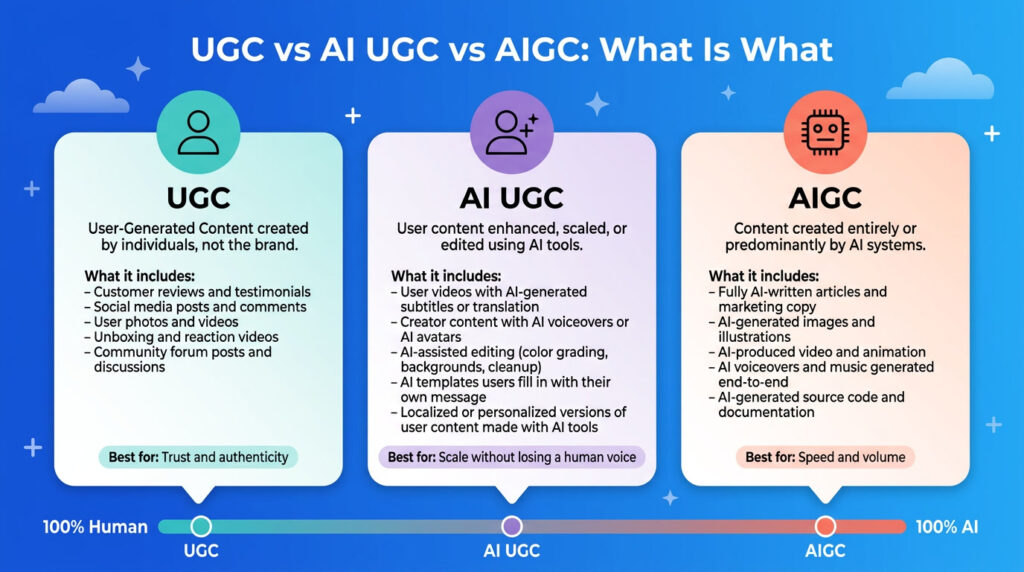
AIGC is often confused with two related terms: UGC and AI UGC. Each one describes a different mix of human and AI input.
| Term | Who creates it | Best for |
|---|---|---|
| UGC (User-Generated Content) | A real person, with no AI involved | Authenticity, trust, community building |
| AIGC (AI-Generated Content) | AI, with minimal human input | Speed, scale, SEO content |
| AI UGC (AI-Assisted User-Generated Content) | A real person, enhanced by AI tools | Personalization at scale without losing a human voice |
UGC is content real users create on their own, such as reviews, social posts, and testimonials. It builds trust but is hard to scale, since brands cannot control what users make.
AIGC is content an AI model produces largely on its own, from a blog post to a video. It scales fast and supports SEO, but can feel less personal without human editing.
AI UGC sits between the two. A person still creates the content, but AI tools help with subtitles, translation, voiceovers, or templates. It keeps a human voice while making production faster and more accessible.
Benefits of AIGC
- Faster content creation
- Lower production costs
- Improved scalability
- Greater personalization
- Increased productivity
- Reduced repetitive work
- Better accessibility for businesses and creators
By automating routine tasks, AIGC frees teams to focus on strategy, creativity, and decision-making.
Challenges and Risks of AIGC
- Copyright and ownership questions
- AI hallucinations and factual inaccuracies
- Privacy and data security concerns
- Deepfake technology and misinformation
- Ethical considerations and bias
- Regulatory compliance requirements
Good to know: AI-generated content should support human expertise, not replace it. Human review stays essential for quality, accuracy, and compliance.
People Also Ask
What does AIGC stand for?
AIGC stands for Artificial Intelligence Generated Content, which refers to content created using artificial intelligence technologies.
Is AIGC the same as Generative AI?
No. Generative AI is the technology used to create content, while AIGC refers to the content generated by those technologies.
Can AIGC create unique content?
Yes. Modern AI models can generate original text, images, audio, videos, and source code based on user prompts and contextual information.
Is AIGC only used for text generation?
No. AIGC supports multiple content formats, including images, videos, music, presentations, and multimodal outputs that combine several types of media.
What does UGC mean in AI?
In an AI context, UGC still means User-Generated Content: content created by real people rather than a brand or an AI model, such as reviews, videos, or social posts. It is often discussed alongside AIGC because brands increasingly mix the two, or use AI tools to help users produce UGC faster (a format usually called AI UGC).
What is the 30% rule in AI?
The most common version in content and creative work says AI should handle around 70% of repetitive, first-draft work, while humans keep about 30% for strategy, brand voice, and final judgment.