







The best proxies for eBay seller account management give each store a stable IP in the country where it sells, from residential, ISP or mobile networks rather than data centers. If you already run several eBay stores for clients, product lines or regional sites, the proxy decides where each account connects from every day.
In this guide, you’ll compare 10 proxy options on proxy type, pricing, location coverage and session control. You’ll also see which proxy type fits which eBay task, how to set up one proxy per seller account, and which mistakes cost sellers the most time.
A proxy only covers the network. Each store also needs its own device environment, or accounts can still share app data, cookies and login history. Multilogin gives every eBay seller account its own cloud Android phone with separate app data, location and IP, and runs Seller Hub work in browser profiles from the same dashboard. Built-in residential proxies and mobile minutes are included in every plan, so you can start without a separate proxy bill.
See plans and pricing to check what each Multilogin plan includes.
What a good eBay proxy needs for seller accounts
A good eBay proxy gives one seller account one stable IP, in a location that matches the account, from a clean range, for as long as the account exists. eBay allows multiple accounts, but its multiple accounts policy holds every account to the same buying and selling standards. It also says restrictions on one account may be applied to the member’s other linked accounts, so each account needs to stand on its own.
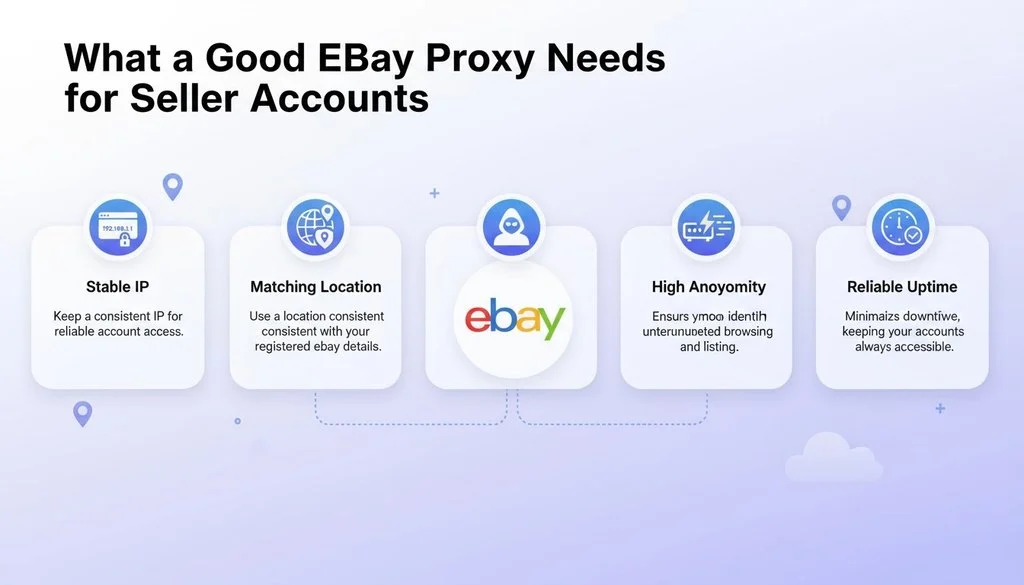
Check these five things before you buy:
- One IP per account, kept long term. Static ISP IPs or dedicated IPs keep the same address between logins. A rotating IP that changes every request or every few minutes makes each login look like it comes from somewhere new.
- Location that matches the account. The right country is the one the account is registered and normally operated from, which is not always the marketplace you sell into. A Vietnam-registered account selling to US buyers should not suddenly log in from a US IP.
- Dedicated, not shared. Shared static IPs are cheaper, but other customers use the same address. For seller accounts with payouts and listing history, dedicated IPs are worth the extra cost.
- Clean reputation. Check every new IP against a public blocklist and an IP lookup before the first login, and replace it if it is flagged or shows the wrong location.
- Protocol support. Make sure the provider offers HTTP, HTTPS or SOCKS5 in the format your tool accepts, with username and password authentication.
Quick picks: the best proxies for eBay seller accounts
For most eBay sellers, the right pick depends on two questions: do you need the proxy inside a full multi-account setup, or as a standalone IP you plug into your own tools? And do you need one fixed IP per store, or many locations? Prices below are list prices checked in October and November 2026.
| If you need… | Start with | Why |
|---|---|---|
| Proxies, cloud phones and Seller Hub profiles in one subscription | Multilogin | Residential proxy traffic and mobile minutes in every plan, one cloud Android phone per store, from $7.08/month |
| Flexible static ISP IPs at mid-market prices | Decodo | Shared and dedicated ISP options, sticky residential sessions up to 24 hours |
| The longest sticky sessions and non-expiring traffic | IPRoyal | Residential sessions up to 7 days, ISP IPs with unlimited traffic |
| Premium ISP IPs from major carriers | Oxylabs | Shared ISP from $16/month for 10 IPs, enterprise-grade support |
| A registered company that wants a compliance-first vendor | Bright Data | Large ISP and residential networks, with business verification for residential access |
| Mobile carrier IPs with fine targeting | SOAX | Carrier and ISP-level targeting on one credit balance |
| The lowest cost per static IP | Webshare, Proxy-Seller or Evomi | Static residential IPs from about $0.30 to $1 per IP, with trade-offs |
| A US-based provider with ethical sourcing commitments | Rayobyte | Member of the Ethical Web Data Collection Initiative |
Why eBay sellers use proxies, and what a proxy can’t do
A proxy gives each eBay seller account its own IP address and location, so stores run from one office or one laptop don’t all connect from the same network. For sellers who run several stores, that is the network half of keeping accounts separate.
What eBay allows
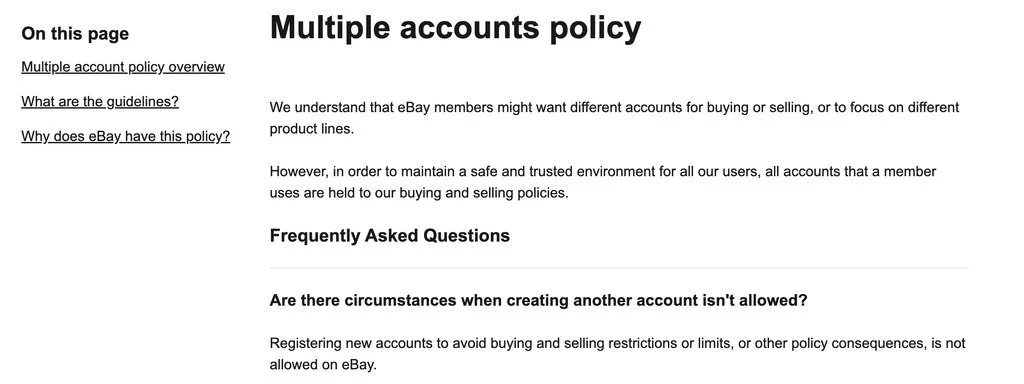
eBay permits more than one account. Its multiple accounts policy names separate accounts for buying and selling or for different product lines as normal reasons, and eBay’s export guide for sellers adds selling on different international eBay sites. What eBay does not allow is opening or using another account to avoid fees, selling limits, restrictions or other policy consequences. Every account you run must meet buyer and seller standards on its own.
What a proxy does for an eBay store
- Gives each account its own IP. Ten stores on one office connection share one public IP. A proxy per store gives each one a separate address.
- Keeps the location consistent. A UK store that always connects from a UK residential IP has a steady, believable login history. An IP that jumps between countries does not.
- Shows the marketplace from the buyer’s side. A US IP lets you check how your listings, shipping options and prices appear on eBay.com from the US.
What a proxy doesn’t do
A proxy changes the network, not the device. Two accounts on different IPs can still be tied together by the same phone or browser, shared cookies, the same payment method, the same return address or near-identical listings. eBay’s duplicate listing rules apply across accounts too.
No proxy can promise that an account won’t be limited or suspended. Account health depends on how you sell: listing quality, shipping times, buyer messages and policy compliance. Treat the proxy as one layer of a clean setup, next to a separate device environment for each store.
That is where Multilogin fits in. Each seller account runs on its own Multilogin cloud phone, a real Android device in the cloud with its own app data, location and IP, and web-based Seller Hub work runs in a separate browser profile from the same dashboard. Residential proxy traffic is included in every plan, and you can also connect any proxy from this list.
Which proxy type fits which eBay task
For day-to-day work on an eBay seller account, use a static ISP proxy or a sticky residential proxy in the store’s country, and keep it assigned to that one account. Rotating and datacenter IPs suit research, not account logins.
| Proxy type | Where the IP comes from | Best eBay use | Trade-off |
|---|---|---|---|
| Static ISP | Fixed IPs registered to internet providers, hosted on fast servers | One long-term IP per seller account; Seller Hub and daily store work | One fixed city; you replace the IP if it expires or degrades |
| Residential (sticky) | Home broadband IPs that hold for a set session length | Seller accounts when you need many countries or cities | Pool quality varies; the IP can change when the session ends |
| Residential (rotating) | Home broadband IPs that change per request or every few minutes | Price checks, competitor research, viewing regional search results | A poor fit for logged-in accounts, because the location keeps moving |
| Mobile | 4G and 5G carrier IPs shared by many phone users | The eBay app on a cloud phone set to Cellular | Higher price per GB; speed depends on the network |
| Datacenter | IPs from hosting and cloud companies | Bulk scraping and monitoring that never logs in | Easy to identify as hosting traffic, so not suited to seller accounts |
Two rules cover most setups. First, one IP per account: never share a proxy between two stores. Second, match the IP to the account’s registered country and keep it steady, because frequent country changes can trigger extra security checks at login.
Protocol matters less than type. HTTP and HTTPS proxies cover browser and app traffic for eBay, while SOCKS5 also carries other TCP traffic. Most providers in this list support both.
The 10 best proxies for eBay compared
Entry prices in this table don’t compare the same things. Multilogin’s price covers cloud phones, browser profiles, proxy traffic and mobile minutes, while the other nine are proxy-only, so you would add a device or browser tool on top. Compare the total cost of running each store, not the sticker price.
| Provider | Best type for eBay accounts | Entry price (list, Oct–Nov 2026) | Session control | Main limit |
|---|---|---|---|---|
| Multilogin | Built-in residential and mobile; static ISP in the app | Free plan; paid from $7.08/month with proxy traffic included | Sticky sessions; ISP IPs with unlimited traffic for 30 days | Built-in proxies run inside Multilogin profiles |
| Decodo | Dedicated ISP | Residential $4/GB pay-as-you-go; dedicated ISP $9.99 for 3 IPs | Sticky up to 24 hours; ISP static | ISP covers far fewer countries than residential |
| IPRoyal | Static residential (ISP) | Residential $7.35/GB for 1 GB; ISP $2.70/IP for 30 days | Sticky up to 7 days | Per-GB price is high at small volumes |
| Oxylabs | Shared or dedicated ISP | Residential $30 for 5 GB; ISP $16/month for 10 shared IPs | Unlimited ISP session length | Shared ISP IPs serve up to 3 users |
| Bright Data | ISP | Residential $8/GB pay-as-you-go; ISP $18/month for 10 shared IPs | Static ISP; custom residential sessions | Residential access limited to vetted companies |
| SOAX | Mobile and residential | $5/GB pay-as-you-go; $200 Builder plan at $3/GB | Sticky sessions with carrier and ISP targeting | Credits expire after 60 days |
| Webshare | Static residential | $6/month for 20 shared IPs | Static | Cheapest IPs are shared; free plan is datacenter only |
| Proxy-Seller | ISP | ISP from about $1–1.50/IP per month; residential $3.50/GB | Static ISP with unlimited bandwidth | ISP in about 23 countries |
| Rayobyte | Residential and ISP | Residential $3.50/GB entry, $2/GB at 50–249 GB | Sticky residential 1–60 minutes | Short sticky window for account work |
| Evomi | ISP (US) | ISP $1/IP shared, $2.50/IP private; residential from $0.49/GB | Static ISP | Static ISP listed for the US only |
Sources for third-party prices: Proxyway, Use Apify ISP proxy roundup (Nov 2026), Proxidize on SOAX (Sep 2026) and each vendor’s pricing page.
The 10 best proxies for eBay seller account management
1. Multilogin: best for running each eBay store on its own device with proxies included
Multilogin is a cloud Android phone platform for multi-account management, founded in 2015. Its proxies are built into every plan and connect directly to each cloud phone and browser profile, so the IP, the device and the store stay together.
What you get for eBay accounts:
- One cloud phone per store. Each eBay seller account runs on its own Multilogin cloud phone, a real Android device in the cloud with separate app data, location and IP. The eBay app keeps its login history between sessions.
- Built-in residential and mobile proxies. Choose the country, ISP and sticky-session length per profile. Multilogin’s proxy FAQ lists coverage in more than 150 countries.
- Cellular or Wi-Fi per cloud phone. Pair Cellular with a mobile proxy for app-first work, or Wi-Fi with a residential or static ISP proxy for a store that normally runs on home broadband.
- Static ISP proxies in the app. Available on Pro 50 and higher, each IP with unlimited traffic for 30 days.
- Bring your own proxy. Add HTTP, HTTPS, ISP or SOCKS5 proxies from any provider in this list.
- Browser profiles for Seller Hub. Bulk listing, reports and other web-based seller tasks run in isolated browser profiles from the same dashboard, and a profile’s location can be synced with its cloud phone.
- Team seats and automation. Assign stores to teammates with permissions, and automate with the API, ADB, Selenium, Puppeteer or Playwright.
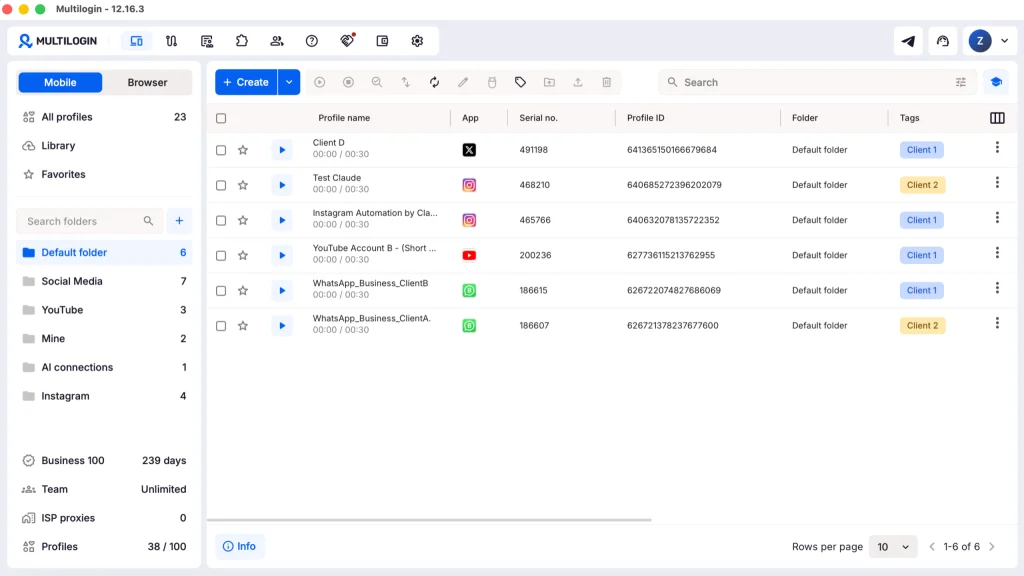
Pricing: Multilogin offers a free plan with no time limit and no credit card needed. Paid plans start from $7.08 per month. Pro 10 costs $11 monthly or $7.08 a month billed annually, with 10 cloud and browser profiles, 1 GB of premium proxy traffic, 60 mobile minutes a month, API access and a team seat. Extra proxy traffic costs from $2.275/GB in bulk, and unused traffic and minutes roll over.
Limits to know:
- Cloud phones can’t receive SMS or calls. If eBay asks for phone verification, use a separate number eBay accepts, such as your own phone or an SMS provider, and enter the code in the app.
- On the free plan, proxy traffic and mobile minutes are one-time and don’t renew.
- 1 GB a month covers light store work; photo-heavy listing uploads may need extra traffic.
- Cloud phones need a reliable internet connection, and first-time setup takes some learning.
Best for: sellers and agencies running several eBay stores who want the device, the proxy and the Seller Hub workspace for each store in one subscription.
2. Decodo: best for flexible static ISP IPs at mid-market prices

Decodo, formerly Smartproxy, sells residential, ISP, mobile and datacenter proxies with a self-service dashboard.
What you get:
- Residential IPs in 195+ locations with country, state, city, ZIP and ASN targeting.
- Sticky residential sessions up to 24 hours, according to Proxyway’s Decodo review.
- Three ISP formats: shared pay per IP, shared pay per GB, and dedicated IPs.
- HTTP(S) and SOCKS5 on all formats.
Pricing: residential traffic is $4/GB pay-as-you-go, cheaper on monthly plans. Dedicated ISP starts at $9.99 for 3 IPs ($3.33 per IP), per Decodo’s ISP guide. A 3-day trial is available.
Limits to know: dedicated ISP IPs cover only a handful of countries, so check your store’s market before you buy. Shared pay-per-IP lists are cheap but shared.
Best for: sellers who want one dedicated IP per store in a major eBay market, with residential traffic for research on the same account.
3. IPRoyal: best for long sticky sessions and non-expiring traffic

IPRoyal is a budget-to-mid-market provider known for long residential sessions and per-IP static residential proxies.
What you get:
- Residential sticky sessions of up to 7 days, longer than most providers.
- Residential traffic that doesn’t expire, so a small seller can buy once and use it over months.
- Static residential (ISP) IPs with unlimited traffic for the whole rental term.
Pricing: residential traffic starts at $7.35/GB for 1 GB pay-as-you-go and drops to $1.75/GB in bulk. Static residential IPs cost $2.70 per IP for 30 days or $2.40 per IP on 90-day terms, per Use Apify’s IPRoyal pricing breakdown.
Limits to know: small residential top-ups are expensive per GB, and static IP country coverage is narrower than the residential pool.
Best for: sellers who want a fixed IP per store at a predictable monthly price per IP.
4. Oxylabs: best for premium ISP IPs from major carriers
Oxylabs is a premium, business-focused proxy provider with large residential and ISP networks.
What you get:
- Shared and dedicated ISP proxies, with unlimited session length on static IPs.
- Residential IPs in 195 countries with city, ASN and ZIP targeting.
- Business onboarding, account managers on larger plans, and free trials for companies.
Pricing: residential starts at $30 for 5 GB ($6/GB). Shared ISP proxies cost $16 a month for 10 IPs, and dedicated ISP proxies $16 a month for 5 IPs ($3.20 per IP), per Proxidize’s Oxylabs pricing breakdown.
Limits to know: shared ISP IPs are shared with up to three users, and concurrency drops after a monthly traffic threshold. Premium pricing makes it expensive for one or two stores.
Best for: agencies running many US and European stores who want dedicated ISP IPs and vendor support.
5. Bright Data: best for registered businesses that want a compliance-first vendor
Bright Data runs one of the largest proxy networks, with residential, ISP, mobile and datacenter IPs plus scraping APIs.
What you get:
- Shared and dedicated ISP proxies billed per IP, with a 100 GB monthly fair-use allowance per IP.
- Residential and mobile IPs with country, city and ASN targeting.
- A compliance process that verifies each customer’s use case.
Pricing: ISP proxies start at $18 a month for 10 shared IPs ($1.80 per IP); dedicated ISP IPs cost about $3.50 each at small volumes. Residential traffic lists at $8/GB pay-as-you-go, lower with commitments and promotions, per Ciphers Security’s October 2026 comparison.
Limits to know: Bright Data now sells residential IPs only to vetted companies, so sole traders may face a longer onboarding. Billing spans many products and can be hard to estimate.
Best for: registered e-commerce businesses and agencies that need documented vendors and are ready for KYC.
6. SOAX: best for mobile carrier IPs with fine targeting
SOAX focuses on residential and mobile proxies, with targeting down to the carrier and ISP.
What you get:
- Residential and mobile traffic from one credit balance.
- Country, region, city and ISP targeting, plus mobile carrier selection.
- Sticky sessions for logged-in work.
Pricing: since its 2026 pricing change, SOAX charges about $5/GB pay-as-you-go, and the $200 Builder plan brings residential traffic to $3/GB. The rate also depends on the exit country’s tier, per Proxidize’s September 2026 SOAX breakdown.
Limits to know: credits expire 60 days after purchase, which hurts low-volume sellers. There is no per-IP static product for a fixed store IP.
Best for: sellers who run the eBay app on a phone set to Cellular and want a carrier IP in the store’s country.
7. Webshare: best budget option for static residential IPs
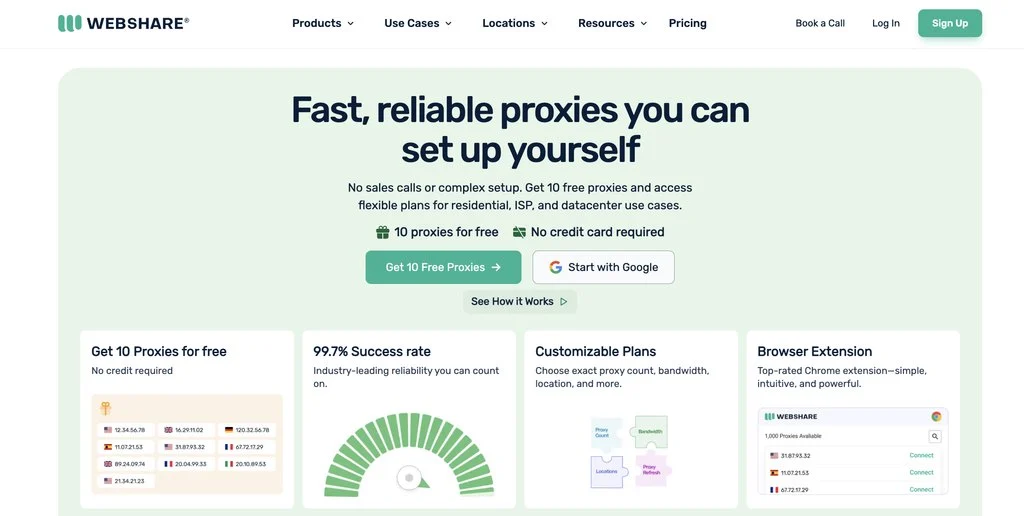
Webshare is a self-service provider with low per-IP prices and a permanent free plan.
What you get:
- Static residential IPs from ISPs such as Comcast and AT&T, with unlimited bandwidth.
- Rotating residential traffic in 195 countries for research.
- HTTP and SOCKS5 on every product.
Pricing: static residential IPs start at $6 a month for 20 shared IPs ($0.30 per IP), per HostAdvice’s Webshare review. Dedicated static residential IPs cost more. Rotating residential starts at $3.50/GB.
Limits to know: the cheapest static IPs are shared with other customers, so pick dedicated IPs for seller accounts. The free plan’s 10 proxies are datacenter IPs, fine for testing but not for eBay stores.
Best for: budget sellers who want static IPs and can pay a little extra for dedicated ones.
8. Proxy-Seller: best low per-IP price for ISP proxies
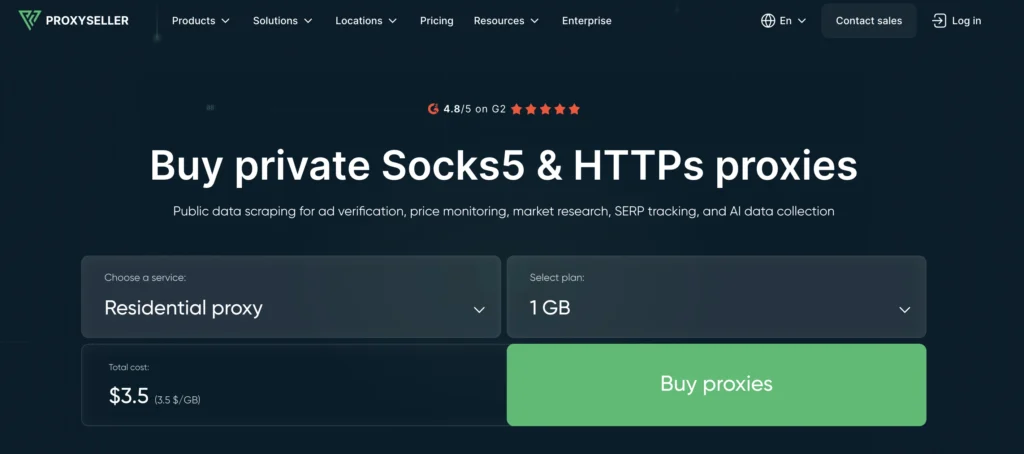
Proxy-Seller is a Cyprus-based provider that sells datacenter, ISP, residential and mobile proxies, priced per IP or per GB.
What you get:
- ISP proxies with unlimited bandwidth, rented per IP for a chosen period.
- Residential IPs with country, region, city and ISP targeting, plus sticky sessions.
- HTTP, HTTPS and SOCKS5, with username and password or IP whitelist authentication.
Pricing: ISP proxies start at about $1–1.50 per IP a month across roughly 23 countries, per Use Apify’s November 2026 ISP roundup. Residential traffic starts at $3.50/GB on small orders.
Limits to know: ISP coverage is limited to about two dozen countries. Shifter’s review notes one residential credential pair per country, which adds setup work for multi-country stores. The refund window is short.
Best for: sellers who need many fixed IPs in common eBay countries at a low monthly cost.
9. Rayobyte: best for a US-based vendor with ethical sourcing commitments
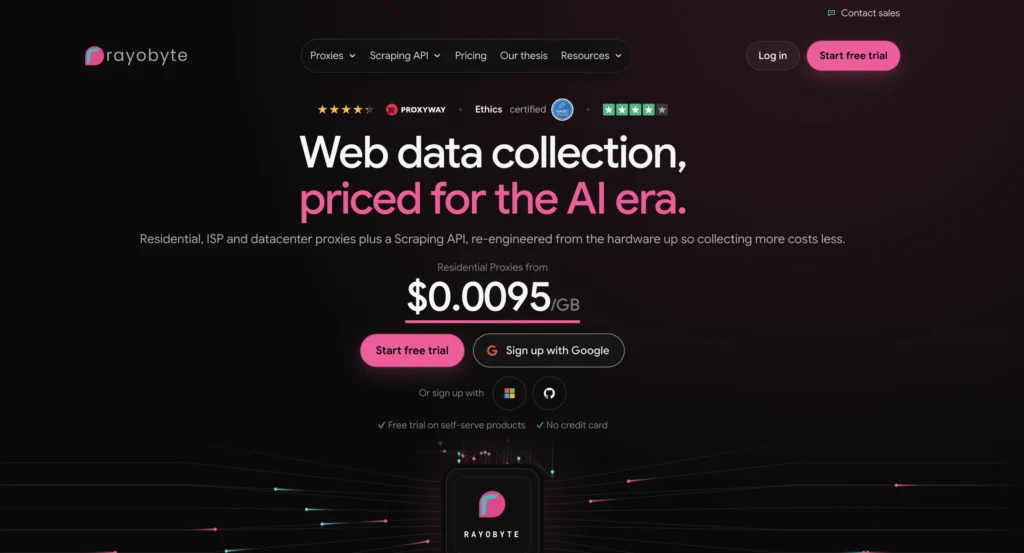
Rayobyte is a US-based provider offering datacenter, ISP, residential and mobile proxies, and a member of the Ethical Web Data Collection Initiative.
What you get:
- ISP and datacenter proxies priced per IP with unlimited bandwidth.
- Residential IPs with per-request rotation or sticky sessions.
- Free residential test traffic for new users.
Pricing: residential traffic starts at $3.50/GB and falls to $2/GB between 50 and 249 GB, per Geonode’s Rayobyte comparison. ISP IPs are priced per IP; check the current rate for your country.
Limits to know: residential sticky sessions last from 1 to 60 minutes, too short to hold one IP for a store across a workday. Use the ISP product for seller accounts. The October 2026 Scale plans drop location targeting, which rules them out for store work.
Best for: US sellers who prefer a US vendor and will use ISP IPs for their stores.
10. Evomi: best low-cost static IP for US-only stores
Evomi is a Swiss provider with low residential pricing and a small static ISP line.
What you get:
- Static ISP IPs in shared, private and “virgin” tiers.
- Residential traffic with city, ISP and ZIP targeting.
Pricing: ISP IPs cost $1 per IP shared, $2.50 private and $4.50 virgin; residential traffic starts at $0.49/GB, per Use Apify’s November 2026 ISP roundup.
Limits to know: static ISP IPs are listed for the US only, so stores on eBay UK, Germany or Australia need another provider.
Best for: sellers with eBay.com stores on a tight budget who want a private US IP per account.
How to set up one proxy per eBay seller account
To set up proxies for several eBay stores, give each store one fixed IP in its own country, attach that IP to a separate device environment, and keep the pairing unchanged. Here is the process with Multilogin; the same order works with any provider from this list.
- Map each store to its market. List every seller account with its eBay site (eBay.com, eBay.co.uk, eBay.de), registered country and the person who runs it.
- Choose the proxy type per store. Use a static ISP or sticky residential IP in the store’s country. If the store is run mainly in the eBay app, a mobile IP on a Cellular connection fits too.
- Create one cloud phone per store. In Multilogin, create a cloud phone for each seller account and attach a built-in proxy or your own HTTP, HTTPS or SOCKS5 proxy. Set the phone to Cellular or Wi-Fi to match the proxy type.
- Check the proxy before the first launch. Run the built-in proxy check and confirm the country and ISP. Each profile gets its own IP and matched geolocation.
- Install the eBay app and sign in. Use the eBay app on the cloud phone for messages, orders and photos. If eBay asks for a code, receive it on a separate number eBay accepts, because cloud phones can’t receive SMS or calls.
- Add a browser profile for Seller Hub. Run bulk listing and reports in a browser profile for the same store, with its location synced to the cloud phone.
- Record and keep the pairing. Note which IP belongs to which store, using custom columns or notes in the dashboard. If an IP expires, replace it with one from the same country and proxy type.
Common proxy mistakes eBay sellers make
Most proxy problems on eBay come from inconsistency, not from the provider. These are the mistakes that cost sellers the most time.
- Sharing one IP across stores. Two seller accounts on the same proxy share a network footprint, which defeats the purpose of buying it.
- Using rotating IPs for logged-in work. An IP that changes mid-session can trigger new-location prompts and extra security checks. Keep rotation for research.
- Picking a country that doesn’t match the account. A UK store connecting from a US IP, or with a device time zone in a third country, looks inconsistent.
- Running stores on free or datacenter proxies. Free lists are shared by strangers, and datacenter IPs are easy to identify as hosting traffic.
- Buying the cheapest shared static IP. Other customers’ activity on a shared IP becomes part of your store’s history. Pay for dedicated IPs on seller accounts.
- Treating the proxy as the whole setup. The same phone, browser, cookies, payment method or return address can still connect stores on different IPs.
- Copying listings across stores. A separate IP doesn’t make duplicate listings acceptable; eBay’s listing rules still apply to each account.
- Ignoring where the IPs come from. Providers that can’t explain how they source residential IPs carry a supply risk, as the July 2026 NetNut takedown showed.
Which proxy should you choose for your eBay stores?
Choose by how many stores you run, which eBay sites they sell on, and whether you already have a device setup for each store. Match your situation to the row below.
| Your setup | Proxy type to use | Start with |
|---|---|---|
| 2–5 stores in one country, run by one seller | Static ISP or built-in sticky residential | Multilogin built-in proxies, or IPRoyal or Webshare dedicated IPs |
| Agency running client stores on eBay US, UK, Germany and Australia | Dedicated ISP per store, plus a separate device per store | Multilogin with its built-in proxies, or with Oxylabs or Decodo ISP IPs |
| Stores run mainly in the eBay app | Mobile or residential on a Cellular connection | Multilogin built-in mobile proxies or SOAX |
| eBay.com stores only, tight budget | Private US ISP | Evomi or Proxy-Seller |
| Registered company that needs a vetted vendor | ISP with documented compliance | Bright Data |
| Price checks and competitor research, no logins | Rotating residential | Decodo or Rayobyte |
If you already use a multi-account tool, buy proxies that plug into it. If you are setting up from scratch, compare a proxy-only plan plus a device tool against a platform that includes both, and add up phones, proxies and seats before deciding.
Conclusion: choosing a proxy for your eBay stores
The best proxies for eBay give each seller account one fixed IP in the store’s own country and keep it there. For most sellers, that means a dedicated static ISP IP or a long sticky residential session, never a shared, rotating or free proxy.
Among standalone providers, Decodo and IPRoyal offer the most flexible mix of static IPs and sticky sessions, Oxylabs and Bright Data suit larger registered businesses, SOAX fits app-first stores on mobile IPs, and Webshare, Proxy-Seller and Evomi keep the cost per IP low with clear trade-offs.
A proxy is still only the network layer. Each store also needs its own device environment, or accounts can share app data, cookies and login history. Multilogin covers both: one cloud Android phone per seller account, built-in residential proxy traffic and mobile minutes in every plan, and browser profiles for Seller Hub from the same dashboard. Plan for phone verification with a separate number, since cloud phones can’t receive SMS.
See plans and pricing to run each of your eBay seller accounts on its own cloud phone with built-in proxies.
Run Unlimited Accounts Without Bans
Run your social media accounts on cloud phones & web browsers
Frequently asked questions
What is the best proxy type for eBay seller accounts?
A dedicated static ISP proxy is the best type for an eBay seller account, because the IP stays the same every day and comes from a real internet provider. A sticky residential session in the store’s country is the next best option when you need more countries than ISP proxies cover.
How many proxies do I need for multiple eBay accounts?
You need one proxy per eBay account. Ten seller accounts need ten separate IPs, each matched to its store’s country and never shared with another account.
Does eBay allow multiple seller accounts?
Yes. eBay’s multiple accounts policy allows separate accounts for buying and selling, for different product lines and for different international eBay sites. Opening or using another account to avoid fees, selling limits or restrictions is not allowed, and every account must meet eBay’s standards.
<strong>Can a proxy stop my eBay account from being suspended?</strong>
No. A proxy only changes the IP address an account connects from. eBay judges accounts on how they sell, including listing quality, shipping, buyer messages and policy compliance, so no proxy can promise an account won’t be limited or suspended.
Can I use free proxies for eBay?
Free proxies are a poor fit for eBay seller accounts. They are usually datacenter IPs shared by many strangers, so use them for testing only and pay for a dedicated IP for each store.
Do I still need a proxy if I use a cloud phone?
Yes. A cloud phone separates the device, and a proxy separates the network, so each store needs both. Multilogin includes residential proxy traffic in every plan, so each cloud phone can get its own IP without a separate proxy subscription.
Can a proxy or cloud phone receive eBay verification codes?
No. Proxies don’t handle SMS, and Multilogin cloud phones can’t receive SMS or calls. Receive the code on a separate number eBay accepts, such as your own phone or an SMS provider, then enter it in the eBay app on the cloud phone.
<s>How</s> much does a proxy for one eBay store cost?
A static ISP IP for one store costs roughly $1 to $3.50 a month in 2026, depending on the provider, country and whether the IP is shared or dedicated. Residential traffic is billed per GB instead, from about $2 to $8 per GB at small volumes.

 Join 4,200+ subscribers