




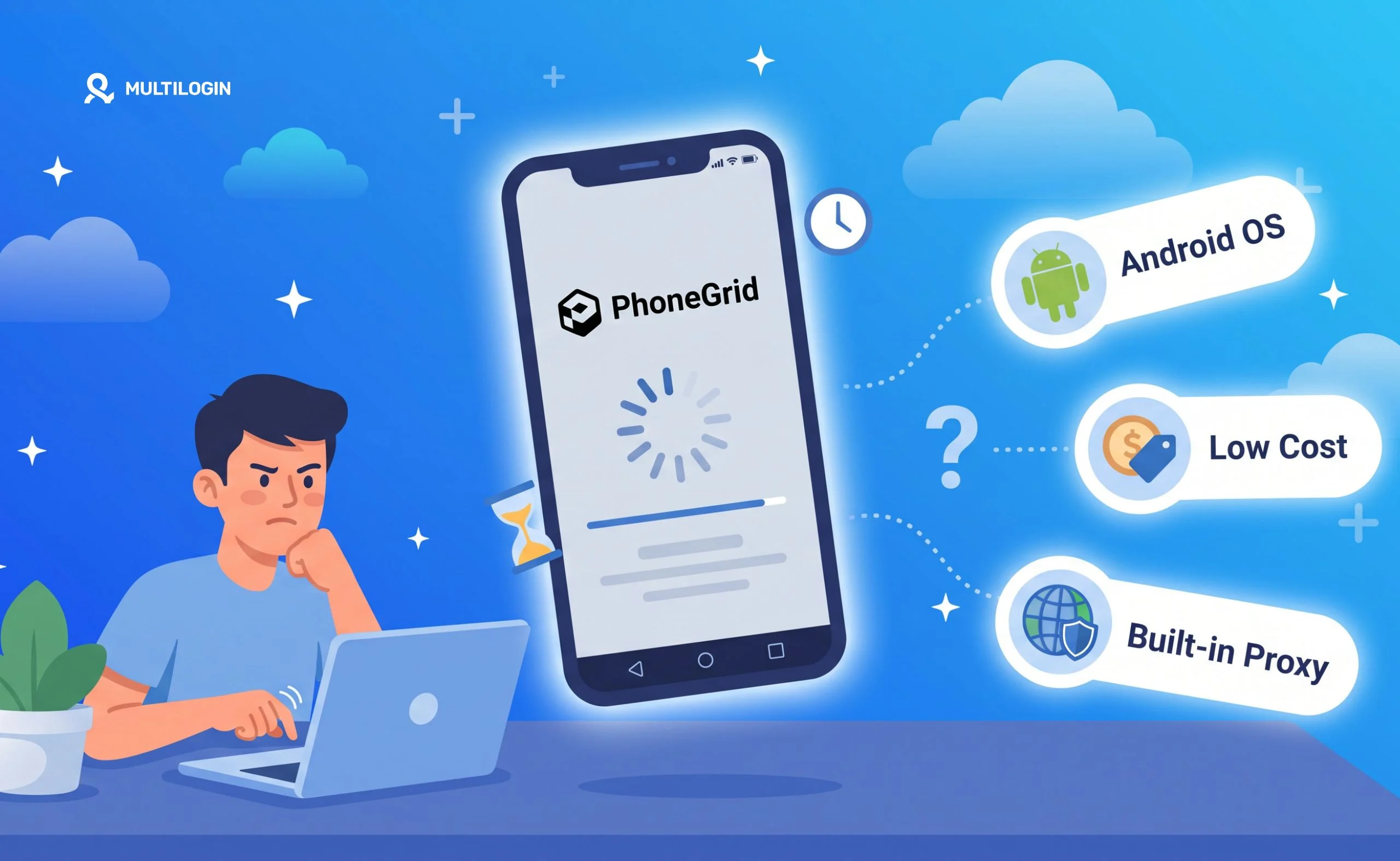

TL;DR: PhoneGrid is a low-cost cloud phone service with strong no-code automation, but you bring your own proxies and there’s very little public feedback about it.
The main PhoneGrid alternatives are Multilogin, GeeLark, MoreLogin, DuoPlus, VMOS Cloud, and GoLogin. All of them run on Windows and macOS.
If you want proxies and minutes in one plan, look at Multilogin cloud phones. For RPA and tap mirroring, GeeLark is the closest match. For the lowest device price, compare DuoPlus and VMOS Cloud.
PhoneGrid in brief: a short review
PhoneGrid is a cloud Android phone platform with browser profiles, run by EASYANT PTE. LTD. in Singapore. We created a free account and went through the macOS client (version 1.2.0). We didn’t run accounts for weeks, so we can’t judge long-term stability.
What it offers. The free plan starts with no card: 2 profiles, 2 team seats, and 100 cloud phone minutes. New phones run Android 11 to 17A at $0.006 a minute. Time zone, language, and location follow your proxy IP, and device details such as model and IMEI are randomized.
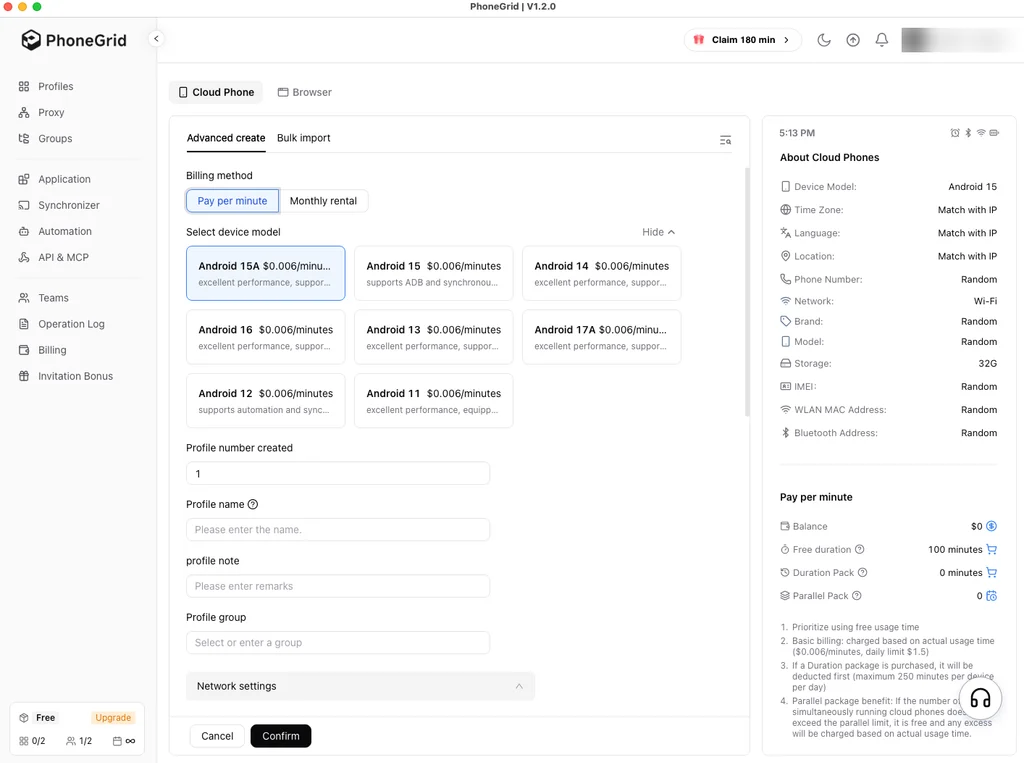
Creating a cloud phone in the PhoneGrid client.
Automation is the strong point. A marketplace holds 15 ready-made templates for TikTok, Instagram, Facebook, and YouTube. The visual editor adds steps such as taps, text recognition (OCR), ADB shell commands, and JS scripts. A Local API, an Open API, and MCP for browser profiles cover coding needs.
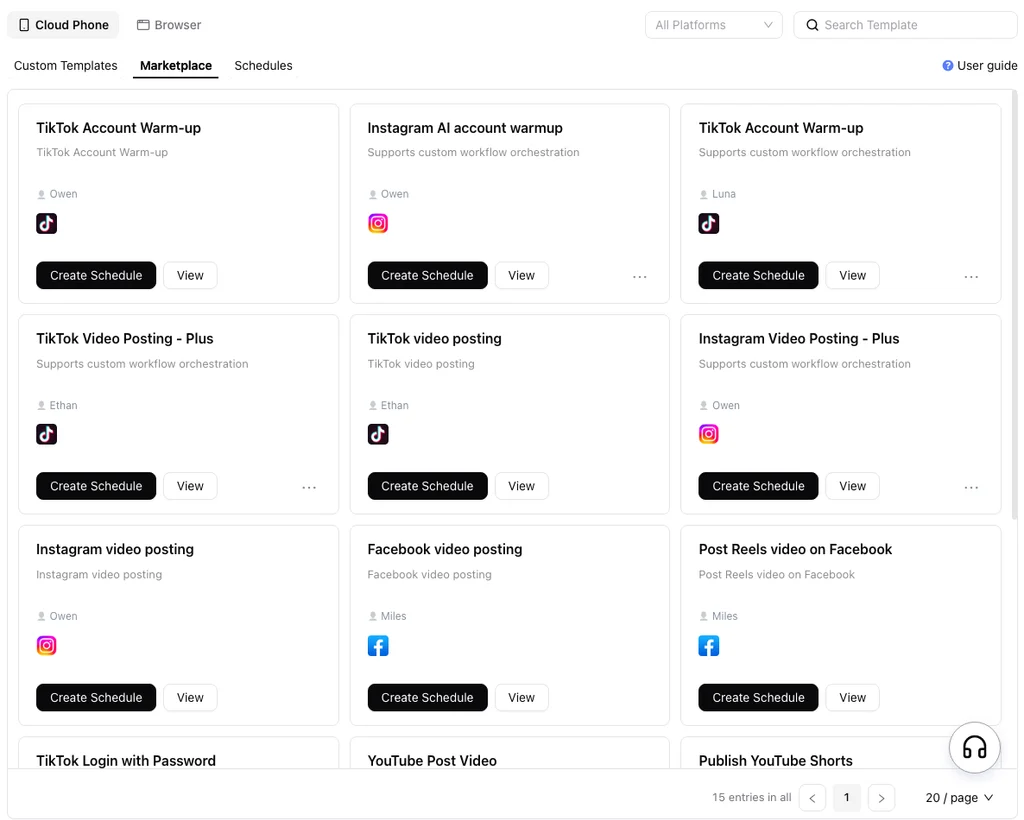
PhoneGrid’s template marketplace. Each template can be copied, edited, or scheduled.
Pricing.
| Plan or add-on | Price |
|---|---|
| Free | $0: 2 profiles, 100 minutes, 2 members |
| Base | $5/month, or $3/month billed yearly: 5 profiles, 50 minutes a month |
| Pay per minute | $0.006/min, capped at $1.50 a day per device |
| Monthly rental | $23 to $25 per device for 30 days |
| Parallel Pack | $30 a month per parallel slot |
Verdict. PhoneGrid is cheap to start and its no-code automation is genuinely useful. The weak spots:
- Proxies are your job. The docs say PhoneGrid “does not sell proxies,” and a phone may have no internet without one.
- No Linux or web version, and refunds exclude used resources and third-party bans.
Why people look for a PhoneGrid alternative
- No second bill for proxies. Each PhoneGrid phone needs one, which adds cost and admin at 20 phones.
- A longer track record before you move client accounts.
- Linux or browser access without installing a client.
- Fuller automation docs for scripts or AI agents. PhoneGrid’s Open API page sends you to “the website” for details, and MCP covers browser profiles only.
PhoneGrid alternatives compared
Price and billing
| Platform | Entry price | Phone time | Proxies |
|---|---|---|---|
| PhoneGrid | Free plan; Base $5/mo or $3/mo yearly (5 profiles) | $0.006/min, max $1.50/day; rental $23 to $25/mo | Bring your own |
| Multilogin | Free plan; Pro 10 from $7.67/mo billed annually or $11 monthly | 60 min/mo included; extra from $0.0084/min, down to $0.0067 | Included: 1 GB a month on Pro 10 |
| GeeLark | Free plan; Base $5/mo or $3.25/mo yearly (5 profiles) | $0.007/min, max $1.20/day; rental $29.90/mo | Bring your own |
| MoreLogin | Free plan; Pro $9/mo, $5.40/mo with yearly discount | $0.006/min, max $1.50/day; rental $23 to $25 | Bring your own or buy theirs |
| DuoPlus | 30-day trial with 1 phone | Startup time $0.0042/min, or $16.91/mo | Bring your own |
| VMOS Cloud | $4.99 per 30 days per device | Per-minute devices also offered | Sold separately, or bring your own |
These prices don’t cover the same things. Multilogin’s entry plan includes proxy traffic, mobile minutes, API access, and a team seat. With the others, add the plan, phone time, and proxies together before you compare.
Mac and Windows support
| Platform | Windows | macOS | Linux and other access |
|---|---|---|---|
| PhoneGrid | Windows 10/11, 64-bit | 10.15 or later, Intel and M-series | Linux coming soon; no web version |
| Multilogin | Windows 10 or later, 64-bit | 14 Sonoma or later, Apple silicon supported | Ubuntu 22 or later |
| GeeLark | Windows 10 or later, x64 | Apple silicon and Intel builds | Ubuntu package and web app |
| MoreLogin | Windows | macOS | Linux desktop and server |
| DuoPlus | Windows x64 | Apple silicon and universal builds | Web version; Android and iOS apps listed |
| VMOS Cloud | Windows 10 or later | 13.0 or later | Web version, Android and iOS apps |
| GoLogin | Windows | Apple silicon and Intel builds | Linu |
1. Multilogin: best for proxies and minutes in one plan
Multilogin is a cloud Android phone platform for multi-account management. Each account gets its own cloud device with separate app data, location, and IP, and browser profiles cover the web side.
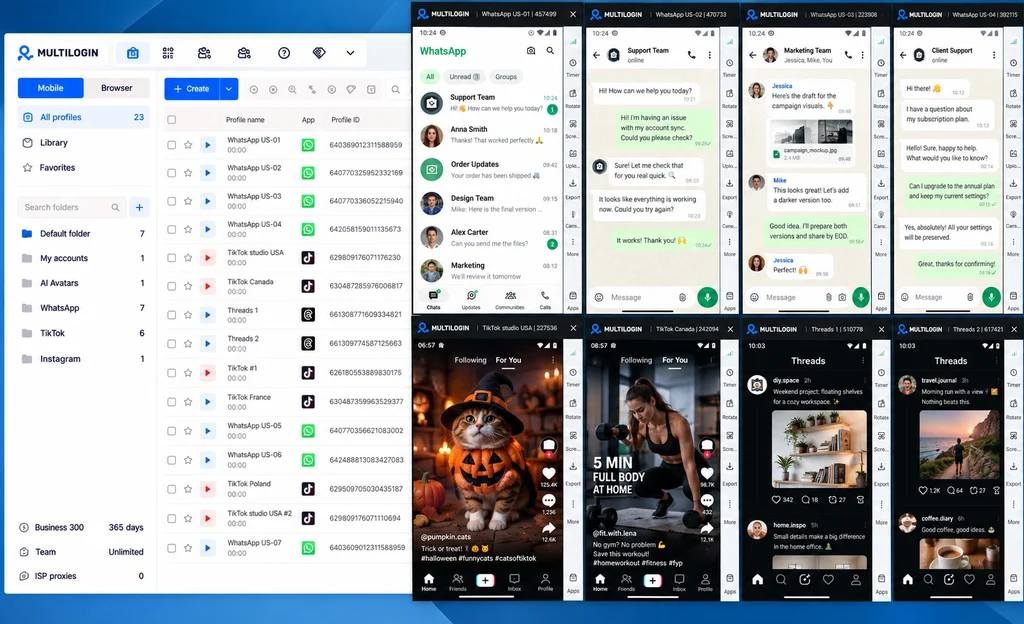
Multilogin with multiple Android cloud phones running at once
Best for: agencies, e-commerce sellers, and social media teams that want cloud phones, browser profiles, and proxies on one bill, and that automate through the API, ADB, or AI agents.
Pricing: free plan with no credit card; paid plans from $7.67 per month (billed annually) or $11 billed monthly. Pro 10 includes 60 minutes and 1 GB of proxy traffic a month.
Pros:
- Residential and mobile proxy traffic included in every plan.
- Android 10 to 16, with cellular or Wi-Fi mode per cloud phone.
- Documented automation: API, full ADB access, Selenium, Puppeteer, and Playwright.
Cons:
- No SMS or calls; you need an external number for codes.
- Needs macOS 14 or later; Windows on ARM isn’t supported.
- Extra minutes cost more than PhoneGrid’s $0.006, and there’s no template marketplace.
For a side-by-side view, see the Multilogin vs PhoneGrid comparison.
2. GeeLark: best for RPA and social media automation
GeeLark is the closest match to PhoneGrid’s feature set. It combines cloud phones and browser profiles with RPA on all plans, a Synchronizer on Pro, and AI tools for creating social media content.
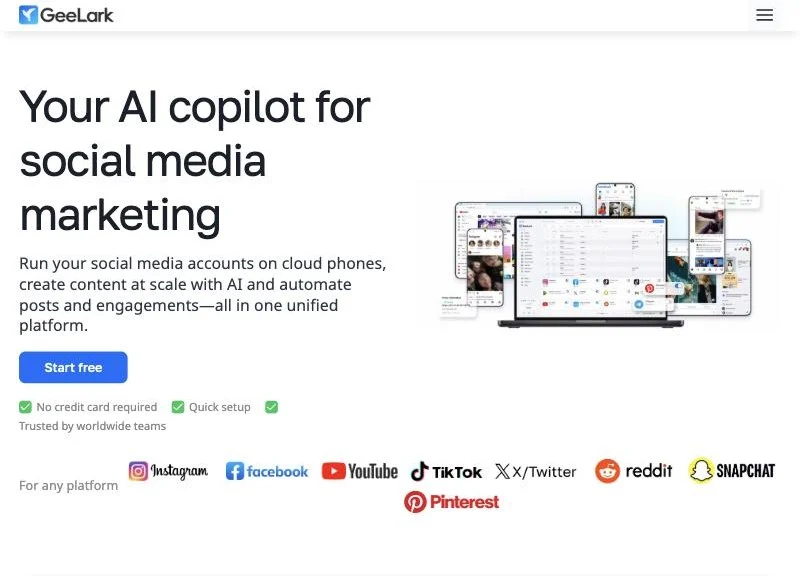
Best for: social media teams that like PhoneGrid’s RPA and tap mirroring but want a longer public review record.
Pricing: free plan with 2 profiles; Base from $5 a month or $3.25 billed yearly for 5 profiles. Phone time costs $0.007 a minute, capped at $1.20 a day.
Pros:
- RPA on every plan, plus a Synchronizer, cloning, and bulk creation on Pro.
- Windows, Mac, Linux, and a web app.
Cons:
- Some Trustpilot reviewers report removed profiles and disconnecting phones.
- No proxies included; you bring your own.
- Monthly device rental is $29.90, above PhoneGrid’s $23 to $25.
3. MoreLogin: best for browser-first teams adding phones
MoreLogin started as a browser profile tool and added cloud phones later. Its phone pricing is almost identical to PhoneGrid’s, and it adds API, ADB, RPA, and a synchronizer.
Best for: teams whose work is mostly in browser profiles but who need some cloud phones on the side.
Pricing: free plan with 2 profiles; Pro lists at $9 a month, or $5.40 with the yearly discount. Phones cost $0.006 a minute (max $1.50 a day) or $23 to $25 per 30 days.
Pros:
- Same per-minute rate and daily cap as PhoneGrid.
- Proxies can be bought inside the app or brought from your own provider.
- Windows, macOS, and Linux clients.
Cons:
- Cloud phones are billed on top of the profile plan.
- Android 12 to 15 only.
- Rated 2.3 out of 5 on Trustpilot, with billing and slow-proxy complaints.
4. DuoPlus: best for phone-only work at volume
Best for: operators who need many Android phones and no browser profiles.
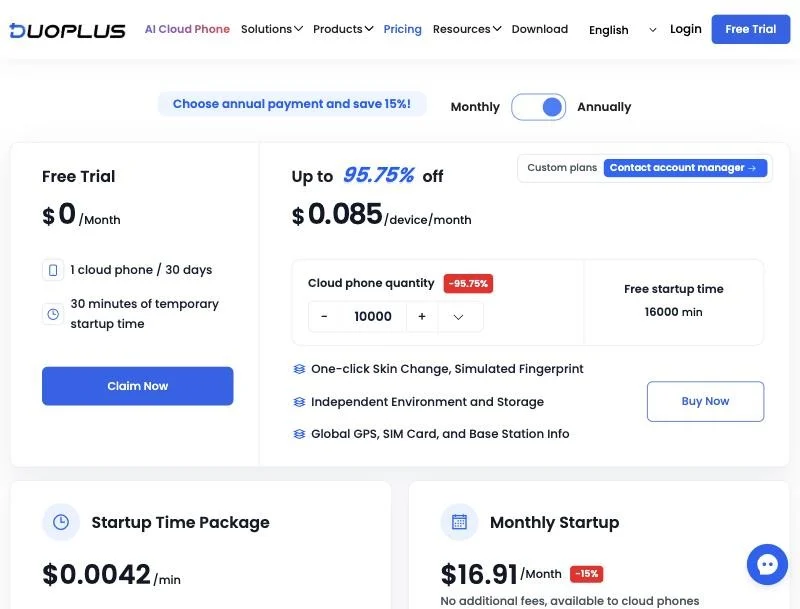
DuoPlus is a phone-only platform that sells device rental and phone runtime separately. It also offers a Cloud Number product for receiving SMS, which PhoneGrid’s docs don’t mention.
Best for: operators who need many Android phones at a low unit price and no browser profiles.
Pricing: a 30-day trial with 1 phone. Startup time costs $0.0042 a minute, or $16.91 a month for unlimited opens; device prices drop sharply at volume.
Pros:
- Low runtime rate and volume discounts on devices.
- Cloud Number service for SMS verification.
- Web version alongside Windows and Mac apps.
Cons:
- No browser profiles.
- Proxies aren’t included, and third-party setup guides list SOCKS5 only.
- Some Trustpilot reviewers report lag and slow connections.
5. VMOS Cloud: best for low device prices
VMOS Cloud sells cloud phones at a flat monthly price per device. Its FAQ describes each phone as a physical device in a data center, and it adds an AI workflow tool, a synchronizer, and an Open API.
Best for: budget users who want a fixed price per device and access from mobile apps as well as desktop.
Pricing: cloud phones from $4.99 per 30 days per device. Proxies are sold separately through its own service, or you bring your own.
Pros:
- One of the lowest fixed device prices in this list.
- AI workflow tool, synchronizer, and Open API.
- Web version, plus Android and iOS apps.
Cons:
- Rated 2.8 out of 5 on Trustpilot, with reports of disconnects and a refused refund.
- No browser profiles.
- Proxies cost extra.
6. GoLogin: best if your work is mostly in browsers
GoLogin is a browser profile tool that includes cloud Android phones in its paid plans. Phones share the same profile quota as browser profiles, so there’s no separate phone bill.
Best for: web-first teams that only occasionally need an Android app.
Pricing: paid plans from $9 a month, or $4.50 billed yearly, with cloud phones included.
Pros:
- Cloud phones included in paid plans at no extra charge.
- Mature browser profile tools for web accounts.
- Windows, Mac, and Linux clients.
Cons:
- Phones use up the same profile quota as browsers.
- Paid plans run up to 10 phones at once.
- Phones stop after 15 minutes of inactivity, per GoLogin’s docs.
PhoneGrid alternative for Mac
PhoneGrid offers Apple silicon and Intel builds for macOS 10.15 or later. All six alternatives have a Mac app too, so check your macOS version.
- macOS 14 or later: every option works; Multilogin, GeeLark, DuoPlus, and GoLogin document Apple silicon support.
- macOS 13 Ventura: VMOS Cloud supports 13.0 or later, and GeeLark publishes builds for older systems. Multilogin needs macOS 14 or later.
- No install: GeeLark, DuoPlus, and VMOS Cloud have web versions.
PhoneGrid alternative for Windows
All six alternatives have a Windows client, and those that list requirements ask for 64-bit Windows 10 or 11. Multilogin doesn’t run on Windows ARM laptops; on those, use a web version from GeeLark, DuoPlus, or VMOS Cloud.
For mixed Windows, Mac, and Linux teams, pick Multilogin, GeeLark, MoreLogin, or GoLogin.
How to choose a PhoneGrid alternative
- Add proxy cost to every plan. Multilogin includes proxy traffic (1 GB a month on Pro 10); the others don’t.
- Estimate phone hours. All-day phones suit rental; short sessions suit per-minute billing. 10 phones for an hour a day use about 18,000 minutes a month, roughly $108 at PhoneGrid’s rate before proxies.
- Match automation. No-code RPA points to GeeLark or DuoPlus. Scripts, ADB, and AI agents point to a documented API, such as Multilogin’s.
- Plan for SMS. DuoPlus and VMOS Cloud sell number services; otherwise use an external provider.
- Test one account for a week before moving client accounts.
Conclusion
PhoneGrid works for small, budget setups if you already have a proxy provider and don’t mind testing a newer product yourself. Look for an alternative when proxy costs grow, when you need fuller automation docs, or when you want a longer track record behind the tool.
For phones, proxies, and minutes on one bill, start with Multilogin’s free plan and open your first Android phone from your computer. If tap mirroring is your main workflow, trial GeeLark. If device price comes first, compare DuoPlus and VMOS Cloud.
Frequently asked questions
What is the best PhoneGrid alternative?
It depends on what you need. Multilogin suits teams that want proxies and mobile minutes included in the plan. GeeLark is closest to PhoneGrid’s RPA and Synchronizer tools. DuoPlus and VMOS Cloud suit buyers focused on low device prices.
Is there a PhoneGrid alternative for Mac?
Yes. Multilogin, GeeLark, MoreLogin, DuoPlus, VMOS Cloud, and GoLogin all have macOS apps. Multilogin needs macOS 14 or later and supports Apple silicon. VMOS Cloud supports macOS 13 or later. GeeLark, DuoPlus, and VMOS Cloud also have web versions.
Is there a PhoneGrid alternative for Windows?
Yes. All the alternatives in this guide have a Windows client, and most list 64-bit Windows 10 or 11 as the requirement. If you use a Windows laptop with an ARM processor, Multilogin isn’t supported; a web-based option such as GeeLark or VMOS Cloud works instead.
Does PhoneGrid include proxies?
No. PhoneGrid says it does not sell or recommend proxies, and a cloud phone needs one to access the internet. Multilogin includes residential and mobile proxy traffic in every plan. GeeLark, MoreLogin, DuoPlus, and VMOS Cloud charge for proxies separately or expect you to bring your own.
Is PhoneGrid free?
PhoneGrid has a free plan with 2 profiles, 100 minutes, and 2 team members. Base costs $5 a month, or $3 a month billed yearly. Phone time beyond the included minutes costs $0.006 per minute, up to $1.50 per device a day.
Is PhoneGrid legit?
PhoneGrid is operated by EASYANT PTE. LTD. in Singapore and publishes pricing, docs, and a refund policy. Independent feedback is very limited: we found one Trustpilot review, which doesn’t describe using the product. Test it on the free plan before relying on it.
Can cloud phones receive SMS verification codes?
Multilogin and PhoneGrid cloud phones can’t send or receive SMS or calls, so you need an external number for codes. DuoPlus and VMOS Cloud sell number or SMS services



 Join 4,200+ subscribers