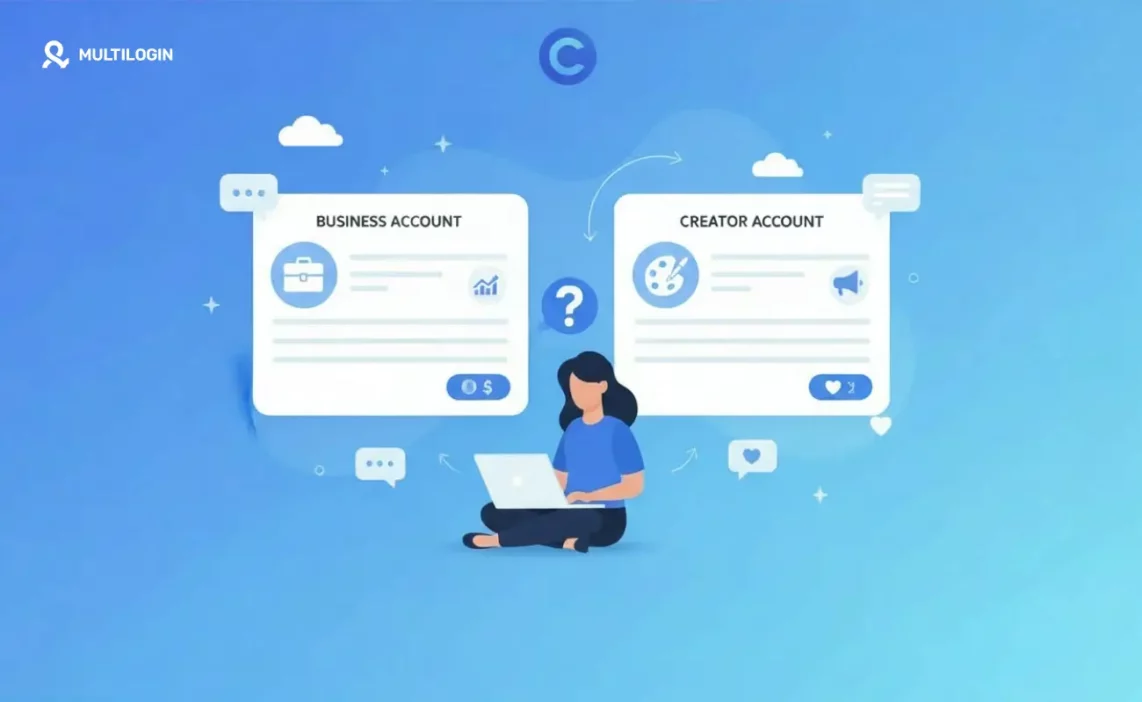



Neither Instagram Business nor Creator accounts are proven to deliver higher conversion rates. Business accounts are generally better suited to brands selling products or services, while Creator accounts fit influencers, personal brands, and people earning through content. The better choice depends on how you attract customers, build trust, and turn followers into buyers.
Both are Instagram professional accounts. They provide analytics, advertising capabilities, and tools to connect with audiences. However, their workflows, commerce integrations, and monetization opportunities can differ.
This Instagram Business vs Creator account comparison explains the differences, examines available research, and helps you choose the account type that fits your sales goals.
Key takeaways
Business accounts are a practical choice for ecommerce stores, local businesses, and service brands that need commerce and customer management tools.
Creator accounts suit influencers, personal brands, coaches, and people who earn through content and partnerships.
Both account types offer Instagram Insights and advertising options. Neither guarantees better reach, engagement, or sales.
Conversion rates depend on more than account type. Content quality, audience intent, product offers, and the buying process also matter.
Instagram Creator vs. Business Account: What is the difference?
The main difference between Instagram Creator and Business accounts is who they are designed for and how users manage their professional activities.
According to Instagram’s professional account documentation, Business accounts are intended for retailers, brands, organizations, and service providers. Creator accounts are designed for public figures, content producers, artists, and influencers.
Both are free professional account types, but some tools depend on eligibility, location, and account setup.
| Feature | Business account | Creator account |
|---|---|---|
| Best suited for | Brands, shops, and service providers | Influencers, creators, and personal brands |
| Instagram Insights | Yes | Yes |
| Professional dashboard | Yes | Yes |
| Instagram advertising | Yes | Yes |
| Profile contact options | Yes | Yes |
| Shopping and product catalogs | Business-focused commerce workflows, subject to eligibility | Commerce access depends on account setup and eligibility |
| Branded content and partnerships | Supported for eligible accounts | Creator-focused partnership opportunities |
| Creator monetization | Depends on program eligibility | Depends on program eligibility |
| Licensed music library | Some accounts have restrictions | Access varies; commercial-use rules still apply |
| Third-party integrations | Depends on the tool and permissions | Depends on the tool and permissions |
Neither account type is automatically better at converting followers into paying customers.
The important question is whether you need tools designed around a business storefront or tools that support a creator-led business.
Does an Instagram Business or Creator account convert better for sales?
There is no reliable universal conversion-rate benchmark proving that Instagram Business accounts outperform Creator accounts, or vice versa.
Both can generate sales, but they often use different customer journeys.
For example, an ecommerce brand might publish product demonstrations, connect a product catalog, and direct shoppers to its website. An influencer might recommend a product through a Reel, share an affiliate link, and earn a commission when followers purchase.
Both activities can generate conversions. However, the factors driving those conversions are not identical.
Consider a discussion on Reddit’s r/SocialMediaMarketing. One social media manager reported growing an ecommerce account from approximately 3,500 to 39,000 followers while direct sales remained low.
Commenters suggested examining audience intent, landing pages, and the customer journey rather than focusing only on follower growth.
This is one user’s experience, not a controlled study. However, it illustrates an important difference: audience growth is not the same as sales conversion.
Before changing your Instagram account type, determine what conversion means for your business:
An online store might measure completed purchases.
A service provider might track qualified enquiries.
A coach might count discovery-call bookings.
An influencer might measure affiliate sales or paid partnership enquiries.
The account that supports your preferred conversion process is usually the better starting point.
Which Instagram account features can improve conversions?
Both professional account types provide tools that can support conversions, but the value of each feature depends on how you sell.
Which account provides better Instagram analytics for sales?
Instagram Business and Creator accounts both offer professional Insights. Neither automatically provides better sales analytics simply because of its account type.
Instagram Insights can help you review content views, interactions, follower activity, audience characteristics, and other performance indicators, depending on eligibility and available data.
Business accounts can also fit workflows that connect Instagram activity with Meta business assets, advertising reports, and ecommerce tracking.
Creator accounts offer performance information useful for evaluating Reels, audience engagement, content formats, and partnerships.
Meta also provides professional dashboard guidance for creators, covering creation, reach, engagement, monetization, and account guidelines.
For sales reporting, however, Instagram Insights alone may not show every completed purchase.
You may also need website analytics, ecommerce order reports, or campaign tracking to understand which posts generate revenue.
Which account is better for Instagram ads and lead generation?
Both Instagram Business and Creator accounts can support paid advertising. Business accounts are usually more practical for structured brand advertising and lead generation workflows.
For example, a service provider might use advertising campaigns to collect enquiries, promote consultations, or direct visitors to a booking page.
A creator might promote a course, digital product, or personal brand through sponsored content.
Access to particular Meta advertising workflows can depend on connected business assets, permissions, region, and eligibility.
Creator-led advertising can also complement a Business account.
In a LinkedIn example shared by advertising specialist Akvile DeFazio, a consulting client’s partnership ad involving a founder’s Creator account generated four leads on its first day at a reported $17 cost per lead. The client’s previous Business-account ads had averaged around $90 per lead.
These results came from different advertising setups. The example does not prove that Creator accounts have higher conversion rates.
Instead, it suggests that creator-led content and brand advertising can work together.
Which account is better for selling products on Instagram?
Business accounts are a strong starting point for product-based ecommerce, especially when you need a product catalog and shopping integrations.
For example, Shopify’s Instagram Shopping documentation describes how eligible merchants can connect products, display a shop, and tag items in Instagram content.
Customers can then visit product pages and complete purchases through the seller’s website.
Shopping eligibility depends on location, product category, professional-account setup, and Meta’s commerce requirements.
A Creator account can also promote products through content, affiliate links, and external storefronts.
The difference is the selling model. A store built around a product catalog has different needs from an individual recommending products to an engaged audience.
Which Instagram account is better for monetization and branded partnerships?
Creator accounts are generally better aligned with influencers who earn through sponsored content, brand partnerships, subscriptions, or audience-supported monetization.
However, access to monetization programs is not guaranteed by switching to Creator.
Meta applies eligibility requirements that may include location, age, account standing, and program-specific conditions.
In its Creator Marketplace announcement, Meta explains how eligible creators and brands can discover partnership opportunities and collaborate on advertising.
Research also suggests that creator-brand collaborations can support audience growth.
A 2025 research working paper by Andrew T. Ching and Daniel Goetz, revised in May 2026, examined collaborative posts involving 260 fashion and beauty brands. It estimated an average 0.52% increase in creators’ follower counts after collaboration posts.
The research measured audience growth, not product purchases. Therefore, it cannot establish which Instagram account type converts more sales.
For creators, the better question is whether an account supports the specific partnership and monetization tools they qualify to use.
Do Instagram Creator accounts get more reach and grow faster than Business accounts?
There is no established rule that Instagram Creator accounts receive more organic reach than Business accounts. Switching account type alone does not guarantee better distribution.
Meta explains in its overview of Instagram ranking systems that content recommendations use multiple signals to predict what people may find relevant or interesting.
Reach also depends on audience interest, content quality, engagement, and how people respond to posts.
Still, some users report changes after switching account types.
In a February 2026 Reddit discussion, an account owner reported that views and follower growth declined after switching from Creator to Business.
The post provides no controlled comparison, so it is not possible to determine whether the switch caused the decline.
Does music access differ between Creator and Business accounts?
Some Business accounts have more limited access to Instagram’s licensed music library.
Instagram’s music guidance explains that licensed music is generally intended for personal, non-commercial use, and some business accounts or post types may have restricted access.
Creator accounts may have different music options, but switching to Creator does not automatically grant permission to use commercial music in advertisements or sponsored posts.
For either account type, check the rights for the intended use.
If your goal is better reach, focus first on audience response, original content, clear messaging, and relevant topics rather than assuming a different account label will solve the problem.
Which Instagram account type is best for your business model?
Choose the Instagram account type that matches how customers discover, trust, and purchase from you.
The following recommendations are practical starting points, not guarantees of higher conversion rates.
| Business model | Suggested account | Why |
|---|---|---|
| Ecommerce store | Business | Suits product catalogs, brand advertising, and shopping workflows |
| Local shop or restaurant | Business | Fits business information, enquiries, and customer contact |
| Influencer | Creator | Focuses on content, audience relationships, and partnerships |
| Affiliate marketer | Creator | Fits personal recommendations and content-led promotion |
| Personal brand | Creator | Keeps the individual at the center of the account |
| Digital product seller | Creator or Business | Depends on whether sales are personality-led or brand-led |
| Coach or consultant | Creator or Business | Depends on whether clients buy from the individual or a company |
| Service provider | Business | Fits customer enquiries, appointments, and business promotion |
Is a Creator account good for small businesses?
Yes. A small business can use a Creator account when its audience primarily follows an individual.
For example, an independent fitness coach selling training programs may prefer Creator tools and a personal-brand presentation.
A gym selling memberships under a business name may prefer a Business account.
Neither option automatically gives a small business better engagement.
What about businesses that use both Creator and Business accounts?
Some operators maintain a separate personal-brand presence and business presence.
For example, a founder might publish educational videos on a Creator account while a related Business account handles product information, customer support, and advertising.
This approach can support different audience needs, but managing two accounts also requires more content planning and consistent communication.
It should serve a real purpose rather than simply duplicate the same posts.
How can you improve Instagram conversions with either account type?
Improve the customer journey before switching account types. Better content and a simpler buying process can make a greater practical difference than the Creator or Business label.
Start with the basics.
Make your offer clear. Explain what you sell, who it helps, and why someone should buy it.
Use relevant content formats. Product demonstrations, customer examples, tutorials, and useful comparisons can answer questions before purchase.
Add a direct next step. Guide interested visitors to the appropriate product page, booking form, or contact method.
Match the landing page to the post. A Reel promoting one product should not send visitors to an unrelated homepage.
Review results regularly. Compare sales and lead data with the content that brought visitors to your offer.
For a wider look at content and profile optimization, see our guide on how to use Instagram for business.
How can you measure which Instagram account converts better?
Measure conversions against a consistent goal and traffic source. Do not use follower count or engagement rate as a replacement for sales performance.
A simple website conversion-rate formula is:
Conversion rate = (Purchases or qualified leads ÷ Website visits) × 100
For example, consider two hypothetical Instagram accounts promoting similar products.
| Metric | Creator account | Business account |
|---|---|---|
| Website visits | 200 | 200 |
| Purchases | 12 | 8 |
| Conversion rate | 6% | 4% |
In this illustration, the Creator account has a higher conversion rate.
However, this does not prove its account type caused the difference. Its audience, content, offer, and traffic quality may also differ.
A useful evaluation process is to:
Define one conversion goal, such as purchases or qualified leads.
Track Instagram-driven traffic and completed conversions using website analytics or sales records.
Compare similar campaigns, offers, and periods.
Review landing-page performance and audience differences.
Look for repeatable results rather than judging one viral post.
For paid campaigns, also monitor cost per lead, cost per purchase, and return on advertising spend.
When possible, test content and offers within your existing account before changing account type. A before-and-after account switch cannot isolate the effect of the switch from other changes.
Should you switch from an Instagram Creator account to a Business account?
Switch to Business when you need a more business-focused workflow, not simply because you expect higher reach or sales.
For example, switching may make sense when you are moving from personal content into running an established ecommerce brand or a service business.
Switching from Business to Creator may be appropriate when your account is mainly focused on individual content creation and partnerships.
Instagram lets users change professional account types through account settings. Menu names can vary by app version.
For detailed setup instructions, see how to create an Instagram Business account.
Before switching, check that the tools you depend on, including commerce integrations, music options, scheduling tools, and monetization features, will still be available.
How can you manage multiple Instagram Business and Creator accounts?
If you already manage several Instagram accounts, keeping each account’s workflow organized becomes important, regardless of whether you choose Business or Creator.
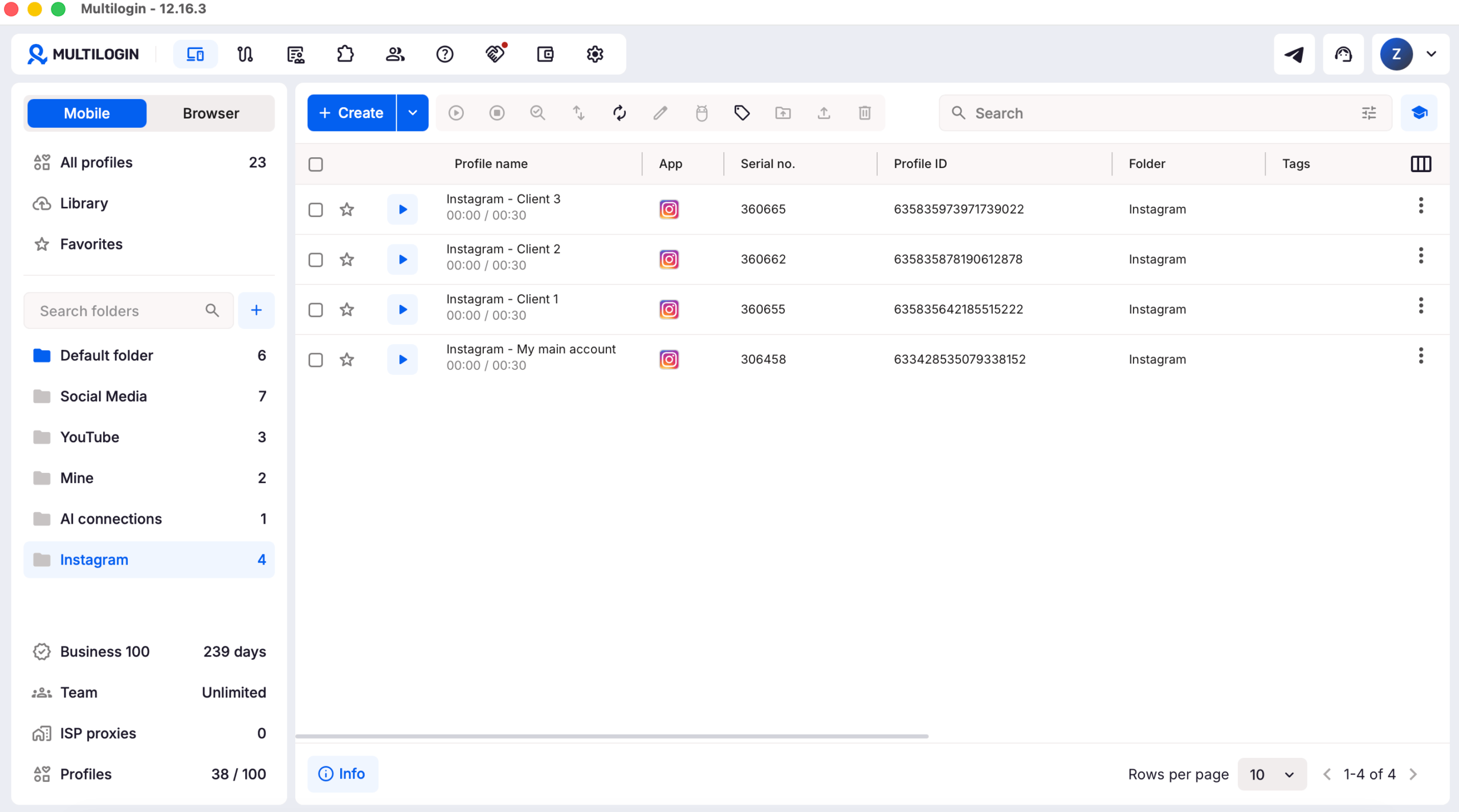
For example, you may manage a personal Creator account, an ecommerce Business account, and separate social profiles for different brands or regions.
Multilogin is a cloud Android phone platform for multi-account management like Instagram, Twitter, YouTube, etc. It lets you run Instagram’s native Android app on separate cloud phones, with persistent app data and login sessions.
Multilogin also includes isolated browser profiles for web-based account workflows, built-in proxies, mobile minutes, and centralized profile management.
A practical setup is to use one cloud phone per Instagram account and label profiles by their purpose.
For example, you could organize profiles as Creator, Store, and Regional Brand, then manage content and account activity separately.
This separation helps keep workflows organized. It does not guarantee better reach, higher conversions, or freedom from Instagram restrictions.
For instructions, see how to run multiple Instagram accounts with Multilogin cloud phones.
If your existing account-management workflow needs separate Android devices, you can explore Multilogin’s free plan to evaluate the setup.
Verdict: Is an Instagram Business or Creator account better?
Choose Instagram Business for a business-led selling workflow and Instagram Creator for a person-led content business. Neither account type is universally better at converting followers into customers.
A Business account is a logical starting point for ecommerce brands, shops, and service providers. A Creator account often suits influencers, coaches, personal brands, and people earning from content partnerships.
Some businesses benefit from using both account types for different purposes.
Ultimately, the best choice is the one that supports your audience, sales process, and required tools. Measure completed sales and leads before deciding whether switching accounts is necessary.