
The cloud phone market has a lot of noise right now. New entrants, aggressive pricing, and feature lists that sound impressive until you try to actually use them at scale.
BitCloudPhone from BitBrowser is one of the newer players making a push in the Android emulator and cloud phone space. Multilogin has been the standard for professional multi-account management since 2015. Both claim to solve the same fundamental problem: running multiple accounts on separate, isolated device environments without triggering platform detection.
So which one actually delivers?
This review breaks down both products honestly across every dimension that matters: technology, features, pricing, performance, and the critical question of whether they actually keep accounts safe.
We’ll cover BitCloudPhone pricing, BitCloudPhone’s feature set, and exactly how it stacks up against Multilogin’s cloud phone and antidetect browser combination.
What Is BitCloudPhone?
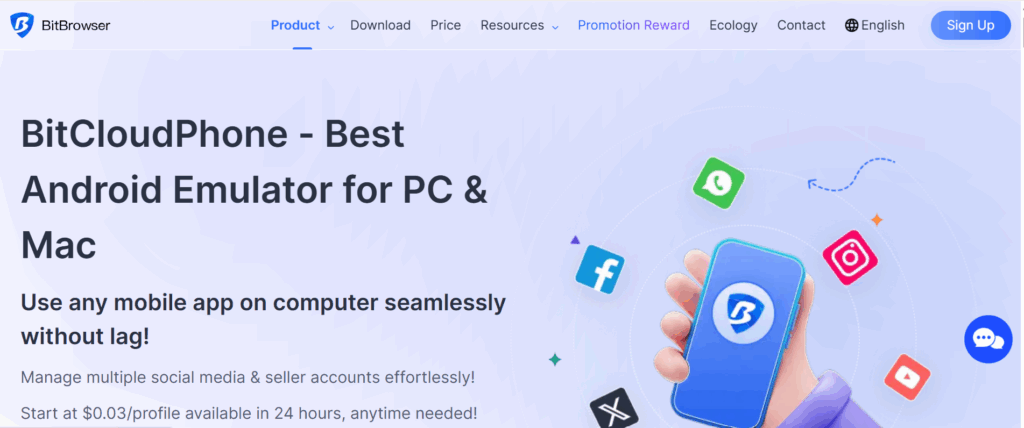
BitCloudPhone is the cloud phone product from BitBrowser, a Hong Kong-based multi-account management company. It positions itself as an Android emulator for PC and Mac that lets users manage multiple social media accounts, simulate Android devices, and run mobile apps from a browser-based interface.
According to BitBrowser’s website, BitCloudPhone:
- Simulates Android devices with parameters like language, time zone, location, carrier, and SIM card
- Supports apps from Google Play and custom APK files
- Claims to support 600+ mobile carriers worldwide
- Offers team management and permission assignment features
- Runs on Windows and Mac
BitCloudPhone pricing starts at $0.03 per profile per 24 hours, with a temporary usage model at $0.07 per 15 minutes, capped at $1.60 per day.
What Is Multilogin?
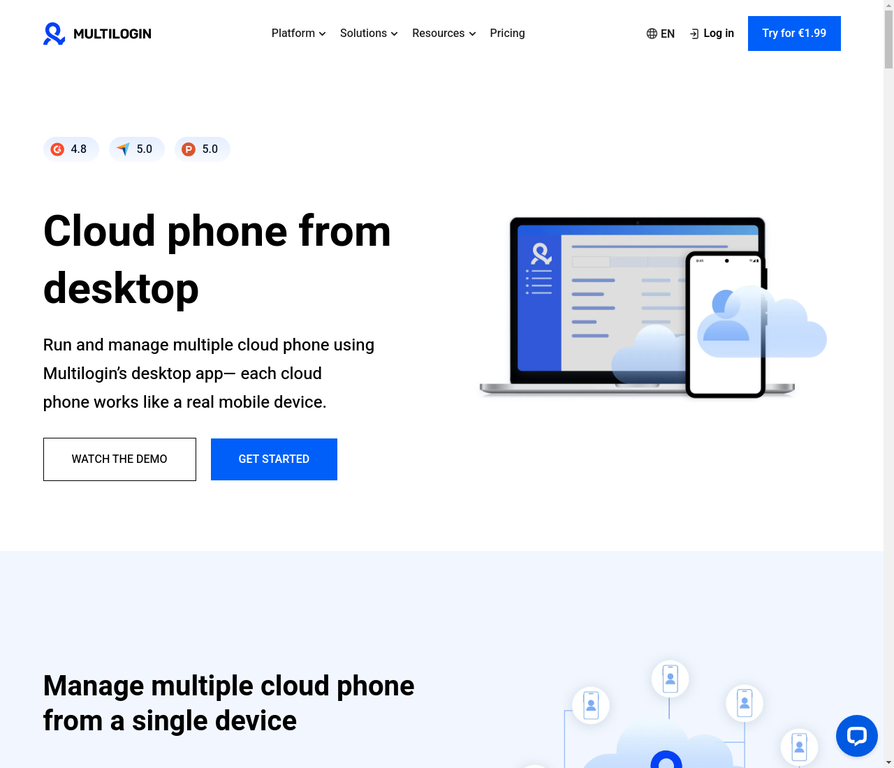
Multilogin is a professional multi-account management platform built around two core products: an antidetect browser for desktop web-based account management and cloud phones for native mobile app management.
Multilogin has been operating since 2015 and is used by performance marketers, e-commerce agencies, airdrop farmers, social media agencies, and affiliate networks managing accounts at scale across every major platform.
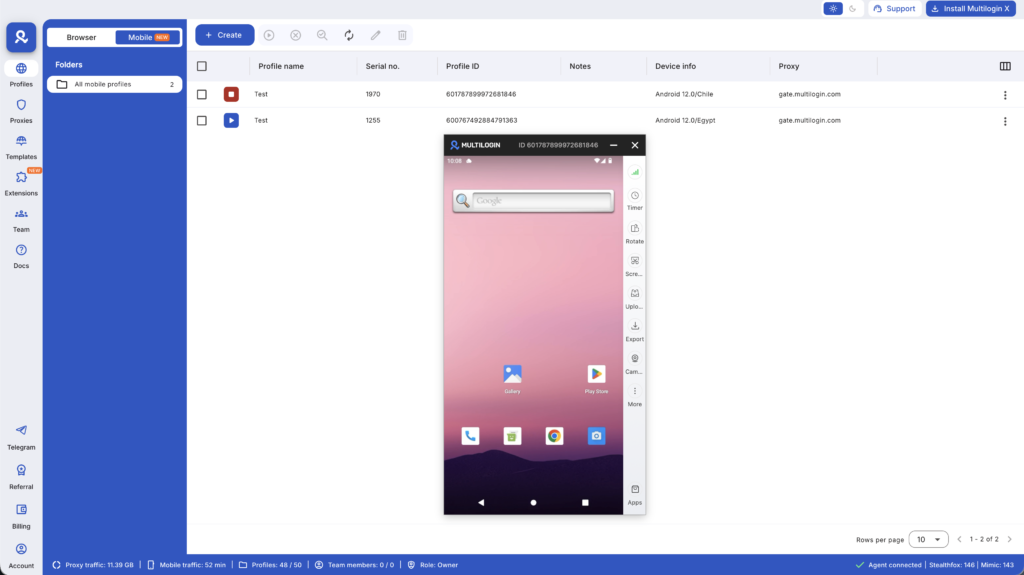
Multilogin’s cloud phones are real Android devices running in the cloud, each with genuine hardware identifiers, location-matched mobile proxies, persistent sessions, and full native app support. The antidetect browser creates isolated browser profiles with unique fingerprints for desktop account management.
The two products are integrated into one dashboard, making Multilogin a complete solution for both mobile and desktop multi-account operations.
At a Glance: BitCloudPhone vs Multilogin
Feature | BitCloudPhone | Multilogin |
Device technology | Android emulator (software) | Real Android hardware in cloud |
Antidetect browser | Separate product (BitBrowser) | Built-in (Mimic + Stealthfox) |
Fingerprint parameters | Basic device simulation | 30+ customizable parameters |
Built-in proxies | External setup required | Included, location-matched |
Pre-farmed cookies | Not available | Available |
Platform since | Newer entrant | 2015 |
Pricing model | Per-profile per day | Monthly subscription |
Starting price | $0.03/profile/day | From €5.85/month |
Team collaboration | Basic sub-accounts | Full RBAC + audit logs |
Unified dashboard | No (two separate products) | Yes |
Support | Community + ticket | 24/7 dedicated support |
BitCloudPhone vs Multilogin: Head-to-Head Comparison
1. Technology: Real Devices vs Android Emulation
This is the most important technical distinction and where the comparison starts to diverge significantly.
BitCloudPhone explicitly describes itself as an Android emulator. The product page uses terms like “simulate the Android operating system,” “emulate Android Phone on PC,” and “Android Simulator.”
Emulators replicate Android in software on PC hardware. They do not use actual mobile chipsets. Platform detection systems, particularly on Instagram, TikTok, and Facebook, have become increasingly effective at identifying emulated device environments versus genuine Android hardware.
Multilogin Cloud Phones run on real Android hardware hosted in the cloud. These are not emulated environments. The underlying hardware is genuine mobile chipsets, which means the device signals that platforms read, radio baseband identifiers, genuine ARM architecture, and hardware-level sensor data, match what they expect to see from a real device.
TikTok’s risk engine, Instagram’s device trust scoring, and Facebook’s hardware verification all look at signals that emulators cannot authentically replicate.
Criteria | BitCloudPhone | Multilogin |
Underlying hardware | PC-based emulation | Real Android chipsets |
ARM architecture | Simulated | Genuine |
Radio/baseband signals | Not present | Real mobile signals |
Hardware sensor data | Software approximation | Authentic hardware output |
TikTok detection risk | Higher (emulator flags) | Lower (genuine device) |
Instagram trust score | Reduced | Full |
Verdict: Multilogin’s real hardware approach is fundamentally more resistant to platform detection than emulation. For anyone managing accounts on platforms with aggressive device detection, this difference matters significantly.
2. Browser Fingerprinting and Identity Isolation
BitCloudPhone provides device parameter simulation for mobile profiles including language, time zone, location, carrier, and SIM data. However, the emulator approach means these parameters are software-generated on PC hardware, which can produce inconsistencies in how they appear to platform detection systems.
Multilogin has built its entire product around fingerprint integrity. The antidetect browser offers 30+ customizable fingerprint parameters including canvas, WebGL, audio context, font enumeration, hardware concierge data, and more. Because Multilogin’s cloud phones run genuine hardware, the fingerprint signals are authentic at the hardware level, not simulated in software.
Multilogin’s two dedicated antidetect browsers, Mimic (Chromium-based) and Stealthfox (Firefox-based), have been in active development and platform testing for a decade. The fingerprint engine is continuously updated against new detection methods deployed by platforms.
Fingerprint Element | BitCloudPhone | Multilogin |
Canvas fingerprint | Basic | Unique per profile |
WebGL rendering | Basic simulation | Hardware-authentic |
Audio context | Limited | Customizable |
Font enumeration | Not specified | Controlled per profile |
Timezone/locale | Yes | Yes, with IP alignment |
Carrier simulation | Yes (600+ carriers) | Yes, location-matched |
Fingerprint update cadence | Not published | Continuous, platform-tested |
Dedicated antidetect browsers | No (separate BitBrowser) | Yes (Mimic + Stealthfox) |
Verdict: Multilogin’s fingerprinting is more comprehensive, more consistently maintained, and more thoroughly tested against the platforms that matter most.
3. Platform Support and App Compatibility
BitCloudPhone supports Google Play apps and custom APK files on Windows and Mac. The product page lists Facebook, YouTube, Google, and Twitter as supported apps.
Multilogin Cloud Phones support the full Google Play ecosystem and custom APKs, with specific testing and optimization for the platforms most relevant to professional account managers: Instagram, TikTok, Facebook, Twitter/X, WhatsApp, Telegram, and the major e-commerce platforms.
Both products support running mobile apps on desktop environments. The key difference is that Multilogin’s real hardware means app behavior, including native push notification delivery, authentic sensor responses, and hardware-level API calls, mirrors genuine mobile use. Emulated environments can produce app behavior anomalies that platforms flag.
Platform | BitCloudPhone | Multilogin |
Supported | Supported + tested | |
TikTok | Supported | Supported + tested |
Supported | Supported + tested | |
Twitter/X | Supported | Supported + tested |
Not specified | Supported | |
Telegram | Not specified | Supported |
Google Play apps | Yes | Yes |
Custom APK | Yes | Yes |
Push notifications | Emulated | Genuine (real hardware) |
Sensor API responses | Approximated | Hardware-authentic |
4. Proxy Integration
BitCloudPhone supports proxy IP configuration with a one-click proxy setup. The product mentions support for global residential proxy settings, but proxies must be sourced and paid for separately.
Multilogin includes built-in residential proxies that are location-matched to each cloud phone profile. This is not a separate integration requirement. When you configure a US-based cloud phone profile, the built-in proxies provide US residential IP addresses from that geographic location. The cookie profiles, timezone, language, carrier, and IP all align by default, eliminating the configuration errors that create detection risk.
Additionally, Multilogin’s antidetect browser integrates directly with major proxy providers and supports residential, datacenter, ISP, and mobile proxies across all browser profiles.
Proxy Feature | BitCloudPhone | Multilogin |
Built-in residential proxies | No (external required) | Yes, included |
Location-matched proxies | Manual setup | Automatic |
Proxy types supported | Residential (external) | Residential, ISP, DC, mobile |
IP/timezone/cookie alignment | Manual | Automatic |
Proxy health monitoring | Not specified | Yes |
Risk of misconfiguration | Higher | Lower |
Verdict: Multilogin’s built-in, location-matched proxy integration eliminates a major source of configuration error that creates account risk. BitCloudPhone requires separate proxy sourcing and manual alignment.
5. Pre-Farmed Cookies
BitCloudPhone does not mention pre-farmed cookies as a feature.
Multilogin provides pre-farmed cookies that give new browser profiles and cloud phone profiles the trust signals of established accounts from day one. This feature is particularly valuable for platforms that weigh account history heavily in their trust scoring, including Discord, Reddit, and various e-commerce platforms. When managing multiple social media accounts, pre-farmed cookies mean new profiles avoid new-account restrictions from the moment they’re created.
Cookie Feature | BitCloudPhone | Multilogin |
Pre-farmed cookies | Not available | Yes |
Platform-specific cookie profiles | Not available | Yes |
Geographic cookie alignment | Not available | Yes |
Cookie refresh cadence | N/A | Regular updates |
Bypass new-account restrictions | No | Yes |
Verdict: Multilogin only. This feature alone meaningfully changes how fast new accounts can operate without restrictions.
6. Team Collaboration
BitCloudPhone offers sub-account permission management with flexible assignment of profile access. Team members can operate independently with profiles transferred between accounts.
Multilogin provides team collaboration tools across both cloud phones and browser profiles: role-based access control (RBAC), granular permission settings, audit logs tracking which team member accessed which account, encrypted credential storage, and profile sharing without exposing passwords.
Collaboration Feature | BitCloudPhone | Multilogin |
Sub-account support | Yes | Yes |
Role-based permissions | Basic | Full RBAC |
Audit logs | Not specified | Yes |
Encrypted credential storage | Not specified | Yes |
Profile sharing without passwords | Not specified | Yes |
Profile transfer | Yes | Yes |
Simultaneous multi-user access | Yes | Yes, with controls |
7. BitCloudPhone Pricing vs Multilogin Pricing
BitCloudPhone pricing:
- Time-based: $0.03 per profile per 24-hour period
- Temporary: $0.07 per 15 minutes, capped at $1.60 per day
- No listed monthly subscription plan
At $0.03 per profile per day, managing 50 cloud phone profiles continuously costs approximately $45 per month. At 100 profiles, that is $90 per month, for cloud phones only, with proxies still needing to be sourced and paid for separately.
Multilogin pricing:
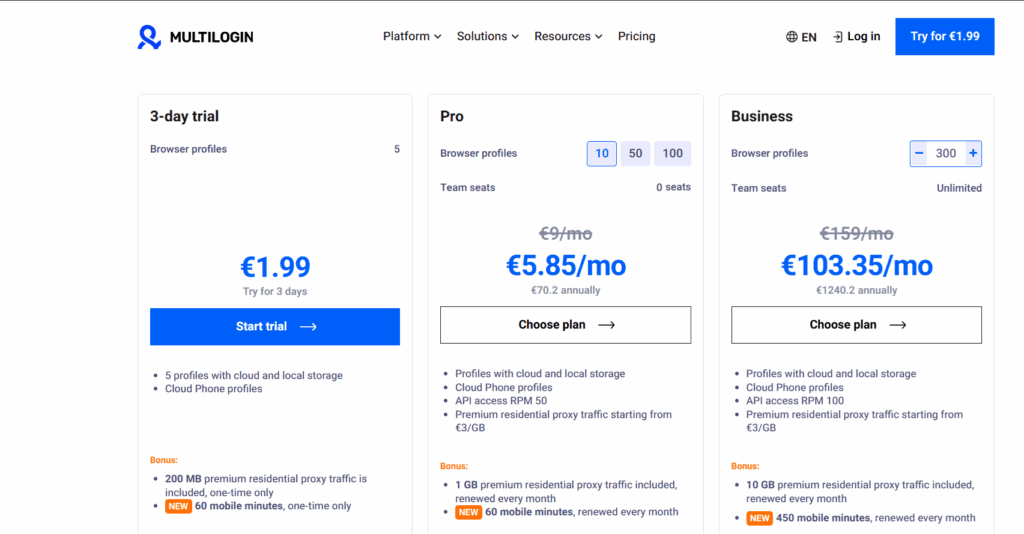
- Starts at €5.85 per month for the Starter plan
- Subscription-based with predictable monthly cost
- Includes cloud phones and antidetect browser in one platform
- Built-in proxies included
- See full Multilogin pricing
Pricing Factor | BitCloudPhone | Multilogin |
Entry price | $0.03/profile/day | From €5.85/month |
50 profiles (continuous use) | ~$45/month + proxy costs | Flat subscription |
Proxies included | No (extra cost) | Yes |
Antidetect browser included | No (separate product) | Yes |
Pricing model | Pay-per-use | Predictable subscription |
Cost predictability | Variable | Fixed monthly |
Best value at scale | Worse (costs compound) | Better (flat rate) |
The pricing comparison requires context. BitCloudPhone’s per-profile-per-day model becomes expensive when profiles are used continuously and proxy costs are added on top. Multilogin’s subscription model provides better cost predictability and includes both the antidetect browser and cloud phones in a single plan.
More importantly: a lower-cost product that results in account bans is not actually cheaper. Account recovery, content migration, audience rebuilding, and revenue lost during downtime cost far more than any subscription price difference.
Verdict: Competitive at small scale for occasional use. Multilogin’s integrated platform and predictable pricing makes it more economical for professional operations managing 20+ accounts continuously.
Where BitCloudPhone Falls Short
Emulator Signals Remain a Detection Risk
The fundamental limitation of BitCloudPhone is architectural. Building cloud phones on emulated Android rather than real hardware means the device signals that platform detection systems read are software-generated reconstructions rather than genuine hardware outputs. Major platforms actively fingerprint for emulator characteristics.
For casual testing or development work, this may be acceptable. For professional multi-account management where account health directly impacts revenue, emulator detection is a real risk that real hardware eliminates.
Limited Track Record
Multilogin has been operating since 2015. The platform has been tested against every major platform update, every algorithm change, and every detection method evolution across a decade of professional use. BitCloudPhone is significantly newer, with a limited track record of sustained performance against the platforms that matter most.
When platform detection algorithms update, which they do regularly, products with mature engineering teams and deep platform-specific testing respond faster. Newer entrants lag behind.
No Unified Dashboard
BitBrowser offers an antidetect browser as a separate product. BitCloudPhone is a separate product. While they are from the same company, the integration between them is not as seamless as Multilogin’s unified platform where cloud phones and the antidetect browser share a single dashboard, profile management, and consistent fingerprint data.
For agencies managing multiple social media accounts that need both mobile and desktop access, switching between separate tools creates operational friction that Multilogin’s unified approach eliminates.
Documentation and Support Maturity
BitBrowser’s documentation is available, but user reviews suggest a learning curve particularly around proxy configuration and fingerprint settings. Multilogin’s decade of operation has produced comprehensive documentation, an active knowledge base, and customer support infrastructure that reflects years of refinement.
Where BitCloudPhone Has an Edge
Entry-Level Pricing for Occasional Use
For very small-scale users who need cloud phone access occasionally rather than continuously, BitCloudPhone’s per-day pricing model can be cheaper than a monthly subscription. If you need 5 profiles for 10 days per month, time-based pricing may work out lower than a subscription tier.
Free BitBrowser Profiles
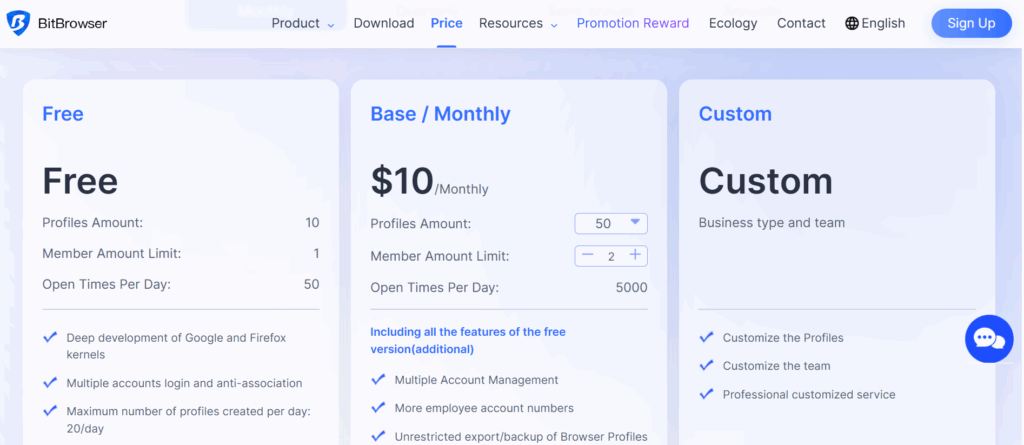
BitBrowser’s antidetect browser offers 10 free profiles permanently, which gives new users an entry point to test the ecosystem before committing to paid plans. This is a genuine advantage for smaller operators or those evaluating antidetect browsers for the first time.
Who Should Use Each Product?
Use Case | BitCloudPhone | Multilogin |
App development and testing | Good fit | Overkill for testing only |
Occasional mobile access (5-10 profiles) | Good fit | Consider vs subscription cost |
Social media agency (10-50+ accounts) | Risky | Strong fit |
E-commerce multi-store management | Risky | Strong fit |
Airdrop farming at scale | Risky | Strong fit |
Limited | Strong fit | |
Performance marketing multi-account | Risky | Strong fit |
Budget exploration / first tool | Acceptable | Starter plan available |
Professional agencies (revenue-critical) | Not recommended | Recommended |
BitCloudPhone Makes Sense For:
- Developers testing app behavior across Android device configurations
- Small-scale operators who need occasional cloud phone access
- Users already embedded in the BitBrowser ecosystem
- Budget-conscious beginners experimenting with mobile multi-account management
Multilogin Makes Sense For:
- Professional agencies managing 10 to 1,000+ accounts for clients
- Airdrop farmers and crypto community managers scaling across multiple wallets
- E-commerce operators managing Amazon, eBay, and marketplace seller accounts
- Social media agencies managing Instagram, TikTok, and Facebook accounts for multiple brands
- Performance marketers running multi-account advertising operations
- Anyone for whom account health directly impacts business revenue
Full Feature Comparison: BitCloudPhone vs Multilogin
Feature | BitCloudPhone | Multilogin |
Core Technology | ||
Device type | Android emulator | Real Android hardware |
Cloud hosting | Yes | Yes |
Desktop operation | Yes (Windows + Mac) | Yes (Windows + Mac) |
Fingerprinting | ||
Fingerprint parameters | Basic simulation | 30+ customizable |
Canvas/WebGL spoofing | Limited | Yes |
Timezone/language | Yes | Yes, IP-aligned |
Hardware-level signals | Approximated | Genuine |
Proxy | ||
Built-in proxies | No | Yes |
Proxy types | External residential | Residential, ISP, DC, mobile |
Auto location matching | No | Yes |
Cookies | ||
Pre-farmed cookies | No | Yes |
Platform-optimized profiles | No | Yes |
Browser | ||
Dedicated antidetect browser | Separate product | Built-in (Mimic + Stealthfox) |
Chromium-based browser | Via BitBrowser | Mimic |
Firefox-based browser | No | Stealthfox |
Team Features | ||
Role-based permissions | Basic | Full RBAC |
Audit logs | Not specified | Yes |
Encrypted credentials | Not specified | Yes |
Profile sharing | Yes | Yes |
Pricing | ||
Starting price | $0.03/profile/day | From €5.85/month |
Proxies included | No | Yes |
Browser included | No (separate) | Yes |
Pricing predictability | Variable | Fixed |
Support | ||
Customer support | Ticket + community | 24/7 dedicated |
Documentation maturity | Developing | Extensive (10 years) |
Platform since | Recent | 2015 |
Need a better Bit Cloud Phone Alternative? Try Multilogin Cloud Phones.
The Bottom Line: BitCloudPhone vs Multilogin
Decision Factor | Winner |
Technology (real hardware vs emulation) | Multilogin |
Fingerprint depth and reliability | Multilogin |
Platform detection resistance | Multilogin |
Built-in proxy integration | Multilogin |
Pre-farmed cookies | Multilogin |
Unified dashboard | Multilogin |
Track record and maturity | Multilogin |
Professional agency use | Multilogin |
Team collaboration depth | Multilogin |
Overall value at scale | Multilogin |
BitCloudPhone is a functional product at competitive entry-level pricing. For developers, testers, and small-scale operators who need occasional access to Android environments for light multi-account use, it is a workable option.
For professional operators managing client accounts, running e-commerce operations, scaling affiliate campaigns, or doing anything where account bans directly cost money, Multilogin is the superior platform across every dimension that matters for account safety.
The reasons come down to three things:
- Real hardware vs. emulation. Multilogin’s cloud phones run on genuine Android devices. BitCloudPhone simulates Android in software. In 2026, platform detection is sophisticated enough that this distinction is not theoretical. It is the difference between accounts that survive and accounts that get flagged.
- Integrated platform. Multilogin manages cloud phones and antidetect browser from one dashboard with built-in proxies, pre-farmed cookies, and team collaboration tools. BitCloudPhone is one product in a two-product ecosystem that requires more configuration and management overhead.
- Proven track record. Multilogin has been continuously refined against real platform detection updates for a decade. BitCloudPhone does not have that engineering history behind it yet.
The price difference between the two platforms is real. The cost of losing accounts due to detection failures is almost always larger.
Ready to try Multilogin? Start your plan from €5.85 and get cloud phones and the antidetect browser in one platform built specifically for professional multi-account operations.
Frequently asked questions About BitCloudPhone vs Multilogin
BitCloudPhone is an Android emulator and cloud phone product from BitBrowser, a Hong Kong-based multi-account management company. It allows users to simulate Android devices on PC and Mac for managing multiple social media accounts without physical devices.
BitCloudPhone pricing starts at $0.03 per profile per 24-hour period for the time-based model, or $0.07 per 15 minutes (capped at $1.60 per day) for temporary access. There is no standard monthly subscription tier listed on their pricing page.
No. BitCloudPhone uses Android emulation technology, while Multilogin Cloud Phones run on real Android hardware hosted in the cloud. This is a fundamental technical difference that affects how platform detection systems read device signals from each product.
BitCloudPhone’s emulation approach creates risks with platforms that specifically fingerprint for emulator characteristics. Real hardware cloud phones like Multilogin’s are more resistant to this type of detection because they generate authentic hardware-level signals that emulators cannot replicate.
A cloud phone runs on real Android hardware hosted remotely. An Android emulator runs Android in software on PC hardware. Cloud phones produce genuine hardware signals that platform detection systems trust. Emulators produce software-generated signals that advanced detection systems can identify as non-genuine.