




Amazon supports several legitimate multi-account setups, but the rules differ for customer, Business, Family, and Seller Central accounts. Sellers may maintain more than one account in a region only for a legitimate business need and while all accounts are in good standing. Multilogin can help you organize mobile and web workspaces much more efficiently, whereas it does not change Amazon’s rules.
TL;DR
- Amazon permits additional Seller Central accounts when there is a legitimate business need and all related accounts remain in good standing.
- Before opening another account, check whether Global Selling, marketplace switching, Amazon Business, Amazon Family, or Seller Central User Permissions already meet your needs.
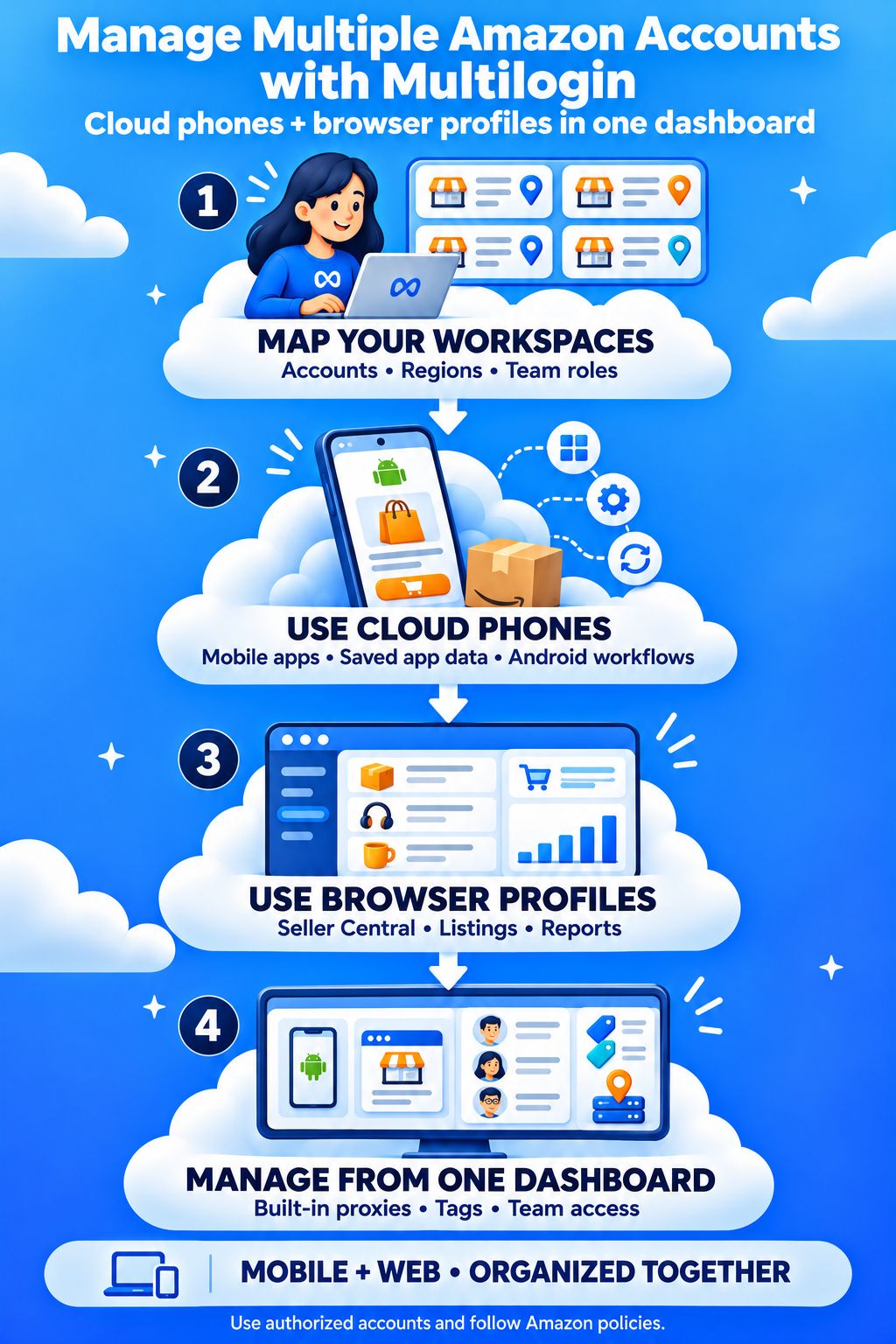
- Multilogin provides cloud Android phones for mobile-app workflows and browser profiles for Seller Central and other web tasks. Built-in proxies, tags, notes, and team access keep both workflows organized in one dashboard.
Can You Have Multiple Amazon Accounts?
Yes, but the correct setup depends on the type of account you need.
| Account type | What Amazon supports | Recommended approach |
|---|---|---|
| Personal and Amazon Business accounts | Amazon lets eligible users link and switch between personal and Business accounts while keeping their purchasing data separate | Use Amazon’s account-linking feature before adding third-party tools |
| Amazon Family accounts | An Amazon Family can include up to two adults, each with an individual Amazon account | Use Amazon Family to share eligible Prime benefits within the same household |
| Seller Central accounts in different regions | Amazon Global Selling supports regional marketplaces and account switching | Check whether your existing regional setup already covers the target country |
| Multiple Seller Central accounts in one region | Additional accounts are permitted when there is a legitimate business need and all accounts are in good standing | Document the business reason and use accurate ownership and registration information |
| Team access to one seller account | Seller Central supports additional users and permissions | Give each employee access instead of sharing the primary login |
Before creating another account, identify which of these situations applies. For example, a new employee or product category does not automatically require a completely new Seller Central account.
When Does Amazon Allow Multiple Seller Central Accounts?
Amazon generally allows one Seller Central account per seller in each region. A seller may operate an additional account when there is a legitimate business need and all existing accounts are in good standing.
Examples of legitimate business needs may include:
- Operating distinct brands as separate businesses
- Manufacturing products for separate companies
- Participating in an Amazon program that requires another account
- Maintaining legally separate business operations
Amazon no longer generally requires sellers to obtain prior approval before opening an additional account. However, the seller remains responsible for demonstrating the legitimate business purpose and complying with the Amazon Seller Code of Conduct.
When You May Need Multiple Seller Accounts & How to Manage Them Efficiently
While creating another account adds verification, administration, tax, and payment responsibilities, there’re several scenarios you may consider having and managing multiple seller accounts.
Selling in multiple countries
Amazon Global Selling does support regional accounts and marketplace switching. However, once your business scales internationally, account switching and logins could be a lots of unwanted repetitive work. In this case, multiple seller accounts for targeted countries and regions help you dig deeper into the global markets and sell better.
Giving employees or agencies access
At first, when several people need to work on the same business, you can first add them through Seller Central User Permissions. Once your team grows and there’re more and more permissions and passwords to share, account management could be real pain.
Separating personal and business purchases
Amazon itself supports linking eligible personal and Amazon Business accounts. The accounts remain can separate while users can move between them through Amazon’s account switcher. Again, once your business grows and there’re 50 accounts waiting for you to sort out, the official tools become less stable and comfortable to use.
Sharing Prime benefits at home
Amazon Family can include up to two adults, each with an individual Amazon account. Members must share the same primary residential address. The Family Organizer shares a payment method for household verification. Order history may also be shared depending on each member’s settings, so review the current privacy and order-sharing options before inviting another adult.
How to Avoid Getting Banned by Amazon
Amazon employs sophisticated algorithms to monitor for suspicious behavior, especially when it comes to multiple accounts. Here’s how to keep your accounts safe from bans:
- Use Separate Devices or Browser Profiles: Always use different devices or create separate browser environments using tools like Multilogin to ensure Amazon sees them as independent.
- Stick to Unique Payment Methods: Each account should have its own payment methods and shipping addresses. Using the same credit card across accounts could flag Amazon’s system.
- Use Different IP Addresses: Using the same IP address for multiple accounts can get them flagged. Tools like VPNs and proxies can help manage separate IPs.
- Follow Amazon’s Guidelines: Stay within the terms of service, avoid fraudulent activities, and don’t create accounts that violate Amazon’s rules.
How Multilogin Supports Safe Amazon Mobile and Web Workflows
Multilogin is a cloud Android phone platform for multi-account management. It also includes browser profiles for Seller Central and other web-based tasks.
Choose the environment that matches the work:
| Amazon workflow | Multilogin environment |
|---|---|
| Amazon Seller app or another Android app | Cloud Android phone |
| Seller Central listings, reports, orders, and messages | Browser profile |
| Mobile storefront checks | Cloud Android phone |
| Desktop storefront and regional research | Browser profile |
| Work shared between team members | Cloud-stored browser profile or assigned cloud phone |
| Supporting social accounts for an Amazon brand | One cloud phone per mobile-app account |
Each cloud phone keeps its apps, app data, login history, location, and connection settings with that phone. Browser profiles keep web sessions, cookies, and connection settings in separate workspaces. These environments together help businesses organize workflows and reduce reliance on multiple physical devices.
Attention: They do not replace Amazon’s account policies and verification requirements.
How to Set Up an Efficient Amazon Workflow in Multilogin
Start with one account or task. Test the complete workflow before creating more workspaces.
Step 1: Map the Accounts and Tasks You Already Have
List each Amazon account, business, marketplace, task, and responsible operator. A simple workspace plan might look like this:
| Workspace name | Purpose | Operator |
|---|---|---|
| BrandA-US-SellerCentral | Listings, orders, and account health | US marketplace manager |
| BrandA-UK-Research | UK storefront and competitor research | SEO specialist |
| BrandA-Mobile | Mobile-app tasks | E-commerce manager |
These are workspace names, not recommendations to create additional Amazon seller accounts.
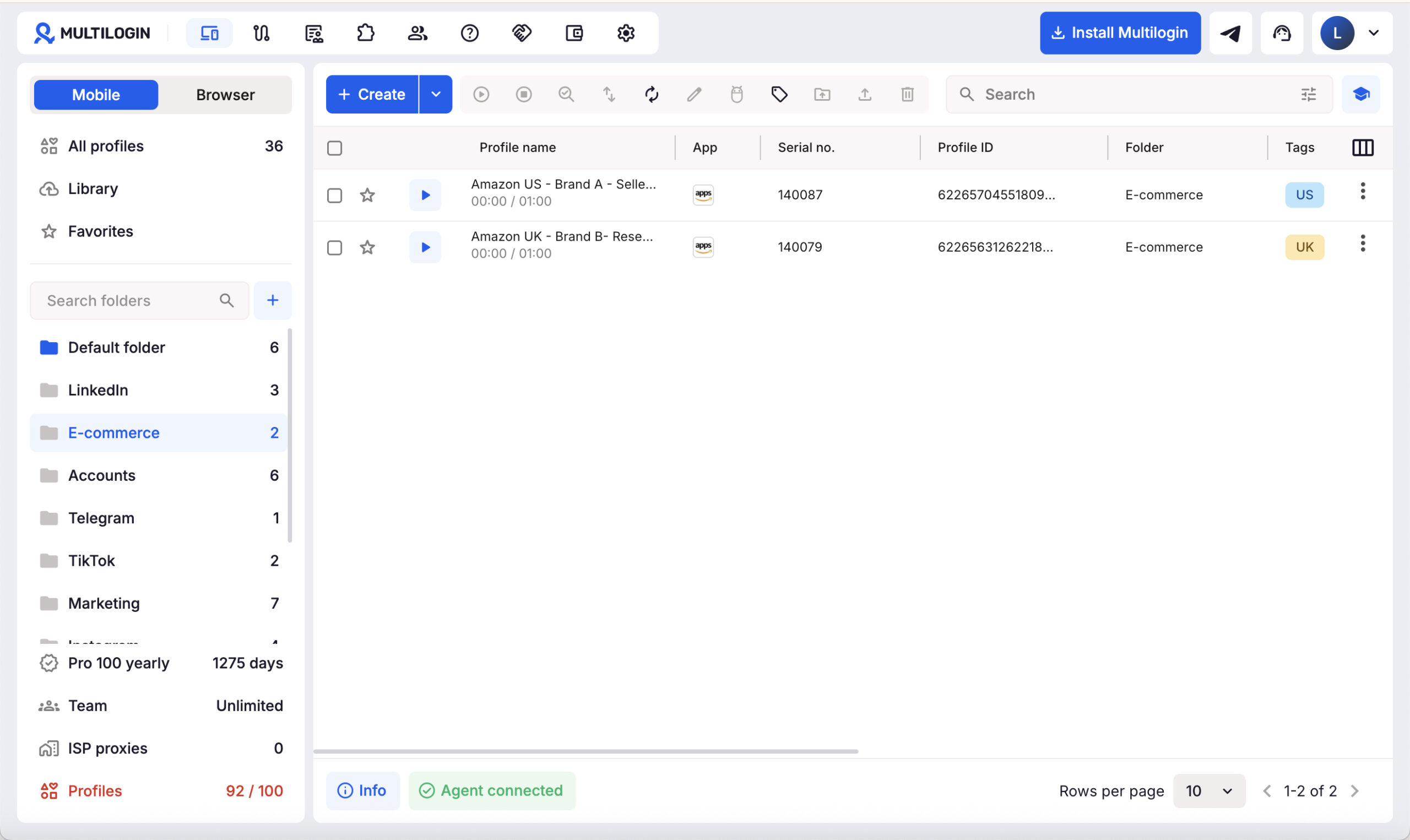
Step 2: Choose a Cloud Phone or Browser Profile
Open Multilogin and select Profiles.
- Choose Mobile → Create when the workflow requires an Android app.
- Choose Browser → Create when the work happens in Seller Central or another website.
Use a browser profile for most Seller Central administration. Use a cloud phone when a genuine Android environment is necessary for the mobile workflow.
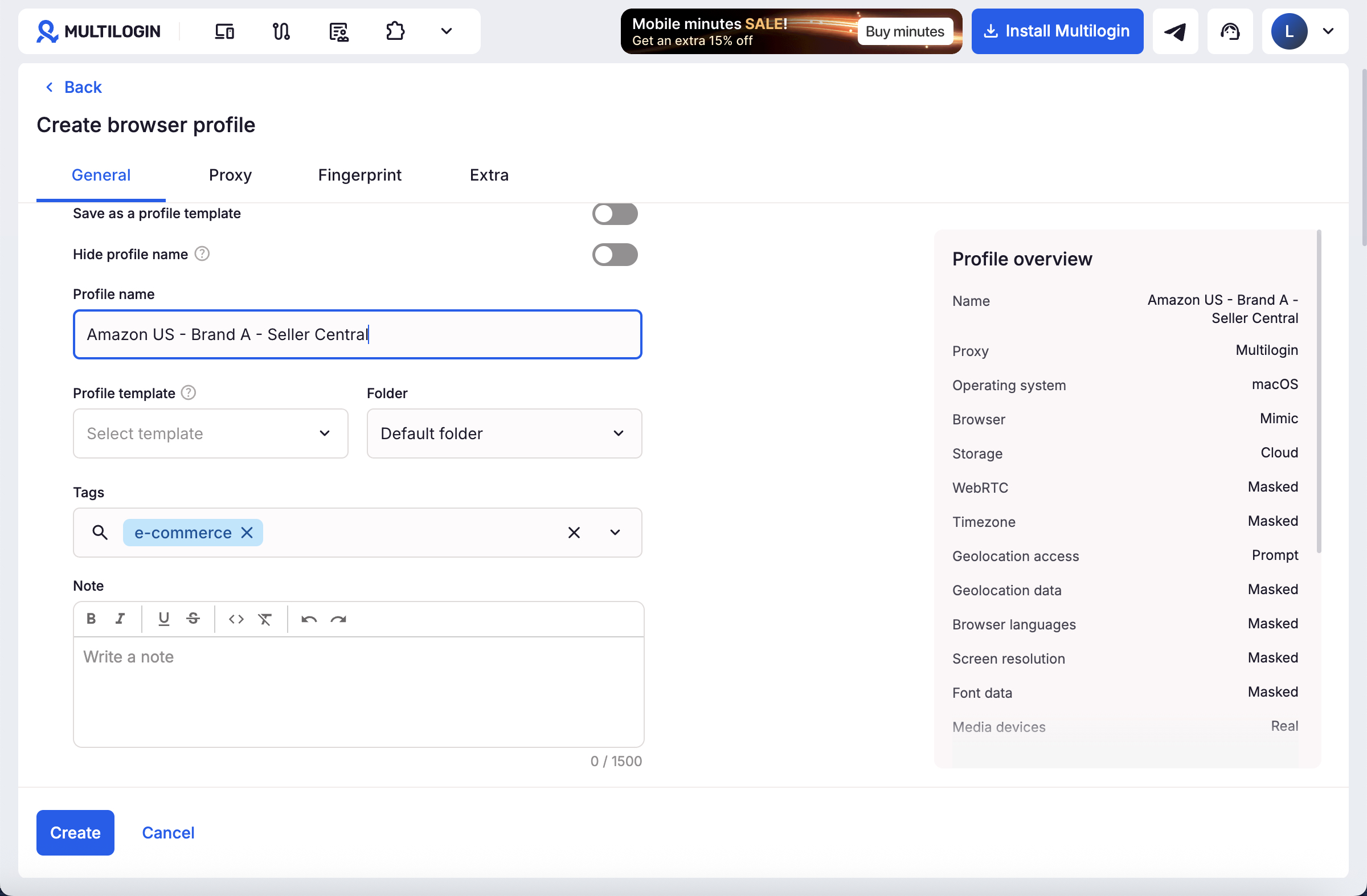
Step 3: Name and Organize the Workspace
Use a consistent naming format such as:
Brand-Region-Task
Examples include:
BrandA-US-SellerCentralBrandA-UK-ResearchBrandB-Mobile-App
Add tags for the business, region, account status, or responsible team. Use the Notes field to record the workspace purpose and any operational instructions. Do not store passwords, payment details, or recovery codes in profile notes.
Step 4: Configure and Check the Connection
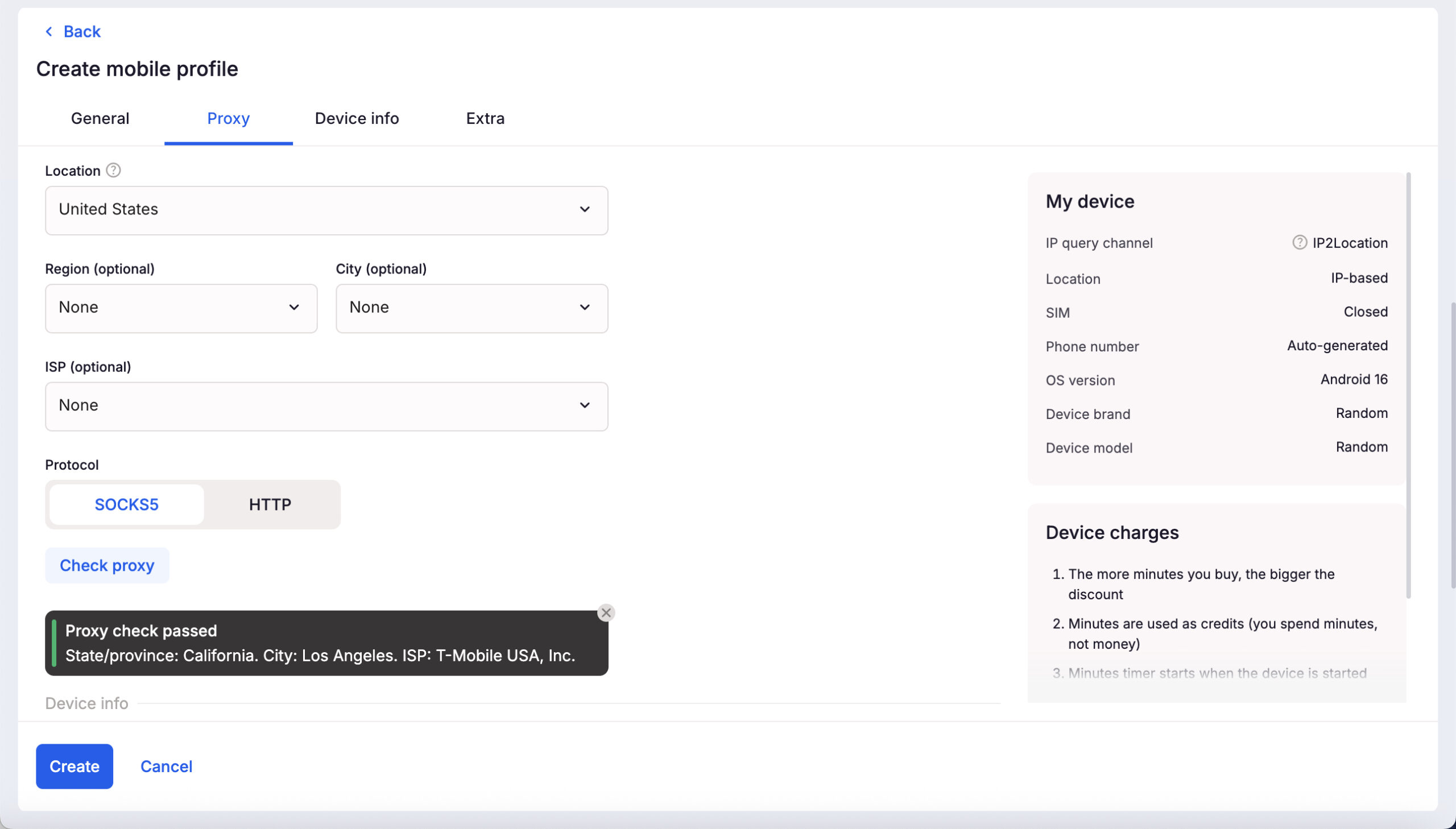
Open the profile’s proxy settings and choose Multilogin or an approved third-party connection.
Select the connection type and location that fit the account’s real business workflow. Click Check proxy before creating the profile.
Keep the working setup consistent. Avoid changing countries, cities, devices, or connection types without an operational reason.
For a cloud phone, a public proxy is required because the Android device runs remotely. For Seller Central browser work, confirm that the connection and location fit the business and operator.
Step 5: Start the Workspace and Complete Normal Verification
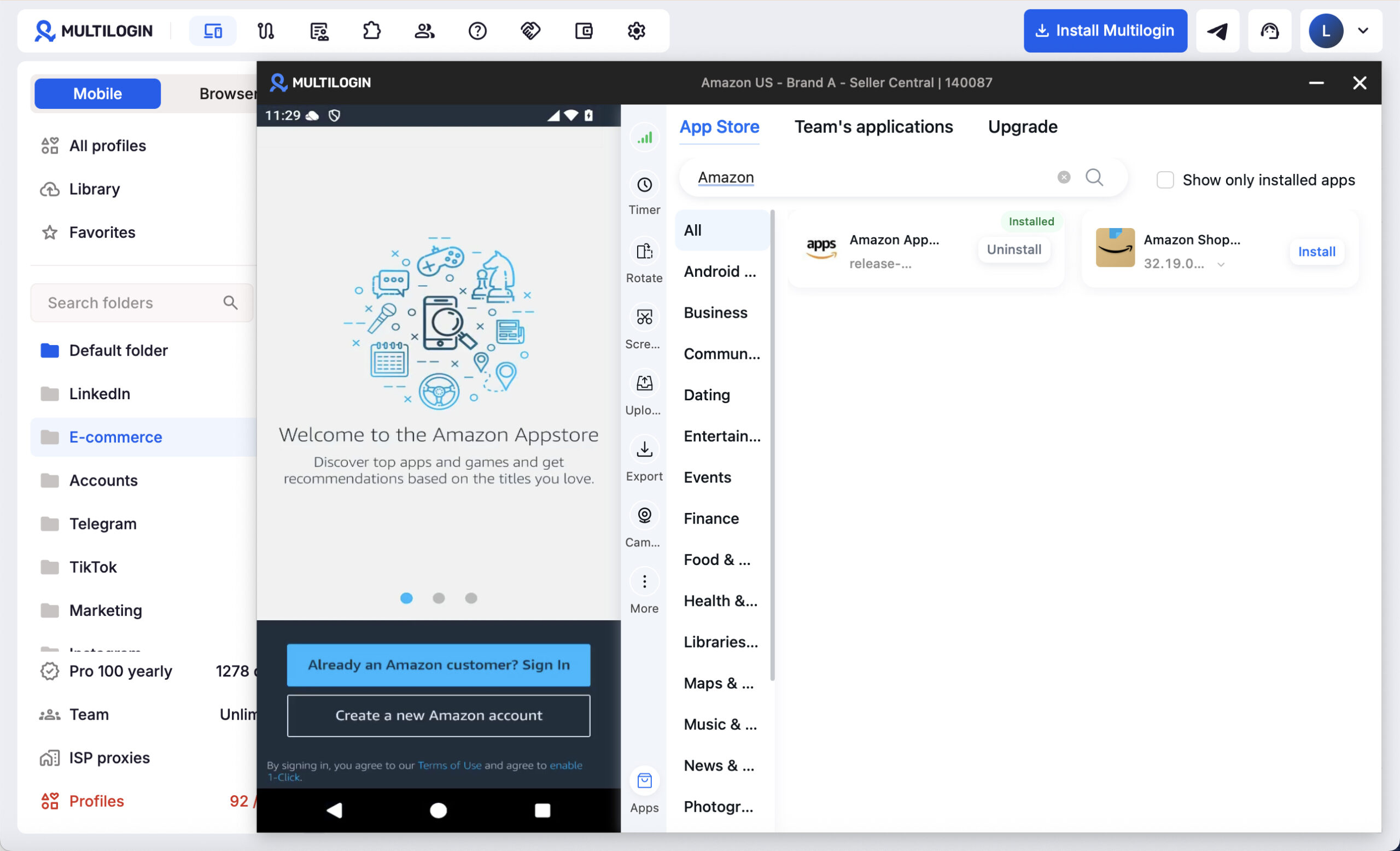
Start the browser profile or cloud phone and sign in to the Amazon account.
Use the account’s normal verification method. Before moving an existing workflow, confirm that the responsible operator can access:
- The registered email address
- The accepted phone number
- Two-step verification
- Recovery codes
- Seller Central account-health notifications
If several employees manage the business, add them through Seller Central User Permissions instead of sharing the primary login.
If you plan to use the Amazon Seller app on a cloud phone, test the app with the selected Android version and required region before expanding the setup.
Step 6: Test Continuity and Team Access
Stop the workspace and reopen it to confirm that the required session and data remain available.
For browser profiles, choose cloud storage if team members need to resume the workspace from another computer. Assign each workspace only to the people responsible for that business or task.
For cloud phones, stop the phone after completing the mobile work so it does not continue consuming mobile minutes.
Review actual mobile-minute and proxy-traffic usage during the test. This will help you select the Multilogin plan before expanding the workflow.
Common Mistakes When Managing Multiple Amazon Accounts
Opening an account without a legitimate business need
Operational convenience alone may not justify another Seller Central account. Check whether marketplace switching, user permissions, or another existing Amazon feature already solves the problem.
Treating every country as a separate seller account
Amazon’s regional structures can cover several marketplaces. Review your Global Selling setup before registering another independent account.
Sharing the primary seller login
Use Seller Central User Permissions for employees, contractors, and agencies. This creates clearer responsibility and makes access easier to remove when someone leaves the team.
Using inaccurate business information
Account information should reflect the real business structure. Do not change addresses, payment information, company details, or ownership information simply to make related businesses appear unrelated.
Treating software as a substitute for compliance
Cloud phones and browser profiles organize mobile and web workspaces. They do not create a legitimate business need or prevent Amazon from applying its policies.
Ignoring problems in another related account
A policy issue in one seller account may affect other related accounts. Monitor Account Health and resolve warnings or deactivations promptly.
Build an Amazon Setup Around Your Real Business Structure
The right setup begins with the business, not the software. Confirm which Amazon accounts you are authorized to operate, whether another seller account is necessary, and who needs access to each workflow.
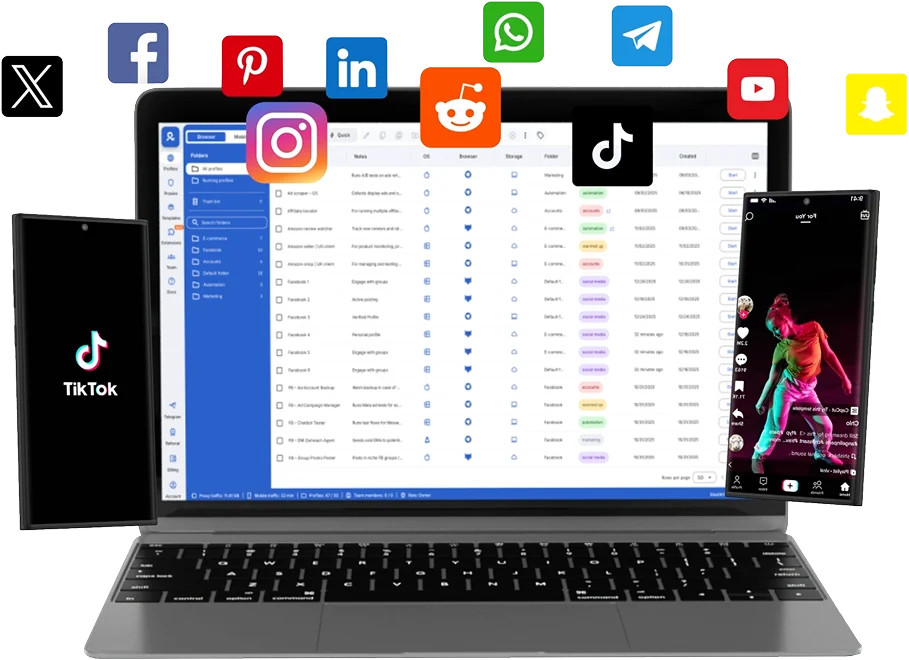
Multilogin brings cloud Android phones, browser profiles, built-in proxies, and team access into one platform. Use a cloud phone for mobile tasks and a browser profile for Seller Central, then organize both from the same dashboard.
Multilogin offers a free plan with no time limit and no credit card needed. Paid plans start from $7.08 per month. Start free today!
Manage multiple accounts with Android cloud phones
Build account trust, reach new locations, and grow faster from one dashboard
Frequently Asked Questions About Multiple Amazon Accounts
Can I Have Multiple Amazon Accounts?
Yes, but Amazon only allows one personal account per individual. For business purposes, sellers can have multiple accounts if necessary, with explicit approval from Amazon.
Can I Share Amazon Accounts?
Yes, Amazon Household allows two adults to share Prime benefits while keeping their purchase histories separate.
How Does Amazon Detect Multiple Accounts?
Amazon tracks multiple factors, including IP addresses, device usage, and payment details, to detect users managing multiple accounts.
Is It Legal to Have Multiple Amazon Accounts?
Yes, it’s legal, but Amazon’s terms of service prohibit individuals from having more than one personal account. Multiple seller accounts are allowed under specific circumstances.
Can Amazon Ban Me for Multiple Accounts?
Yes, if you create multiple accounts in violation of Amazon’s policies, Amazon can suspend or ban your accounts.
How to Get Permission for Multiple Amazon Seller Accounts?
You must request Amazon’s permission by proving the business need for more than one account, such as managing distinct product lines or brands.
Do I need Amazon’s approval for a second seller account?
Amazon generally no longer requires prior approval when a seller has a legitimate business need and all existing accounts are in good standing. Sellers should still document the business purpose and comply with the Seller Code of Conduct.
Can I have separate personal and Amazon Business accounts?
Yes. Amazon supports separate personal and Amazon Business accounts and provides account-linking and switching features for eligible users.
Does selling in another country require another seller account?
Not always. Amazon Global Selling and regional marketplace structures may allow you to manage several stores through an existing regional setup. Check the marketplace selector in Seller Central first.
Can two people manage the same Seller Central account?
Yes. The account owner can add authorized users and control their permissions through Seller Central User Permissions. Team members should not share the primary account password.
Should I use a cloud phone or a browser profile for Amazon?
Use a cloud phone when the workflow requires an Android app or mobile storefront. Use a browser profile for Seller Central, desktop research, reports, listing management, and other web-based work.
Can Multilogin prevent an Amazon account from being deactivated?
No. Multilogin provides cloud Android phones, browser profiles, built-in proxies, and team-management tools for organizing authorized account workflows. Amazon still evaluates business information, account history, activity, verification, performance, and policy compliance.
What happens if one related seller account is deactivated?
Other related accounts may also be affected. Review the Account Health notifications, identify the original account and policy issue, and follow Amazon’s appeal or reinstatement process. The original account may need to be reinstated before related accounts can return to normal operation.
Final Thoughts
Managing multiple Amazon accounts can be beneficial for sellers, businesses, and families, but it requires careful adherence to Amazon’s policies.
Tools like Multilogin make it easier to manage multiple accounts safely by creating unique cloud phones & browser environments, protecting your accounts from being flagged.
Whether you’re looking to separate personal and business activities or manage multiple brands, following Amazon’s guidelines will help you avoid account suspension and ensure smooth operations.
 Join 4,200+ subscribers