





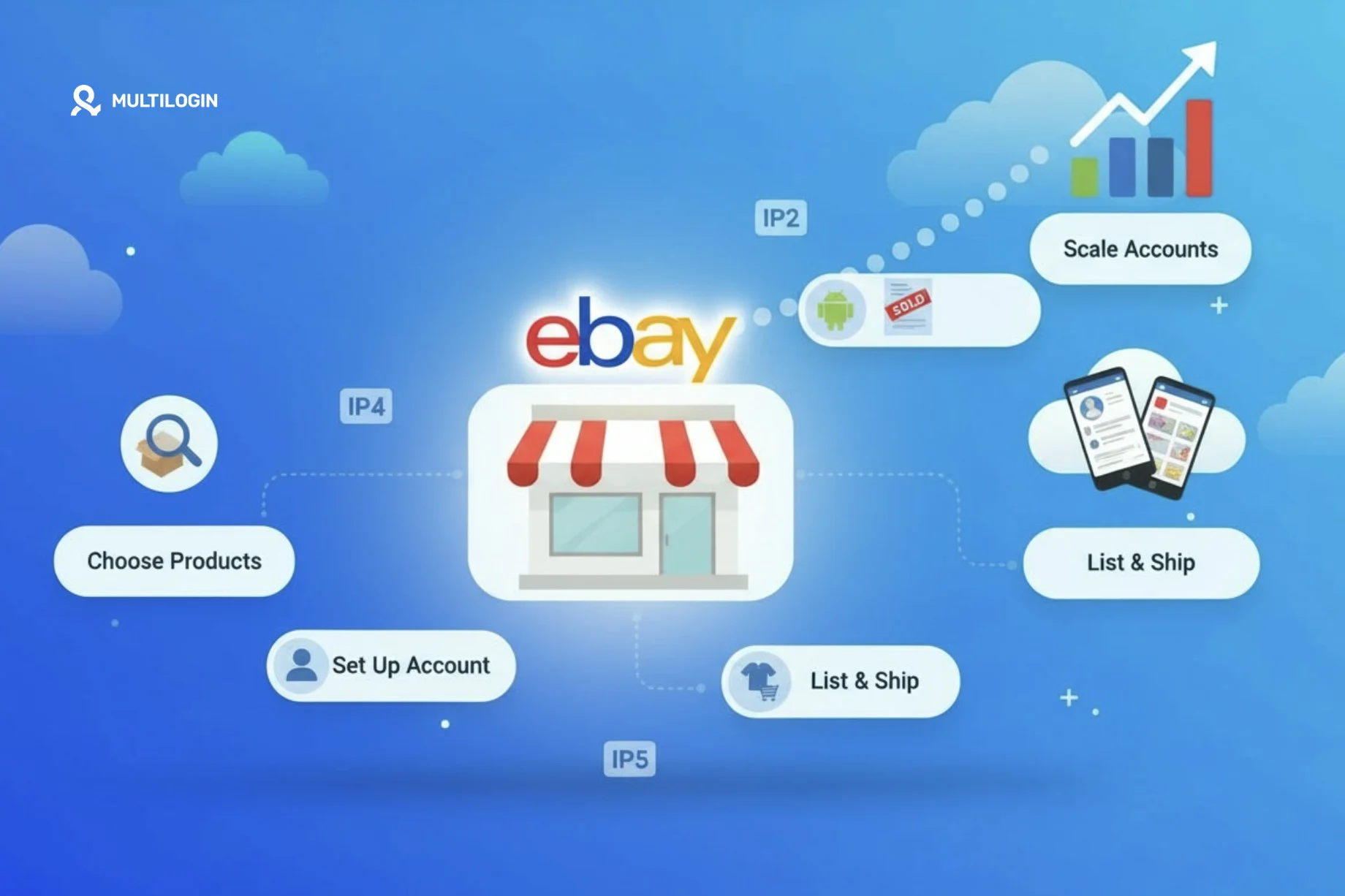

To start an eBay business, you need four things in place: a product you can source at a margin, a seller account that matches how you are registered (personal or business), a verified bank account for payouts, and listing prices that already account for eBay’s fees. Registration is the easy part. The real work is picking products and keeping your seller performance clean from the first order.
This guide walks you through the setup step by step, from account type and verification to listings, shipping and selling limits. You will also see what it costs to sell on eBay.com in 2026, when an eBay Store subscription pays off, and how to run more than one seller account within eBay’s rules.
That last part matters once you grow. Many sellers end up with separate accounts for different product lines, clients or markets. Multilogin is a cloud Android phone platform for multi-account management: each eBay seller account runs on its own real Android device in the cloud, with separate app data, location and IP. Browser profiles cover web tasks such as Seller Hub, and residential proxies and mobile minutes are included in every plan.
Set up your free cloud phone and run your first eBay seller account on it from day one.
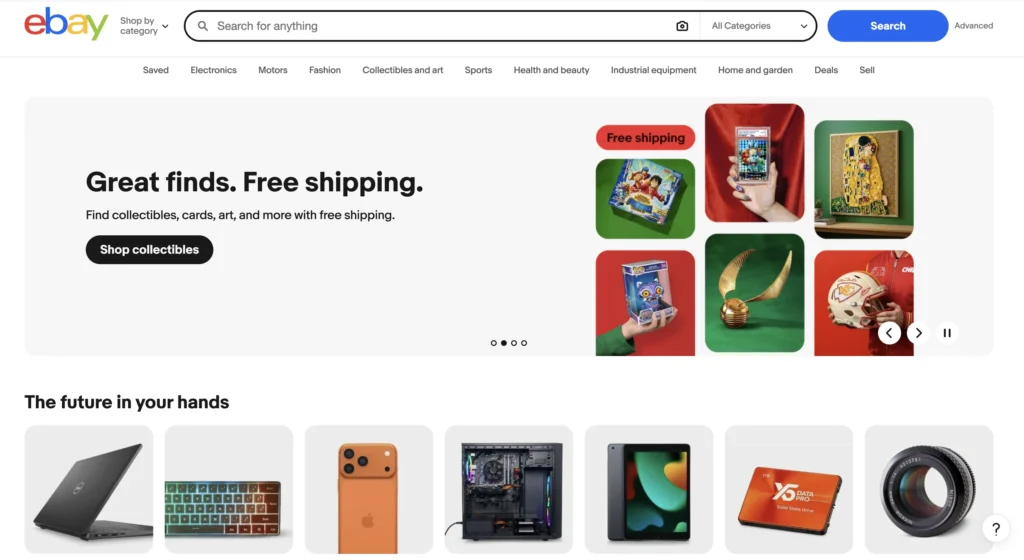
What you need before you start an eBay business
You need a unique email address, identity details, a bank account in the same name as your eBay account, and a phone number that can receive verification codes. Have these ready before you register so verification does not stall your first listings.
| Requirement | Why eBay needs it | Practical tip |
|---|---|---|
| Email address | Each eBay account is registered to its own email | Use a dedicated business inbox, not your personal one |
| Account type (personal or business) | Decides which details eBay verifies and how you appear to buyers | Pick business if you resell sourced stock or already trade as a company |
| Identity details | eBay confirms who you are when you register as a seller | Individuals usually provide full name, address and date of birth; businesses add the legal business name |
| Bank account for payouts | eBay pays out sales to a verified account | The name on the bank account must match the eBay account name, and a business eBay account needs a business bank account |
| Payment method for fees | Covers fees eBay can’t deduct from sales | A card on file avoids blocked listings when payouts are low |
| Phone number | Used for account and security verification | Keep a number you control long-term; changing it later adds friction |
| Products and a sourcing plan | Selling limits and fees make low-margin stock hard to scale | Test a small batch before buying in bulk |
| Shipping setup | Late or untracked shipments hurt your seller level | Price packaging and postage into every listing |
Choose your eBay business model
Most eBay businesses fit one of four models: reselling, wholesale, private label or dropshipping. The model decides how much cash you need upfront, how much control you have over shipping, and which eBay rules you need to watch.
| Model | How it works | Upfront cost | Main risk on eBay |
|---|---|---|---|
| Reselling (thrift, clearance, used goods) | Buy single items cheaply, list and ship them yourself | Low | Time per listing: each item needs its own photos and description |
| Wholesale | Buy branded stock in bulk from a distributor | Medium to high | Price competition and brand rights on listings |
| Private label | Sell your own branded product made by a manufacturer | High | Building demand for a brand buyers don’t know yet |
| Dropshipping | A wholesale supplier ships orders directly to your buyers | Low | You stay responsible for delivery times and returns you don’t control |
Dropshipping has a specific rule. eBay allows it only when orders are fulfilled directly by a wholesale supplier. Buying the item from another retailer or marketplace and having it shipped to your buyer is not allowed (eBay drop shipping policy). Whichever supplier ships, late deliveries still count against your seller level.
If you are unsure, reselling is the cheapest way to learn what sells in your category. Many sellers move to wholesale or private label once they know their margins.
How to start an eBay business: 7 steps
Starting an eBay business follows seven steps: choose products, pick an account type, register and verify, set business policies, list, ship on time, and grow within your selling limits. Each step below explains what to do and where new sellers usually slip.
Step 1: Choose what you will sell
Pick products by what has already sold, not by what is listed. On eBay, filter search results by Sold items to see real sale prices and how often an item moves. Terapeak product research in Seller Hub adds average sold price, shipping cost and sell-through over a longer period.
A simple test is the sell-through rate: sold listings divided by sold plus active listings over the same period. If 60 units sold and 140 are still active, sell-through is 30%. A low rate means many sellers compete for few buyers, so you will need a better price or a better listing to move stock.
Also check the payout, not just the sale price. An item that sells for $20 with $6 of postage leaves little room once fees and product cost come out.
Before you buy stock, check two things:
- Restricted and prohibited items. Some categories need approval or are banned outright.
- Brand rights. Rights owners in eBay’s VeRO program can have listings removed if you misuse their trademarks in titles or photos.
Step 2: Pick a personal or business account
Choose a business account if you sell in volume, resell items you bought or made for sale, or already run a business outside eBay. A personal account suits clearing out household items or testing a niche. You can switch a personal account to business later under Account settings > Personal information > Account type.
Step 3: Register and verify as a seller
Go to My eBay > Selling to start seller registration. eBay confirms your identity, your bank account for payouts and, for business accounts, your business details. If eBay cannot verify your bank account automatically, it may ask you to confirm small test deposits.
Step 4: Set up business policies
Create shipping, payment and return policies once, then apply them to every listing. This keeps handling times and return windows consistent, which is what buyers and eBay’s performance metrics measure you on.
Step 5: Create your first listings
Write titles with the words buyers actually search, fill in every item specific, and state condition honestly. Item specifics such as brand, size and model feed eBay’s search filters, so a blank field can hide your listing from filtered searches. You can add up to 24 photos per listing at no extra cost.
Choose the listing format that fits the item:
| Format | Best for | What to know |
|---|---|---|
| Fixed price (Buy It Now) | Steady stock you can relist | Good ‘Til Cancelled listings renew every calendar month and each renewal counts toward your free listing allowance |
| Fixed price with Best Offer | Higher-priced items where buyers expect to negotiate | Set auto-accept and auto-decline prices so you don’t answer every offer by hand |
| Auction | Rare or collectible items where demand sets the price | A reserve price costs extra, even if the item doesn’t sell |
Source for fees: eBay selling fees.
Step 6: Ship on time and watch your seller level
eBay evaluates every seller on the 20th of each month and assigns one of three seller levels. Your level affects your fees, your visibility and, for Top Rated sellers, a badge buyers can see.
| Seller level | What it means | Effect |
|---|---|---|
| Top Rated | Well above eBay’s minimum standards, with an established sales history | Listings with same- or 1-business-day handling and 30-day free returns can earn Top Rated Plus, including a 10% final value fee discount |
| Above Standard | Meets eBay’s minimum standards | Standard fees |
| Below Standard | Falls below the minimums | +6% on final value fees, +7% after four consecutive months, and possible selling restrictions |
Two metrics decide whether you drop to Below Standard: a transaction defect rate above 2%, and cases closed without seller resolution above 2 or 0.3% of transactions, whichever is higher. Late shipments alone will not make you Below Standard, but you need a low late shipment rate to reach Top Rated.
In practice: upload tracking from an integrated carrier, ship within your stated handling time, and solve problems before a buyer opens a case. Out-of-stock cancellations count as defects, so keep inventory accurate.
Step 7: Grow within your selling limits
Every new eBay seller starts with selling limits on the number of items and total value they can list. Limits depend on account age, identity confirmation and whether the account is linked to an established one. As your sales and metrics stay strong, eBay raises them, and you can request an increase from Seller Hub.
Do not open a new account to get around a limit. eBay prohibits registering accounts to avoid selling limits or restrictions, and doing so can lead to all of your accounts being suspended.
How much it costs to sell on eBay
On eBay.com, most sellers pay two fees: an insertion fee once they pass 250 free listings a month, and a final value fee of 13.6% plus a per-order fee when an item sells. Everything else depends on your category, upgrades, buyer location and seller performance.
| Fee | Amount (eBay.com, no Store, most categories) | When it applies |
|---|---|---|
| Insertion fee | First 250 listings per month free, then $0.35 per listing | Each new listing or renewal past the free allowance |
| Final value fee | 13.6% of the total sale up to $7,500, then 2.35% on the portion above | When the item sells. The total includes item price, shipping charged and sales tax |
| Per-order fee | $0.30 for orders of $10 or less, $0.40 above $10 | Every order |
| International fee | 1.65% of the total sale | US-registered sellers whose buyer or delivery address is outside the US, unless they use eBay International Shipping |
| Promoted Listings (optional) | General strategy: an ad rate from 2% to 100% of the total sale, charged only if the item sells within 30 days of an ad click. Priority strategy: cost per click | Only on listings you promote |
| Optional upgrades | For example, Bold costs $4 on a fixed price listing | Only if you add them |
| Below Standard surcharge | +6% on final value fees, +7% after four months | Accounts rated Below Standard |
| Dispute fee | $20 per dispute | When you are found responsible, for example in a chargeback |
Source: eBay selling fees, checked 25 November 2026. Some categories use different rates: Books & Magazines is 15.3% and Guitars & Basses is 6.7%, for example.
Worked example. You sell an item and the buyer pays $50 in total, including shipping and tax. You are still within your 250 free listings, so there is no insertion fee. The final value fee is 13.6% of $50 ($6.80) plus $0.40, so eBay keeps $7.20 and pays out $42.80. Product cost and postage still come out of that payout, so set prices from this number, not the sale price.
Add Promoted Listings to the math. If you promote the same item with a general strategy at a 5% ad rate and the sale comes from an ad click, eBay charges another $2.50 on that $50 sale. Your payout drops to $40.30 (eBay Promoted Listings).
A simple pricing check. Before you list, add up product cost, packaging, postage, final value fee, per-order fee and any ad rate. If the total is more than about 70–75% of your planned sale price, you are left with little margin for returns and refunds, so raise the price or drop the product.
Selling from outside the US? Fees follow the eBay site you list on and your registered country. Sellers based in Vietnam and several other Asian markets have their final value fee on shipping calculated on the option the buyer picks when the item is not in the US. Check eBay’s fee page for your country before you set prices.
Do you need an eBay Store subscription?
You do not need an eBay Store to start an eBay business. A Store starts paying off when you list more than 250 items a month or sell enough that a lower final value fee covers the subscription.
| Store tier | Monthly renewal | Yearly renewal (per month) | Free fixed price listings per month | Insertion fee after allowance |
|---|---|---|---|---|
| No Store | $0 | $0 | 250 | $0.35 |
| Starter | $7.95 | $4.95 | 250 | $0.30 |
| Basic | $27.95 | $21.95 | 1,000 (all categories) | $0.25 |
| Premium | $74.95 | $59.95 | 10,000 (all categories) | $0.10 |
| Anchor | $349.95 | $299.95 | 25,000 (all categories) | $0.05 |
| Enterprise | Not available | $2,999.95 | 100,000 (all categories) | $0.05 |
Source: eBay Store selling fees, checked 25 November 2026.
Starter keeps the standard 13.6% final value fee in most categories, so it mainly adds Store tools rather than savings. From Basic up, the rate in most categories drops to 12.7%, and to 9.35% in most Consumer Electronics categories.
Quick break-even check for Basic (yearly renewal):
- Final value fee saving. In a category that drops from 13.6% to 12.7%, you save 0.9% of sales. That covers the $21.95 monthly fee at roughly $2,440 in monthly sales.
- Listing saving. At 600 fixed price listings a month without a Store, you pay for 350 of them: 350 × $0.35 = $122.50. Basic covers all 600 for free.
If either number fits your plan, Basic is usually worth it. If neither does, sell without a Store until your volume grows.
How to scale to more than one eBay seller account
eBay allows more than one account, for example separate accounts for buying and selling or for different product lines. Every account must meet eBay’s buyer and seller standards on its own, and you cannot open accounts to avoid fees, selling limits or restrictions. You also cannot use one account to bid on another account’s listings.
How to structure several eBay seller accounts
A second account works best when it has a clear reason to exist. Use this checklist before you open one:
- One purpose per account. A separate product line, client or market. This is also the reason eBay’s policy recognises.
- Its own email address. eBay registers each account to a unique email.
- Its own business policies. Shipping, payment and return policies per account keep promises consistent for each store’s buyers.
- Its own performance tracking. Seller levels are evaluated per account and per region, so one account can be Top Rated while another is only Above Standard.
- A plan for selling limits. A new account starts with its own limits. Factors include account age, identity confirmation and a link to an established account.
The harder part is running those accounts day to day. On one phone or laptop, you log in and out constantly, app data mixes between stores, and every account shows the same location. For a broader overview of the options, see our guide to multi-account management. The next section covers how Multilogin handles it.
How Multilogin helps you run multiple eBay seller accounts
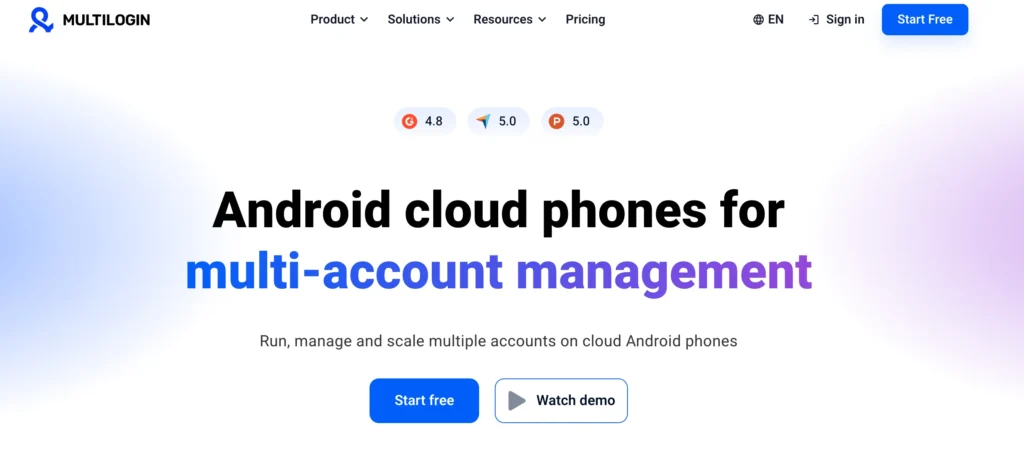
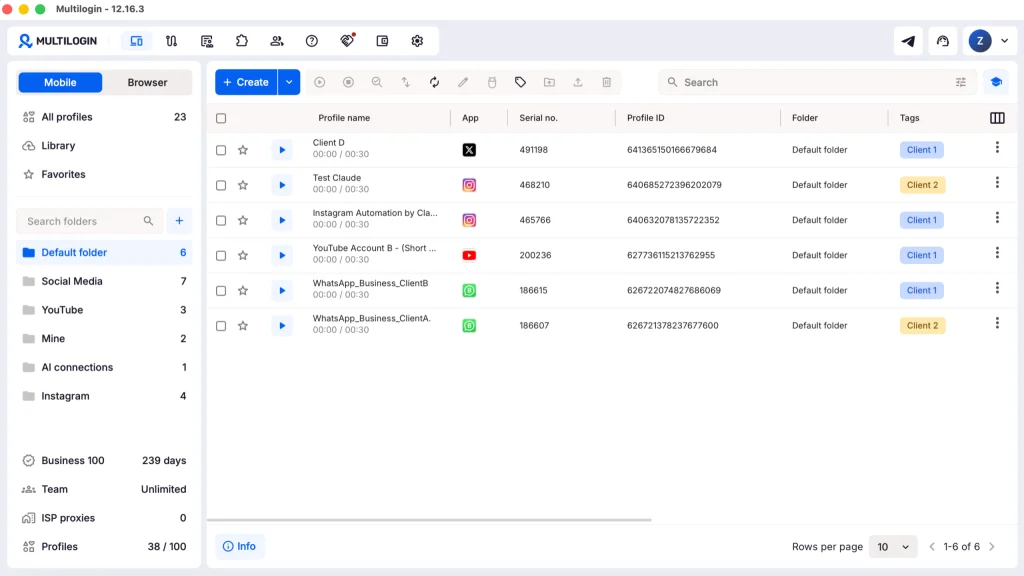
Multilogin is a cloud Android phone platform for multi-account management. Each eBay seller account runs on its own Multilogin cloud phone, a real Android device in the cloud with separate app data, location and IP. Browser profiles handle web tasks such as Seller Hub from the same dashboard, and residential proxies and mobile minutes are included in every plan.
See how it works on the cloud phone for eBay page.
Which eBay tasks run where
Most sellers split work between the eBay app and Seller Hub on the web. Multilogin covers both, so each account keeps the same location across mobile and web.
| Task | Where it runs best | Multilogin layer |
|---|---|---|
| Answering buyer messages and offers | eBay app | Cloud phone for that account |
| Photographing items and quick listings | eBay app | Cloud phone (camera and screen mirroring available) |
| Checking orders and printing labels on the go | eBay app | Cloud phone |
| Bulk listing, CSV uploads and reports | Seller Hub on the web | Browser profile for that account |
| Store design, promotions and advertising dashboard | Seller Hub on the web | Browser profile |
How to set it up
- Create one Multilogin cloud phone per eBay account. Pick from 30+ real Android device types across 12 brands and choose the Android version per profile.
- Assign a location. Built-in residential proxies give each cloud phone its own IP and matched geolocation. Each phone can run on Cellular or Wi-Fi, and you can connect third-party HTTP, HTTPS, ISP or SOCKS5 proxies instead.
- Install the eBay app. Install it from the built-in store or upload an APK. App data and login history stay on the cloud phone between sessions, so each store opens already signed in.
- Add a browser profile for Seller Hub. Each browser profile has its own cookies, session and IP. Sync its location with the account’s cloud phone so mobile and web match.
- Bring in your team. Team seats and permissions let you share or assign profiles without sharing passwords, and custom columns, colour tags and notes keep stores organised.
- Automate when you are ready. Multilogin offers an API and full ADB access, and works with Selenium, Puppeteer, Playwright and Postman.
What one subscription covers
Multilogin is the only platform that includes cloud phones, browser profiles, residential proxies and mobile minutes in all plans. There is no per-device rental and no separate proxy bill. Extra mobile minutes start from $0.0084 per minute, and extra proxy traffic from $2.275 per GB in bulk. Unused minutes and traffic roll over.
Limits to plan for
- Verification codes. Multilogin cloud phones cannot receive SMS or calls. If eBay asks for a code, use your own phone or an external SMS provider and enter the code in the app on the cloud phone.
- Connection. Cloud phones need a reliable internet connection. A slow connection affects how smoothly they run.
- Setup time. The first setup can take a while. The Learning Center videos help.
- Content still matters. Separate cloud phones do not fix duplicate or copied listings. eBay’s listing rules apply to what you post, whatever device you use.
Pricing
Multilogin offers a free plan with no time limit and no credit card needed. Paid plans start from $7.08 per month. The Pro 10 plan includes 10 cloud and browser profiles, 1 GB of premium proxy traffic, 60 mobile minutes per month, API access and a team seat. On the Free plan, profiles are deleted after 7 days of inactivity, and proxy traffic and mobile minutes do not renew each month. Compare plans on the pricing page.
Common mistakes when starting an eBay business
Most early problems on eBay come from pricing without fees, slow shipping and account setup shortcuts. Avoid these six:
- Pricing from the sale price, not the payout. A 13.6% fee plus $0.40 per order turns thin margins negative. Work back from what eBay pays out.
- Mismatched names. If the name on your bank account differs from your eBay account, payouts can be blocked during verification.
- Buying stock before checking sold listings. Active listings show what sellers hope for. Sold listings show what buyers paid.
- Promising a handling time you cannot keep. Late shipments pull your seller level down, and a Below Standard rating adds 6% to your fees.
- Using brand names you have no right to. Rights owners can have listings removed through eBay’s VeRO program.
- Opening a second account to get around a limit. This breaks eBay’s multiple accounts policy. Open extra accounts only for a real business purpose, such as a separate product line.
Conclusion
To start an eBay business, pick products from sold data, register the account type that matches your bank account, set your business policies, and price every listing from the payout after fees. Then protect your seller level with on-time shipping, and let your selling limits grow with your track record.
Once one account is running well, the next step is often a second account for a new product line, client or market. Keep each account to a clear purpose, meet eBay’s standards on every one, and give each its own environment. A Multilogin cloud phone per account runs the eBay app on a real Android device, while browser profiles handle Seller Hub work from the same dashboard. Plan for verification codes on a separate number, because cloud phones cannot receive SMS.
Start free, no credit card, and run each of your eBay seller accounts on its own Multilogin cloud phone as your business grows.
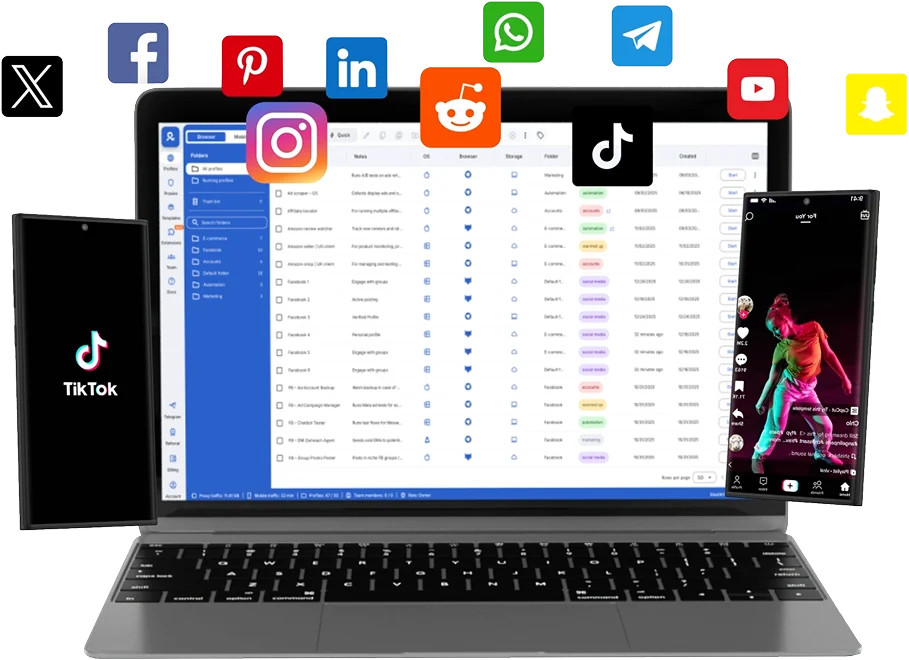
Run Unlimited Accounts Without Bans
Run your social media accounts on cloud phones & web browsers
Frequently asked questions
How much does it cost to start an eBay business?
Opening an eBay account is free, and eBay.com gives every seller 250 free listings a month. When an item sells, most categories cost 13.6% of the total sale plus $0.30 or $0.40 per order. An eBay Store is optional and starts at $4.95 per month on yearly renewal.
Do I need a business account to sell on eBay?
You can start with a personal account, but eBay expects a business account if you sell in volume, resell sourced stock or already run a business. You can switch from personal to business later in your account settings. Your bank account type should match your eBay account type.
Can I start an eBay business from outside the US?
Yes. eBay accepts sellers registered in many countries, including Vietnam. Fees, payouts and some shipping rules follow your registered country and the eBay site you list on, so check eBay’s fee page for your country before pricing.
<strong>Can a proxy stop my eBay account from being suspended?</strong>
No. A proxy only changes the IP address an account connects from. eBay judges accounts on how they sell, including listing quality, shipping, buyer messages and policy compliance, so no proxy can promise an account won’t be limited or suspended.
Can I have more than one eBay seller account?
Yes. eBay allows multiple accounts for valid reasons, such as separating buying from selling or running different product lines. Each account must meet eBay’s standards, and opening accounts to avoid fees, limits or restrictions is not allowed.
Can I use the eBay app on a Multilogin cloud phone?
Yes. Install the eBay app from the built-in store or upload an APK, and your app data and login history stay on that cloud phone between sessions. Multilogin cloud phones cannot receive SMS or calls, so use your own phone or an external SMS provider for verification codes.
Does Multilogin have a free plan?
Yes. Multilogin offers a free plan with 5 profiles, no time limit and no credit card needed. Proxy traffic and mobile minutes on the Free plan are one-time, and paid plans start from $7.08 per month.
Is dropshipping allowed on eBay?
Yes, if a wholesale supplier ships the order directly to your buyer. Buying the item from another retailer or marketplace and having them ship it to your buyer is not allowed. You remain responsible for delivery times, returns and buyer satisfaction.
How long does it take to become a Top Rated seller?
Your account must be active for at least 90 days, with an established sales history and performance well above eBay’s minimum standards. eBay checks your performance on the 20th of each month and upgrades qualifying sellers on the 1st of the following month.
Should I promote my listings from day one?
Not necessarily. Start by getting titles, item specifics and photos right, then test Promoted Listings on a few items with a general strategy, where you pay only when a promoted item sells. Count the ad rate in your pricing so a promoted sale is still profitable.
 Join 4,200+ subscribers