


Most TikTok content advice tells you to post more, jump on trends faster, and use trending sounds. None of that is wrong. None of it is the actual reason some accounts grow and others stall.
What separates TikTok accounts that consistently get views from those that don’t is format selection. The right format creates natural watch-through, drives saves and shares, and gives the algorithm a clear signal to expand distribution. The wrong format, even with great content inside it, loses viewers in the first three seconds and never makes it past the initial test pool.
This guide covers 20 TikTok content ideas that are actually working in 2026, organised by the job each format does for the algorithm. It also covers how the TikTok algorithm actually distributes content in 2026, so you understand why each format works rather than just copying it. And for agencies and creators managing multiple TikTok accounts, the final section covers the account infrastructure that keeps those profiles safe.
How the TikTok algorithm distributes content in 2026
Before the formats: a clear picture of what TikTok actually rewards, because it has changed significantly since 2023 and 2024.
The TikTok algorithm in 2026 ranks content based on three weighted signal groups: engagement signals including likes, comments, shares, and saves at around 40% weight; content signals including captions, hashtags, sounds, and video information at around 35% weight; and user signals including watch history, device settings, and account preferences at around 25% weight.
The distribution process works in expanding batches. When you publish a video, TikTok shows it to a small initial audience of 200 to 500 users.
If that batch engages strongly, watches to completion, replays, comments, and shares, the algorithm pushes it to a larger group. This process repeats in expanding waves, and each wave has an engagement threshold the video needs to clear.
The most important shift in 2026: TikTok’s 2026 algorithm update significantly elevated the weight of save signals relative to previous years.
This change reflects TikTok’s push toward being a search and reference platform rather than purely an entertainment feed. Content formats that drive saves — tutorials, checklists, step-by-step guides, and comparison content — now have a structural distribution advantage they did not have in 2024 and 2025.
Three signals now dominate distribution decisions: rewatch and loop rate, completion rate, and shares with meaningful comments. Metadata helps with search but is weaker for initial distribution experiments. Followers matter less than the engagement your clip earns.
With that model in mind, here are the 20 formats that are structurally built to perform well against those signals.
Formats that drive saves: the highest-leverage signal in 2026
Saves are now the signal most closely associated with distribution expansion. Any format where a viewer thinks “I want to come back to this” before the video ends is a save-generating format. These five are the strongest.
1. The specific tutorial
Educational content is one of the most durable formats on TikTok. It works because it delivers immediate, tangible value. Teach your audience one specific thing. The more specific the topic, the higher your completion rate, because viewers stay to get the answer.
The key word is specific. “How to grow on TikTok” does not get saves. “How to write a TikTok hook that keeps people watching past three seconds” does, because the viewer can use it immediately. One skill, one video, one clear outcome. Keep it under 60 seconds where possible. Show the result first, then explain how to get there.
This format suits every niche: finance, fitness, cooking, marketing, design, skincare, business. The topic changes, the structure does not. For agencies managing business accounts, this is the single highest-ROI format to build into a content calendar.
2. Step-by-step process video
Process videos show how something is done from start to finish. They work because the numbered structure creates a natural retention loop: viewers stay to see whether step four or step seven is the one they are missing. They also drive saves because people want to follow the process later.
Structure: open with the finished result or outcome, state the number of steps upfront (“here are the five steps I use every time”), then move through each step with on-screen text labelling each one. End with a result visual. The numbered structure also works well for TikTok search, since it matches how people phrase queries: “how do I” and “steps to” are among the most common search formats on the platform.
3. Resource or tool roundup
“Five tools I use every day as a social media manager.” “Three apps that changed how I edit videos.” “The four Chrome extensions every freelancer needs.” These perform because they are inherently saveable: viewers save them to come back and try each tool.
Keep the list tight. Three to seven items works better than ten or fifteen because the format stays punchy and each item gets enough screen time to be convincing. On-screen text matters here: each tool or resource name should appear clearly on screen so viewers can pause and note it down. That pause behaviour also contributes to average watch duration, which is a positive signal for distribution.
4. Checklist or framework video
Checklists give viewers something concrete to act on. “The social media audit checklist I use for every new client.” “Seven things to check before you post on TikTok.” The format works because the list structure holds attention (viewers stay to compare what they already do against what they are hearing) and because it drives saves for future reference.
Use on-screen text for each checklist item. Voiceover moves faster than most people can read, so showing the text gives viewers a reason to pause and a reason to save. For the social media management niche specifically, checklist videos consistently produce strong save rates.
5. Before and after
Before and after works across every niche that involves transformation: fitness, design, copywriting, home organisation, content strategy, brand building. The format creates natural curiosity and watch-through because the viewer needs to see the after to resolve the tension the before creates.
The structure is simple: show the before state briefly, create a visual transition, show the after, and then explain what changed. For business and marketing accounts, this works well as a content critique format: show a weak piece of content, then show the improved version, and explain the specific change that made the difference.
Formats that drive rewatches and loop rate
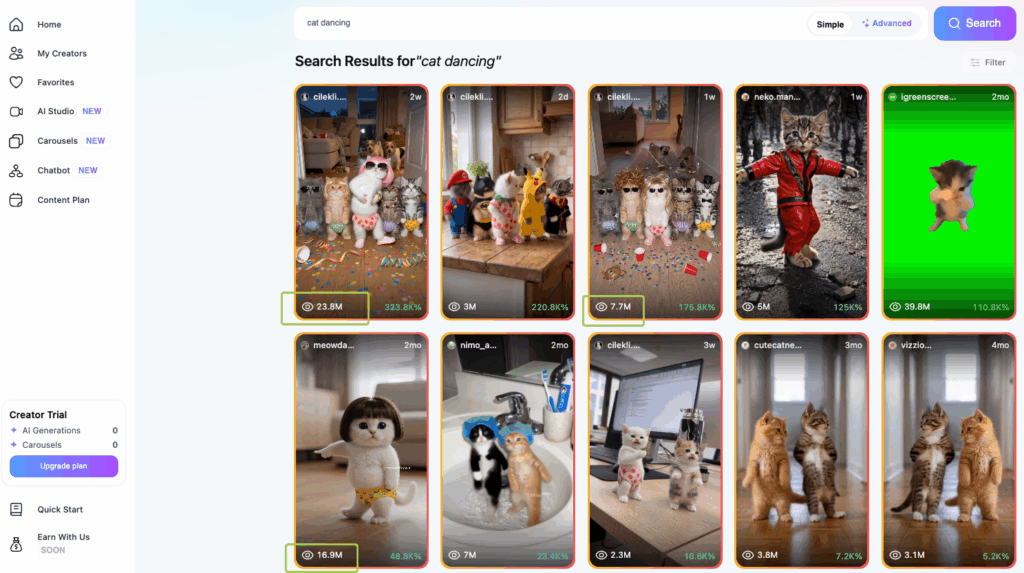
Loop rate is the most distinctive TikTok signal. TikTok counts each loop. Looping content is the cheat code that nothing else replicates. These formats are built to make people watch again.
6. The seamless loop
A seamless loop is a video where the last frame connects directly back to the first, so the video appears to play continuously without a visible end. When done well, viewers watch multiple times before they realise the video has repeated. Every rewatch counts as a loop in TikTok’s tracking, which makes this format disproportionately powerful for distribution.
Seamless loops work best for process videos, satisfying physical or visual content, and any content that shows a cycle or pattern. They require slightly more editing effort but the distribution reward is significant. Short videos (under 20 seconds) are easiest to loop naturally.
7. Dense information delivery
Videos that pack a genuinely high density of useful information into 30 to 60 seconds drive rewatches because viewers feel like they missed something. “Wait, what was the second one?” is the internal monologue you are trying to create. This requires the information to be genuinely useful and the pacing to be fast enough that one pass does not feel complete.
The structure: tight scripting with no padding, on-screen text that moves faster than the voiceover, and content where each item genuinely builds on or contrasts with the previous one. Finance, marketing tips, and productivity content work well in this format. So does any niche where the target audience is actively trying to learn.
8. The visual reveal or transformation
Any video built around a visual reveal creates a natural rewatch impulse: the first watch is about anticipation and the reveal, the second watch is about looking at what you missed the first time. Product reveals, room transformations, design process videos, food preparation, and any tactile physical process all suit this format.
Unboxing or first look content lets the visual reveal do the work. The same texture and sound principle that works for food content applies to anything tactile: makeup, packaging, prints, tech, fabric.
Formats that drive shares and comments
Shares to DMs are weighted around three times more than likes in TikTok’s algorithm. Comments with depth (two or more sentences) outperform emoji comments. These formats are built to generate both.
9. Hot take or unpopular opinion
Stake out a clear position on something your audience cares about and back it up in under 60 seconds. The format pulls comments on its own because people show up to agree, disagree, or share their own version.
The key is genuine conviction. A tepid “some people think X but it’s complicated” is not an unpopular opinion. A clear “X is actually worse for your growth than most people admit, and here’s why” is. The goal is to say something specific enough that people with a view on the topic feel compelled to respond. This format also drives shares to DMs because viewers send it to people they know will have a reaction.
For business accounts, this is one of the most powerful ways to build a recognisable point of view. Agencies managing client accounts should be careful here: the brand needs to actually own the opinion for it to land. Generic controversy does not produce the same result as a genuine, considered position.
10. The question that forces self-reflection
“Are you making this mistake on TikTok?” “Do you know the difference between reach and impressions?” “What’s your content pillar strategy?” Questions that make the viewer evaluate their own situation drive comments because people want to answer. They also drive shares because viewers send them to colleagues or friends who they think should see it.
Open with the question in the first two seconds, either spoken or as on-screen text. Then spend the rest of the video answering it in a way that rewards the viewer who stuck around. The question hook is one of the most reliable attention-holding openers across every niche.
11. Reaction and commentary
Reacting to trending content, news, or other creators’ videos remains one of the most accessible formats on TikTok. The barrier to entry is low, but the key to making it work is adding genuine value or a unique perspective rather than just reacting for the sake of it.
For business and brand accounts, reaction content works best when it responds to industry news, platform changes, or widely circulated pieces of content in the niche. The reaction gives the video a built-in context that viewers already have, which reduces the amount of scene-setting required and gets to the value faster. Comments are high on this format because viewers come in with their own reaction already formed and want to share it.
12. Duet and response content
Duets and Stitch videos create conversation between creators. For brand and business accounts, using Stitch to respond to a question someone asked in their own video is one of the most natural and high-trust content formats available. It demonstrates expertise without the format feeling promotional, and it creates a built-in community signal that the algorithm reads as positive engagement.
Stitch is particularly effective for answering common questions in your niche. Find videos where someone asks a question you can answer definitively, stitch it, and give a clear, specific answer. The question-and-answer structure holds attention and drives saves for future reference.
13. Ranking or tier list
Start with “here are X ranked from worst to best.” This sets the expectation that the best is at the end, which keeps viewers watching. Include at least one controversial ranking that drives comments. Use on-screen text and numbers so viewers can follow without audio.
Ranking content is inherently engaging because people have opinions about rankings. “Why did you put X at number two?” is a comment that writes itself. For business accounts, ranking tools, strategies, platforms, or approaches in your niche is a format that produces consistent engagement without requiring trending audio or production resources.
Formats built for TikTok search in 2026
Since so many users search TikTok directly, the words you put in your caption, on-screen text, and spoken audio help TikTok understand and surface your video. Write captions a human would actually search, name the topic plainly. These formats are specifically optimised for TikTok’s growing search behaviour.
14. The direct answer video
Someone types “how do I grow on TikTok without showing my face” into TikTok search. A video titled and spoken exactly as that question is answered ranks for that query. This format treats TikTok like a search engine, which is increasingly how younger audiences use it.
The structure: state the question in the first two seconds (spoken and on screen), answer it directly and completely, and end with a CTA to follow for more answers in the same topic area. Captions should include the exact phrasing someone would search, not a clever or cryptic version of it.
15. Day in the life
Lifestyle content that shows routines, processes, or behind-the-scenes moments performs well across nearly every niche. It works because it feels personal and invites comparison, which keeps viewers watching.
For creators and business accounts, day-in-the-life content builds parasocial connection while simultaneously demonstrating the tools, processes, and habits that define the account’s niche. A social media manager’s day in the life naturallyshows the tools they use, the decisions they make, and the challenges they navigate, all of which is useful content disguised as personal content. The format also performs well in TikTok search for “day in the life of [role or profession]” queries.
16. Myth-busting video
“You don’t need a big following to go viral on TikTok.” “Posting every day does not automatically grow your account.” “Going viral is not the same as growing.” Myth-busting content works because the viewer comes in with an existing belief and either has it confirmed or challenged. Both outcomes create engagement.
The format also performs well in search because people search for validation of their existing beliefs (“does posting every day on TikTok actually work”) and myth-busting content tends to match those queries while providing a more nuanced answer than the query assumes.
Formats for consistent account growth
These formats are not optimised for a single viral moment. They are optimised for building a consistent, growing audience over time.
17. Series content
Series formats improve returning viewers and session time. They also give you built-in next-video intent, which helps followers convert into consistent viewers. End with an open loop that is genuinely unresolved to pull viewers back for part two.
A series can be structured around a multi-part tutorial, a recurring review format, an ongoing challenge, or a sequential case study. The label “Part 1” in the first video sets the expectation that more is coming and gives viewers a reason to follow before the next video drops. For agencies managing client accounts that need a consistent content calendar, a well-structured series produces a reliable weekly posting rhythm without requiring a new creative concept for every video.
18. Trend participation with a niche twist
Trends provide pre-qualified viewer context: people already understand the setup, which increases average watch time. The winners use trends as containers and add a twist that makes the content uniquely theirs.
Copying a trend exactly is low-value. Adapting a trending format to your specific niche is high-value. A trending audio used in a cooking video works differently from the same audio used in a finance context, and the contrast between format and niche often generates comments and shares on its own. Check the TikTok analytics dashboard and TikTok’s Creative Center for trend identification before a format peaks.
19. POV or perspective video
POV content places the viewer inside a situation: “POV: you just got your first social media client” or “POV: you are a brand account manager at 9am on a Monday.” The format creates instant emotional identification and drives shares because viewers send it to people they know will recognise the situation.
For business and brand accounts, POV content is one of the most effective ways to speak directly to a target audience without it feeling like an ad. The format signals empathy and insider knowledge, both of which build audience trust faster than promotional content.
20. Faceless TikTok content
Faceless TikTok is growing significantly in 2026. Text-over-footage formats, voiceover-only videos, and screen-recorded walkthroughs all qualify as faceless content and perform well in niches where the information is more compelling than the presenter. For agencies managing multiple brand accounts where the creator is not available to appear on camera, faceless formats make consistent content production operationally realistic.
Stock footage, ambient video, or simple animations all work. This format scales exceptionally well with AI-powered video tools that handle text placement, timing, and background footage selection automatically. For social media management, marketing, finance, and any information-heavy niche, the voiceover-plus-screen-recording format is one of the highest-output, lowest-barrier options available. See when to post for maximum reach and how to go viral on TikTok for the distribution side.
How to use these formats in a content calendar
Twenty formats is too many to run simultaneously. The most effective approach is to pick three to five formats that match your niche and production capacity, run them consistently for four to six weeks, and use your analytics to identify which formats are producing the strongest completion rates and save rates. Then do more of those.
TikTok is more crowded in 2026, and the accounts winning at every size are the ones treating the platform like a system. Pick the formats that fit your niche, set a cadence you can keep, and use your analytics to decide what to do more of.
Buffer data shows posting three to five times a week is a sweet spot for most accounts. Consistency helps the algorithm learn your style, but quality still matters. Skip a day rather than rush out a weak video.
For the full planning framework, see how to plan social media content and the complete content calendar guide. For AI tools that accelerate content production across these formats, see the best AI tools for social media marketing.
Managing multiple TikTok accounts safely in 2026
For creators, agencies, and brands managing more than one TikTok account, account infrastructure is the operational foundation that everything else depends on. TikTok is a mobile-first platform that checks device sensor signals including hardware identifiers, accelerometer data, and tap timing patterns.
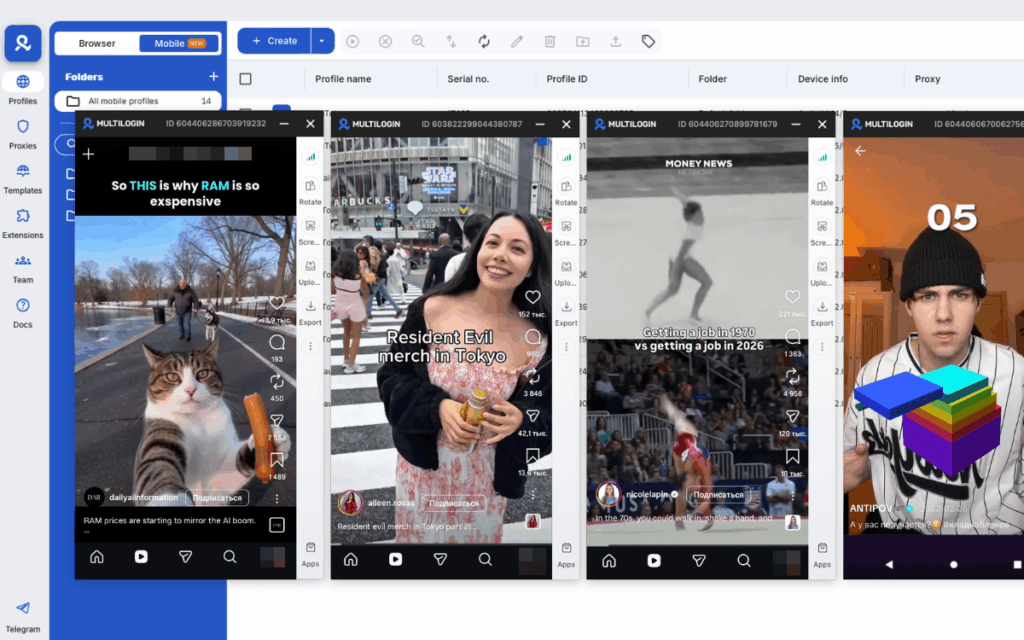
Managing multiple TikTok accounts from the same device or the same browser session creates the exact pattern the platform flags for suspicious multi-account activity.
Each TikTok account needs its own isolated device environment: its own real Android device with its own hardware identity, its own IP address, and its own persistent session history.
That is what Multilogin cloud phones provide. Each cloud phone is a real ARM-based Android device hosted in the cloud, with its own device identity and its own residential proxy IP.
To TikTok, each cloud phone looks like a separate, real phone with a separate user. A flag or restriction on one account does not spread to others.
This is especially important for agencies managing TikTok accounts for multiple clients.
See how to run multiple TikTok accounts without bans and best cloud phones for TikTok for the full setup process. For the account warm-up workflow that new TikTok profiles need before they can handle full posting volume, see how to warm up accounts.
Multilogin offers a permanent free plan with no credit card required, covering 5 social profiles with 200 MB of residential proxy traffic and 30 minutes of cloud phone usage. Paid plans start from $7.08 per month on annual billing for Pro 10, covering 10 profiles with 60 mobile minutes per month and 1 GB of proxy traffic per month.
Additional cloud phone minutes are billed at $0.0073 per minute with rollover. Business plans from $57.08 per month annually cover 300 or more profiles with unlimited team seats. Full pricing at multilogin.com/pricing.