




how to fix twitter x shadowban 2026
Run Unlimited Accounts Without Bans
Run your social media accounts on cloud phones & web browsers
Twitter shadowbans can be a frustrating experience, especially if you rely on the platform to connect with your audience or promote your brand. If you’ve noticed a sudden drop in engagement or your tweets aren’t getting the visibility they used to, you might be experiencing a shadowban.
In this guide, we’ll look into what a Twitter/X shadowban is, how to identify it, and most importantly, how to fix or avoid it.
What is a Twitter shadowban?
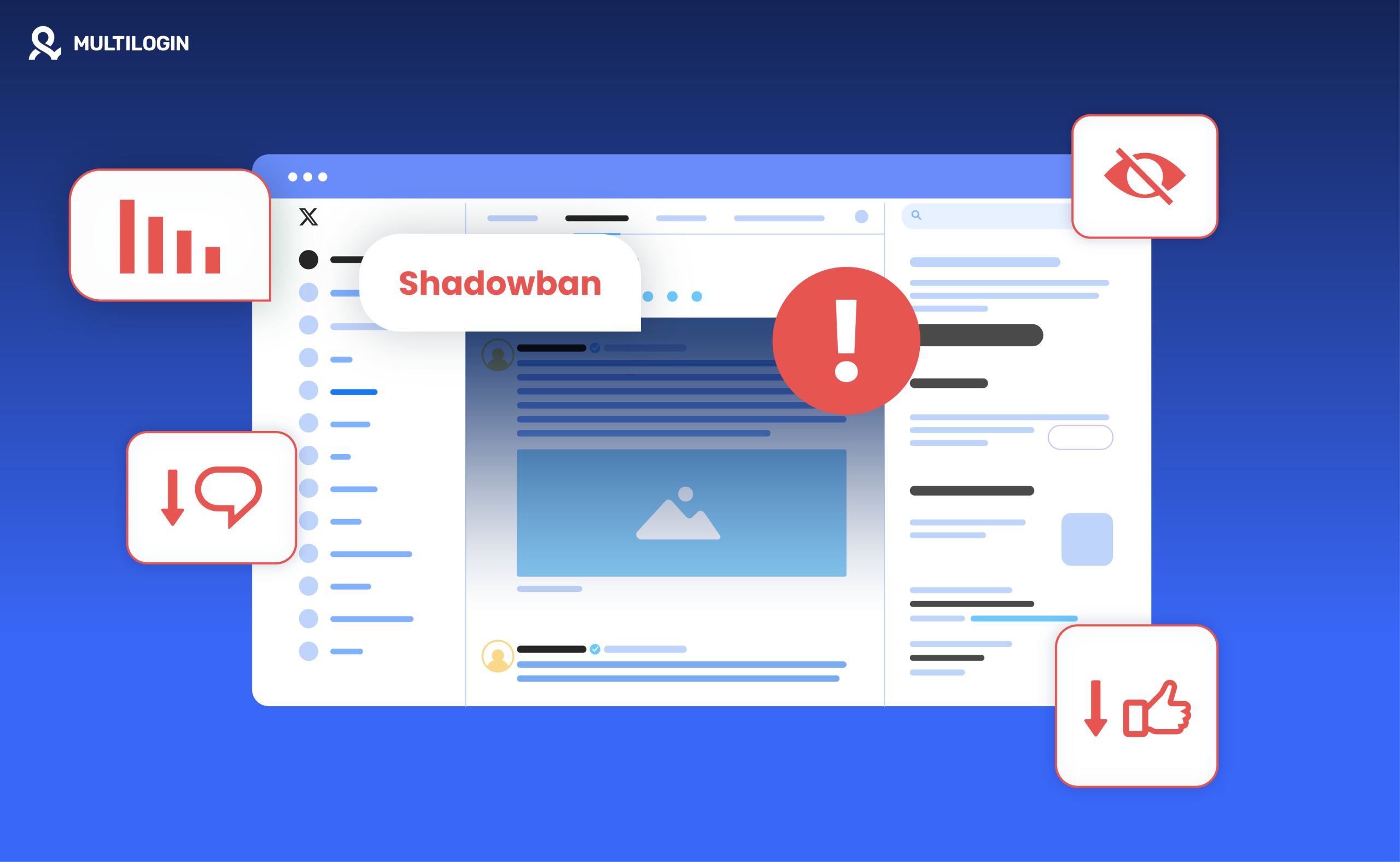
A Twitter/X shadowban, that also known as Twitter hell banning and Twitter ghost banning, happens when your account or specific posts become harder to find without a direct notification from the platform. Actually it’s a stealth restriction where X limits the reach and discoverability of your account or posts without notifying you.
Unlike a full ban, you can still tweet, like, reply, and interact with others. However, your content may not appear in search results, hashtags, recommendations, reply threads, or timelines the way it normally would.
Essentially, Twitter/X reduces your visibility, making it much harder for your content to reach a broader audience. But how do you tell if you’re shadowbanned on Twitter or not?
The most common signs include a sudden drop in impressions, fewer replies, reduced engagement, and posts that don’t appear in search results when you check from another account or incognito mode.
What are the types of Twitter/X shadowbans?
The most commonly reported types of Twitter (X) shadowbans are search suggestion bans, search bans, reply deboosting, and ghost bans. Other visibility restrictions can affect hashtags, trends, timelines, and recommendations.
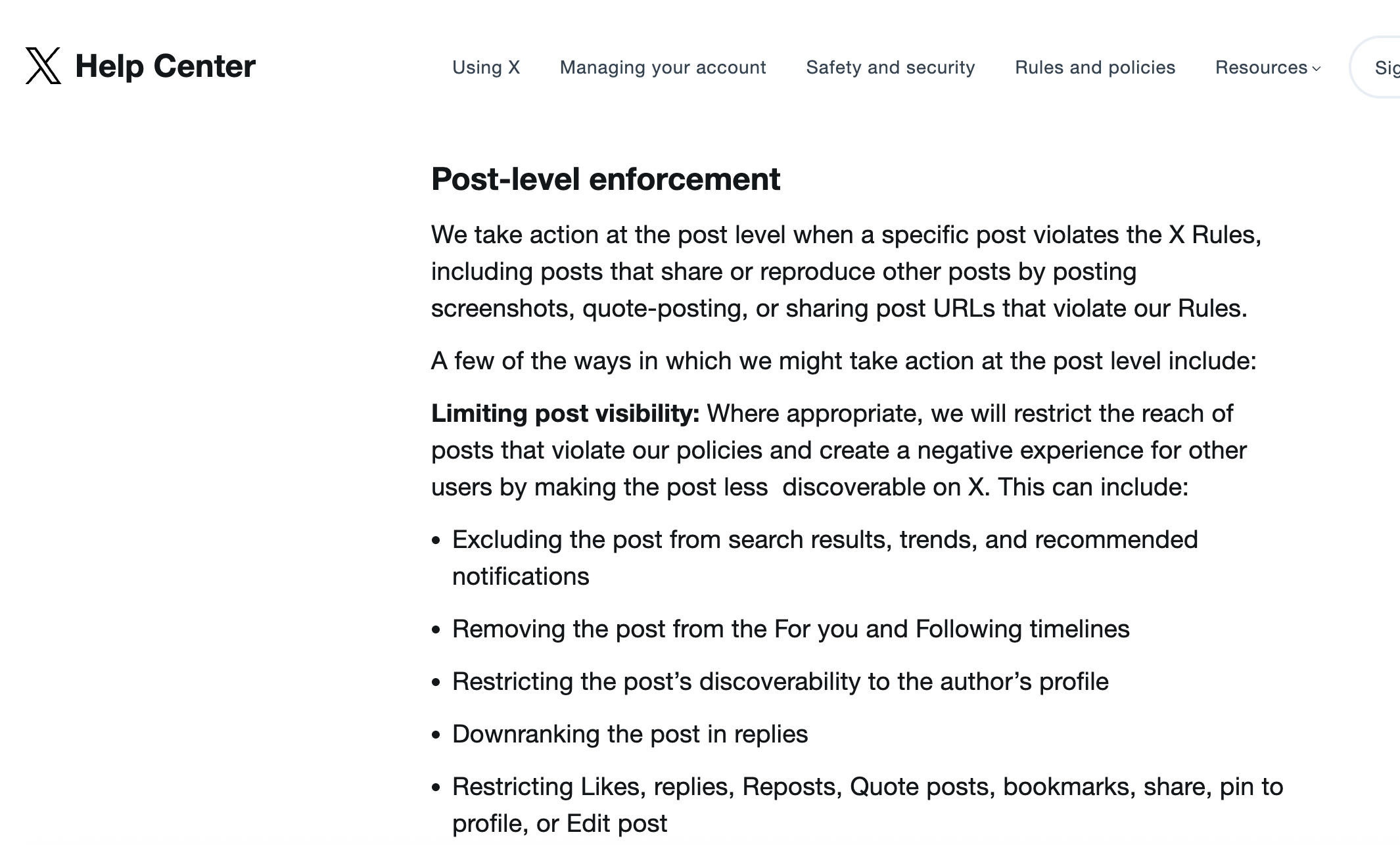
Although X denies shadowbanning, its official policies confirm that the platform can reduce the visibility and discoverability of posts. The following categories explain how these restrictions may affect your account and content.
1. Search suggestion ban
A search suggestion ban is an unofficial term for when your X account stops appearing in search autocomplete suggestions.
People may still find your account by visiting your profile directly or searching for your username. However, missing search suggestions do not necessarily indicate a shadowban. Profile completeness, recent account activity, and search relevance can also affect account discovery.
2. Search ban
A Twitter search ban occurs when some or all of your posts stop appearing in X search results, even though they remain published on your profile.
According to X’s search rules and restrictions, the platform may filter content that negatively affects search quality, including repetitive posts, spam, and hashtag misuse.
3. Hashtag and trends ban
A hashtag or trends ban refers to reduced or restricted post visibility in hashtag searches and trending conversations.
X can exclude posts from these discovery surfaces when they violate its policies. This restriction often overlaps with search filtering.
However, using a trending hashtag does not guarantee that your post will appear in the corresponding search results.
4. Reply deboosting
Reply deboosting happens when X reduces the visibility of your replies by ranking them lower in conversation threads.
Your replies may remain accessible but become harder for other users to discover. X also considers relevance, interactions, and other signals when ranking replies.
As explained in X’s documentation on conversations, replies do not always appear in chronological order. A lower reply position alone does not confirm a shadowban.
5. Recommendation and timeline filtering
Recommendation and timeline filtering limits where your posts appear in X’s For You feed, Following timeline, or recommended notifications.
X may apply these restrictions to content that violates its rules. As a result, fewer people may discover your posts, even when they remain accessible on your profile.
Depending on the restriction, visibility can be reduced for both followers and non-followers.
6. Ghost ban (thread ban)
A ghost ban, also called a thread ban, is an unofficial term users describe when their replies appear published on their accounts but are missing from conversations viewed by others.
X does not officially recognize ghost bans as a separate enforcement category. However, its policies allow it to limit post discovery to the author’s profile.
Missing replies can also result from privacy settings, spam filtering, hidden replies, or technical issues.
7. Sensitive content filtering
Sensitive content filtering limits the visibility of posts containing media that X identifies as potentially sensitive.
Depending on the content label, viewer’s age, and account settings, a post may appear behind a warning or be excluded from search results.
This is not necessarily a shadowban. X provides safe search settings that allow users to control which content appears in their search results.
8. Engagement restrictions
Engagement restrictions limit how users can interact with a post or what actions an account can perform, rather than simply reducing content visibility.
Under X’s Authenticity policy, enforcement measures may restrict interactions such as likes, replies, reposts, and bookmarks. X may also temporarily limit access to certain account features.
These restrictions can occur alongside visibility filtering, but they are not shadowbans in the traditional sense.
Twitter/X shadowban types at a glance
The main difference between Twitter shadowban types is where your account or content becomes less visible and whether the restriction affects discovery or engagement.
| Restriction type | What is affected | Officially documented by X? |
|---|---|---|
| Search suggestion ban | Account autocomplete suggestions | Not as a separate ban type |
| Search ban | Posts in search results | Yes, as search filtering |
| Hashtag and trends ban | Hashtag searches and trending conversations | Yes, as visibility restrictions |
| Reply deboosting | Reply ranking in conversation threads | Yes |
| Recommendation and timeline filtering | Home timelines and recommended notifications | Yes |
| Ghost ban (thread ban) | Replies missing from conversations | Not as a separate ban type |
| Sensitive content filtering | Search visibility and media accessibility | Yes |
| Engagement restrictions | Post interactions or account features | Yes, but not classified as a shadowban |
A drop in impressions, missing search results, or reduced reply visibility does not automatically mean your account is shadowbanned. Normal content ranking, privacy settings, and technical issues can produce similar results.
How does a Twitter/X shadowban work?
A Twitter/X shadowban works by reducing the visibility of an account or its posts without necessarily suspending the account. X uses content ranking, visibility filtering, and policy enforcement to determine which posts appear in search results, timelines, replies, notifications, and recommendations.
In 2026, the Twitter/X shadowban mechanism can be explained through three processes:
- Behavior and content assessment: X evaluates account activity, content quality, user interactions, and potential policy violations.
- Visibility filtering: X may exclude posts from search results, trends, recommendations, or timelines.
- Reduced distribution: Posts may remain published but become harder to discover, while replies may appear lower in conversation threads.
According to X’s Authenticity policy and search rules and restrictions, activities that may lead to visibility restrictions include:
- Repeatedly publishing duplicate or nearly identical content.
- Misusing hashtags or trending topics.
- Sending unsolicited automated replies or using unauthorized automation.
- Publishing substantially similar content across multiple accounts, except in permitted cases such as language localization.
- Using multiple accounts to artificially increase engagement.
Depending on the restriction, your posts may remain visible on your profile while reaching fewer followers and non-followers. X may also apply labels to inform users about visibility restrictions.
However, a sudden drop in impressions does not necessarily mean you are shadowbanned. As X explains in its guide to limited post reach, normal content ranking, user preferences, platform experiments, and technical issues can also affect visibility.
How long do Twitter shadowbans last?
Twitter (X) shadowbans have no fixed duration. Visibility restrictions may be temporary or continue for longer, depending on the reason for the restriction, the severity of the violation, and the account’s history.
As of November 2026, X does not publish a standard recovery time for search bans, reply deboosting, or recommendation filtering. Although some users report recovering within 24 to 72 hours or one to two weeks, these are unofficial estimates rather than confirmed recovery periods.
According to X’s policies on locked and limited accounts, the platform may temporarily restrict account features for a specified period. In these cases, X may display a notice with a countdown or instructions for restoring access.
How long a visibility restriction lasts may depend on:
- The nature and severity of the policy violation.
- The account’s history of previous violations.
- Whether X requires account verification or corrective action.
- Whether the restriction affects an individual post or the entire account.
If you believe X has restricted your account incorrectly, you can submit an appeal.
Simply waiting 48 or 72 hours does not guarantee that a Twitter shadowban will be lifted or that your previous reach will return.
What factors influence how long a Twitter shadowban lasts?
The duration of a Twitter (X) shadowban may depend on the type and severity of the policy violation, previous account violations, and any corrective actions X requires. However, X does not publish a specific recovery period for each type of visibility restriction.
1. The type of content you post
Content that violates X’s rules can lead to reduced visibility or stricter enforcement.
Spam, harmful links, abusive content, and repeated duplicate posts may trigger restrictions. The enforcement measure depends on the nature and severity of the violation.
2. Your posting and engagement frequency
Excessive or aggressive activity can trigger temporary account restrictions.
Publishing repetitive posts, sending large numbers of unsolicited replies, or rapidly following and unfollowing accounts may violate X’s rules. However, high posting frequency alone does not necessarily indicate spam.
3. Your account history
Previous policy violations can influence the severity of X’s enforcement actions.
According to X’s Authenticity policy, repeated violations may result in stricter restrictions or account suspension.
4. Your use of automation
Unauthorized or spam-related automation can lead to search filtering and account restrictions.
Mass-follow tools, unsolicited automated replies, and automated duplicate posts may violate X’s automation rules. Automation that complies with these rules is not automatically a violation.
5. Your activity across multiple accounts
Coordinated activity across multiple X accounts can trigger visibility restrictions if it artificially increases engagement or manipulates conversations.
Publishing substantially similar content across accounts or using multiple accounts to inflate engagement may violate X’s policies. Managing multiple accounts for distinct, permitted purposes is not itself a violation.
6. Account verification and corrective actions
Completing required verification or corrective actions may help restore restricted account features.
According to X’s guidance on locked and limited accounts, some users may need to verify their email address or phone number, remove policy-violating content, or complete a specified restriction period.
These actions may restore account functionality, but they do not guarantee that previous content reach will return immediately.
How to get rid of a shadowban on Twitter (X)?
To get rid of a shadowban on Twitter, check for account restrictions, remove policy-violating content where required, stop spam-related activity, secure your account, and appeal incorrect enforcement decisions. X does not guarantee a fixed recovery period or the restoration of your previous reach.
Follow these seven steps to address potential visibility restrictions.
Step 1: Check for account restrictions
Check whether X has applied a visibility label, temporary account restriction, or verification request.
Review your notifications, account notices, and emails from X. If the platform requires verification or other corrective actions, follow the instructions provided.
Remember that a sudden drop in impressions does not necessarily indicate a shadowban. Understanding how the X algorithm works can help you distinguish normal changes in reach from potential visibility restrictions.
Step 2: Review and remove policy-violating content
Review your recent posts, replies, reposts, hashtags, and links for potential violations of X’s Authenticity policy.
Pay particular attention to:
- Duplicate or nearly identical posts.
- Irrelevant hashtags or misuse of trending topics.
- Repeated links without meaningful context.
- Unsolicited or aggressive replies and mentions.
- Abusive content that violates X’s rules.
- Malicious or misleading links.
If X requires you to remove a specific post, follow the instructions or appeal the decision if you believe it is incorrect. Deleting posts does not automatically reset your account’s status.
Step 3: Reduce excessive posting and engagement
Stop repetitive or aggressive activity that may violate X’s spam policies.
Avoid publishing duplicate posts, sending mass replies, and repeatedly following and unfollowing accounts to gain attention.
Taking a short break may help prevent further policy violations. However, X does not confirm that staying inactive for 24, 48, or 72 hours will remove a shadowban.
Step 4: Stop unauthorized automation
Disable automation tools that violate X’s rules or generate spam-related activity.
Review any bots, automated replies, mass-follow services, or engagement tools connected to your account.
Automation itself is not prohibited. You can continue using tools that comply with X’s automation rules, such as permitted post scheduling through the official API.
Step 5: Engage genuinely with your audience
Focus on original content, relevant conversations, and genuine interactions instead of artificial engagement.
Avoid repetitive comments, unsolicited promotional replies, and using multiple accounts to artificially increase likes, replies, or reposts.
If you manage multiple Twitter accounts, give each account a distinct purpose and publish content relevant to its audience.
These practices support compliance with X’s policies but do not guarantee immediate recovery.
Step 6: Secure your Twitter/X account
Protect your account from unauthorized access that could lead to spam or other policy violations.
- Review connected apps under Apps and sessions.
- Revoke access to unfamiliar or suspicious applications.
- Change your password if you suspect unauthorized access.
- Enable two-factor authentication (2FA).
- Review active login sessions and sign out of unfamiliar devices.
Securing your account helps prevent unauthorized activity, but it does not directly remove existing visibility restrictions.
Step 7: Appeal the restriction through X Support
Submit an appeal if you believe X has incorrectly restricted your account or content.
For individual posts with visibility restriction labels, use the available appeal option on the affected post. For eligible account-level restrictions, use X’s official appeal form.
When submitting an appeal, include:
- Your X username.
- A clear description of the restriction.
- When you first noticed the issue.
- Links to affected posts and relevant screenshots.
- Any corrective actions you have already taken.
X does not publish a guaranteed response or recovery time for shadowban-related issues. Continue monitoring your search visibility, replies, and post impressions to assess changes in your content’s reach.
How to check if your account is shadowbanned on Twitter?
You can check if your Twitter (X) account is shadowbanned by testing your search visibility, checking reply rankings, reviewing account notifications, and comparing how your posts appear to followers and non-followers. X does not provide a universal shadowban checker, so using several methods together gives you a clearer picture.
1. Use a Twitter shadowban tester
A Twitter shadowban tester is a third-party tool that checks whether your account or posts appear in search results, search suggestions, or reply threads.
These tools can help identify potential visibility restrictions, including search bans, search suggestion bans, and reply deboosting.
However, shadowban checkers cannot access all of X’s internal ranking and filtering systems. Treat their results as indicators rather than definitive proof of a restriction.
2. Perform a manual shadowban check
You can manually check for a Twitter shadowban by searching for your public posts and profile from another account.
Follow these steps:
- Open X using another account or an incognito window if logged-out search is available.
- Search for your username to check whether your profile appears in search suggestions and account results.
- Enter
from:yourusernamein the search bar and select the Latest tab. - Search for the exact text of a recent public post.
- Search for a hashtag you recently used.
If your public posts consistently fail to appear, your search visibility may be limited.
Before drawing a conclusion, check your account privacy settings, email verification status, and sensitive content filters, as these can also affect search visibility.
3. Ask someone who does not follow you to check
Ask a non-follower to check whether your profile, posts, and replies are visible from their X account.
This helps you understand how your content appears to people outside your existing audience.
Compare the results from more than one account, as personalized search results, content preferences, and account settings can affect what individual users see.
4. Check your reply visibility
You can check for reply deboosting by asking another user to locate one of your existing replies in a public conversation.
If your reply consistently appears near the bottom of threads or under the “Show probable spam” option, X may be reducing its visibility.
However, X does not always display replies in chronological order. Understanding how the X algorithm works can help you distinguish normal reply ranking from potential visibility restrictions.
5. Check account notifications and visibility labels
Review your X notifications, account notices, and individual posts for official signs of visibility restrictions.
X may display labels explaining that a post’s reach has been limited due to a policy violation. You may also receive notices about temporary account restrictions or verification requirements.
An official notice provides stronger evidence of enforcement than a third-party shadowban tester. However, the absence of a notice does not confirm that your content is free from visibility filtering.
How to interpret your Twitter shadowban test results
The meaning of a shadowban test result depends on where your content is missing and whether other factors could explain the reduced visibility.
| Test result | Possible explanation |
|---|---|
| Profile missing from search suggestions | Search suggestion filtering or incomplete profile information |
| Public posts missing from search results | Search filtering or account settings |
| Posts missing from hashtag searches | Search filtering or content relevance |
| Replies appearing under “Show probable spam” | Potential spam or low-quality reply filtering |
| Replies missing from public conversations | Visibility restrictions, hidden replies, or technical issues |
| Sudden drop in impressions | Reduced distribution, normal ranking changes, or visibility restrictions |
| Official visibility restriction label | Confirmed post-level enforcement |
| Rate limit exceeded message | Account or request limit, not necessarily a shadowban |
If you receive an activity limit error rather than experiencing reduced visibility, check how Twitter rate limits work.
No single test can confirm every type of Twitter shadowban. Compare multiple results and check for official enforcement notices before deciding what action to take.
What are the common reasons for shadowbans or low reach on Twitter (X)?
Common reasons for Twitter shadowbans include spammy activity, duplicate content, unauthorized automation, hashtag abuse, aggressive following, coordinated account activity, and content that violates X’s rules.
However, low reach does not necessarily indicate a shadowban. Content relevance, audience interest, recommendation systems, and normal ranking changes can also affect visibility.
Spammy activity
Repetitive, aggressive, or unsolicited activity can trigger visibility restrictions on X.
Examples include sending bulk promotional replies, repeatedly mentioning unrelated users, and artificially increasing engagement. Posting frequently is not necessarily a violation if your activity follows X’s rules.
Duplicate content
Repeatedly publishing identical or nearly identical posts can reduce your visibility in search results.
This applies to content published repeatedly from one account or distributed across multiple accounts. X permits certain exceptions, such as cross-posting content localized into different languages.
Harmful or policy-violating content
Content that violates X’s safety policies may receive reduced distribution, visibility labels, or stronger enforcement.
Examples include hateful conduct, targeted harassment, threats, scams, malicious links, and misleading media that violates platform rules.
Depending on the violation, X may restrict individual posts or the entire account.
Unauthorized automation
Automation that generates spam or artificially increases engagement can lead to visibility restrictions or account suspension.
Examples include unsolicited automated replies, automated likes, and mass-follow tools. However, X permits certain types of automation, such as compliant post scheduling through its official API.
Hashtag abuse
Misusing hashtags to manipulate search results or trending conversations can lead to visibility restrictions.
Using several hashtags is not automatically a violation. Problems arise when hashtags are irrelevant to the content or are used excessively for spam and unrelated promotion.
Aggressive following and unfollowing
Repeatedly following and unfollowing large numbers of accounts to increase your follower count violates X’s rules.
X calls this practice follow churn. It can result in account restrictions or stronger enforcement.
Coordinated activity across multiple accounts
Using multiple X accounts to artificially increase engagement or manipulate conversations can trigger visibility restrictions.
This includes coordinating likes, replies, reposts, and other interactions to artificially increase the popularity of content.
Managing multiple accounts for distinct, legitimate purposes is not itself a policy violation.
How to avoid a shadowban on Twitter (X)?
To prevent a Twitter shadowban, follow X’s rules, publish original and relevant content, avoid artificial engagement, use compliant automation, manage multiple accounts responsibly, and keep your accounts secure.
These practices help reduce the risk of policy violations, but they cannot guarantee unrestricted visibility or prevent every shadowban.
Follow Twitter/X guidelines
Follow X’s rules on content, account activity, automation, and engagement.
Regularly review X’s rules and policies, especially before introducing new automation tools, publishing workflows, or additional accounts.
Publish original and relevant content
Create content that provides value to your audience instead of repeatedly sharing the same messages. Use relevant hashtags, provide meaningful context when sharing links, and avoid repetitive promotional replies.
If you manage accounts for different brands, regions, or audiences, adapt your content to each account’s purpose.
Use compliant automation
Use automation only for activities permitted by X’s policies. Avoid automated likes, unsolicited bulk replies, aggressive following, and services that artificially increase engagement.
If you automate publishing through the official API, understanding X API pricing and usage limits can help you plan your workflows and manage costs.
Maintain responsible account activity
Avoid repetitive, aggressive, or unsolicited interactions that may violate X’s anti-spam policies.
Focus on relevant conversations, meaningful replies, and genuine audience engagement.
X does not publish a universal safe posting frequency that guarantees protection from visibility restrictions. Staying within technical rate limits does not automatically mean your activity complies with platform rules.
Manage multiple Twitter accounts responsibly
Give each X account a distinct purpose, publish content relevant to its audience, and avoid coordinated activity that artificially increases engagement.
X allows users to operate up to 10 accounts for different, non-duplicative purposes, provided they comply with its rules.
If you manage accounts for different brands, regions, or campaigns, keep their content, login sessions, and daily workflows organized separately. Avoid publishing substantially similar posts across accounts or using several accounts to artificially amplify the same content.
Managing multiple Twitter accounts is not itself a policy violation. What matters is how you operate them and whether their activity complies with X’s rules.
Keep your accounts secure
Protect your Twitter accounts from unauthorized access that could result in spam or policy violations.
Enable two-factor authentication, review connected applications, revoke access to suspicious tools, and sign out of unfamiliar devices.
Regularly review account notifications and monitor changes in post visibility to identify potential issues early.
How can Multilogin help during this process?
If you manage several Twitter/X accounts for clients, brands, or regional campaigns, the goal is not to “trick” the platform. The goal is to keep every account organized, consistent, and separate, so your workflow does not look messy or coordinated.
This matters because X may limit accounts that post similar content across multiple accounts, engage with the same posts, abuse of hashtags, or use automation in a way that affects how content is discovered. X also collects signals like IP address, browser type, device information, cookies, location, and log data for safety and anti-spam purposes.
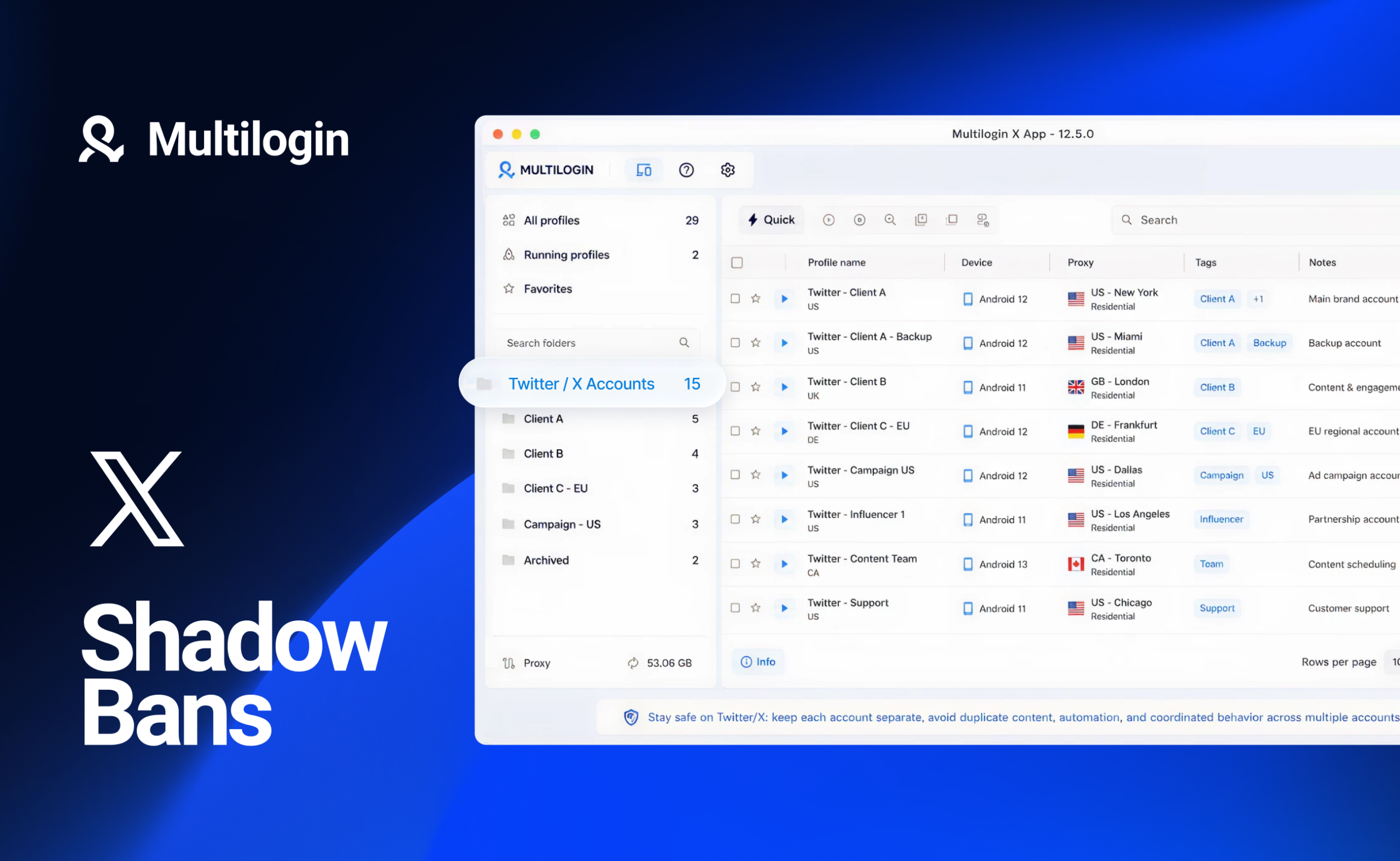
Multilogin cloud phones can help social media teams keep mobile-first account workflows cleaner. Each cloud phone works as a separate Android environment, so you can manage accounts without switching between physical devices or mixing sessions on the same setup.
This can be useful when you manage accounts for different brands, locations, or campaigns. Instead of logging in and out of many accounts from one device, you can keep each account in its own cloud phone profile with its own session, app data, and setup.
For example, if you manage Twitter/X together with Instagram, TikTok, Reddit, or Facebook, cloud phones for social media management can help you keep each account workflow more organized from one dashboard.
Still, cloud phones are not a shortcut around Twitter/X rules. You should avoid duplicate posts, mass engagement, fake interactions, and similar content across multiple accounts. The safest strategy is to combine clean account separation with natural posting, real engagement, and consistent activity.
What does Twitter/X say about shadowbans?
Twitter has officially stated that it does not shadow ban users in the strict sense of the term.
In its official explanation on shadow banning, Twitter defines shadow banning as deliberately making someone’s content undiscoverable to everyone except the person who posted it, without letting that person know.
Twitter says it does not do this. The platform explains that users should still be able to see posts from accounts they follow, although they may sometimes need to visit the account’s profile directly to find them.
However, Twitter/X also makes it clear that not all content appears equally in search results. According to its search rules and restrictions, X filters search results to keep them relevant and may remove low-quality posts or accounts from search if they create a poor search experience.
This can happen when accounts repeatedly post duplicate or near-duplicate content, abuse hashtags or trending topics, send automated posts or replies, post similar messages across multiple accounts, or aggressively follow and unfollow people.
X’s ranking systems also use different signals to decide which results appear in search. These may include engagement, relevance, account signals, post quality, user interactions, spam reports, blocks, and how closely the post matches the search query.
This means Twitter/X does not usually describe reduced visibility as a shadowban. Instead, it presents it as part of its ranking, filtering, and safety systems.
In practice, an account may still be active, and followers may still receive its updates, but its posts, replies, profile, or search suggestions may become harder to find.
Twitter also confirmed in the past that some accounts were affected by a search auto-suggestion issue. These accounts did not appear in search suggestions even when users searched for their names. Twitter said this issue affected hundreds of thousands of accounts, was not limited to politics or geography, and was later resolved.
You can also review the X Privacy Policy to understand what information X collects, including IP address, browser type, device information, cookies, and log data.
Run Unlimited Accounts Without Bans
Run your social media accounts on cloud phones & web browsers
Frequently Asked Questions About Twitter Shadow Bans
How do I know if I’m shadowbanned on Twitter?
Signs of a shadow ban include a sudden drop in engagement, reduced visibility of your tweets in search results and hashtags, and limited interaction on your posts.
How long do Twitter shadowbans last?
Shadow bans typically last from a few days to a couple of weeks, depending on the severity of the infraction and how quickly you address the issue.
How do I get rid of a Twitter shadowban?
To lift a shadow ban, review and remove any problematic content, reduce your posting frequency, and engage authentically with your audience. You can also appeal to Twitter Support if you believe the ban is unjust.
Can a shadow ban be removed?
Yes, a shadow ban can be removed. The key is to correct the behavior that triggered the ban and allow time for Twitter’s algorithm to re-evaluate your account.
How do I check if my account is shadowbanned?
You can use online shadowban testers or perform a manual check by searching for your content while logged out or in incognito mode.
How do I stop shadow banning?
To prevent shadow banning, follow Twitter’s guidelines, avoid automation, and maintain consistent activity on your account.
What is a Twitter shadowban tester?
A Twitter shadowban tester is an online tool that checks whether your account or specific tweets are hidden from search results and hashtags.
Can I get unshadowbanned from Twitter?
Yes, you can get unshadowbanned by addressing the behavior that caused the ban and allowing time for the algorithm to reset your account’s status.
How long does a shadow ban last?
The duration of a shadow ban varies but typically lasts from a few days to a couple of weeks.
How to avoid getting shadowbanned on Twitter?
To avoid getting shadowbanned on Twitter, keep your activity natural. Don’t post the same content repeatedly, abuse hashtags, use bots, or send automated replies. Also, avoid posting similar messages across multiple accounts or tagging people who don’t interact with you. X may limit accounts that look spammy or create a poor experience in search, replies, or timelines. If you manage several client or brand accounts, cloud phones for twitter can help keep mobile-first workflows more organized across Twitter/X, Instagram, TikTok, and other platforms.
What does it mean to be shadowbanned on Twitter?
Being shadowbanned on Twitter means your posts are still live, but fewer people can see or find them. Your tweets may disappear from search results, trends, recommended notifications, or timelines. In some cases, your replies may be pushed lower, or your post may only be easy to find on your profile. X does not officially call this a shadowban. It describes it as limiting post visibility, ranking content, or filtering search results.
Can you tag people if you’re shadowbanned on Twitter?
Yes, you may still be able to tag people if you’re shadowbanned on Twitter. However, the tag may not get normal visibility. Your post can still be hidden from search, removed from recommendations, or downranked in replies. Also, avoid mass-tagging people. X may treat repeated mentions, especially accounts that don’t follow you, as spammy behavior.
Is a Twitter shadowban the same as suspension?
No. A suspension limits or removes account access more directly. A shadowban usually means the account still works, but its content gets reduced visibility in search, replies, hashtags, timelines, or recommendations. Why are my tweets not showing in search? Your tweets may not show in search because of duplicate content, hashtag abuse, automation, spammy replies, suspicious links, similar posts across multiple accounts, or other quality signals. It can also happen because of Twitter/X ranking and filtering systems.
Curious how to create multiple Google accounts effortlessly? See how Multilogin simplifies the process!
Run your social media accounts on cloud phones & web browsers
Final Thoughts
A Twitter shadowban can limit your content’s visibility without suspending your account. However, a sudden drop in impressions or engagement does not necessarily mean X has restricted your account.
If you suspect a shadowban, check your search and reply visibility, review account notifications, address policy violations, and appeal incorrect restrictions. Remember that X does not guarantee a fixed recovery period.
To avoid future visibility restrictions, publish original content, use relevant hashtags, follow X’s automation rules, and focus on genuine engagement.
If you manage multiple Twitter accounts, Multilogin can help you organize mobile and web workflows through separate cloud Android phones and browser profiles. However, account separation cannot replace compliance with X’s policies or guarantee unrestricted reach.
Long-term visibility depends on relevant content, authentic interactions, responsible account management, and compliance with platform rules.

 Join 4,200+ subscribers