
Residential Proxies
Use Multilogin’s premium residential proxies to stay undetected across browser profiles and cloud phones. Built for multi-account management, web scraping, automation, and mobile-first operations:
- 24-hour sticky sessions for stable connections
- 95% clean IPs to reduce bans
- 30M+ residential IPs in 195+ countries
- City-based targeting in 1,400+ locations
Bypass bans & CAPTCHAs with built-in proxies
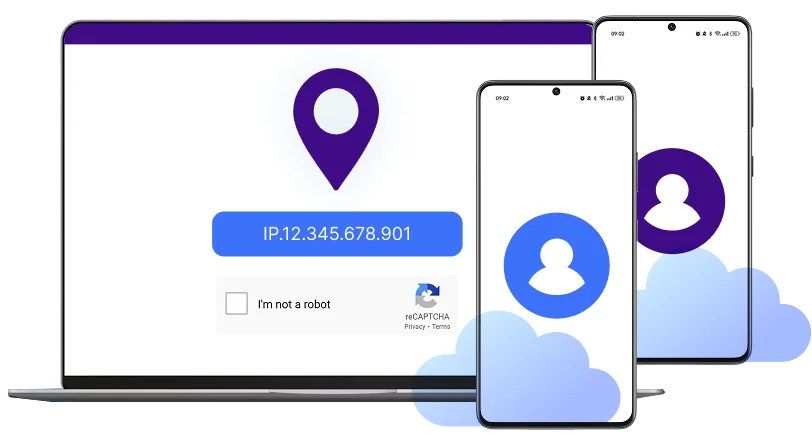
Multilogin’s residential IPs are combined with advanced antidetect technology and more than 55 customizable parameters, ensuring consistent identity signals across sessions.
Break geo-restrictions with residential proxies
Multilogin enables accurate geo-targeting for both web and mobile workflows. Proxies stay consistent with device settings, language, and time zone, creating natural location-based behavior, with bandwidth rollover and IP quality filtering to maintain performance at scale.
Improve real-time data access
Run multiple residential proxies at once to collect data efficiently and at scale. Ideal for market research, competitor analysis, ad verification, and monitoring localized content:
- Bypass anti-bot systems
- Continuous, reliable data flow
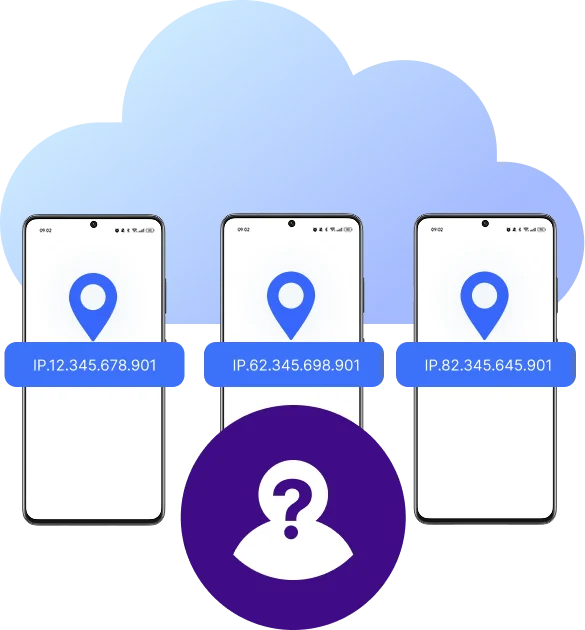
Enhance anonymity with residential proxies
Hide your real IP address by replacing it with one from a real device connected to an Internet Service Provider (ISP). This makes you appear like a regular user browsing the internet and strengthens privacy while maintaining stability for long sessions, repeated logins, and long-term account activity.
- Real device IPs
- ISP-level masking
- Undetectable browsing
Looking for cloud phones?
-
3-day access to Multilogin
-
5 cloud or local profiles
-
200 MB proxy traffic included
-
3-day access to Multilogin
-
5 cloud or local profiles
-
200 MB proxy traffic included
What are cloud phones?
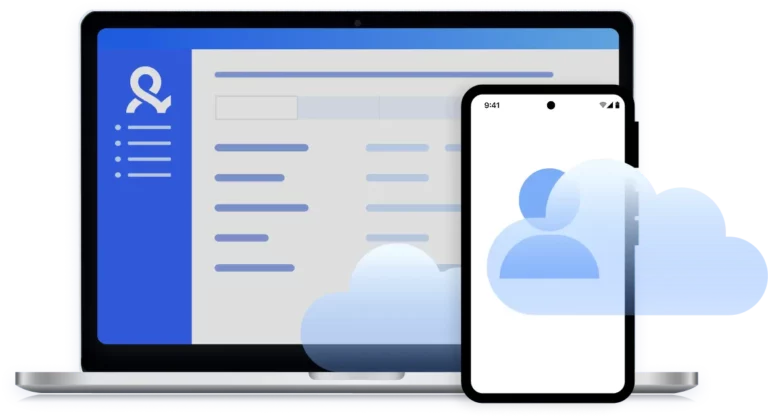
Cloud Phones are real Android devices in the cloud, giving each account a persistent mobile environment with genuine device IDs, isolated app data, and stable sessions, so you can easily manage Instagram, TikTok, Reddit, and other social media accounts.
Why use proxies and a browser from the same provider?
Using proxies from one provider and environments from another often creates mismatched signals that platforms detect. Multilogin solves this by aligning residential IPs with browser profiles and cloud phones that share the same antidetect foundation.
Multilogin features

Bypass bot protection
Our fingerprint masking technology is capable of modifying numerous browser fingerprints to avoid detection.
Integration with Selenium, Playwright, and Puppeteer
Automate data extraction with popular browser automation drivers all while keeping them invisible to anti-automation bots.

Residential rotating proxies
Gain access to premium residential proxy nodes in 1400+ cities across 150+ countries with your Multilogin subscription.
Fingerprint adjustment to proxies
All browser fingerprints are automatically adjusted to match the proxy’s location, enhancing anonymity.
Supports for all proxy types
Whether you use our proxies or bring your own, Multilogin supports all proxy types.
Data sync over VPS
Use our cloud profiles to synchronize browser data across multiple VPS instances effortlessly.
Fully featured browsers
Unlike headless browsers that websites can easily detect, our browsers mimic real user activity, preventing restrictions by websites.
Easy dockerization
Dockerize your scraping instances with ease using our quick dockerization guide.
Related solutions you might like
Most Awarded Antidetect Browser













Watch the Multilogin demo for advanced data scraping
Get a 10-minute demo video demonstrating how Multilogin can help you continuously extract large amounts of data using an advanced antidetect browser with built-in residential proxies. Just enter your name, last name, and email below, and we’ll send the demo video straight to your inbox.
How to start using Multilogin with residential proxies
Launch and manage real mobile environments in the cloud with residential proxies.

Sign up
Register using a verified email address

Choose your plan
Select from various subscription plans tailored to your business needs

Download the Multilogin X app
Install the Multilogin desktop app to manage mobile sessions securely.

Access the Multilogin dashboard
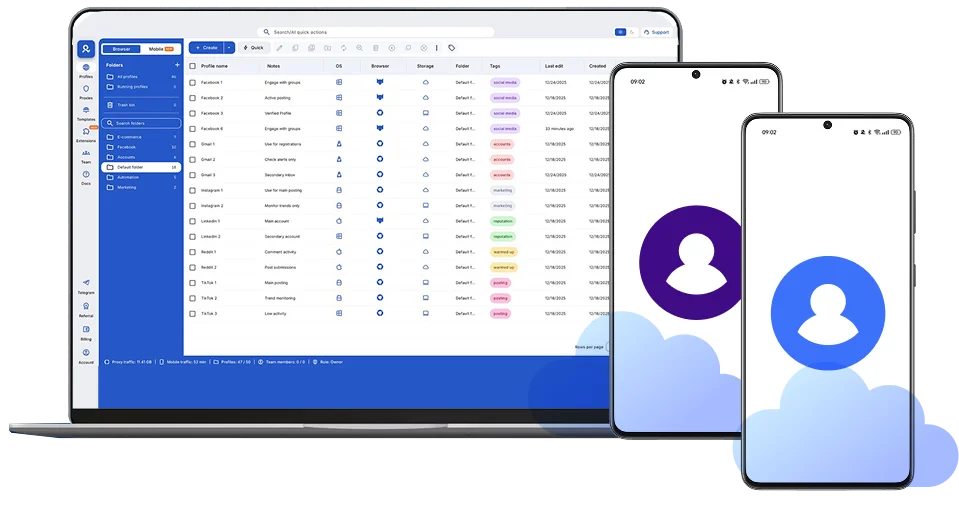
Launch cloud phones and browser profiles, assign residential proxies, configure fingerprints, and manage mobile environments from one place.

Manage multiple browser profiles and cloud phones
Set up and manage multiple cloud phones using separate browser profiles with consistent identities.
Residential Proxies in 2026: The Smarter Way to Stay Private and Manage Multiple Accounts
Ever hit a digital wall — blocked content, endless CAPTCHAs, or sudden account restrictions — just because of where you’re connecting from? If so, residential proxies are no longer an optional infrastructure.
In 2026, it’s not just about hiding your IP. It’s about using real residential connections inside environments that behave like real users, whether on the web or inside mobile apps.
At their core, residential proxies route your traffic through IPs assigned by ISPs to real home devices. Websites see you as a genuine user from that location, dramatically reducing detection and blocks. When combined with persistent browser profiles or cloud phones, residential proxies support long-term, stable operations instead of short-lived sessions.
What is a residential proxy?
A residential proxy routes your internet connection through a real device—like a home user’s laptop or smartphone—connected to the web via a legitimate Internet Service Provider (ISP). In simpler terms, instead of websites seeing your real IP, they see the IP of a real device in another location. That makes your online activity appear natural, helping you avoid blocks and access content as if you were there.
The benefits of using residential proxies
People use proxies for all sorts of reasons, but here are some of the biggest advantages:
- Privacy and anonymity: By masking your real IP, residential proxies help ensure your online activities remain private.
- Bypass geo-restrictions: These proxies make it look like you’re accessing the web from another location, letting you unlock content that might be restricted in your region.
- Added security: If you’re browsing or making purchases online, residential proxies provide an extra layer of security by hiding your real IP from malicious sites.
Residential vs. datacenter proxies: What’s the difference?
Residential Proxies
- Use real IPs assigned to homeowners by ISPs.
- Provide high anonymity and are harder to detect.
- Ideal for scraping, ad verification, managing social media or e-commerce accounts.
Datacenter Proxies
- Come from cloud hosting providers or server farms.
- Faster and cheaper than residential proxies.
- Easier to detect and block by websites.
- Better suited for speed-focused tasks like basic automation or accessing low-security sites.
In short: use residential proxies when stealth and reliability are critical. Use datacenter proxies when you need speed and lower cost, and detection isn’t a big concern.
Rotating residential proxies vs static residential proxies
Not all proxies work the same way. Depending on what you need them for, you’ll want to choose between two main types:
Static residential proxies:
With static proxies, you get a fixed IP address that stays the same every time you connect. This is great for things like:
- Managing multiple social media or e-commerce accounts
- Logging into platforms that require a consistent identity
- Reducing the chances of triggering CAPTCHAs or security blocks
Rotating residential proxies:
On the other hand, rotating proxies assign you a new IP address every time you make a request. This makes them perfect for:
- Web scraping and data collection
- Monitoring prices or trends on multiple sites
- Avoiding detection when making frequent automated requests
If you’re running a business that relies on gathering data or managing multiple accounts, knowing when to use static vs. rotating proxies is key.
Multilogin offers both options, making it easy to find the right fit for your needs.
Why use residential proxies in 2026?
Residential proxies are more important than ever, especially as websites and social platforms become stricter about automation, location consistency, and device behavior. When combined with browser profiles or cloud phones, they create stable environments that platforms trust.
Here’s where they shine:
- Bypass geo-restrictions: Access region-locked content, apps, and platforms from anywhere in the world. When used with cloud phones, location signals stay consistent across IP, device settings, and app behavior.
- Web scraping without bans: Residential IPs help automated requests blend in with real user traffic, improving success rates when collecting data and reducing blocks or CAPTCHAs.
- Multi-account management: Safely manage multiple social media, e-commerce, or ad accounts. Each account runs through its own residential IP and, when needed, its own cloud phone or browser profile, reducing the risk of account linking.
- Unbiased market research: View local pricing, search results, ads, and app content exactly as users in specific regions see them — both on the web and inside native mobile apps.
- Extra privacy and security: Add a protective layer between your real connection and the internet. Residential proxies mask your real IP while cloud phones and browser profiles keep device data isolated and secure.
What to look for in a residential proxy provider
Not all proxy providers are created equal. As detection systems get more advanced, choosing the right provider matters just as much as choosing the right tools. Here’s what to look for in 2026:
- Ethical IP sourcing: Choose providers that source residential IPs through clear, opt-in methods. This reduces legal risk and ensures IPs are cleaner, more stable, and less likely to be flagged.
- Large IP pool: A bigger and more diverse IP pool lowers the chance of reuse and detection. This is especially important when running multiple browser profiles or cloud phones in parallel.
- Speed and stability: Look for low latency, high uptime, and reliable performance. Stable connections are critical for long sessions, automation workflows, and persistent cloud phone usage.
- Accurate geo-targeting: Strong providers allow targeting by country, city, or region. When paired with cloud phones, geo-targeting should stay consistent with device settings, language, and time zone.
- Easy setup: The best residential proxies work seamlessly inside browser profiles and cloud phones, without manual configuration or third-party tools slowing you down.
- Good support: Fast, knowledgeable support helps resolve issues quickly, whether you’re running a single account or managing large-scale workflows across multiple environments.
Where to buy residential proxies
If you’re thinking about investing in a proxy service, here’s what you need to know about pricing:
- Best residential proxies: Premium proxies are the way to go for the fastest speeds, highest security, and most reliable connections. They cost more but are worth it for businesses or users who need top-tier performance.
- Cheap residential proxies: If you don’t require enterprise-level security or blazing-fast speeds, there are more affordable proxy options that still perform well. These are ideal for casual users who just want to browse securely.
- Free residential proxies (Use with caution): While free proxies might seem like an attractive option, they often come with significant drawbacks. They can be slow, unreliable, or even unsafe, making them a riskier choice for anyone serious about online privacy.
Multilogin offers a variety of options to suit different needs and budgets, giving you the flexibility to choose according to your requirements.
When considering static residential proxies
If you regularly log into the same accounts or manage long-term sessions, a static residential proxy is the better choice. A consistent IP helps platforms recognize stable behavior over time, reducing the chances of security checks or repeated CAPTCHAs.
Static residential proxies are especially useful when paired with cloud phones or persistent browser profiles, where the same device, location, and IP work together to create a natural, long-term account environment.
When you should consider free residential proxies
Not every workflow requires a large proxy budget. If you’re testing a new setup, running small-scale tasks, or learning how residential proxies work, a free or entry-level option can be a good starting point.
Multilogin offers affordable plans and limited free access, allowing you to test residential proxies inside real environments — including browser profiles and cloud phones — before upgrading to a paid plan as your needs grow.
How residential proxy pricing works
Most providers use one of two models:
- Pay-as-you-go (PAYG): Pay per GB of data used. Good for short-term or unpredictable usage.
- Monthly subscriptions: Get a set amount of bandwidth each month, usually with better per-GB pricing.
Avoid “free” residential proxies—they often come with poor speeds, major privacy issues, or IPs that have been abused and blacklisted.
Datacenter proxies are usually cheaper and charged per IP or bandwidth, making them attractive for cost-conscious users—but keep in mind they’re easier to block.
Final thoughts
If you value online privacy, need access to region-locked content, or manage multiple accounts, residential proxies are no longer optional — they’re essential infrastructure. Choosing the right type, whether static residential proxies for long-term stability or rotating residential proxies for higher anonymity, has a direct impact on account health and workflow reliability.
Multilogin provides built-in access to both static and rotating residential proxies, designed to work seamlessly inside secure environments. With a large pool of real residential IPs, combined with advanced antidetect technology across browser profiles and cloud phones, teams can manage accounts, collect data, and run daily operations with confidence.
By choosing a reliable provider and using residential proxies as part of a unified setup, you get a smoother, more secure, and more predictable way to work online — without constant blocks, resets, or disruptions.
Residential proxies FAQ
What is a residential proxy?
A residential proxy routes your internet traffic through a real device, such as a home user’s laptop or smartphone, connected to an Internet Service Provider (ISP). This makes it appear as if you’re browsing from a real person’s IP address, increasing anonymity and reducing the risk of detection.
When used inside Multilogin’s browser profiles or cloud phones, residential proxies help create consistent, realistic online behavior across web and mobile environments.
How do residential proxies operate?
A residential proxy acts as a middle layer between you and the websites you visit. Instead of connecting directly, your traffic is routed through a real residential IP, masking your real location and identity.
In Multilogin, residential proxies are assigned directly to browser profiles or cloud phones, allowing each environment to operate with its own IP and location — ideal for multi-account workflows and data access.
Why should I buy premium proxies
Residential proxies provide a secure and reliable connection that appears genuine to websites. These proxies are essential to enhance web scraping capabilities, efficiently manage multiple accounts, and bypass geographical restrictions.
Multilogin offers a great selection of residential proxies, simplifying the process of finding and buying them. From your profile settings, you can convenient access to a vast network of over 30M +IP addresses and manage proxies. And the best part? It is completely free of charge. Multilogin provides the necessary security and anonymity for a wide range of online activities. It meets the needs of flexible and professional web browsing, offering a reliable solution for all your online needs.
What are the key differences between residential and static proxy?
Rotating residential proxies:
- Use real residential IPs that change periodically
- Best for scraping, automation, and high-anonymity tasks
Static residential proxies
- Use real ISP-assigned IPs that remain fixed
- Ideal for long-term logins, account management, and cloud phone sessions that need a consistent identity
Why use residential proxies for web scraping?
Residential proxies make scraping activity appear like normal user traffic, reducing blocks and CAPTCHAs. They improve success rates, allow geo-targeted data collection, and provide more reliable access to protected websites.
When combined with browser profiles or cloud phones, residential proxies support stable scraping environments that don’t break after a few requests.
How to use residential proxies?
Using proxies involves several steps:
- Choose a reliable provider
- Sign up and get credentials
- Configure your proxies
- Set up IP rotation
With Multilogin, residential proxies are applied directly to browser profiles or cloud phones, eliminating manual configuration and reducing the risk of setup errors.
How often does the residential proxy update?
The residential proxy updates at configurable intervals, typically ranging from every few seconds to every 24 hours, depending on your needs and the specific settings you choose. This flexibility allows you to balance between minimizing detection risk and maintaining efficient scraping operations.
When should you use residential proxies?
Use residential proxies when you need to look like a real person browsing from a specific place. They’re great for things like managing multiple social media accounts, checking prices in different countries, scraping websites, or getting around content blocks.
What are the main use cases for residential IP addresses?
People use residential proxies for various purposes.
- In social media management, they allow the creation of multiple social media accounts on one device for effective marketing.
- In market price monitoring, they help businesses collect data and monitor pricing trends to attract customers.
- For cybersecurity penetration testing, they are using them to hide IPs and simulate cyberattacks for security testing.
- In web data scraping, they enable data collection and competitor monitoring with continuous IP rotation.
- People widely use residential proxies in ad verification to ensure ad integrity by checking and blocking suspicious ads.
- Site unblocking – Residential proxies let you access geo-restricted websites and content, making them especially useful in regions where certain platforms or services are blocked. information access.
Do residential proxies work with tools like Puppeteer or Selenium?
Yes, residential proxies work seamlessly with automation tools like Puppeteer, Selenium, Scrapy, and others. When used together, they help your automated tasks run more smoothly and stay under the radar by routing traffic through real residential IPs.
How to choose the best residential proxy provider?
Focus on providers with wide location coverage, a large and diverse IP pool, and responsive customer support. Speed and reliability are key, so make sure their proxies perform well. Also, compare pricing and look for extra features that add value to your use case.
Why are residential proxies better than datacenter proxies?
Residential proxies use real-device IPs, making them much harder to detect compared to datacenter proxies, which often get blocked easily.
Are residential proxies legal?
Yes. Residential proxies are legal when used ethically and responsibly for tasks like research, verification, and business operations. Always ensure your provider sources IPs through opt-in methods.
How do residential proxies work?
Residential proxies help Instagram automation by making actions like posting, following, or liking appear as normal user behavior. When used with isolated browser profiles or cloud phones, they reduce the risk of triggering Instagram’s security systems.
What are the main use cases for residential proxies?
Residential proxies are ideal for:
- Managing multiple accounts on social media or e-commerce platforms without triggering security measures.
- Web scraping and data collection without getting blocked by anti-bot systems.
- Bypassing geo-restrictions to access region-locked content.
- Ad verification to check whether ads are being displayed properly across various regions.
- Market research to view competitor pricing, ads, and search results as local users would.
What are the different types of Residential Proxies?
There are two main types of residential proxies:
- Static residential proxies: Use a fixed IP address, making them suitable for tasks where a consistent identity is needed, such as managing social media accounts.
- Rotating residential proxies: Use a new IP address for each request, ideal for web scraping and tasks that require frequent IP changes to avoid detection.
Can you use residential proxies anywhere?
Yes, you can use residential proxies anywhere as long as the service provider supports your geographic location. Multilogin provides global coverage with over 30 million residential IPs from 195+ countries, allowing you to bypass geo-restrictions and access content as if you were browsing from a specific region or city.