


Below are ten alternatives to VMOS Cloud, one section each, with what each is good at, where it falls short, and what it costs once device time and proxies are counted.
You will also see why this search returns two unrelated product categories, and which of the ten publish pricing at all. New to the category? Start with how cloud Android phones work.
TL;DR
A VMOS cloud phones alternative is either a cloud-hosted Android device you rent monthly, or an on-device app running a second Android system inside your own phone. For account work at scale, only the first group applies.
Among the plan-based platforms, fees cluster between €4.50 and $7.08 a month at ten profiles. What moves your bill is not that number, but whether proxies and device time come with the plan or arrive as a second invoice.
Each option is covered below, then grouped by the job it suits.
Cloud phone platforms at a glance
Everything in this table is a cloud platform. The on-device apps that also show up for this query have a section of their own further down.
| Platform | Best for | Plan at 10 profiles | Proxies | Device runtime |
|---|---|---|---|---|
| Multilogin | Multi-account work across apps and web | $7.08/mo annually | Included, all plans | 60 min included, then $0.0067/min |
| GeeLark | Automation and AI content | $6.75/mo annually | Not included | $0.007/min |
| MoreLogin | Browser-first teams | $5.4/mo | Sold separately | $0.006/min or $23–25/device |
| GoLogin | Browser profiles, light mobile use | €4.50/mo annually | None at this tier | 30 min/mo included |
| DuoPlus | Mobile-only multi-account work | $11.79/mo for 10 devices | Not included | $0.0042/min after 60 free |
| Redfinger | 24/7 gaming | Not published | Not published | Not published |
| LDCloud | LDPlayer ecosystem users | Not published | Not published | Not published |
| UgPhone | Gaming and long AFK sessions | Not published | Not published | Not published |
| cloudf.one | Singapore-only accounts | $5 per 24h test | n/a, device is on a carrier SIM | Rented by the day |
| Genymotion Cloud | App testing and QA | Quote only | n/a | n/a |
Prices checked on each provider’s own pricing page on 3 October 2026. GoLogin publishes in euros, the others in US dollars. DuoPlus prices vary by device count, so the figure shown is for ten devices. For a head-to-head with the product you are leaving, see Multilogin vs VMOS Cloud.
Key takeaways
- This search mixes two product categories. On-device apps run inside your
handset; cloud phones are rented devices in a data centre. - At the same profile count, plan fees differ by a few dollars. Proxy bills and
device time do not. - Of the platforms that publish pricing, Multilogin is the only one bundling
residential proxies, mobile minutes and browser profiles into every plan. - Four of the ten publish no pricing, which makes budgeting for a team hard.
- No cloud phone receives SMS or calls. App verification needs a separate number
on every platform here.
What a VMOS cloud phones alternative actually means
It returns one of two different things, and the difference decides everything else.
On-device virtualisation apps run a second Android system inside the phone in your hand. Virtual Master, X8 Sandbox and VPhoneOS belong here. They are free or cheap and need no subscription, because everything runs on hardware you own.
Cloud Android phone platforms rent you devices hosted in a data centre. A cloud phone keeps its own app data and login history between sessions, reached from one dashboard.
Running a second WhatsApp account on your own phone is an on-device job. Managing social media accounts for clients across three regions is not, and no app on one handset changes that.
VMOS Cloud: what you are leaving
Priced on the same day as everything else here, so the comparisons line up.
VMOS Cloud rents by the day rather than selling a profile plan. A standard machine in Hong Kong is $0.11 per day with 4 GB of RAM and 8 cores. A Pixel 7 Pro instance is $0.30 per day.
There is also a per-minute device at $0.005 per minute, billed from five minutes and capped at $1 per device per day. That is the lowest per-minute rate in this comparison.
Proxies come separately from OwlProxy, part of the same VMOS group: $1.00 per GB for dynamic IPs, $1.15 per GB for mobile, $0.05 per day for a static residential proxy.
At ten devices: $33 a month for the devices alone, before traffic. Ten profiles on a plan-based platform start between €4.50 and $7.08, with device time metered on top.
Those are different units. A rented device is available whether you use it or not; a metered profile costs nothing idle and charges every minute it runs.
Multilogin
A cloud Android phone platform for multi-account management, with browser profiles for web-based accounts in the same subscription.
| Pros | Cons |
|---|---|
| Residential proxies and mobile minutes in every plan | Needs a reliable internet connection |
| Cloud phones and browser profiles under one subscription | SMS verification needs an outside number, from an SMS provider or a phone rental service |
| Billed time stops at 180 minutes per session | |
| Unused traffic and minutes roll over | |
| Free plan with no time limit, no card |
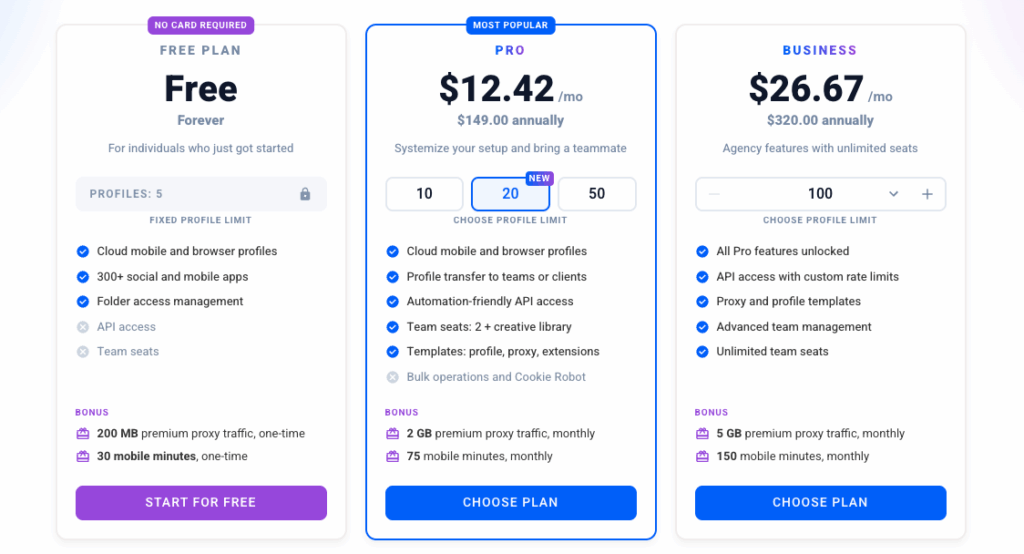
Price. Free plan with 5 profiles. Pro 10 at $7.08/mo with 1 GB and 60 minutes monthly.
Best for teams running accounts daily across both mobile apps and the web who want one vendor and a number they can forecast.
GeeLark
Positions itself around social media automation and AI content generation, with cloud phones underneath.
| Pros | Cons |
|---|---|
| Unlimited free team seats on every paid plan | Proxies sit outside the subscription |
| Strong automation and content tooling | Device time billed per minute on top |
| Tiers from 5 to 50,000 profiles | No published cap on runtime spending |
| Free plan to test the workflow | Monthly total varies with usage |
Price. Free plan with 2 profiles and 30 minutes. Base from $3.75/mo at five profiles, $6.75 at ten, $9.75 at twenty, billed annually. Pro from $14.25. Device time $0.007 per minute. Annual billing saves 25%.
Best for operators whose work is mostly automated runs and who already have a proxy supplier. See GeeLark alternatives for a closer look.
MoreLogin
A browser profile product with a cloud phone module added alongside it.
| Pros | Cons |
|---|---|
| Daily spending cap of $1.5 per device | Cloud phones billed outside the plan |
| Low entry price for browser profiles | Proxies are a separate purchase |
| Android 12 to 15, camera and file upload | Browser-first, mobile added later |
| Free plan covering two users | Two invoices to reconcile |
Price. Free plan with 2 profiles and 2 users. Pro at $5.4/mo with a 40% discount applied, from a $9/mo base, covering 10 profiles. Cloud phones at $0.006 per minute capped at $1.5 a day, or $23–25 per device per 30 days.
Best for teams whose accounts are mostly web-based, with occasional mobile work. Compare against MoreLogin alternatives.
GoLogin
An established browser profile tool that has added a cloud Android layer.
| Pros | Cons |
|---|---|
| Lowest entry tier in this comparison | Only 30 cloud minutes a month, any tier |
| Mature product with a large user base | No proxy data at the 10-profile tier |
| Proxy data included from the second tier | Priced in euros, complicating comparison |
| 7-day free trial on paid plans | Mobile layer secondary to the browser |
Price. Free plan with 3 profiles. Professional 10 at €4.50/mo, Professional 25 at €9.50, Professional 50 at €14.50, Professional 100 at €19.50, all at annual billing with a 50% discount applied. Residential traffic of 2 GB starts at Professional 25.
Best for browser-led work where a cloud phone is needed occasionally rather than daily.
DuoPlus
Mobile-only, and the one platform here that rents devices and bills time at once.
| Pros | Cons |
|---|---|
| Lowest per-minute rate among plan alternatives | Device rent charged even when switched off |
| Volume discounts down to $0.085 per device | No browser profile layer at all |
| Free trial of one phone for 30 days | Proxies not included |
| Unlimited concurrent and total opens | Headline price assumes 10,000 devices |
Price. Devices from $1.70 each per month at one device, $1.179 at ten, $0.3648 at a thousand. Startup time at $0.0042 per minute after the free allowance. A monthly startup package is $16.91. Annual billing saves 15%.
Best for mobile-only operations where devices run in short bursts rather than all day. At the volumes its discounts target, the question becomes phone farming logistics.
Redfinger
One of the longer-standing providers, describing its product as a cloud Android emulator and virtual smartphone service.
Its front page leads with 24/7 gaming before it mentions marketing or multi-account work, and we could not find a public pricing page: the plan link goes to a blog post.
Best for continuous gaming sessions and existing users of the platform. Watch for no published pricing and a product built around play, not accounts.
LDCloud
From the team behind LDPlayer, operated by Hongkong LDCloud International Co. Limited. The site is organised around multi-instance and synchronous operation.
Top-ups run through a Recharge section after registration rather than a published price list.
Best for people already working inside the LDPlayer ecosystem. Watch for unpublished pricing, which makes a workload hard to cost in advance.
UgPhone
Five device tiers, from 3 cores and 3 GB of RAM up to 8 cores and 16 GB, on Android 10 to 13, with servers in Hong Kong, Germany, Japan, the USA, Singapore and Taiwan. Operated by Globaltoo Technology Pte Ltd.
The plan page leads with game support and 24/7 AFK sessions. Figures appear only after registration.
Best for long unattended sessions where device specifications matter more than account tooling. Watch for no published pricing and no account-management layer.
cloudf.one
The outlier, and worth knowing for one specific job. It rents real physical phones located in Singapore, each on a genuine local mobile carrier connection, rather than cloud-hosted devices in a data centre.
Fifteen apps come pre-installed, among them TikTok, Instagram, Xiaohongshu and Lemon8. A free trial needs no card, and a paid 24-hour test at $5 is credited toward a longer plan.
Best for accounts that must look Singaporean, such as a TikTok Shop run from abroad. Watch for one country only, and no published subscription price.
Genymotion Cloud
A different category of product. The company describes it as an Android emulator and sells to QA and development teams: device customisation, test environments, deployment through AWS, Azure, GCP and Alibaba Cloud.
Enterprise plans route to a sales contact rather than a public price list.
Best for app testing and QA pipelines. Watch for a product not built for managing social or marketplace accounts.
On-device options: Virtual Master, X8 Sandbox, VPhoneOS
These run a second Android system on your own phone rather than renting one. They appear in almost every list for this search because they answer the original VMOS use case: cloning an app or two on a handset you already own.
They suit personal use, such as a second messaging account. They do not scale to account operations, because everything still runs on one device, in one location, on one connection.
If you are leaving VMOS because you need more devices rather than a different app, this group will not solve it.
Who includes proxy traffic, and who sends you elsewhere
Every account on every platform here connects through a proxy. The question is whether that traffic is part of what you already pay for.
| Platform | Proxy traffic | Where you get it | At the 10-profile tier |
|---|---|---|---|
| Multilogin | Included in every plan | Same subscription | 1 GB a month, unused rolls over |
| GoLogin | From Professional 25 upward | Same subscription | Nothing at this tier |
| GeeLark | Not included | A separate vendor | Nothing at any tier |
| MoreLogin | Sold separately | A separate purchase | Nothing at any tier |
| DuoPlus | Not included | A separate vendor | Nothing at any tier |
| VMOS Cloud | Through OwlProxy, same group | A separate purchase | $1.00/GB dynamic, $1.15/GB mobile |
Read down the first column and the pattern is plain. Multilogin is the only platform here that includes residential traffic at every tier, and the only one where unused traffic carries into next month rather than expiring.
Everyone else sends you to a second vendor, including VMOS Cloud: OwlProxy sits in the same corporate group, but it is still a separate purchase on a separate invoice.
That matters beyond the money. A second vendor means a second account to manage, a second bill to reconcile, a second support queue when an IP goes bad, and traffic you cannot see in the dashboard where your profiles live.
Pro tip: Proxy traffic is the line people forget when comparing plans, because it is not on the pricing page they are reading. It arrives on a different vendor’s invoice a month later.
How to check what a platform will really cost you
- Estimate monthly device-minutes. Accounts × hours per day × 30 × 60.
- Subtract included minutes, then multiply the rest by the per-minute rate.
- Price the proxies at a published rate if they are not in the plan.
- Check whether unused resources roll over or reset each month.
- Check whether browser profiles are included, since Reddit, YouTube
channel management and marketplace back offices are web-based. - Add the totals and compare.
Pro tip: Run step 1 against last month’s actual hours, not next month’s plan. Idle device time is where per-minute billing accumulates unnoticed.
Common problems and limitations
No cloud phone receives SMS or calls. App verification needs a number it accepts, from your own phone or an SMS provider, entered in the app on the cloud phone.
A weak connection degrades everything. A cloud phone is a remote device and feels slow on a poor connection regardless of the hardware behind it.
Setup takes time. Moving from one handset to a dashboard is a workflow change, and accounts already signed in on VMOS need re-authenticating.
Free tiers expire quietly. Multilogin deletes free profiles after 7 days of inactivity and free-plan resources do not renew. Check the equivalent terms wherever you trial.
Separate devices do not fix content problems. Posting near-identical content across accounts can still cause trouble, whatever the device setup.
Misconceptions worth clearing up
“Cloud phones are just emulators.” An emulator simulates Android on other hardware. These platforms run real Android devices in data centres, which is why app data persists. Several vendors describe their devices in those terms on their own sites, so treat it as a category trait rather than one vendor’s edge.
“The cheapest plan means the cheapest month.” At ten profiles the plans sit within a few dollars of each other. Device time and proxies decide the bill.
“More profiles is the main thing to buy.” Profiles are usually the cheapest part. Runtime and traffic scale with the work.
“A single quoted price tells you what a platform costs.” GoLogin is the test of that. It has four tiers in euros, and the figure repeated most often elsewhere is the undiscounted rate for the smallest one.
Which option fits your situation
One subscription, or several invoices
| Cloud phones | Browser profiles | Proxies | Mobile minutes | |
|---|---|---|---|---|
| Multilogin | Included | Included | Included | Included |
| GeeLark | Included | Included | Separate | Metered |
| MoreLogin | Separate | Included | Separate | Metered |
| GoLogin | 30 min/mo | Included | From tier 2 | Capped at 30 |
| DuoPlus | Rented | None | Separate | Metered |
What happens when a session runs long
| Platform | Billed time stops at |
|---|---|
| Multilogin | 180 minutes per session, then free |
| MoreLogin | $1.5 per device per day |
| VMOS Cloud | $1 per device per day, per-minute devices |
| GeeLark, GoLogin, DuoPlus | No published cap |
Can you budget it before you buy
| Platform | Pricing published | Currency | Resources roll over |
|---|---|---|---|
| Multilogin | Yes | USD | Yes |
| GeeLark | Yes | USD | Not stated |
| MoreLogin | Yes | USD | Daily cap instead |
| GoLogin | Yes | EUR | Not stated |
| DuoPlus | Yes | USD | Not stated |
| Redfinger, LDCloud, UgPhone, Genymotion | No | n/a | n/a |
Where Multilogin is not the answer
| If this is you | Look at |
|---|---|
| Continuous gaming | Redfinger or UgPhone |
| App testing rather than accounts | Genymotion Cloud |