








-
Cloud phones
Multilogin
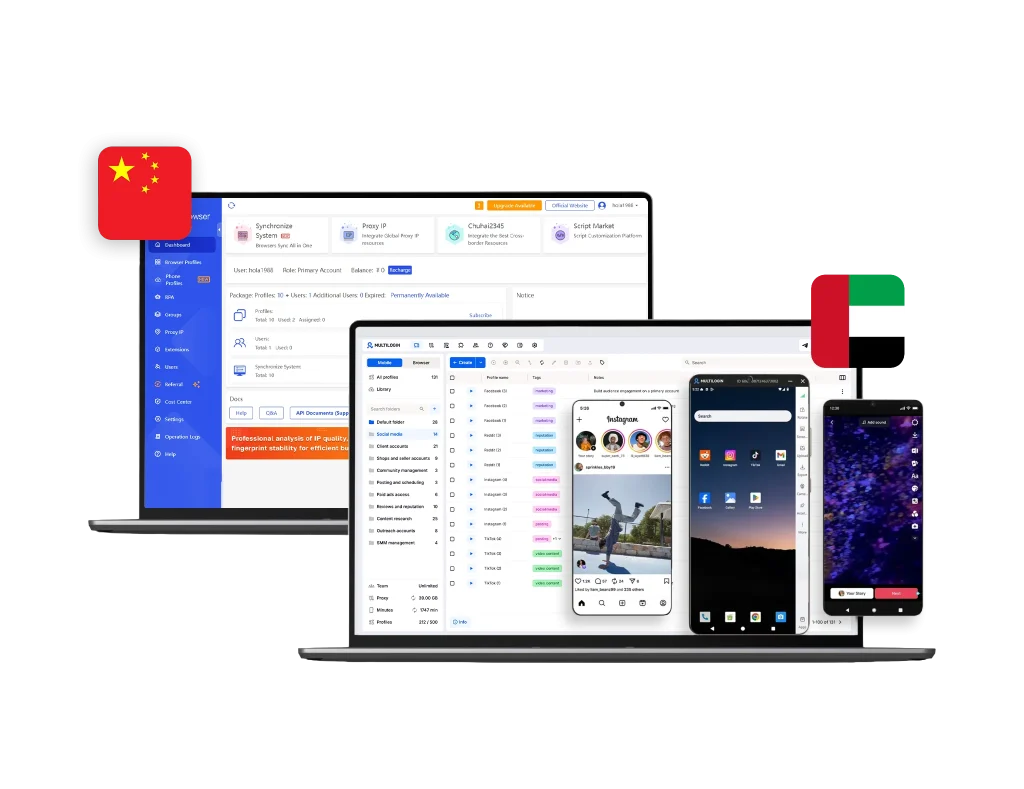
Multilogin provides cloud phones for social media management. They are fully unique Android devices hosted in the cloud. You can run native mobile apps and control multiple accounts from a single dashboard.
BitBrowser
BitBrowser offers cloud phones through BitCloudPhone, but the product is positioned inconsistently between “Android emulator” and “cloud phone” on its own site. Each profile needs a separate SOCKS5 proxy set up manually, and automation workflows are not supported on cloud phones, only on browser profiles.
-
Built-in proxies
Multilogin
Multilogin includes a built-in premium residential proxy system, so you don’t start from zero or juggle extra providers. You get 30M+ high-quality IPs across 195+ countries, all managed inside one dashboard. Sessions can stay super-sticky for up to 24 hours, unused bandwidth rolls over, and a smart IP-quality filter removes weak or previously flagged IPs before they reach your workflow. And if you already have a proxy setup you trust, you can plug in any third-party provider with no limitations.
BitBrowser
BitBrowser does not include any built-in residential proxies, so every user has to buy external proxy services on their own. This makes the setup more expensive, harder to manage, and easier to break when you’re running many accounts. Because everything must be configured manually — from sourcing proxies to testing them and fixing bad IPs — the workflow becomes slower, less stable, and far more time-consuming, especially for users who just want a ready system that works out of the box.
-
Usability and user interface
Multilogin
Multilogin is simple and flexible — a natural fit for solo users, small teams, and anyone who doesn’t want to deal with complicated setup. It works straight away, without technical steps or confusing menus, so you can focus on tasks that actually move your projects forward. The interface stays clean and predictable even as your workflow grows, and Android mobile emulation makes it easy to manage mobile-first platforms like social media without switching devices. Everything is designed to keep your daily work fast, clear, and frustration-free.
BitBrowser
BitBrowser leans heavily toward technical users and bigger teams. Its setup, profile management, and automation flow require more technical effort, which can slow down beginners or anyone who wants a quick, simple workspace. Because the interface expects users to understand configuration steps on their own, solo users and smaller non-technical teams often struggle to get started. The lack of mobile emulation also creates extra friction for anyone managing mobile-first platforms like social media, forcing them to rely on external tools or separate devices.
-
Web automation
Multilogin
Multilogin is built for heavy automation — the kind where you’re running hundreds or thousands of profiles and every extra click slows you down. You can launch profiles with simple commands, rename them on the fly, switch proxies in seconds, and juggle multiple tasks without breaking the flow. AI Quick Actions help you skip repetitive steps, turning slow manual routines into fast, predictable actions. Multilogin connects naturally with Selenium, Playwright, Puppeteer, Postman, and the Multilogin CLI, giving you full control whether you prefer scripts, dashboards, or command-line workflows. Everything fits into the same automation system, so when your workload grows, your setup keeps up.
BitBrowser
BitBrowser offers only basic automation, and its setup depends heavily on Selenium with a Puppeteer driver, which limits what you can build. It does not support Playwright, doesn’t offer Postman integrations, and has no CLI, which makes deeper, API-driven workflows harder to create. When you push it to higher volumes, the system can feel rigid — handling thousands of accounts or dealing with strict bot-detection systems becomes unreliable, and CAPTCHA-heavy sites often slow the workflow down even more. For teams that depend on stable, flexible automation, these gaps can turn into daily bottlenecks.
-
Fingerprinting customization
Multilogin
Multilogin gives you 55+ advanced fingerprint controls, letting every profile behave like a real, separate user. You can fine-tune Canvas, WebGL, geolocation, timezone, language, hardware specs, and more without breaking the natural look of the browser. The platform uses Stealthfox (Firefox-based) and Mimic (Chromium-based) to keep profiles stable on even the strictest platforms. You also get full extension support, so custom setups stay intact. With Android mobile emulation, you can manage mobile-first platforms the same way you handle desktop ones. And when you need to scale fast, one-click profile creation lets you spin up clean, isolated environments instantly, without losing hours to manual setup.
BitBrowser
BitBrowser uses an AI-generated Canvas Fingerprint system, which looks realistic but gives you very limited control over key settings like WebGL, timezone, and hardware details. This makes it harder to create truly unique, stable fingerprints for sensitive platforms. It also blocks “suspicious” profiles at startup, which can interrupt workflows and cause unnecessary profile loss. For users who need reliable, customizable fingerprints, this restricted approach quickly becomes a major drawback.
-
Data privacy & security
Multilogin
Multilogin is based in Europe and follows strict GDPR standards, which means your data stays protected and never handled loosely. When your subscription ends, your information is automatically deleted after 3 months, without needing to request it. Passwords are secured through hashing, so they’re never stored or transmitted in plain text. All account data and browser sessions are protected with AES encryption, keeping every profile safe inside encrypted cloud storage. The result is a setup where your privacy stays under your control at all times.
BitBrowser
BitBrowser is a Chinese company based in Hong Kong and offers standard encryption for accounts and sessions. However, it provides no clear details about GDPR compliance, data retention, or what happens to your information after you stop using the tool. While the basic protection is fine for casual use, the lack of transparency can be a concern for users who need stricter privacy standards or work with sensitive client data.
-
Browser core & updates
Multilogin
Multilogin releases frequent core updates every 2–4 weeks, closely following official browser releases. Each update focuses on improvements, security fixes, and stronger stability for automation tools like Selenium, Playwright, Puppeteer, Postman, and the CLI. These updates also keep Android mobile emulation aligned with real-device behavior, helping profiles stay consistent across mobile-first platforms.
BitBrowser
BitBrowser updates regularly, it focuses more on improving the user experience and fixing bugs, which may not be as proactive in addressing new detection techniques.
-
Browser flexibility
Multilogin
Multilogin gives you two dedicated browsers — Mimic (Chromium-based) and Stealthfox (Firefox-based). You can switch between them whenever you need, which is helpful if a platform reacts differently to one browser. If something feels off or a site behaves unexpectedly, you simply launch the same profile in the other browser and keep moving without losing time. This flexibility keeps your workflow stable, even when platforms tighten their checks.
BitBrowser
BitBrowser runs on a single browser engine and doesn’t offer a Firefox-based or alternative browser option, so you can’t switch environments when a site reacts badly. It does support Chrome extensions, but the lack of multiple browser cores limits flexibility and makes troubleshooting harder — especially when managing sensitive or high-volume accounts.
-
Pricing
Multilogin
Multilogin starts you off with a free plan, including 5 browser profiles so you can test your setup and workflows first. After the trial, plans start at $7.08.
Cloud Phone usage is billed transparently per minute, with starter Cloud Phone packages already included in the subscription. There are no hidden fees — core features and built-in proxy infrastructure are part of the plan, so costs stay predictable as you scale.BitBrowser
BitBrowser looks inexpensive at first, but the limits show up quickly. The Free plan gives you only 10 profiles, 1 team member, and just 50 opens per day, which isn’t practical for anyone managing real workflows. The $10/month Base plan increases this to 50 profiles and 2 team members, but you still deal with daily open limits, no built-in residential proxies, and constant manual setup. Their Custom plan doesn’t list clear pricing, meaning larger teams must negotiate everything — from profile counts to team seats — without transparent costs. For users who scale, these restrictions make BitBrowser feel more expensive over time because you need extra proxies, extra automation tools, and extra storage just to keep things running.
What Multilogin offers that BitBrowser doesn’t
Multilogin lets you manage multiple accounts from one beginner-friendly platform. You get a full set of features needed for both browser and mobile account management without any extra tools.
Multilogin vs. BitBrowser recap chart
Find out why Multilogin is the preferred alterative to BitBrowser
-
Platform maturity
Multilogin
Launched in 2015, more mature and stable platform
BitBrowser
Launched in 2020, less mature platform
-
Country of origin
Multilogin
United Arab Emirates
BitBrowser
China
-
Platform compatibility
Multilogin
macOS, Windows, Linux
BitBrowser
macOS, Windows, Linux
-
Mobile emulation
Multilogin
IOS, Android
BitBrowser
IOS, Android
-
Desktop app
Multilogin
Included
BitBrowser
Included
-
Security
Multilogin
High security, uses md5, SHA-2, and AES
BitBrowser
High security
-
Fingerprinting technology
Multilogin
High level
BitBrowser
High level
-
Quick profile creation
Multilogin
Included
BitBrowser
Included
-
Frequent updates
Multilogin
Frequent and detailed updates
BitBrowser
Regular updates
-
Built-in proxies
Multilogin
Included
BitBrowser
Not included
-
Quick profile creation
Multilogin
Included
BitBrowser
Included
-
Support
Multilogin
24/7 Live Support, supports 5 languages
BitBrowser
Available, can be slow
-
Knowledge centre
Multilogin
Included
BitBrowser
Included
-
Unlimited free team member accounts
Multilogin
Included
BitBrowser
Included
-
Passes all browser fingerprint checkers
Multilogin
Included
BitBrowser
Included
-
Trial
Multilogin
Included
BitBrowser
Not included
-
Market Position
Multilogin
Beginner-friendly and scalable for businesses and teams of any size
BitBrowser
Suitable for beginners and small teams
BitBrowser user or new to the game? Discover Multilogin, a reliable alternative to BitBrowser.
Explore Multilogin, a smarter alternative to BitBrowser.
Why people love Multilogin
-

A Good Cloud Phone for Account Management
Running a small team means I need control over who can access what, and Multilogin handles that well. The team access controls let me manage permissions without giving everyone the keys to every account. On top of that, the cloud phones keep everything isolated so one account issue doesn’t put the rest at risk. Solid choice for agencies managing multiple clients or accounts.
-

The best service for great ideas and big minds!
Always here for their clients, always ready to help out. I am using the service for 3-4-5 months now and brought me lots of great things 🙂 Hope to grow it on a larger scale and continue using the service …
-

Cloud phones make it easy to manage multiple TikTok accounts with AI agents
I use Multilogin to manage a bunch of AI agents running TikTok accounts for different countries. Since each agent needs its own account, I wanted an easy way to keep everything organized. Cloud phones make it super easy. Every account has its own phone, so I don’t have to buy or manage a bunch of real devices. I can see everything in one dashboard while the AI agents handle posting and the rest of the daily work.
-

Ideal for Social Media Management
I mainly use Multilogin for client social media management, and the cloud phones have been the biggest advantage for me. I can keep different clients in separate environments, leave their sessions running, and jump between accounts without constantly switching physical devices. It feels much more practical than trying to manage everything from a pile of phones.
-

Perfect browser for work, worth the money!
My overall experience with Multilogin has been excellent. I really like its intuitive dashboard, reliable customer support, and competitive pricing. It has become an essential part of my e-commerce business, and I highly recommend it to anyone looking for a dependable solution.
-

Safer accounts using Cloud Phones for social profiles
Running social profiles on cloud phones feels safer, everything is properly separated instead of relying on browser fingerprint tricks alone. Been running mine for a couple months with zero linking issues.
-

Efficient Account Management and Outstanding Support with Multilogin
Multilogin has been an excellent tool for managing multiple accounts efficiently. The setup was quick, and I was able to start using it right away with no learning curve. The interface feels just like Chrome, making it easy to navigate and work without interruption. Performance has been smooth, and browsing feels natural and responsive.
The award-winning platform for social media growth















See more comparisons
- Compare with Android Emulator
-
Compare with

- Compare with Browser Emulator
-
Compare with

-
Compare with

-
Compare with
-
Compare with

-
Compare with

-
Compare with

-
Compare with

-
Compare with

-
Compare with

-
Compare with

-
Compare with

-
Compare with

-
Compare with

-
Compare with

-
Compare with

-
Compare with

-
Compare with
-
Compare with

-
Compare with

-
Compare with

-
Compare with

-
Compare with

-
Compare with

-
Compare with

-
Compare with
-
Compare with

-
Compare with

-
Compare with

-
Compare with

-
Compare with

-
Compare with

-
Compare with

-
Compare with

-
Compare with

-
Compare with
Watch the Multilogin Demo
Learn how Multilogin can boost your business. Check the video below to see its full capabilities in a short demo video.
Desktop app
Multilogin provides a fully integrated desktop app designed to remove friction. The built-in launcher connects automatically, background updates run quietly, and profiles sync instantly across web and desktop. You can start, pause, or continue work from any device without breaking sessions. Everything is built to keep workflows consistent, reduce manual steps, and support teams that scale.
BitBrowser offers a desktop app, but it still relies on local profile storage and more manual setup. Because profiles don’t sync across devices, teams must move files manually, which slows down collaboration and creates version conflicts. Updates require more user involvement, and switching between machines often adds extra steps. For fast-moving workflows, this structure can feel limiting.
Multilogin vs. Bitbrowser: Which multi-account management platform to choose in 2026?
Choosing the right multi-account management platform in 2026 comes down to reliability. BitBrowser attracts users with low pricing and simple features, but its limited control, unclear privacy standards, weak automation compatibility, and lack of built-in proxies create friction as soon as you try to scale. Multilogin, on the other hand, is built for long-term workflows — stable fingerprints, premium residential proxies, Android mobile emulation, automation support, daily testing, and strong EU-level data protection. Below is a clear breakdown based on real user pain points.
Bitbrowser vs Multilogin: User experience (Which feels better for daily work)
BitBrowser can feel rigid for everyday work because most actions require more setup, and beginners often hit friction early. The interface expects a technical user, and features like fingerprint control or bulk actions don’t feel intuitive. The lack of Android mobile emulation, inconsistent translations, and more manual steps slow down simple routines. When you’re switching between profiles many times per day, these gaps make the workflow feel heavier, not easier.
Multilogin focuses on clarity and comfort. You open the app, and everything is ready — profiles, proxies, fingerprints, and Android mobile emulation for mobile-first platforms. The layout is simple, actions require fewer clicks, and the system stays fast even when you manage hundreds of profiles. It feels natural for beginners and still powerful enough for advanced users who need stability every single day.
Bitbrowser vs Multilogin: Proxy integration (Which saves you more headaches)
BitBrowser requires you to buy, import, and configure every proxy manually, which becomes time-consuming the moment you scale. There is no built-in residential proxy pool, no IP-quality checks, and no bandwidth rollover. You depend entirely on external services, which drives up cost and increases the chance of bans when a provider gives you weak IPs. For teams, this setup becomes messy fast.
Multilogin eliminates this overhead with built-in premium residential proxies (30M+ IPs) and automatic quality filtering. You get sticky sessions up to 24 hours, bandwidth rollover, and real-time IP scoring. If you already have your own proxies, you can plug them in instantly. Everything is structured to save time, avoid errors, and keep accounts stable.
You can get a first try of all these features with Multilogin’s free plan.
Bitbrowser vs Multilogin: Fingerprinting technology (Enterprise security requirements)
BitBrowser relies on AI-generated Canvas fingerprints, which look realistic but give users very limited control. You can’t adjust WebGL, timezone, fonts, hardware, or deep fingerprint layers. Suspicious profiles are auto-blocked at startup, but this doesn’t guarantee strong protection — it only removes obvious failures. For sensitive platforms, these limits can still lead to flags and bans.
Multilogin delivers 55+ fingerprint parameters, covering Canvas, WebGL, timezone, hardware, fonts, language, and more. With Stealthfox and Mimic, fingerprints mimic real devices with high accuracy. Add Active Session Lock, Custom DNS, Google Services compatibility, and Android mobile emulation, and you get enterprise-level protection that stays reliable across platforms that perform deep checks.
Bitbrowser vs Multilogin: Web automation and scraping
BitBrowser offers basic automation, working through Selenium and a partial Puppeteer setup, but lacks Playwright, CLI tools, Postman compatibility, and advanced API workflows. It can work for light scripting, but it struggles with large-scale automation, CAPTCHA-heavy workflows, and high-volume scraping. For anyone managing hundreds or thousands of accounts, this quickly becomes a painful bottleneck.
Multilogin integrates with Selenium, Playwright, Puppeteer, Postman, and its own CLI, giving you full flexibility. You can automate profile creation, fingerprint tuning, proxy assignment, and complex scraping flows. With AI Quick Actions, you can even run codeless automations for repetitive tasks. Whether you’re handling 20 profiles or 10,000, the system stays stable and predictable.
Bitbrowser customer support: Slower response times compared to Multilogin
BitBrowser’s support is limited, slower, and mostly email-based. Response times vary, and users mention inconsistent help quality. There is no 24/7 multilingual support, which creates gaps when issues happen during campaigns or scaling phases.
Multilogin provides 24/7 live support in five languages (EN, RU, VN, CN, PT) and resolves issues quickly. The product is tested on 50+ websites daily, meaning problems get caught before they hit the user. For businesses running time-sensitive operations, this level of support removes stress and downtime.
Bitbrowser vs Multilogin: Total cost analysis (Enterprise value assessment)
BitBrowser looks cheap on the surface, but the final cost is higher. You pay for external proxies, automation tools, extra infrastructure, and deal with the cost of account bans from weaker fingerprints. The Free plan is heavily limited, and the $10 plan still forces users to rely on external providers for core functionality.
Multilogin includes premium residential proxies, Android emulation, advanced fingerprints, full automation, and team features — all in one subscription. The free plan, including 5 browser profiles so you can test your setup and workflows first. After the trial, plans start at $7.08. Because everything works together, you avoid the long-term costs of bad IPs, unstable setups, and extra software.
Final Verdict: Bitbrowser or Multilogin?
BitBrowser works for light use, but its limited fingerprint control, manual proxy setup, weaker automation compatibility, and unclear privacy standards make it risky for any serious workflow. Multilogin gives you enterprise-grade fingerprints, built-in premium proxies, Android emulation, full automation support, daily testing, and 24/7 multilingual assistance. If you need stability, security, and long-term scalability in 2026, Multilogin is the safer and smarter choice.
FAQ: Multilogin vs. BitBrowser
What is BitBrowser primarily used for?
BitBrowser is a browser designed to help users manage multiple accounts by creating separate browser profiles. It is often used for e-commerce, social media management, and digital marketing to avoid account linking and bans.
Is BitBrowser a safe and reliablemulti-account management platform?
While BitBrowser offers basic antidetect features, concerns are often raised about the reliability of its fingerprinting, overall performance stability, and the transparency of its security practices. For critical operations, users often prefer more established and proven solutions like Multilogin, which offers industry-leading fingerprinting and robust security.
Does BitBrowser work on Mac or Linux?
BitBrowser’s primary focus and most stable versions are often for Windows. While versions for other operating systems might exist, their polish and feature parity can be a concern. Multilogin provides native, fully-featured applications for Windows, macOS, and Linux, ensuring a consistent experience.
How good is BitBrowser for automating tasks?
BitBrowser may offer some automation capabilities, but they can be limited compared to specialized solutions. Multilogin offers extensive automation support through its Local API (compatible with Selenium, Puppeteer, Playwright) and AI-powered Quick Actions for codeless automation, making it a superior choice for users needing to automate browser tasks.
Start testing with our free plan today!
What are the main limitations of BitBrowser?
Common limitations reported for BitBrowser include questionable fingerprint reliability, performance instability at scale, limited or less polished automation features, potential security and compliance concerns (e.g., GDPR), and sometimes a subpar user experience or customer support. Users often seek alternatives like Multilogin to overcome these limitations.
How does BitBrowser compare to Multilogin for security?
Multilogin is based in Europe and is fully GDPR-compliant, with a strong emphasis on data security, encryption, and transparent policies. BitBrowser’s security practices and compliance status are often less clear, making Multilogin a more trustworthy option for users handling sensitive data or requiring strict compliance.
Can I easily manage proxies with BitBrowser?
BitBrowser supports proxy integration, but its management tools might be basic. Multilogin offers advanced built-in proxy management, including integrated residential proxies and seamless integration with any third-party provider, offering greater flexibility and control.
Is BitBrowser suitable for large teams or agencies?
BitBrowser has some team features, they are generally less comprehensive than those offered by market leaders. Multilogin is designed for advanced team collaboration, with features like secure profile sharing, granular permissions, cloud sync, and activity logs, making it ideal for agencies and larger teams.
Why should I choose Multilogin over BitBrowser?
Multilogin is all-in-one solution due to its superior fingerprinting technology (with 50+ customizable settings), robust performance and stability, advanced automation capabilities, top-tier security and GDPR compliance, comprehensive OS support (Windows, macOS, Linux), seamless proxy management, and excellent team collaboration features. It provides a more reliable, secure, and professional platform for serious multi-account management.
Sign up and start the free plan today.